
 Buy Crypto
- Markets
 Futures
- Spot
- Copy Trade
- Earn
- More
104% Tariff Threat Sparks US-China Trade War Panic, Can Bitcoin Hold $70,000 Key Level?

The attempt to buy the dip failed as the market did not receive any good news. Early this morning, the White House Press Secretary announced that the additional 104% tariff on China went into effect at noon Eastern Time, leading to another global financial market plunge.
On April 3, when Trump's tariff policy was introduced, U.S. Treasury Secretary Benson advised in a post that all countries should refrain from retaliatory actions and wait to see if there are any negotiations before April 9. There was even a rerun of the "fake news" drama, hoping that Trump might be willing to negotiate on the trade barriers he imposed on multiple countries and specific products, triggering a short-lived "resurrection" in the global capital markets.
Related Reading: "CNBC Guest's Catchphrase Leads to $3 Trillion 'Tariff Fiasco,' Becoming the Most Absurd 10 Minutes in Financial History"
However, after days of bargaining, the market did not receive any good news. From 10% at the beginning of the year to 20% in March, then 34% in early April, and now with an additional 50% "retaliatory escalation," the U.S.-China trade friction has escalated into an "economic nuclear war."
Amid U.S.-China Trade War, Can the Stock Market Hold Up?
Since the Trump administration announced a new round of tariff policies last week, the international capital markets have experienced severe turbulence, with the U.S. stock market taking the brunt of it. By the end of trading on Tuesday, the S&P 500 index fell below 5,000 points for the first time in nearly a year, down 18.9% from its peak on February 19, just a step away from the 20% decline threshold of a "technical bear market." It is estimated that the market capitalization of S&P 500 index constituents evaporated by $5.8 trillion in four trading days, marking the most severe four-day consecutive decline since the index was established in the 1950s.
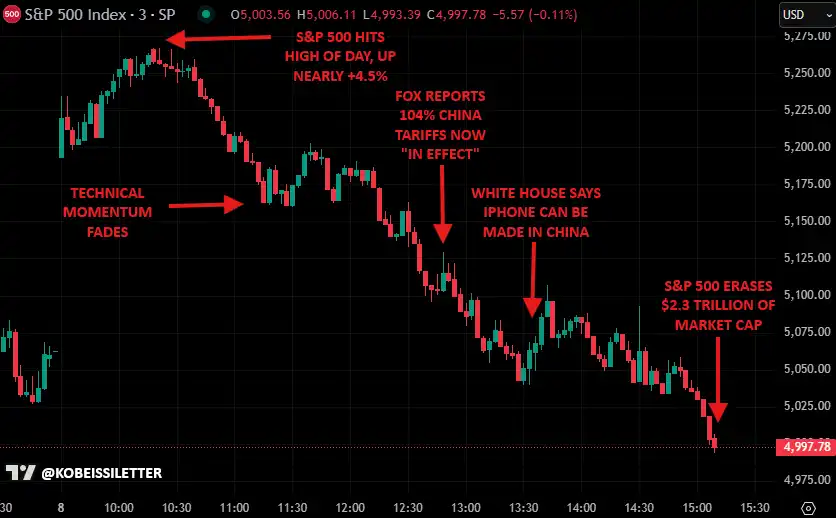
Simultaneously, the U.S. tariff policy has triggered a chain reaction in the global capital markets. According to Bloomberg, since April 3 when Trump proposed the so-called "reciprocal tariffs," the total market value of global stocks has shrunk by $10 trillion, slightly higher than half of the EU's GDP. U.S. tech giants have been hit hard, with Apple, Microsoft, and seven other major tech companies collectively losing $1.65 trillion in market value. Apple, due to its heavy reliance on overseas supply chains, saw its stock price plummet by nearly 23% in four days, marking the largest weekly drop since the outbreak of the 2020 pandemic.
Previously, many thought leaders in the crypto community believed that crypto assets would not be affected by traditional tariffs as their transactions do not need to pass through borders and customs. They argued that in the face of a new era of global trade protectionism and barriers, the value proposition of cryptocurrencies would be even more pronounced. Michael Saylor, the founder of MicroStrategy, stated on April 3, "Bitcoin has no tariffs."
However, the total cryptocurrency market capitalization has dropped by 35% from its peak in December 2024, falling from $3.9 trillion to $2.5 trillion. The "Cryptocurrency Fear and Greed Index" is currently at 17, indicating extreme fear and signaling a bearish market sentiment.
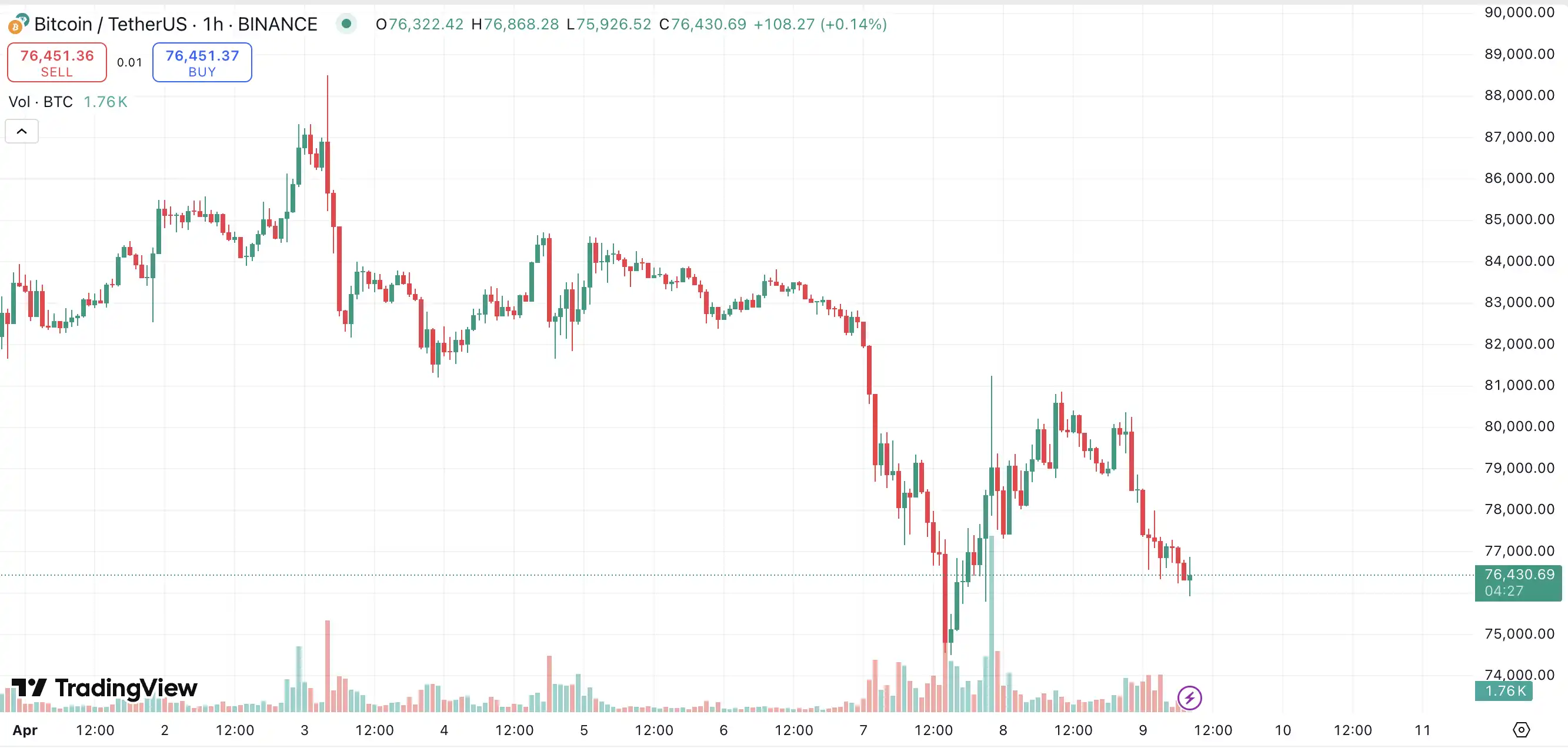
Last night, Bitcoin once again fell below $75,000. Meanwhile, BTC dominance continues to rise, the altcoin market is in a dire state, and Ethereum has once again dropped below $1,400.
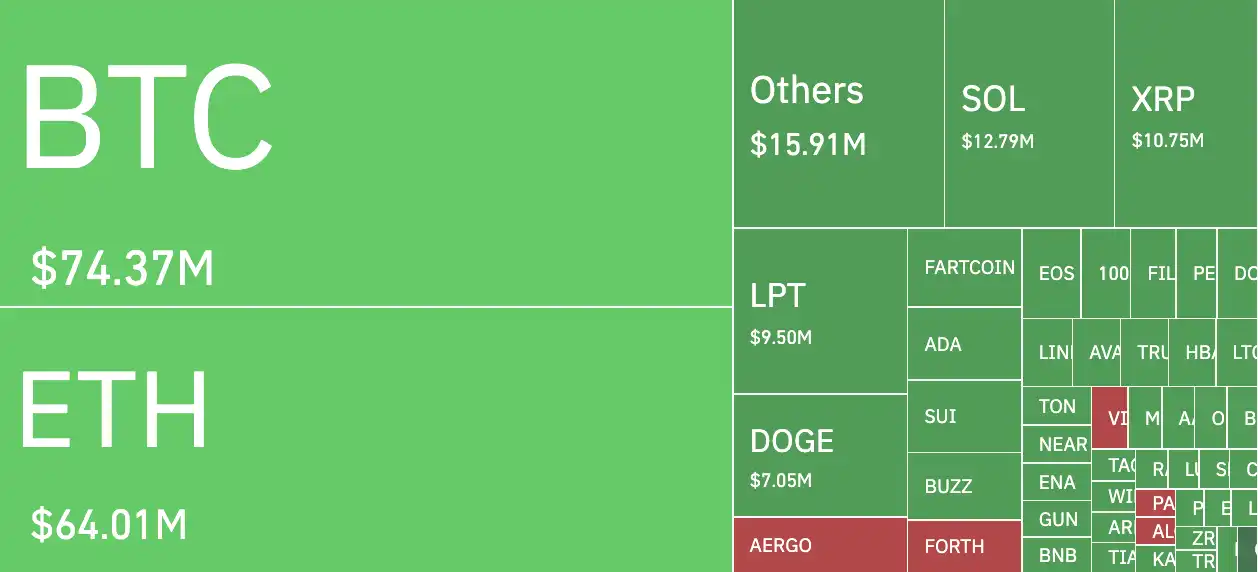
Over the past 12 hours, the crypto market has seen a total of $243 million in liquidations, with $192 million from long liquidations and $51.03 million from short liquidations.
The ongoing decline in Bitcoin's price may even force the "HODL" strategy holders to sell their Bitcoin holdings. According to a Form 8-K filed with the SEC on April 7th, if the Bitcoin price continues to fall, the holders may be forced to sell their Bitcoin holdings to meet their obligations, breaking Michael Saylor's "never selling Bitcoin" pledge.
Since Trump's victory in the November 2024 election, the holders have acquired 275,965 BTC at an average price of $93,228 per BTC ($25.73 billion), with this portion currently holding an unrealized loss of $4.6 billion.
Growing Pessimism: Analysts' Views on the Current Market
Over the past week, several Wall Street banks, including Goldman Sachs and JPMorgan, have warned that if the trade war continues to escalate, the U.S. and global economy could enter a recession this year, further weakening the attractiveness of the financial markets.
Despite this, the White House team is celebrating victory. "We are bottoming now, really bottoming," said Peter Navarro, Trump's chief trade advisor, on Fox News on Monday night. "The rebound is coming. The companies in the S&P 500 that have brought production back to the U.S. will drive the recovery, and it will happen quickly. The Dow at 50,000, I bet my bottom dollar, and there will be no recession."
However, Navarro's optimistic comments did not receive Jamie Dimon's, CEO of JPMorgan, endorsement. In his annual shareholder letter on Monday, Dimon warned that Trump's tariffs would raise prices, drag down the global economy, and weaken the U.S.'s global position by disrupting its ally system. Even some of Trump's allies, including Elon Musk and Bill Ackman, have recently warned that this tariff policy is seriously flawed and is the wrong approach.
Related Reading:《How Do Wall Street Big Shots View Trump's Tariff Policy After the Financial Market Bloodbath?》
Crypto analyst Phyrex believes that from the Fed's behavior logic, even a "defensive rate cut" is unlikely to be implemented quickly unless inflation significantly falls. The real watershed may be when the US GDP data is released at the end of April.
Looking at the crypto market, BTC's turnover rate has dropped today. URPD data shows that even though the price has dropped below $77,000, investors in the $93,000 to $98,000 range have hardly reduced their positions. This indicates that the current selling pressure is not coming from high-level holders, panic selling at the top has not occurred, the on-chain structure is relatively healthy, and as long as there is no more frequent policy reversal in the future, BTC and the risk market may still have room for a phase-wise recovery.
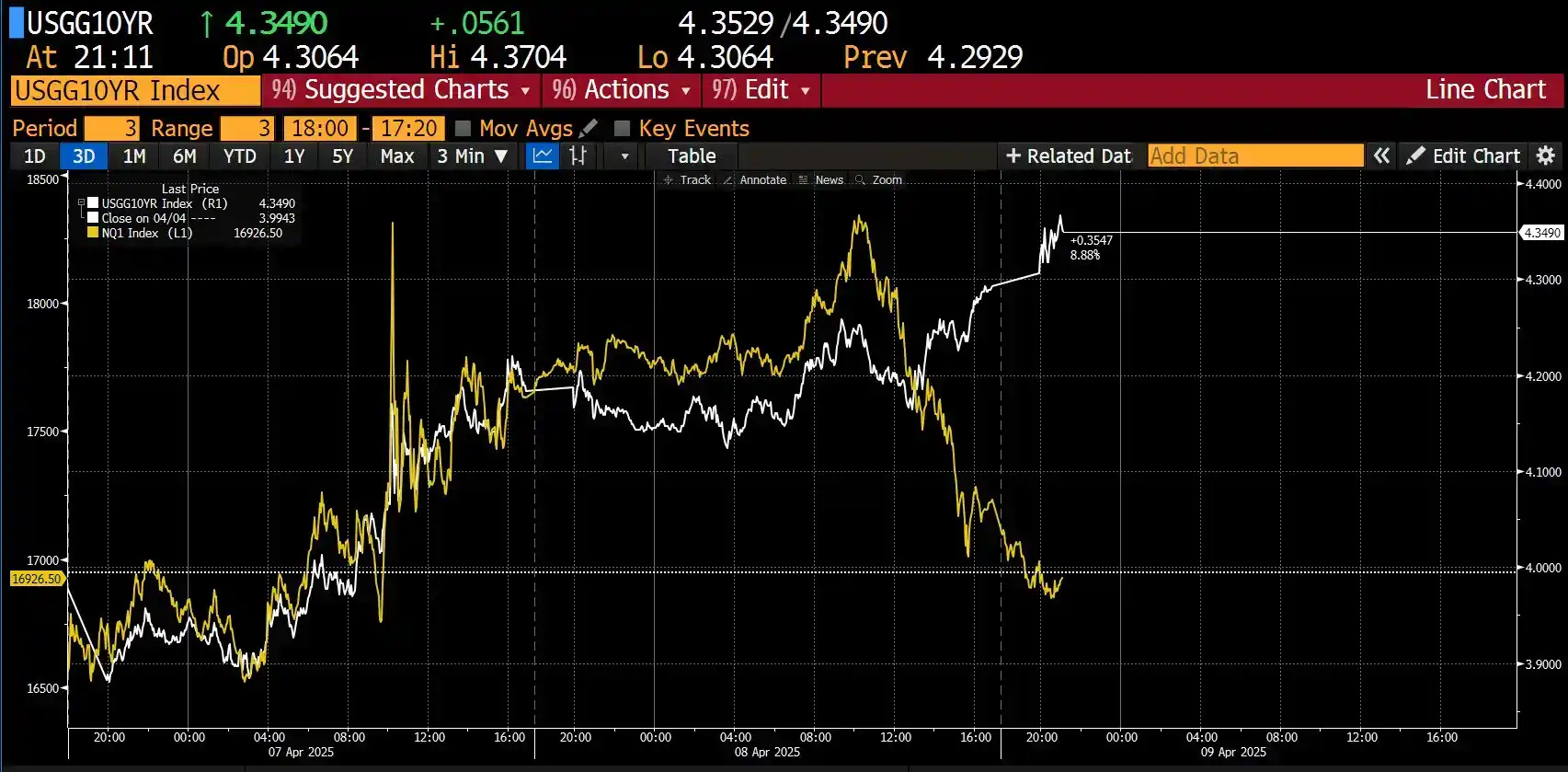
As US treasuries no longer act as a safe haven, the 10-year treasury yield has risen to around 4.3%, higher than the level at the end of March, pushing up the cost of mortgages and other types of loans. The 30-year US bond yield closed at 4.76%, rising by nearly half a percentage point from Monday's low. The US two-year to ten-year treasury yield spread widened to 48 basis points, the steepest level since May 2022.
BitMEX co-founder Arthur Hayes posted, "The Fed doesn't have much time left, the situation is out of control. Previously, a stock market decline would lead to a drop in the US 10-year bond yield, benefiting risky assets. But now, a stock market decline accompanied by an increase in the US 10-year bond yield is a bad thing. The market has finally realized that if US dollar export revenues decrease, there will no longer be buying pressure for bonds or stocks, and the game is over."
Pessimistic expectations are still strengthening. Trader Eugene wrote, "The introduction of global trade tariffs marks a change in the world order unseen in over 50 years. Free trade has been a key factor driving productivity and economic growth, leading to the longest bull market in history. A shift from openness to protectionism will have far-reaching consequences, which will take years to gradually emerge unless Trump completely abandons his tariff plan. I believe this possibility is very low. This will pose a significant long-term resistance to global risky assets."
Regarding cryptocurrency, the recent structural decline in active developers may be the most worrying thing. In the previous cycle, we could observe developer activity and feel reassured because we knew our industry was still benefiting from long-term tailwinds. Fast forward 2-3 years, and we have not produced anything particularly interesting or important, and the future outlook is even worse than it was back then.
In the previous cycle, we were looking forward to the launch of an ETF and a better regulatory environment under government support for cryptocurrency, as the light at the end of the tunnel. Now that all of these have materialized, but once again failed to meet expectations, I don't see anything in the future that could free cryptocurrency from its inherent "Ouroboros" (a self-repeating, self-devouring conundrum).
Looking at a more macro level, the world is currently experiencing a once-in-a-century upheaval. Billionaire hedge fund manager and Bridgewater Associates founder Ray Dalio wrote that while the market and the economy are currently focused on tariffs, deeper global issues should not be overlooked. He pointed out that we are in a "classic collapse" phase of monetary, political, and geopolitical orders, a situation that may only occur once in a lifetime but has occurred multiple times in history.
Dalio suggested not to be distracted by short-term events like tariffs and instead focus on the interaction of five key forces (economic, political, geopolitical, natural, technological). Studying similar cycles in history (such as currency crises) can help predict the future.
"The current changes are part of a historically significant cycle, where tariffs are just a manifestation, and the real driving force is the structural collapse of the monetary, political, and geopolitical order. Understanding the interaction of these forces and learning from historical experiences is essential to better prepare for the future."
You may also like

Cyber Taoist Fortune Teller: Fake Taoist, AI Fortune Telling, and Northeastern Metaphysics History

Bloomberg: Stablecoin Payments Emerge as Crypto VC's Newest Favorite Thing
BeatSwap is evolving towards a full-stack Web3 infrastructure, covering the entire lifecycle of IP rights.
BeatSwap, a global Web3 Intellectual Property (IP) infrastructure project, is attempting to overcome the current fragmentation limitations of the Web3 ecosystem, building a full-stack system that covers the entire lifecycle of IP rights.
Currently, most Web3 projects are still in the stage of functional fragmentation, often focusing only on a single aspect, such as IP asset tokenization, transaction functionality, or a simple incentive model. This structural dispersion has become a key bottleneck hindering the industry's scale application.
BeatSwap's approach is more integrated, integrating multiple core modules into the same system, including:
· IP authentication and on-chain registration
· Authorization-based revenue sharing mechanism
· User-engagement-driven incentive system
· Transaction and liquidity infrastructure
Through the above integration, the platform builds an end-to-end closed-loop path, allowing IP rights to complete a full cycle of "creation, use, and monetization" within the same ecosystem.
BeatSwap is not limited to existing crypto users but is attempting to take the global music industry as a starting point, actively creating new market demand. Its core strategies include:
Exploring and incubating music creators (Artist discovery)
Building a fan community
Igniting IP-centric content consumption demand
The current global music industry is valued at around $260 billion, with over 2 billion digital music users. This means that the potential market corresponding to the tokenization and financialization of IP far exceeds the traditional crypto user base.
In this context, BeatSwap positions itself at the intersection of "real-world content demand" and "on-chain infrastructure," attempting to bridge the structural gap between content production and financial flow.
BeatSwap's upcoming core product "Space" is scheduled to launch in the second quarter of 2026. This product is defined as the SocialFi layer in the ecosystem, aiming to directly connect creators with users and achieve deep integration with other platform modules.
Key designs include:
A fan-centric interactive mechanism
Exposure and distribution logic based on $BTX staking
User paths connected to DeFi and liquidity structures
Thus, a complete user behavior loop is formed within the platform: Discovery → Participation → Consumption → Rewards → Trading
$BTX is designed to be a core utility asset within the ecosystem, rather than just a simple incentive token, with its value directly tied to platform activity and IP use cases.
Main features include:
· Yield distribution based on on-chain authorized actions
· Value reflection based on IP usage and user engagement dynamics
· Support for staking and DeFi participation mechanisms
· Value growth driven by ecosystem expansion
With the increased frequency of IP use, the utility and value support of $BTX will enhance simultaneously, helping alleviate the "disconnect between value and utility" issue present in traditional Web3 token models to some extent.
Currently, $BTX has been listed on several mainstream exchanges, including:
Binance Alpha
Gate
MEXC
OKX Boost
As the launch of "Space" approaches, BeatSwap is actively pursuing more exchange listings to further enhance liquidity and global accessibility, laying a foundation for future market expansion.
BeatSwap's goal is no longer limited to the traditional Web3 narrative but aims to target over 2 billion digital music users and a trillion KRW-scale content market.
By integrating content creators, users, capital, and liquidity into a blockchain framework centered around IP rights, BeatSwap is striving to build a next-generation infrastructure focused on "IP tokenization."
BeatSwap integrates IP authentication, authorization distribution, incentive mechanism, transaction system, and market construction to establish a unified structure that bridges the full lifecycle path of IP rights.
With the launch of the Q2 2026 "Space," the project is expected to become a key infrastructure connecting content and finance in the IP-RWA (Real World Assets) track.

Mag 7 Evaporates $2 Trillion | Rewire News Morning Edition

Losing $19K per Coin Mined, Bitcoin Mining Firms Collective AI Defection

Morning Report | Tom Lee predicts that the cryptocurrency winter will end in April; xStocks introduces a new on-chain private equity fund; Sui mainnet upgraded to V1.68.1

Polymarket rules have changed, how should airdrop participants respond?

Crypto ETF Weekly | Last week, the net outflow of Bitcoin spot ETFs in the U.S. was $296 million; the net outflow of Ethereum spot ETFs in the U.S. was $206 million

This Week's Key News Preview | The U.S. Releases March Non-Farm Payroll Data; Polymarket Expands Fee Structure

Slow Down, That's the Answer to the Age of the Agent

From Cash to Cryptocurrency: Moving Towards a Unified Regulatory Path for Illegal Payments
Who will own the most Bitcoin in 2026

A private feud lasting 10 years, if not for OpenAI's "hypocrisy," would not have led to the world's strongest AI company, Anthropic

"Crypto Tsar" steps down: 130 days of political performance come to an end, how much of Trump's crypto promise remains?

From Utopian Narratives to Financial Infrastructure: The "Disenchantment" and Shift of Crypto VC
A decade-long personal feud, if not for OpenAI's "hypocrisy," there would be no globally leading AI company Anthropic

a16z: The True Meaning of Strong Chain Quality, Block Space Should Not Be Monopolized
a16z: The True Meaning of Strong Chain Quality, Block Space Should Not Be Monopolized
Cyber Taoist Fortune Teller: Fake Taoist, AI Fortune Telling, and Northeastern Metaphysics History
Bloomberg: Stablecoin Payments Emerge as Crypto VC's Newest Favorite Thing
BeatSwap is evolving towards a full-stack Web3 infrastructure, covering the entire lifecycle of IP rights.
BeatSwap, a global Web3 Intellectual Property (IP) infrastructure project, is attempting to overcome the current fragmentation limitations of the Web3 ecosystem, building a full-stack system that covers the entire lifecycle of IP rights.
Currently, most Web3 projects are still in the stage of functional fragmentation, often focusing only on a single aspect, such as IP asset tokenization, transaction functionality, or a simple incentive model. This structural dispersion has become a key bottleneck hindering the industry's scale application.
BeatSwap's approach is more integrated, integrating multiple core modules into the same system, including:
· IP authentication and on-chain registration
· Authorization-based revenue sharing mechanism
· User-engagement-driven incentive system
· Transaction and liquidity infrastructure
Through the above integration, the platform builds an end-to-end closed-loop path, allowing IP rights to complete a full cycle of "creation, use, and monetization" within the same ecosystem.
BeatSwap is not limited to existing crypto users but is attempting to take the global music industry as a starting point, actively creating new market demand. Its core strategies include:
Exploring and incubating music creators (Artist discovery)
Building a fan community
Igniting IP-centric content consumption demand
The current global music industry is valued at around $260 billion, with over 2 billion digital music users. This means that the potential market corresponding to the tokenization and financialization of IP far exceeds the traditional crypto user base.
In this context, BeatSwap positions itself at the intersection of "real-world content demand" and "on-chain infrastructure," attempting to bridge the structural gap between content production and financial flow.
BeatSwap's upcoming core product "Space" is scheduled to launch in the second quarter of 2026. This product is defined as the SocialFi layer in the ecosystem, aiming to directly connect creators with users and achieve deep integration with other platform modules.
Key designs include:
A fan-centric interactive mechanism
Exposure and distribution logic based on $BTX staking
User paths connected to DeFi and liquidity structures
Thus, a complete user behavior loop is formed within the platform: Discovery → Participation → Consumption → Rewards → Trading
$BTX is designed to be a core utility asset within the ecosystem, rather than just a simple incentive token, with its value directly tied to platform activity and IP use cases.
Main features include:
· Yield distribution based on on-chain authorized actions
· Value reflection based on IP usage and user engagement dynamics
· Support for staking and DeFi participation mechanisms
· Value growth driven by ecosystem expansion
With the increased frequency of IP use, the utility and value support of $BTX will enhance simultaneously, helping alleviate the "disconnect between value and utility" issue present in traditional Web3 token models to some extent.
Currently, $BTX has been listed on several mainstream exchanges, including:
Binance Alpha
Gate
MEXC
OKX Boost
As the launch of "Space" approaches, BeatSwap is actively pursuing more exchange listings to further enhance liquidity and global accessibility, laying a foundation for future market expansion.
BeatSwap's goal is no longer limited to the traditional Web3 narrative but aims to target over 2 billion digital music users and a trillion KRW-scale content market.
By integrating content creators, users, capital, and liquidity into a blockchain framework centered around IP rights, BeatSwap is striving to build a next-generation infrastructure focused on "IP tokenization."
BeatSwap integrates IP authentication, authorization distribution, incentive mechanism, transaction system, and market construction to establish a unified structure that bridges the full lifecycle path of IP rights.
With the launch of the Q2 2026 "Space," the project is expected to become a key infrastructure connecting content and finance in the IP-RWA (Real World Assets) track.


 App
App