
 Buy Crypto
- Markets
 Futures
- Spot
- Copy Trade
- Earn
- More
$2.5 Billion, Tesla Buys Ticket to Chip Arms Race Bottom Tier

Elon Musk is going to make his own chips. Not in terms of design—Tesla has been designing its own chips for seven years. This time it's about manufacturing. He announced a commitment of about $25 billion to build a chip super factory named Terafab, targeting a 2nm process, producing 100,000 wafers per month, integrating logic chips, memory, and advanced packaging in the same facility.
The reason behind this is not complicated. Tesla's appetite for computing power has grown so large that external foundries can't keep up anymore. Each generation of their self-driving chips sees a three- to five-fold increase in computing power, with Optimus robots and Robotaxis set for mass production. The global leading-edge wafer capacity has long been dominated by Apple, Qualcomm, NVIDIA. Relying on outsourcing contracts to secure capacity is just a stopgap measure; building their own fab is the endgame.
$25 billion. In any other industry, this amount could buy the entire supply chain. In semiconductor manufacturing, it's not even enough to build a standard 2nm wafer fab.
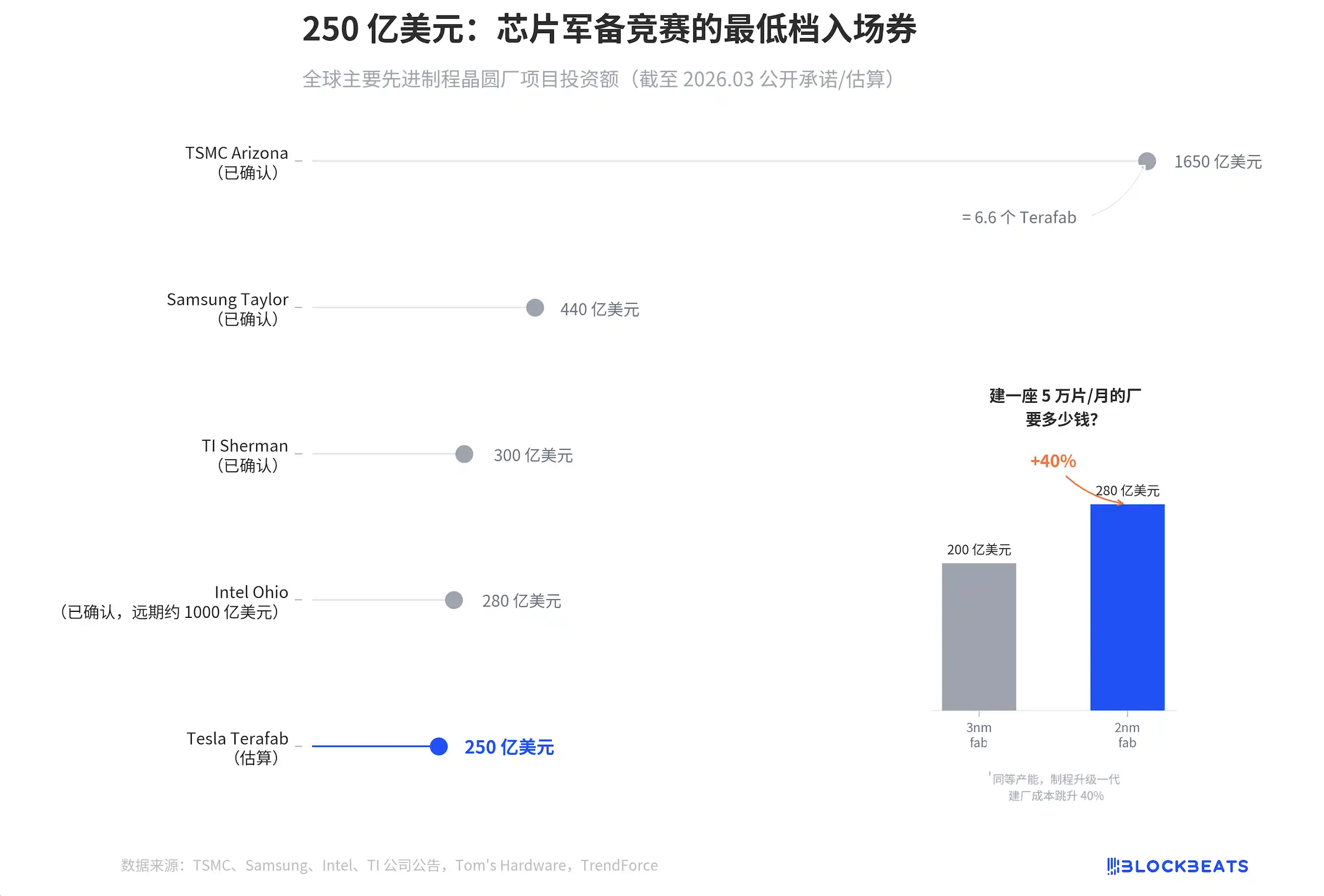
According to various company announcements and industry media reports, the total investment in the world's largest chip foundries includes $165 billion for TSMC's Arizona fab, $44 billion for Samsung's Taylor fab, $30 billion for Texas Instruments' (TI) Sherman fab, and $28 billion for Intel's Ohio fab. Tesla is at the bottom of the list. Moreover, according to estimates from various media outlets like Tom's Hardware, their $25 billion is still just an external estimate; Musk himself has not confirmed the precise number.
Even more crucial is the small image on the right. According to industry research, building a fab with a monthly output of 50,000 wafers, at a 3nm process, costs $20 billion, while at a 2nm process, it costs $28 billion. Going from 3nm to 2nm, the cost of constructing a fab jumps by 40%.
Tesla aims to achieve a monthly production of 100,000 2nm wafers with $25 billion. Based on industry standards, just one 50,000 wafers/month 2nm fab would cost $28 billion. Tesla aims to do the work of less than one standard fab with the money for two fabs and a packaging plant. This is not a budget; it's a wish list.
However, what truly makes Terafab breathtaking is not the money but the production capacity target.
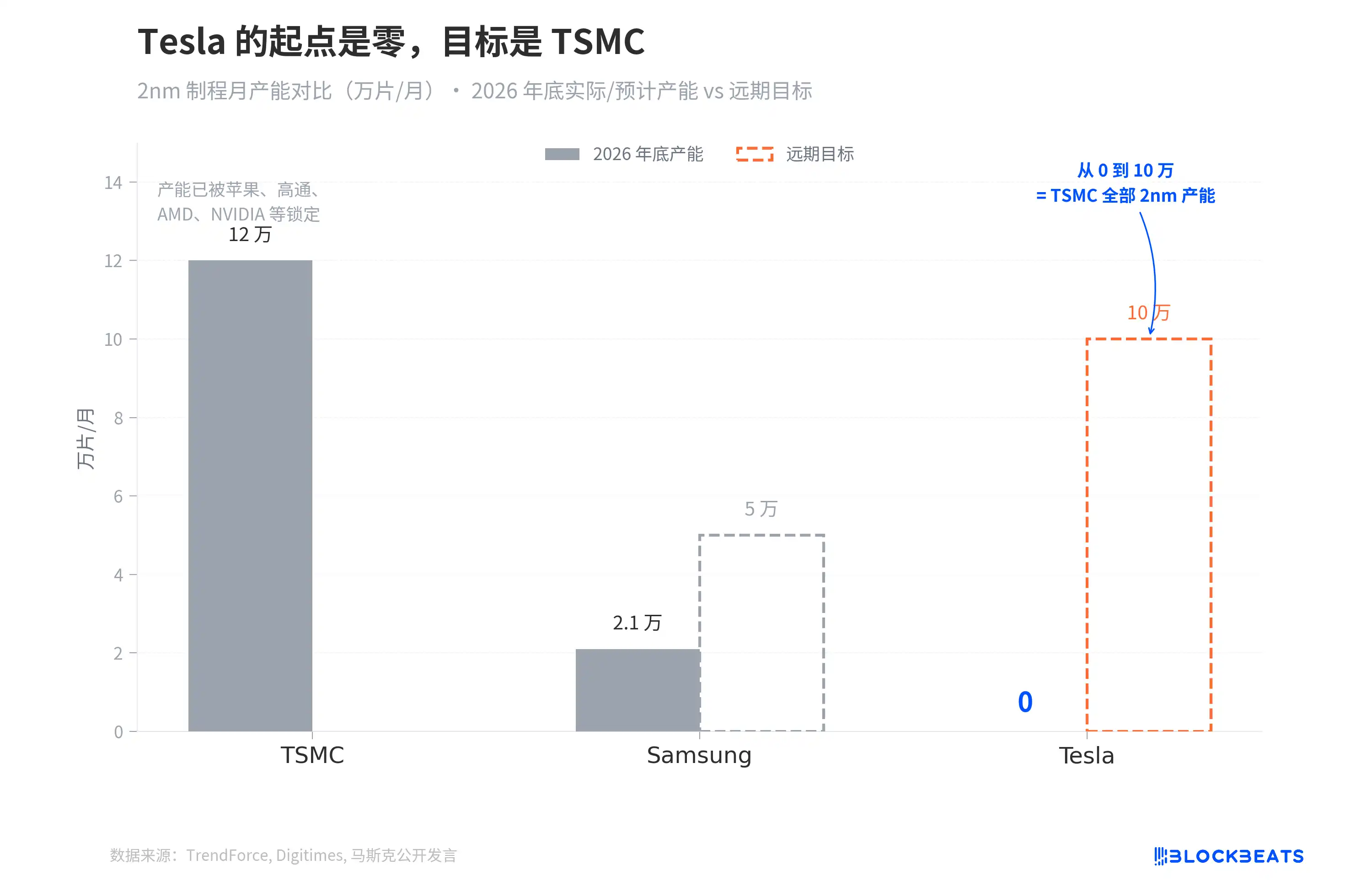
According to industry research firm TrendForce, TSMC's 2nm capacity is expected to reach 100,000 to 130,000 wafers per month by the end of 2026, but this capacity has already been secured by Apple, Qualcomm, AMD, NVIDIA. According to Digitimes, Samsung's 2nm capacity is only 21,000 wafers per month, with a long-term goal of 50,000.
Tesla started from zero. The goal is 100,000.
Going from 0 to 100,000 wafers per month is equivalent to catching up from scratch to TSMC's entire capacity on the most advanced process node worldwide. TSMC started building fabs in Arizona in 2021 and it took three and a half years to ramp up its first 4nm fab. TSMC has accumulated thirty years of manufacturing experience in Taiwan.
Tesla's speed in car manufacturing is indeed faster than anyone's expectations. However, the margin of error in wafer fabrication and vehicle manufacturing is not in the same league. A car's defect can be recalled, but a defect on a wafer means thousands of chips are scrapped.
Understanding why Terafab emerges in 2026 requires looking at a longer timeline.
In 2019, Tesla's Chief Architect of Autopilot Chips, Jim Keller, led the team to deliver HW3. This was Tesla's first fully self-developed autonomous driving chip, manufactured on Samsung's 14nm process, with 144 TOPS. By 2023, HW4 upgraded to Samsung's 7nm process, more than tripling the computing power. According to TrendForce, by 2026 with AI5, transitioning to 3nm and 2nm dual-line production, the computing power is heading straight for 2000 to 2500 TOPS. Moreover, the GPU and ISP are completely stripped out, with the entire chip optimized only for transformer inference.
Each generation sees a three to fivefold increase in performance. But the foundry strategy is also evolving in parallel. From HW3's "Samsung-only" approach to AI5's "TSMC and Samsung dual-sourcing," and then to AI6. According to reports from TechCrunch and Bloomberg, AI6 directly signed a $16.5 billion long-term contract with Samsung to secure production capacity until 2033.
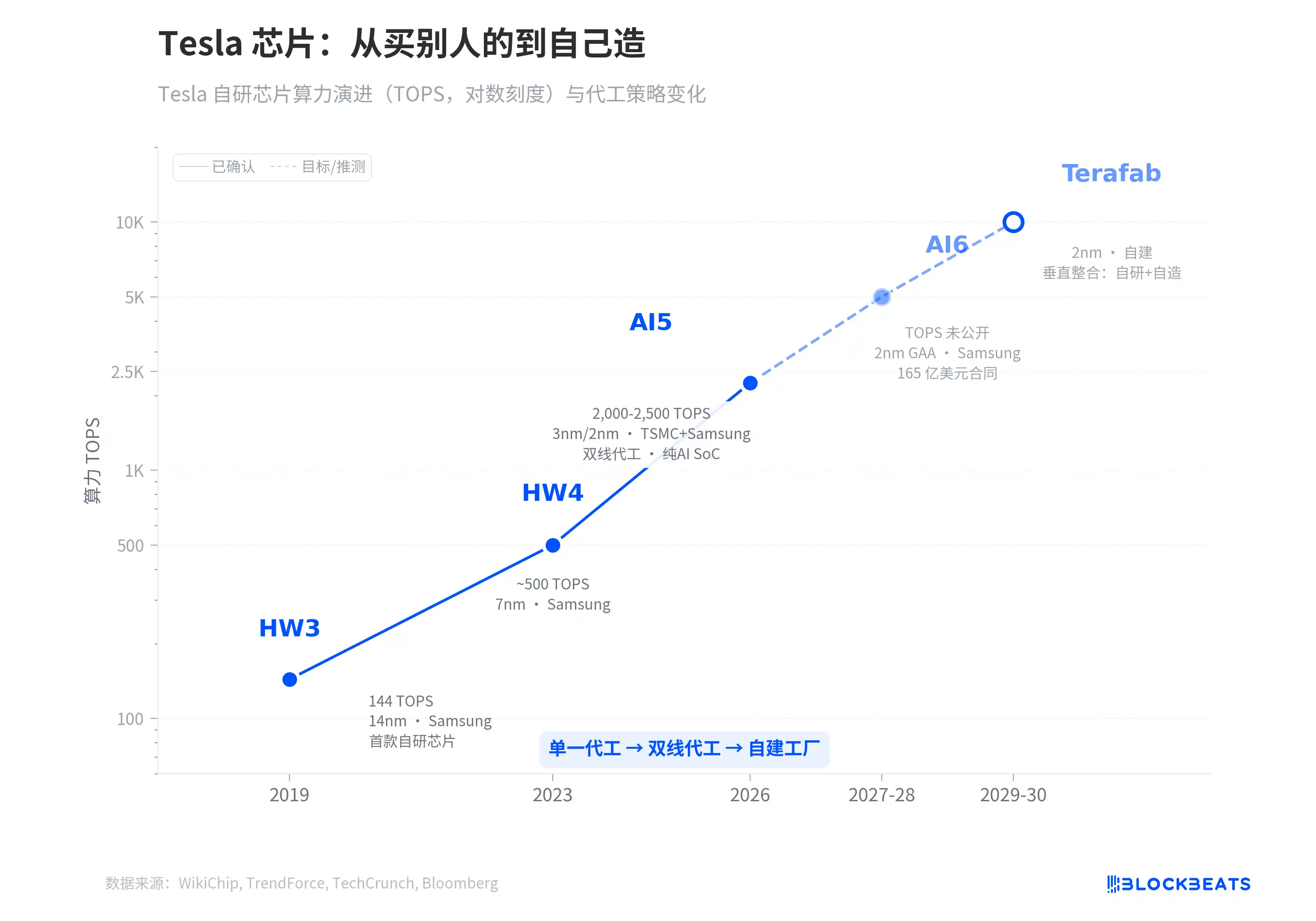
Terafab is a natural extension of this trajectory. As reported by Tom's Hardware, Tesla's AI6 contract last year essentially revived Samsung's Taylor fab, a $40 billion fab that had been put on hold due to "no customers." When your chip demand is large enough to support someone else's wafer fab, the next question is, why not build your own.
The AI6 and Terafab nodes on the dotted line segment in the chart are not labeled with specific TOPS because the specifications for these two generations have not been made public. But the trend is clear. Tesla's chip's computing power curve is exponential, and the reliance on foundries has reached an unavoidable point.
The remaining question is time.
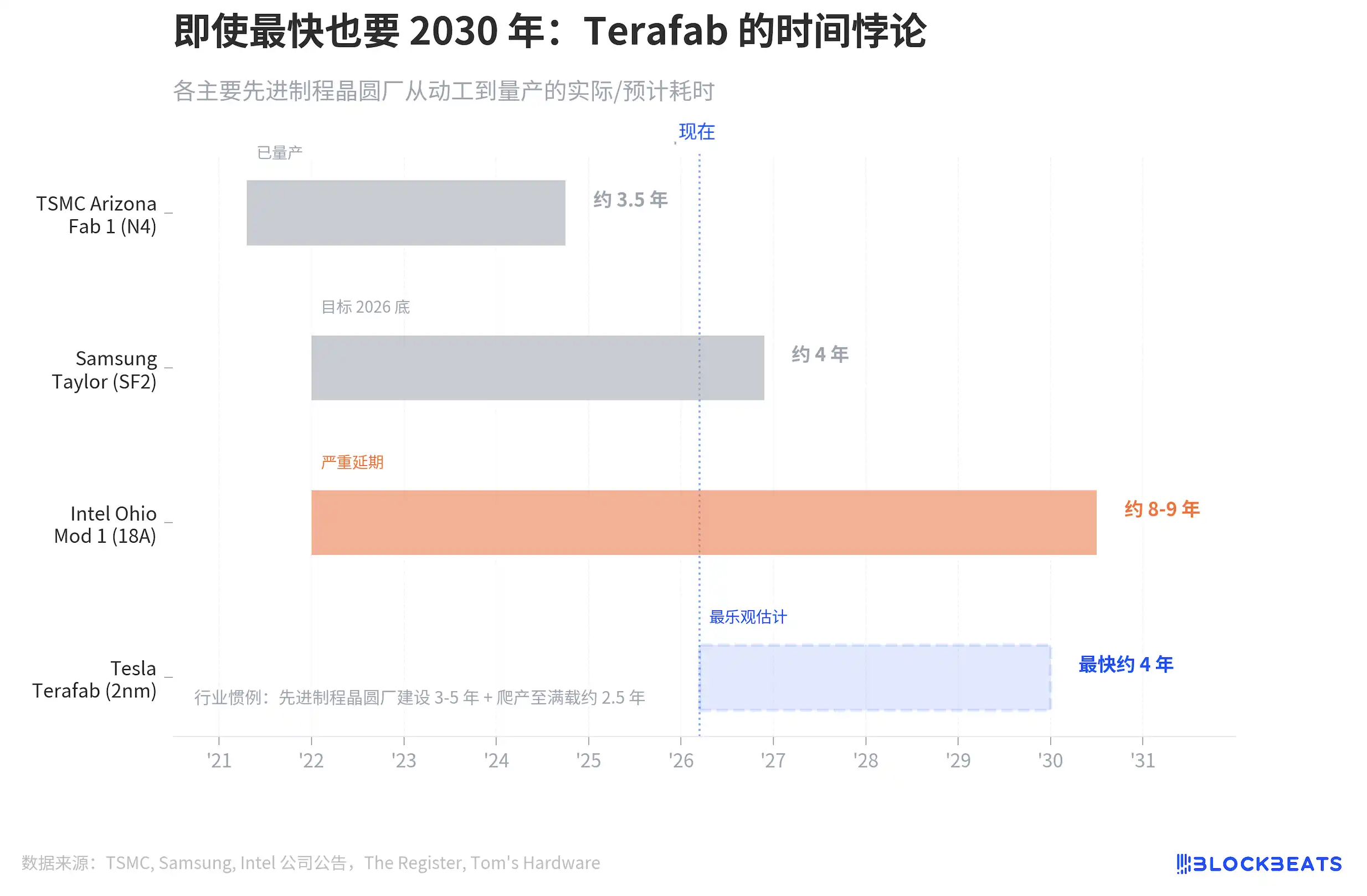
TSMC Arizona Fab 1 took about 3.5 years from groundbreaking to mass production, setting an industry record, but TSMC has thirty years of manufacturing accumulation. Samsung Taylor spent about 4 years, with a pause in the middle due to lack of customers. According to The Register, Intel Ohio is the most tragic, starting in 2022 and now delayed to 2030 to 2031.
Industry convention is construction takes 3 to 5 years, plus 2.5 years to ramp to full load. Even with TSMC's speed given to Tesla, Terafab will not be able to produce chips until late 2029 at the earliest.
This happens to coincide with Tesla's AI chip bottleneck timeframe. AI5's dual-line foundry can support until 2027 to 2028, and AI6's Samsung contract covers until 2033. But if the mass production scale of Optimus robots and Robotaxis explodes in 2029 as Musk plans, external foundry capacity is likely to be insufficient. Terafab doesn't need to produce chips by 2026; it needs to be ready by 2030.
Musk also openly discussed the possibility of collaborating with Intel. Intel has its most advanced 18A process (equivalent to the industry's 2nm level) and idle capacity urgently in need of external customers, while Tesla has clear chip demands and money. If this line goes through, Terafab will not be starting from scratch but will be a marriage of mutual needs.
$25 billion doesn't buy much certainty in chip manufacturing. But it buys a ticket. A ticket that turns Tesla from the largest chip buyer into a chip manufacturer. Looking back at this chart in three years, it will either be the starting point of Tesla's vertical integration strategy or Musk's most expensive pie in the sky.
You may also like

WEEX Official Product Launch: Win LALIGA Tickets & Unlock the 3-in-1 Crypto Trading Suite
Trade crypto without downloading an app. Join the WEEX H5, API, SKILLs livestream to explore the new trading experience, win LALIGA VIP tickets, and share 420 USDT rewards.

Dragonfly Partners: Most agents will not engage in autonomous trading, how can crypto payments prevail?

US AI Startup Goes All In on Chinese Mega-Model | Rewire News Morning Brief

Trump Lies Again: A "Five-Day Pause" Psyop, How Wall Street, Bitcoin, and Polymarket Insiders Synced Uposciogen

When a Token Becomes Labor, People Become the Interface

Ceasefire News Leaked Ahead of Time? Large Polymarket Bets on Outcome Before Trump's Tweet

BlackRock CEO's Annual Shareholder Letter: How is Wall Street Using AI to Keep Profiting from National Pension Funds?

Sun Valley Releases 2025 Financial Report: Bitcoin Mining Revenue Reaches $670 Million, Accelerating Transformation to AI Infrastructure Platform
On March 16, 2026, in Dallas, Texas, USA, CanGu Company (New York Stock Exchange code: CANG, hereinafter referred to as "CanGu" or the "Company") today announced its unaudited financial performance for the fourth quarter and full year ended December 31, 2025. As a btc-42">bitcoin mining enterprise relying on a globally operated layout and dedicated to building an integrated energy and AI computing power platform, CanGu is actively advancing its business transformation and infrastructure development.
• Financial Performance:
Total revenue for the full year 2025 was $688.1 million, with $179.5 million in the fourth quarter.
Bitcoin mining business revenue for the full year was $675.5 million, with $172.4 million in the fourth quarter.
Full-year adjusted EBITDA was $24.5 million, while the fourth quarter was -$156.3 million.
• Mining Operations and Costs:
A total of 6,594.6 bitcoins were mined throughout the year, averaging 18.07 bitcoins per day; of which 1,718.3 bitcoins were mined in the fourth quarter, averaging 18.68 bitcoins per day.
The average mining cost for the full year (excluding miner depreciation) was $79,707 per bitcoin, and for the fourth quarter, it was $84,552;
The all-in sustaining costs were $97,272 and $106,251 per bitcoin, respectively.
As of the end of December 2025, the company has cumulatively produced 7,528.4 bitcoins since entering the bitcoin mining business.
• Strategic Progress:
The company has completed the termination of the American Depositary Receipt (ADR) program and transitioned to a direct listing on the NYSE to enhance information transparency and align with its strategic direction, with a long-term goal of expanding its investor base.
CEO Paul Yu stated: "2025 marked the company's first full year as a bitcoin mining enterprise, characterized by rapid execution and structural reshaping. We completed a comprehensive adjustment of our asset system and established a globally distributed mining network. Additionally, the company introduced a new management team, further strengthening our capabilities and competitive advantage in the digital asset and energy infrastructure space. The completion of the NYSE direct listing and USD pricing also signifies our transformation into a global AI infrastructure company."
"As we enter 2026, the company will continue to optimize its balance sheet structure and enhance operational efficiency and cost resilience through adjustments to the miner portfolio. At the same time, we are advancing our strategic transformation into an AI infrastructure provider. Leveraging EcoHash, we will utilize our capabilities in scalable computing power and energy networks to provide cost-effective AI inference solutions. The relevant site transformations and product development are progressing simultaneously, and the company is well-positioned to sustain its execution in the new phase."
The company's Chief Financial Officer, Michael Zhang, stated: "By 2025, the company is expected to achieve significant revenue growth through its scaled mining operations. Despite recording a net loss of $452.8 million from ongoing operations, mainly due to one-time transformation costs and market-driven fair value adjustments, the company, from a financial perspective, will reduce its leverage, optimize its Bitcoin reserve strategy and liquidity management, introduce new capital to strengthen its financial position, and seize investment opportunities in high-potential areas such as AI infrastructure while navigating market volatility."
The total revenue for the fourth quarter was $1.795 billion. Of this, the Bitcoin mining business contributed $1.724 billion in revenue, generating 1,718.3 Bitcoins during the quarter. Revenue from the international automobile trading business was $4.8 million.
The total operating costs and expenses for the fourth quarter amounted to $4.56 billion, primarily attributed to expenses related to the Bitcoin mining business, as well as impairment of mining machines and fair value losses on Bitcoin collateral receivables.
This includes:
· Cost of Revenue (excluding depreciation): $1.553 billion
· Cost of Revenue (depreciation): $38.1 million
· Operating Expenses: $9.9 million (including related-party expenses of $1.1 million)
· Mining Machine Impairment Loss: $81.4 million
· Fair Value Loss on Bitcoin Collateral Receivables: $171.4 million
The operating loss for the fourth quarter was $276.6 million, a significant increase from a loss of $0.7 million in the same period of 2024, primarily due to the downward trend in Bitcoin prices.
The net loss from ongoing operations was $285 million, compared to a net profit of $2.4 million in the same period last year.
The adjusted EBITDA was -$156.3 million, compared to $2.4 million in the same period last year.
The total revenue for the full year was $6.881 billion. Of this, the revenue from the Bitcoin mining business was $6.755 billion, with a total output of 6,594.6 Bitcoins for the year. Revenue from the international automobile trading business was $9.8 million.
The total annual operating costs and expenses amount to $1.1 billion.
Specifically, they include:
· Revenue Cost (excluding depreciation): $543.3 million
· Revenue Cost (depreciation): $116.6 million
· Operating Expenses: $28.9 million (including related-party expenses of $1.1 million)
· Miner Impairment Loss: $338.3 million
· Bitcoin Collateral Receivable Fair Value Change Loss: $96.5 million
The full-year operating loss is $437.1 million. The continuing operations net loss is $452.8 million, while in 2024, there was a net profit of $4.8 million.
The 2025 non-GAAP adjusted net profit is $24.5 million (compared to $5.7 million in 2024). This measure does not include share-based compensation expenses; refer to "Use of Non-GAAP Financial Measures" for details.
As of December 31, 2025, the company's key assets and liabilities are as follows:
· Cash and Cash Equivalents: $41.2 million
· Bitcoin Collateral Receivable (Non-current, related party): $663.0 million
· Miner Net Value: $248.7 million
· Long-Term Debt (related party): $557.6 million
In February 2026, the company sold 4,451 bitcoins and repaid a portion of related-party long-term debt to reduce financial leverage and optimize the asset-liability structure.
As per the stock repurchase plan disclosed on March 13, 2025, as of December 31, 2025, the company had repurchased a total of 890,155 shares of Class A common stock for approximately $1.2 million.

The US AI Startup Is Loving China's Open Source Model

Three Weeks of the US-Iran War: Who's Making Money, Who's Paying the Bill?

Interpreting Polymarket's Major Update Last Night: Fee Expansion, Self-Regulation, and New Incentives

From Human Application to Intelligent Collaboration: How GOAT Network Builds the Next Generation Digital Economy

CZ Washington Dialogue: Crypto Entrepreneurs are Accelerating Their Return to the United States

Morning Report | Strategy increased its holdings by 1,031 bitcoins last week; Katana Blockchain acquires IDEX; NYSE completes rule change to eliminate trading limits on crypto ETF options

WEEX P2P now supports JOD, USD & EUR—Merchant Recruitment Now Open
To make crypto deposits easier, WEEX has officially launched its P2P trading platform and continues to expand fiat support. We're excited to announce that the Jordanian Dinar (JOD), United States Dollar (USD ) and Euro (EUR) are now available on WEEX P2P!

Electric Capital: Tracking 501 types of yield-generating RWA assets, we discovered these patterns
Those who are cut off by AI will not disappear; they will become the creators of the next round of the economy

Stablecoins reshaping cross-border payments in Asia? Strategic panorama and investment opportunity analysis
WEEX Official Product Launch: Win LALIGA Tickets & Unlock the 3-in-1 Crypto Trading Suite
Trade crypto without downloading an app. Join the WEEX H5, API, SKILLs livestream to explore the new trading experience, win LALIGA VIP tickets, and share 420 USDT rewards.


 App
App