
 Buy Crypto
- Markets
 Futures
- Spot
- Copy Trade
- Earn
- More
36 years, 4 wars, 1 script: How does capital price the world in conflict?

Original Title: "36 Years, 4 Wars, 1 Script: How Capital Prices the World in Conflict"
Original Source: Bitget Wallet
War shows the world ruins, but capital only cares about price.
As the Middle East flames reignite, a colleague in Dubai reports bombings and air raid sirens, the missile-streaked sky a harbinger of humanity's unknown fate.
On another invisible timeline, the global financial market has already begun recalculating: How high should oil prices go? Will gold continue its surge? When will the stock market hit bottom and rebound?
Capital is not sympathetic, nor is it angry. It simply does one thing calmly — prices uncertainty. To most, it is invisible, intangible, logically cold, and rhythmically ruthless.
But in turbulent times, understanding how capital operates and prices risk may be the common person's last line of defense against the historical tide. Looking back at geopolitical conflicts and financial history, you will find an almost unchanging pattern: In the face of war, the capital market always repeats the same script, and over the past 36 years, this script has been fully enacted four times.
What Capital Fears Most is Not Conflict, But "Waiting"
From the 1991 Gulf War, the 2003 Iraq War, to the 2022 Russia-Ukraine conflict, the script has always been the same. These three globally impactful geopolitical crises have played out the pricing rules of the capital market in the "incubation period - outbreak period - clarification period."
The financial market is essentially an expectation discounting machine. When the conflict is in the incubation period, the fear of unknown disruption will drive oil and gold to sky-high prices, and global stock markets will plummet off a cliff. However, Wall Street follows a bloody rule: "Buy to the sound of cannons."
Once the first cannon sounds (or when the situation clarifies), the greatest uncertainty is then resolved. Safe-haven assets often quickly peak and fall back, while the stock market completes a deep V-shaped reversal from the depths of despair. The war may still be ongoing, but capital's panic has ended.
Here is a deep analysis of the changes in the capital markets during these three historical events:
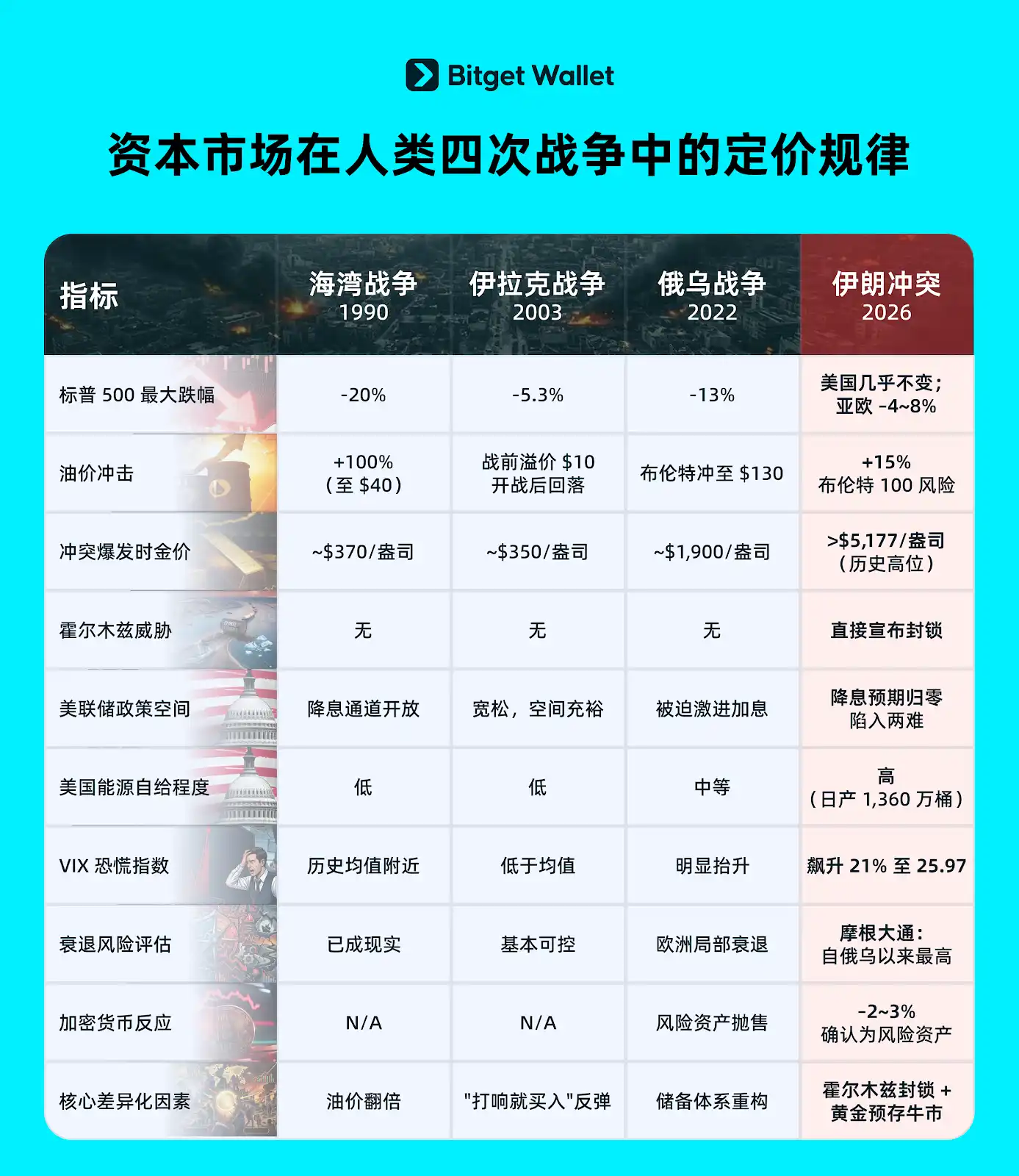
1. 1990-1991 Gulf War: Classic "V-Shaped Reversal" and the Oil Spike
This war is a textbook example in modern financial history of studying geopolitical impacts, perfectly illustrating the principle of "buy the rumor, sell the news."
· Pre-Crisis Period (August 1990 - January 1991): Panic and Hedging
Oil Price Surge: After Iraq's invasion of Kuwait, the market was in extreme panic about a Middle East oil supply disruption. In just two months, the international oil price skyrocketed from around $20 per barrel to over $40, a price increase of over 100%.
Stock Market Crash: Influenced by the oil price surge and the looming war, the U.S. S&P 500 index plummeted by nearly 20% from July to October 1990.
· The Boot Drops (January 17, 1991): Counterintuitive Market Upheaval
On the first day of the U.S.-led "Operation Desert Storm" when the market saw an extremely counterintuitive trend: Due to the overwhelmingly favorable progress of the war, the "uncertainty" was instantly removed.
Oil Price Plunge: The oil price experienced one of its largest single-day drops in history on the day the war started (plunging over 30%).
Stock Market Rally: The S&P 500 index soared on that day, followed by a sharp V-shaped reversal, not only reclaiming all lost ground within six months but also hitting a historic high.
2. 2003 Iraq War: The "Relief" after a Prolonged Downtrend
The 2003 Iraq War, combined with the aftermath of the dot-com bubble burst and post-9/11 security concerns, saw the market's reaction more as a "short pain is better than long pain" relief.
· Pre-Crisis Period (Late 2002 - March 2003): Slow Painful Dismemberment
During the prolonged months of diplomatic back-and-forth and war preparations, the capital market was as jittery as a startled bird. The S&P 500 index continued its downward trend, with global capital flooding into gold and U.S. treasuries for safe haven.
Oil prices slowly rose from $25 to nearly $40 due to war expectations and events like the Venezuelan strike.
· Boot on the Ground (March 20, 2003): Bad News Exhausted is Good News
Remarkably, the absolute bottom of the US stock market occurred in the week before the war started (around March 11, 2003).
As the missiles were actually heading towards Baghdad, the market instead saw it as "bad news exhausted." The stock market then quickly rallied, kicking off a four-year bull market. Safe-haven assets like gold quickly cooled off as the conflict progressed smoothly.
3. 2022 Russia-Ukraine Conflict: "Superinflation" Caused by Supply Chain Disruption
Unlike the first two Middle East wars (where the US swiftly achieved overwhelming victory without causing long-term substantial damage to the global supply chain), the Russia-Ukraine conflict had a more profound and heavy impact on the capital market, fundamentally changing the underlying logic of the macroeconomy.
· Crisis Eruption (February 2022): Epic Commodity Storm
Russia is a global energy and industrial metal giant, while Ukraine is the "breadbasket of Europe." After the conflict erupted, Brent crude oil briefly surpassed $130 per barrel; European natural gas prices skyrocketed several times over; and staple commodities like wheat and nickel reached historic highs.
· Ongoing Impact: The "Double Whammy" of Inflation Surge and Monetary Tightening
Simultaneous Stock and Bond Market Decline: The most lethal market impact of the Russia-Ukraine conflict was its complete shattering of the fragile global supply chain post-pandemic, directly triggering the most severe inflation in Europe and the US in 40 years.
To combat this "input-induced inflation" caused by geopolitical war, the Federal Reserve was forced to initiate the most aggressive rate-hike cycle in history. The result was a rare "stock-bond sell-off" in 2022 (both stocks and bonds falling), with the Nasdaq index plummeting over 30% that year.
Deadly Illusion: Never Attempt to Make a "War Profit"
Let's bring the timeline back to reality.
The sudden escalation of the current Middle East situation has once again thrust the global capital market into a "stress test" period full of uncertainty.
Looking at the transmission chain of the macroeconomy, the most core threat of the Middle East conflict to the capital market lies in "physical supply chain disruption → soaring energy prices → global inflation rebound → central banks forced to maintain tightening policies → sharp decline in risk assets."
Capital Market Chain Reaction Analysis
1. International Crude Oil: The Epicenter of the Storm
Chain Reaction: The Middle East holds the lifeline of global oil (especially key passages like the Strait of Hormuz). Once a conflict escalates or poses a risk to major oil-producing countries, the market immediately factors in "geopolitical risk premium." This can cause Brent and WTI crude oil to experience a short-term impulse spike.
Deep Impact: Crude oil is the mother of all industries. The surge in oil prices will not only raise costs in the aviation, logistics, and chemical industries but will also directly threaten the recently stabilized global Consumer Price Index (CPI) in the form of "input inflation."
2. Precious Metals (Gold/Silver): The Traditional Ultimate Safe Haven
Chain Reaction: When facing war, geopolitical turmoil, and potential runaway inflation, funds instinctively flow into gold. Gold prices usually gap up before and during the early stages of a conflict, hitting interim or even historical highs; silver, due to its industrial properties, will experience higher volatility compared to gold.
Deep Impact: It is important to note that the surge in gold prices is often sentiment-driven. Once the situation starts to clarify (even if the conflict continues), the risk-off sentiment diminishes, and gold prices are prone to spike and then fall back, reverting to a pricing logic dominated by real U.S. interest rates.
3. U.S. Stock Market: The Inflation Specter and "Valuation Kill"
Chain Reaction: War is generally bearish for the U.S. stock market as a whole. The Volatility Index (VIX) will quickly surge, funds will exit high-valuation tech stocks (such as the AI sector and semiconductors) and flow into defensive sectors like defense, traditional energy, and utilities.
Deep Impact: What the U.S. stock market fears most is not the gunfire in the Middle East but the inflation rebound triggered by the gunfire. If a sharp rise in oil prices leads to persistent high U.S. CPI, the Federal Reserve will be forced to delay rate cuts or even raise rates again. This macro liquidity tightening will deal a heavy blow to the valuation of tech stocks represented by the Nasdaq.
4. Crypto Market: Liquidity Drain of High-Risk Assets
Cascading Effect: Despite Bitcoin's ongoing narrative of being "digital gold," during the past few actual geopolitical crises (such as the early stages of the Russia-Ukraine conflict, Middle East tensions escalating), the cryptocurrency market's actual performance has looked more like a "highly elastic Nasdaq index."
Profound Impact: Faced with war panic, Wall Street institutions tend to prioritize selling off the most liquid and high-risk assets to cash out, with the cryptocurrency market often taking the first hit, experiencing a downturn. At the same time, altcoins face liquidity depletion. However, in cases where conflict triggers a local fiat collapse or the traditional banking system is disrupted, the safe haven properties of cryptocurrency assets, characterized by "censorship resistance and borderless transfers," are favored by some hedging funds.
Comparing three historical geopolitical conflicts, we can distill the core principles for ordinary people to deal with geopolitical crises:
1. "Uncertainty" is the Greatest Killer: The stock market's most severe drops almost always occur during the brewing and brinkmanship periods before the outbreak of war. Once the war truly breaks out (especially when the situation becomes predictable), the stock market often hits rock bottom and rebounds. This confirms a Wall Street saying: "Buy when the cannons are roaring."
2. Commodity "Buying the Dip" Trap: Before and during the early stages of a war, commodities like oil and gold often skyrocket to incredible highs due to panic. However, if the war does not substantially and durably disrupt physical supply (as in the Gulf and Iraq wars), prices will quickly collapse after the war starts. Blindly chasing after high-priced commodities can easily make institutions the bagholders.
3. Distinguish "Emotional Shock" from "Fundamental Disruption": If the war is only an emotional shock (such as a local, lopsided conflict), the stock market that drops sharply will quickly bounce back. But if the war leads to a long-term rupture in core supply chains (such as the energy/food crisis triggered by the Russia-Ukraine conflict), it will alter the global pricing anchor of funds through "inflation and rate hikes," resulting in a very prolonged market turmoil in such cases.
History does not simply repeat but always rhymes with the same tune. When observing the current capital movement, we need to make a calm judgment: Is the current conflict merely temporary emotional panic, or will it truly reshape the global inflation and interest rate cycle as a black swan event?
Geopolitical games have no set rules; a late-night ceasefire announcement can instantly wipe out highly leveraged chasing positions. In a crisis, the primary principle is always to preserve capital.
The Defense Lineup for Turbulent Times: How Can Ordinary People Make Their Moves?
Amid the dual shadows of warfare and inflation, the core focus of ordinary investors must shift from “pursuing high returns” to “preserving capital, defending against inflation, and hedging tail risks.” It is recommended to rearrange assets according to the following “defense counterattack” lineup:
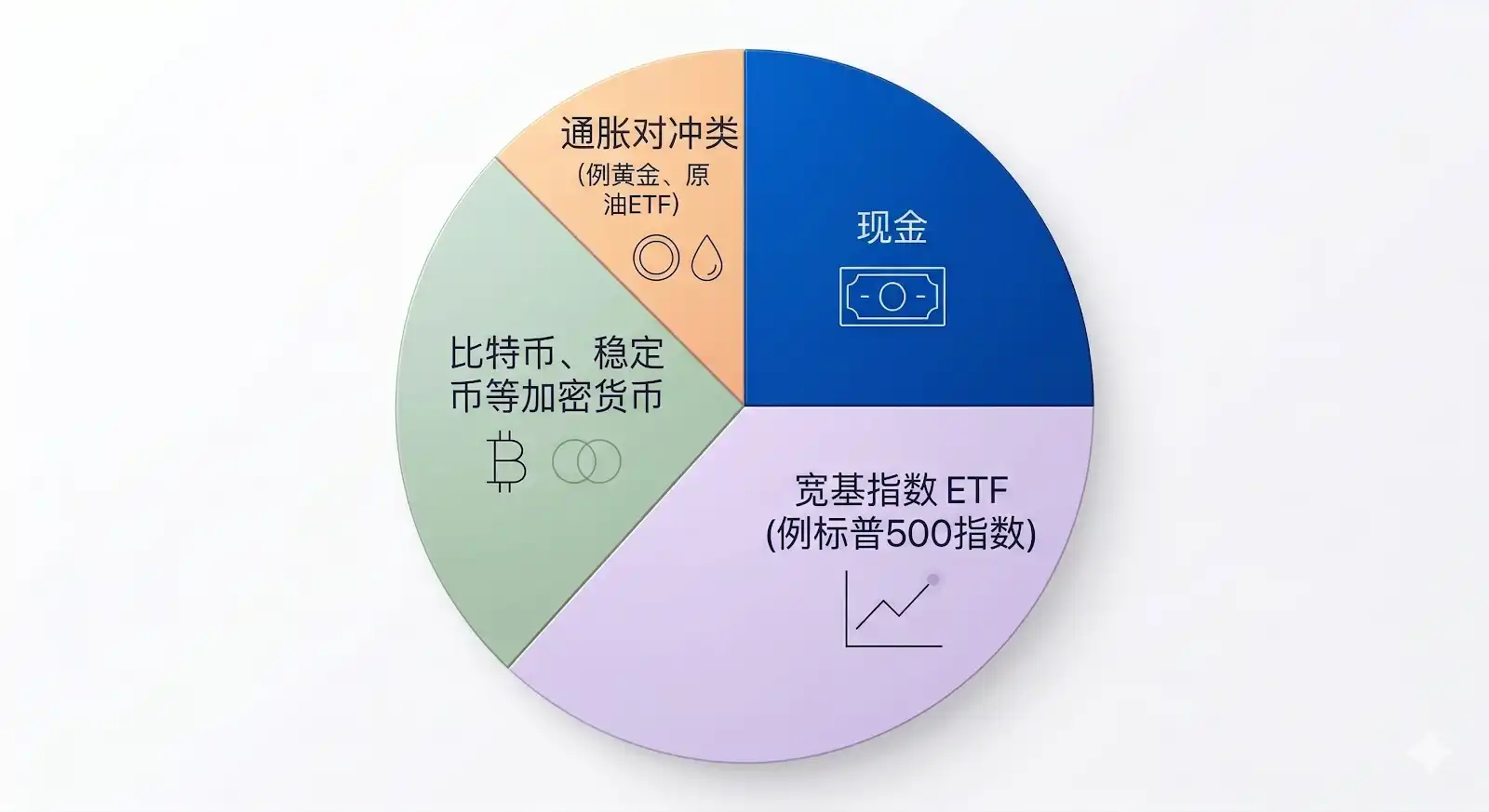
Strategy 1: Build a Strong Cash Moat (20%-30% Allocation)
· Approach: Increase holdings of cash and cash equivalents (such as high-yield USD deposits, short-term government bonds, money market funds).
· Rationale: In times of crisis, liquidity is the lifeline. Holding an ample amount of cash can not only ensure that your family's quality of life is not affected by skyrocketing prices in extreme situations, but also allow you to have the firepower to “buy the dip” in high-quality assets after a market crash.
Strategy 2: Purchase Inflation Hedges (10%-15% Allocation)
· Approach: Allocate appropriately to gold ETFs, physical gold, or a small amount of broad energy sector ETFs.
· Rationale: The mission of this portion of your funds is not to make big money, but to hedge against risks. If a war leads to an oil supply disruption and price surges, the part of your increased living expenses can be offset by the rise in gold and the energy sector. Remember: Do not chase after all-time highs in a frenzy when the headlines are dominating the news.
Strategy 3: Tighten the Frontline and Defend Core Equity Positions (30%-40% Allocation)
· Approach: Sell off high-debt, unprofitable small-cap stocks and concentrate your funds into broad index ETFs (such as the S&P 500) or established mega-cap companies with strong cash flows.
· Rationale: During times of war, a single stock faces significant black swan risks (such as sudden supply chain disruptions leading to bankruptcy). Embracing broad index funds allows you to use the national fate and the systemic resilience of the entire economy to hedge against the fragility of individual companies. As long as you stick to dollar-cost averaging, ignore short-term paper losses, crises often reveal long-term “golden craters.”
Strategy 4: Risk Mitigation of Crypto Assets (For Web3 Users)
· Approach: Properly reduce holdings of high-volatility meme coins; consolidate funds into Bitcoin (BTC) as a long-term base position, or swap for USD stablecoins (USDC/USDT) to be deposited in top compliant platforms to earn interest. Once geopolitical risks are considered manageable and market liquidity returns, you can allocate 10-30% of funds to invest in meme coins according to your risk preference, seizing alpha opportunities.
· Rationale: Liquidity crises triggered by wars have a greater impact on small-cap coins. Stablecoins can hedge against crises and provide more flexible liquidity reserves than traditional banks.
Absolute Red Lines Never to Cross
1. Strictly No Leverage: Geopolitical situations can change in an instant, with a ceasefire announcement enough to cause a 10% crash in oil prices. In leveraged trading, you may not survive long enough to see a lasting victory before being liquidated in a short-term upheaval.
2. Abandon the "War Profiteering" Game Theory: The information gap in the capital markets is extremely brutal. When you decide to go long on a certain asset due to escalating conflicts, Wall Street's quant funds are often already prepared to "take profit, sell the fact."
In the face of macro upheavals, the most powerful weapon for ordinary individuals is not precise prediction, but rather common sense, patience, and a healthy balance sheet.
War will eventually end, and order will be rebuilt from the ruins.
At the peak of extreme panic, the most counterintuitive move is to remain rational, while the most dangerous action is to panic sell. Remember the oldest adage in the investment world: Never bet on doomsday—because even if you win, there will be no one to cash you out.
And our greatest wish, after all, is for conflicts to cease, for families torn apart to reunite, and for world peace.
This article is contributed content and does not represent the views of BlockBeats.
You may also like

LALIGA Match Report: Vinícius scores as 10-man Real Madrid secure a 3-2 comeback victory in Madrid derby
In the early hours of March 23, 2026, Round 29 of LALIGA delivered a headline clash at the Santiago Bernabéu. Real Madrid hosted their local rivals, Atlético de Madrid, in a high-stakes encounter. Under referee José Munuera, the match unfolded at a fierce pace, packed with physical duels and momentum swings. After a five-goal thriller, Real Madrid held firm for a 3–2 home win, taking all three points. They remain second on 69 points, now four behind leaders Barcelona.
From a numbers standpoint, Real Madrid stayed composed under pressure, completing 526 passes with a 52.4% share of possession. Atlético struck first in the 33rd minute through Lookman. After the break, Real Madrid flipped the game: Vinícius converted a penalty to level, then Valverde fired them ahead. Molina pulled Atlético back on level terms, but Vinícius stepped up again in the 72nd minute to seal the win. Late drama followed as Valverde saw red, forcing Real Madrid to defend deep with ten men through the final stretch. Atlético's aggressive approach—12 fouls and 4 yellow cards—kept the pressure on, but they couldn’t stop the comeback.
WEEX Insights: As the official LALIGA partner in the Hong Kong and Taiwan regions, WEEX sees this win as a masterclass in control under pressure. Even after a red card and constant attacks, Real Madrid stayed sharp and executed with precision. That same discipline—staying calm in volatile moments and acting with clarity—reflects the core trading mindset WEEX stands for. LALIGA fan campaigns are coming soon—celebrate the game with WEEX.
About WEEX
Founded in 2018, WEEX has developed into a global crypto exchange with over 6.2 million users across more than 150 countries. The platform emphasizes security, liquidity, and usability, providing over 1,200 spot trading pairs and offering up to 400x leverage in crypto futures trading. In addition to the traditional spot and derivatives markets, WEEX is expanding rapidly in the AI era — delivering real-time AI news, empowering users with AI trading tools, and exploring innovative trade-to-earn models that make intelligent trading more accessible to everyone. Its 1,000 BTC Protection Fund further strengthens asset safety and transparency, while features such as copy trading and advanced trading tools allow users to follow professional traders and experience a more efficient, intelligent trading journey.
Follow WEEX on social media
X: @WEEX_Official
Instagram: @WEEX Exchange
Tiktok: @weex_global
Youtube: @WEEX_Official
Discord: WEEX Community
Telegram: WeexGlobalGroup

LALIGA Match Report: Araujo seals 1–0 win as Barça tighten grip on top spot
In the early hours of March 22 (Beijing Time), Barça edged Rayo Vallecano 1–0 at Camp Nou in a key Round 29 clash. The hard-earned win lifts Barça to 73 points, strengthening their hold on first place.
Barça controlled the game with 61% possession and a sharp 89% passing accuracy (460 passes). Rayo pushed back with intensity, earning 9 corners, but Barça's defense stayed solid. Yellow cards for Raphinha, Yamal, and Cubarsí highlighted the physical edge of the match. Second-half subs like Rashford and Olmo added fresh energy to help see out the result. Rayo remain 14th on 32 points.
WEEX Insights: As the Official LALIGA Partner in HK & TW, WEEX sees Barça’s 89% passing accuracy as a clear example of high execution with minimal error. Staying precise under pressure and finding the breakthrough reflects the same disciplined approach used in rational trading.
LALIGA interactive campaigns are coming soon—stay tuned with WEEX ⚽️
About WEEX
Founded in 2018, WEEX has developed into a global crypto exchange with over 6.2 million users across more than 150 countries. The platform emphasizes security, liquidity, and usability, providing over 1,200 spot trading pairs and offering up to 400x leverage in crypto futures trading. In addition to the traditional spot and derivatives markets, WEEX is expanding rapidly in the AI era — delivering real-time AI news, empowering users with AI trading tools, and exploring innovative trade-to-earn models that make intelligent trading more accessible to everyone. Its 1,000 BTC Protection Fund further strengthens asset safety and transparency, while features such as copy trading and advanced trading tools allow users to follow professional traders and experience a more efficient, intelligent trading journey.
Follow WEEX on social media
X: @WEEX_Official
Instagram: @WEEX Exchange
Tiktok: @weex_global
Youtube: @WEEX_Official
Discord: WEEX Community
Telegram: WeexGlobalGroup

These days, even hackers are losing money
Arm Chips In-House: Rewire News Brief

IOSG: Stablecoin Reshaping Asia Cross-Border Payments? Strategic Landscape and Investment Opportunities Analysis

\$73 Billion OpenAI Aims for IPO: Drops Sora, Snubs Disney, Puts Microsoft in Risk Factors

The Chip Industry's Most Secure Middleman Just Took a Very Risky Turn

CZ's Latest Interview: My Experience is Replicable, Writing a Book to Inspire Young Entrepreneurs

Morning News | Invesco acquires a $900 million on-chain fund from Superstate; ParaFi has raised $125 million for its new fund; Solana Foundation launches developer platform SDP

What is the background of this new fund that the two major prediction market platforms have rarely joined forces to create?

SIREN, another leveraged scam

Token has become extremely popular, and the blockchain is very sad

Tether's major shareholder invests £12 million to support the "British version of Trump" in the cryptocurrency sector

Huang Renxun's Latest Podcast: Will NVIDIA Reach $1 Trillion? Will the Number of Programmers Increase Instead of Decrease? How to Deal with AI Anxiety?
Besides Resolv Hack, This DeFi Vulnerability Type Has Occurred Four Times

Trump Cries Peace, $1.5 Billion Dash | Rewire News Evening Brief
From x402 to MPP: Cloudflare's crucial vote, will it go to Coinbase or Stripe?

BlackRock CEO issues annual open letter: The wave of tokenization has arrived, and we will lead this trend
LALIGA Match Report: Vinícius scores as 10-man Real Madrid secure a 3-2 comeback victory in Madrid derby
In the early hours of March 23, 2026, Round 29 of LALIGA delivered a headline clash at the Santiago Bernabéu. Real Madrid hosted their local rivals, Atlético de Madrid, in a high-stakes encounter. Under referee José Munuera, the match unfolded at a fierce pace, packed with physical duels and momentum swings. After a five-goal thriller, Real Madrid held firm for a 3–2 home win, taking all three points. They remain second on 69 points, now four behind leaders Barcelona.
From a numbers standpoint, Real Madrid stayed composed under pressure, completing 526 passes with a 52.4% share of possession. Atlético struck first in the 33rd minute through Lookman. After the break, Real Madrid flipped the game: Vinícius converted a penalty to level, then Valverde fired them ahead. Molina pulled Atlético back on level terms, but Vinícius stepped up again in the 72nd minute to seal the win. Late drama followed as Valverde saw red, forcing Real Madrid to defend deep with ten men through the final stretch. Atlético's aggressive approach—12 fouls and 4 yellow cards—kept the pressure on, but they couldn’t stop the comeback.
WEEX Insights: As the official LALIGA partner in the Hong Kong and Taiwan regions, WEEX sees this win as a masterclass in control under pressure. Even after a red card and constant attacks, Real Madrid stayed sharp and executed with precision. That same discipline—staying calm in volatile moments and acting with clarity—reflects the core trading mindset WEEX stands for. LALIGA fan campaigns are coming soon—celebrate the game with WEEX.
About WEEX
Founded in 2018, WEEX has developed into a global crypto exchange with over 6.2 million users across more than 150 countries. The platform emphasizes security, liquidity, and usability, providing over 1,200 spot trading pairs and offering up to 400x leverage in crypto futures trading. In addition to the traditional spot and derivatives markets, WEEX is expanding rapidly in the AI era — delivering real-time AI news, empowering users with AI trading tools, and exploring innovative trade-to-earn models that make intelligent trading more accessible to everyone. Its 1,000 BTC Protection Fund further strengthens asset safety and transparency, while features such as copy trading and advanced trading tools allow users to follow professional traders and experience a more efficient, intelligent trading journey.
Follow WEEX on social media
X: @WEEX_Official
Instagram: @WEEX Exchange
Tiktok: @weex_global
Youtube: @WEEX_Official
Discord: WEEX Community
Telegram: WeexGlobalGroup
LALIGA Match Report: Araujo seals 1–0 win as Barça tighten grip on top spot
In the early hours of March 22 (Beijing Time), Barça edged Rayo Vallecano 1–0 at Camp Nou in a key Round 29 clash. The hard-earned win lifts Barça to 73 points, strengthening their hold on first place.
Barça controlled the game with 61% possession and a sharp 89% passing accuracy (460 passes). Rayo pushed back with intensity, earning 9 corners, but Barça's defense stayed solid. Yellow cards for Raphinha, Yamal, and Cubarsí highlighted the physical edge of the match. Second-half subs like Rashford and Olmo added fresh energy to help see out the result. Rayo remain 14th on 32 points.
WEEX Insights: As the Official LALIGA Partner in HK & TW, WEEX sees Barça’s 89% passing accuracy as a clear example of high execution with minimal error. Staying precise under pressure and finding the breakthrough reflects the same disciplined approach used in rational trading.
LALIGA interactive campaigns are coming soon—stay tuned with WEEX ⚽️
About WEEX
Founded in 2018, WEEX has developed into a global crypto exchange with over 6.2 million users across more than 150 countries. The platform emphasizes security, liquidity, and usability, providing over 1,200 spot trading pairs and offering up to 400x leverage in crypto futures trading. In addition to the traditional spot and derivatives markets, WEEX is expanding rapidly in the AI era — delivering real-time AI news, empowering users with AI trading tools, and exploring innovative trade-to-earn models that make intelligent trading more accessible to everyone. Its 1,000 BTC Protection Fund further strengthens asset safety and transparency, while features such as copy trading and advanced trading tools allow users to follow professional traders and experience a more efficient, intelligent trading journey.
Follow WEEX on social media
X: @WEEX_Official
Instagram: @WEEX Exchange
Tiktok: @weex_global
Youtube: @WEEX_Official
Discord: WEEX Community
Telegram: WeexGlobalGroup


 App
App