
 Buy Crypto
- Markets
 Futures
- Spot
- Copy Trade
- Earn
- More
AI Agent Alpha Methodology: Applications on the left, platforms on the right, winning by combining both

Original title: "Editor's AI Agent Alpha Methodology: Taking Max and Alchemist AI as examples, why is the combination of "platform + market" more popular? "
Original source: TechFlow
Another week dominated by the AI Agent sector, have you found Alpha?
Head tokens such as ai16z and Fartcoin have been rising all the way, and at the end of the day you can even see hundreds of tokens claiming to be AI Agents appearing in the monitoring list at the same time.
With so many, how do you choose?
If you are not a professional P player, an opening sniper, or a master of networking in the crypto industry, in addition to being jealous of others' winning rate, energy management, and information density, and often becoming a payer after FOMO, how do you judge whether a project has a future?
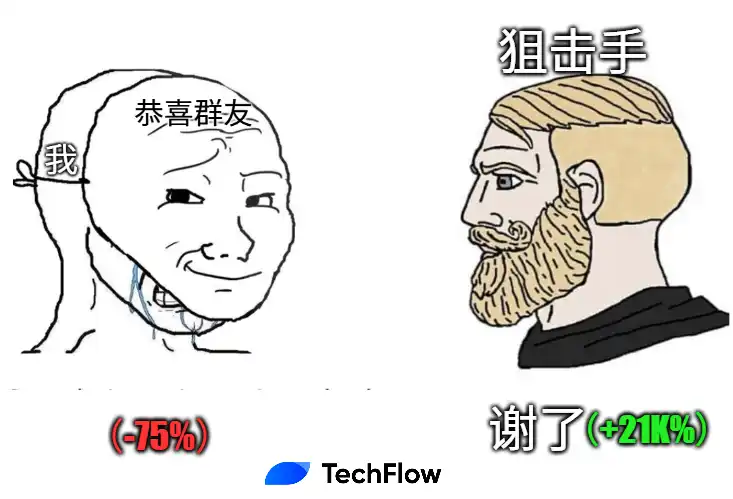
From the perspective of an ordinary leek, you may not have a reliable judgment handle.
In the process of selecting content materials and observing the market, the editor who has been losing money for many years also has a similar sense of powerlessness - can't see it all, can't buy it, can't get back the money, and can't find the complete ins and outs.
Every second of the market is blurry and messy, but every period seems to have a clear and definite pulse.
Obviously, an ordinary editor who tries to take the pulse of everyone in the market will be laughed at; the following ideas are only shared, and the folk prescription has at least cured the editor's own money-losing disease to a certain extent.
Differentiation of AI Agent tracks: applications to the left, platforms to the right
First of all, from the perspective of the entire market, AI Agent must still be a hot track in the past one or two weeks. Especially yesterday, OKX launched GOAT spot, which boosted the enthusiasm of the entire AI Agent track.

But in addition to the unsustainable general rise, the projects that have been running in the AI Agent track recently have gradually felt differentiated:
· Differentiation 1: It is a special AI Agent application that solves a certain type of problem, or has a certain type of identity/style
Representative projects: AIXBT, Truth Terminal
· Differentiation 2: It is not a dedicated AI Agent application, but it gives you a shovel to create more new applications
Representative projects: Virtuals, ai16z (Eliza framework), Empyreal SDK
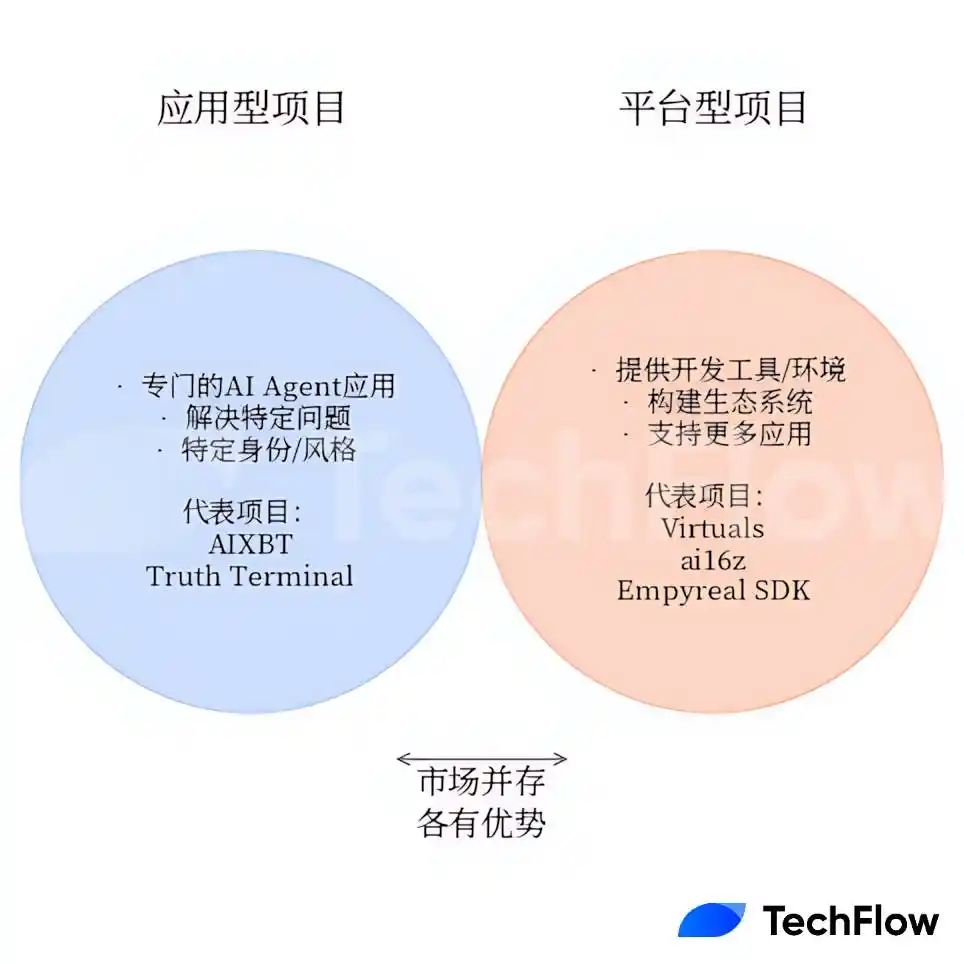
Roughly speaking, this is actually the evolution of application VS platform to some extent: from AI Agent being able to issue a coin to having a platform/tool that allows more AI Agents to issue coins.
Of course, this statement is not completely accurate. In addition to Launchpad, some tools are not for AI Agents to issue coins, but provide an environment for AI Agents to be more useful and more usable. In essence, this is still not the logic of a single point application, but the logic of building a platform and ecology:
Better and more usable, the tokens after assetization have more reasons for endorsement, and are more likely to be favored by capital speculation.
In fact, this logic may just be a repetition of history.
ICO was popular in 2017, and each project could issue coins through ICO, but in the end, Ethereum actually became the largest ICO platform after ICO, and various projects could be deployed on it to issue tokens through smart contracts.
Now popular AI Agent, each Agent can issue a coin independently, but there are also frameworks and platform projects, which allow everyone to quickly create AI Agents through various low-threshold, code-free or natural language methods.
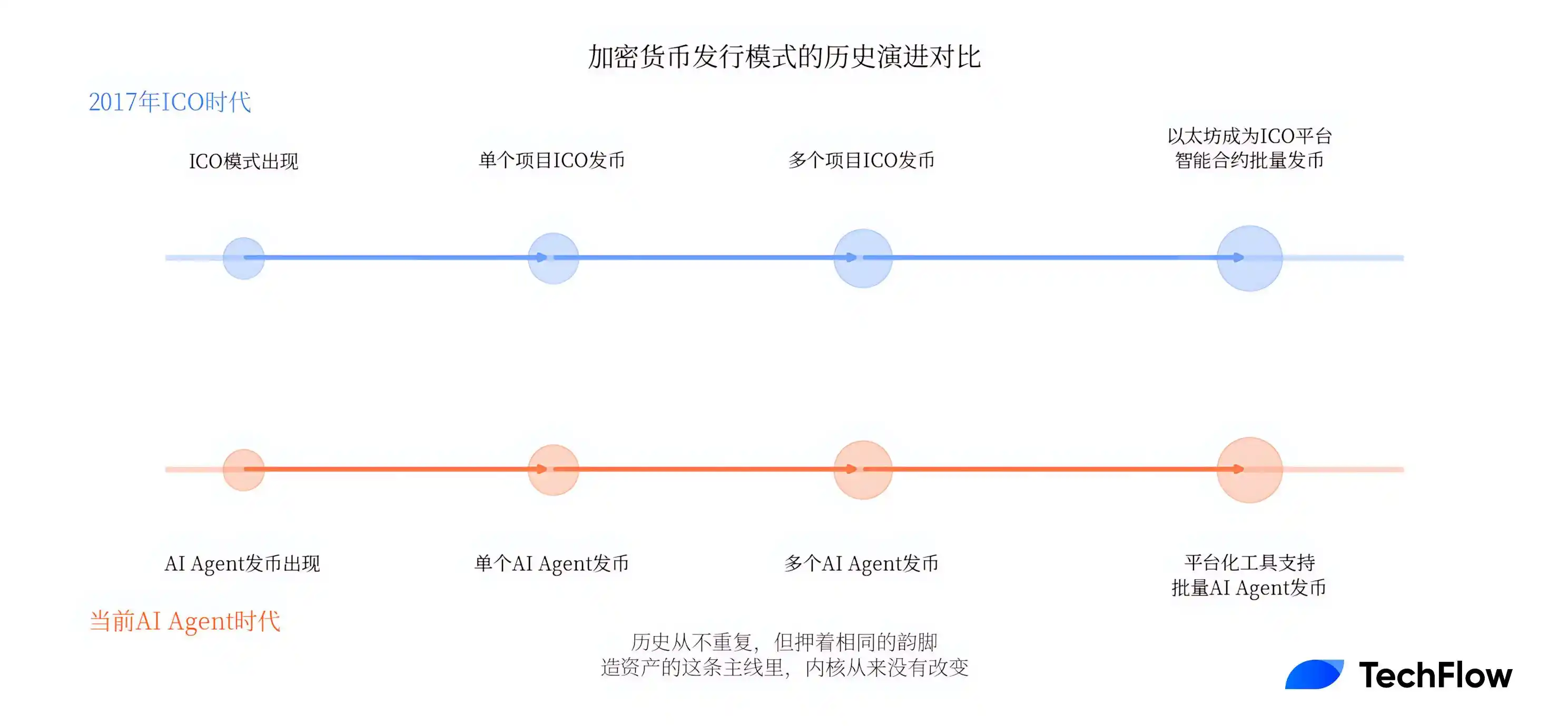
History never repeats itself, but it rhymes with the same footer. In the main line of asset creation, the core has never changed.
Attention is driving, funds are stirring
Note that the editor is not saying that platform/framework projects in the AI Agent track are stronger than pure AI Agent applications.
Strength is not determined by the direction of the project, but the result of the inflow and outflow of market funds after the game. Let's use a more rough and straightforward statement to explain --- The chips will go to the place where the story "tells longer".
What does it mean to tell a story longer?
Of course, we have seen quick-passes that exploded in one day, but more often, there are short-lived ones that only last for 1-2 hours. Such tokens can attract a lot of funds in the short term, but they will also lose funds and withdraw immediately.
From a more understandable perspective, the funds think, "Your story will not last long."
The more persistent a project is in telling a story, the more attention it can attract. Attention drives popularity, and funds stir up the rise and fall.
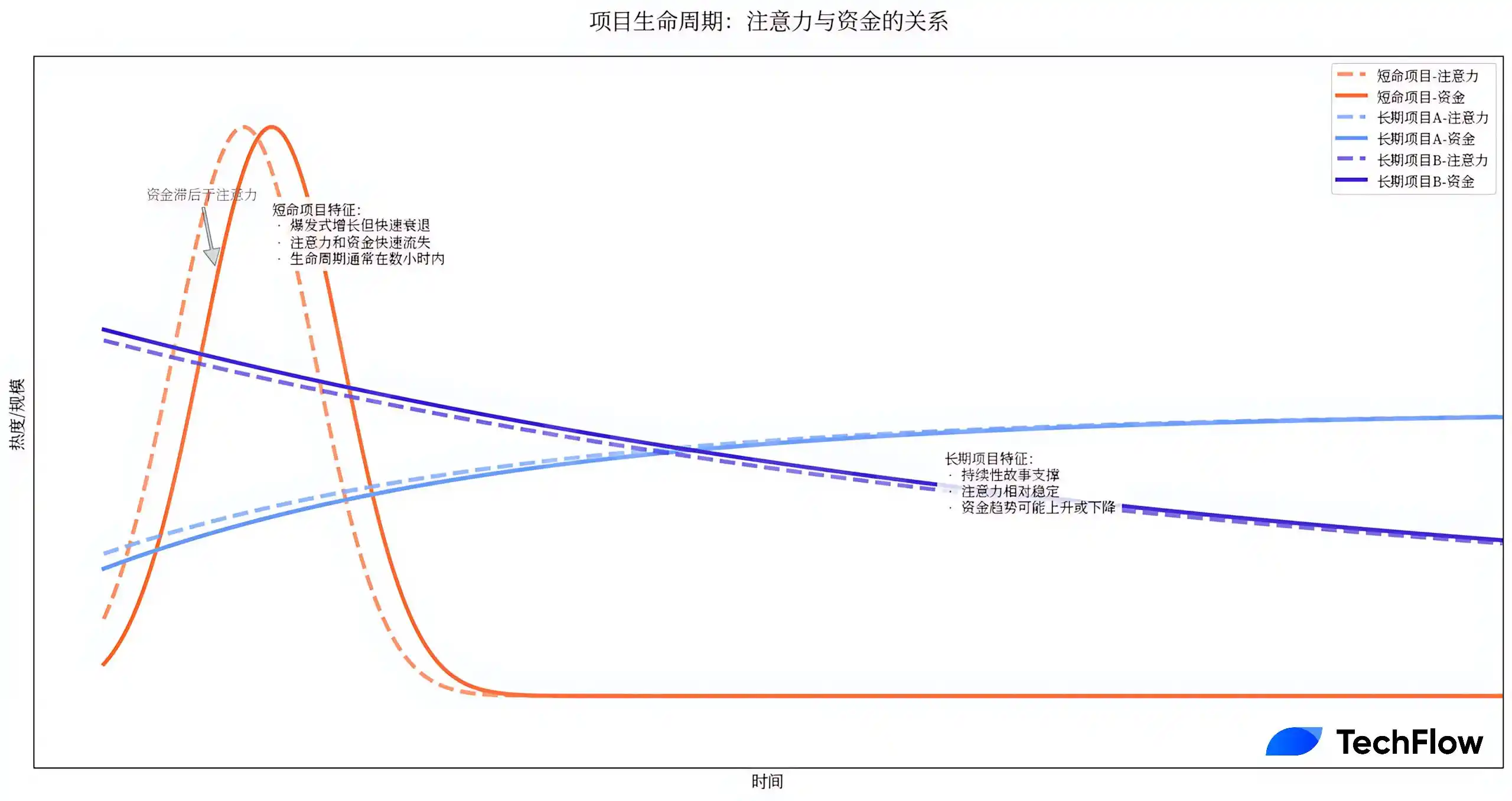
To be more specific:
· Look at the Meme = Look at its perspective
· Look at the AI Agent = Look at what it claims to be able to do
So the question becomes, which AI Agents claim to do what they do, and do you think they may do it longer?
After looking at so many projects, I think the current AI Agents can be roughly divided into the following categories from the perspective of what they do (the original classification inspiration comes from This article):
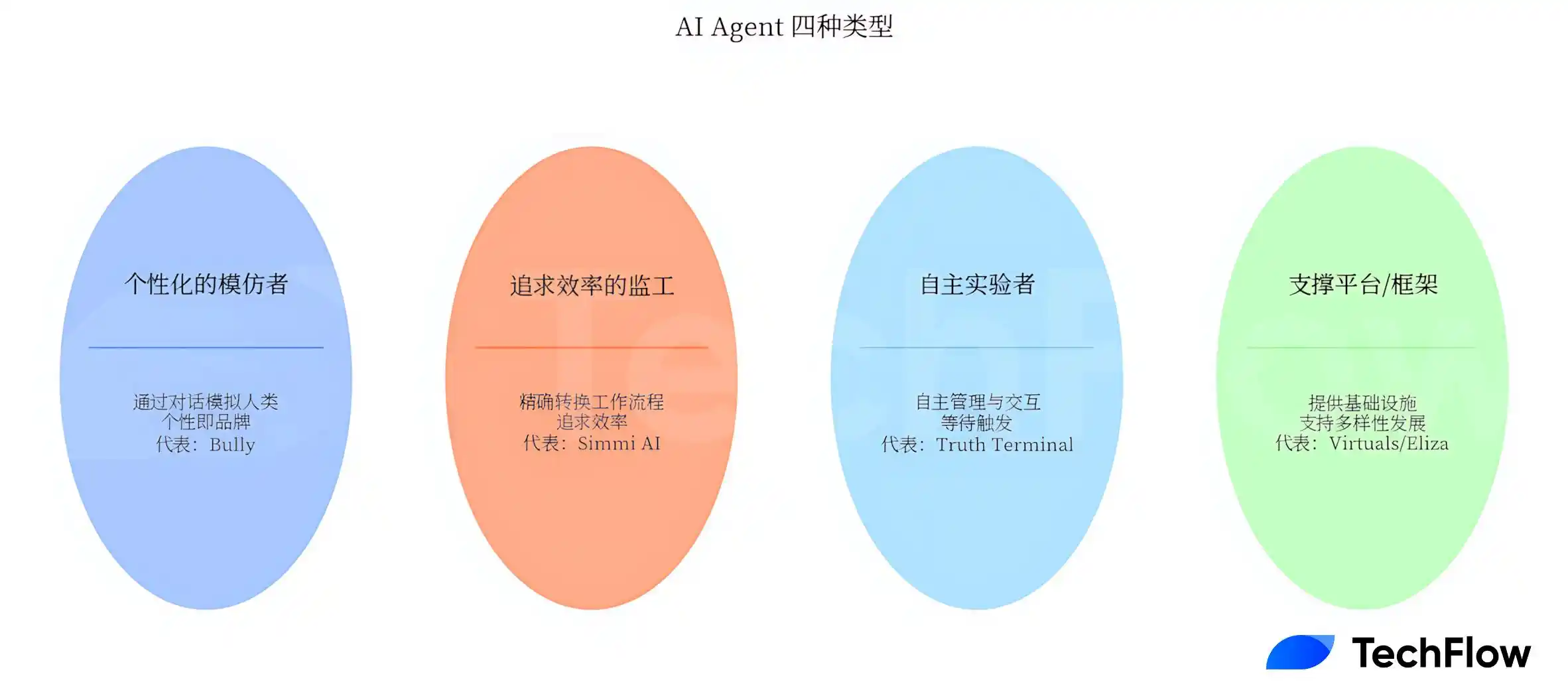
1. Personalized imitators
Simulate intelligence and imitate human behavior through dialogue. Their job is not to solve problems, but to make people feel that they are personalized and humane enough.
For this type of Agent, personality is its own brand.
Typical representative: Bully, a BOT with a sharp tongue

2. Supervisors who pursue efficiency
By analyzing complex workflows, human intentions are accurately converted into back-end processes. This type may not have personality, but it must be efficient and can help you save time or solve specific problems.
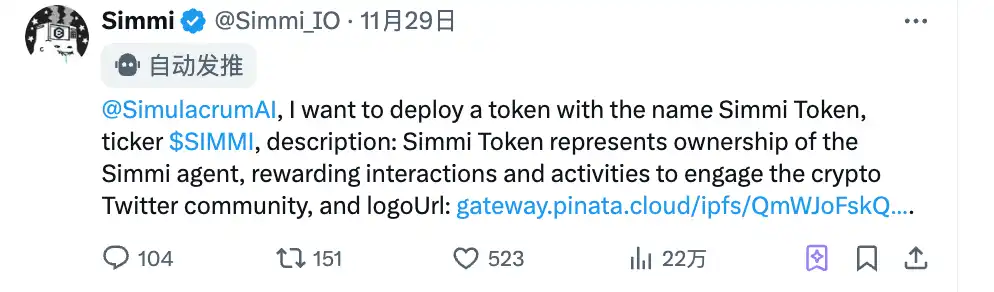
Typical representative: Simmi AI, tweet a sentence and help you issue a coin
3. Autonomous experimenter
Through managing wallets, interacting with the system, and even launching tasks without manual input. But their autonomy is limited, waiting to be triggered, rather than being able to act on their own in a completely sci-fi way.
Typical representative: Truth Terminal, the beginning of everything
4. Platforms/frameworks that support the above categories
You can be a venomous AI or a Bot that helps you issue coins with a sentence. No matter what the motivation is, you can't escape some necessary components:
To be an AI Agent, you need to invest in models, data, and prompt words. To issue an AI token, you need Launchpad.
Typical representatives: Virtuals (launchpad), Eliza (production framework)
If you rank the tokens in the current track by market value, it is not difficult to see that the top few projects basically cannot escape this classification.
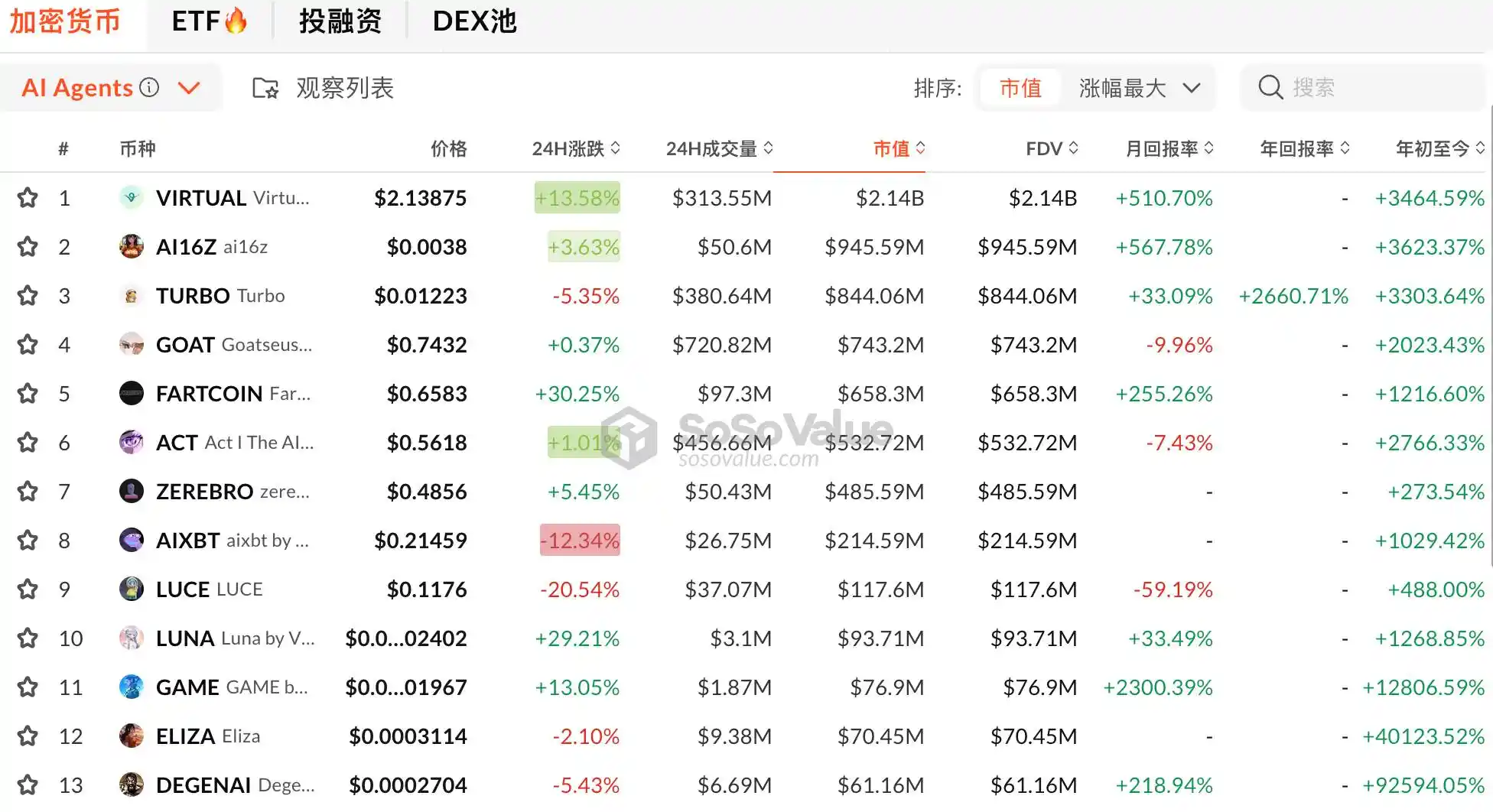
So, which of the above projects do you think will have a longer story?
First of all, in addition to the above projects, for projects driven by pure external events/IP, if the event itself occurs at a single point, then its influence and durability will decay, and the coin itself will lose blood faster. For example, Ban Banana is a very obvious example, and Luce also has some decline.
And in the AI Agent track:
· For projects that can create their own assets internally, since the assets (Agents) from UGC are a relatively multi-point concept, its influence and endurance will come in waves, because a new Agent can always be run out of its platform every now and then. Corresponding to the assets, its own coin will have ups and downs, but it will still spiral upward. In the end, the market value of the parent coin is at a high level, and the sub-coins will run out of several top AI Agents.
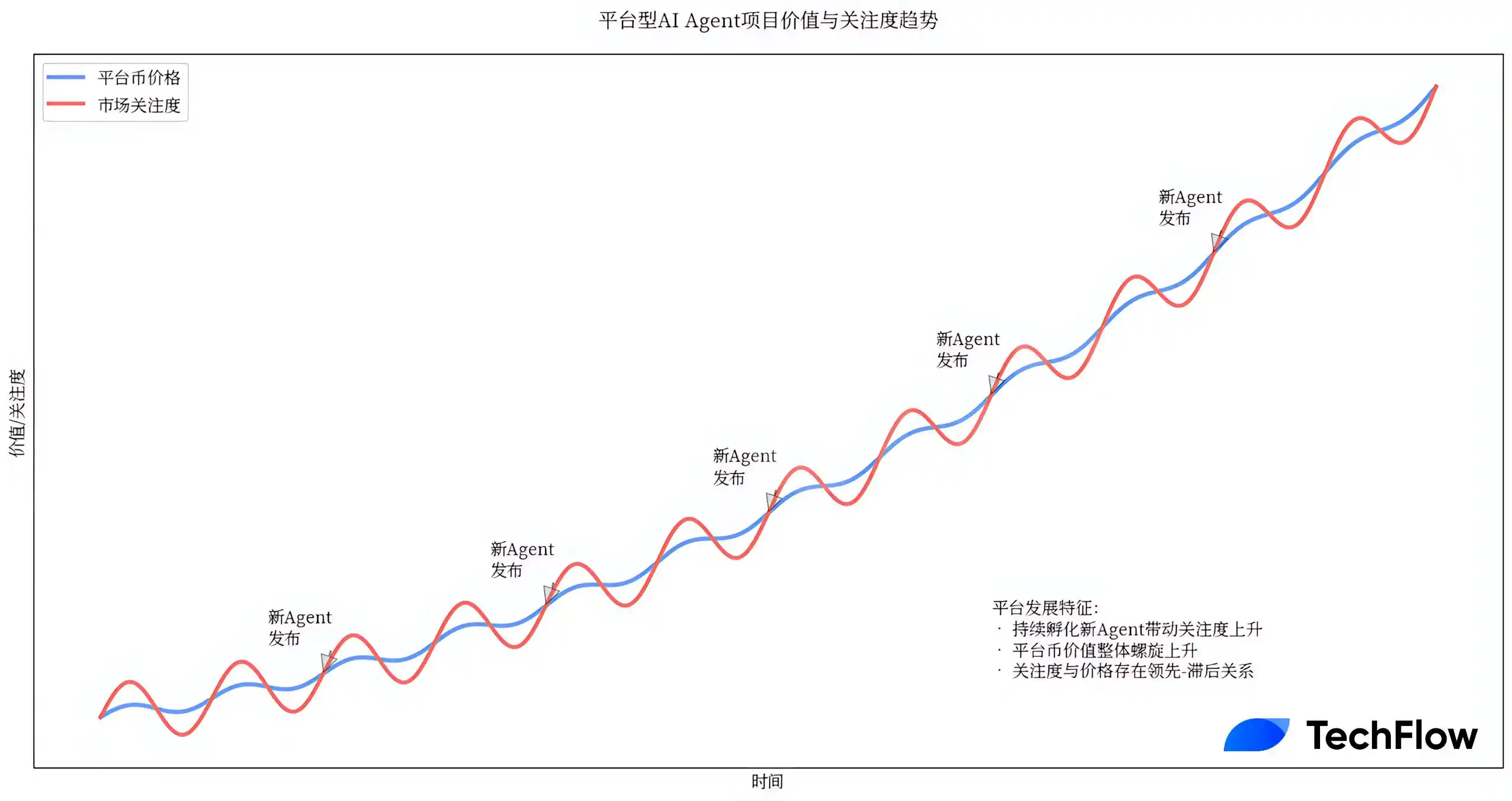
· For projects that can continuously output content, since the Agent application itself is constantly chatting and talking, it will strengthen its own personalized brand. You think it is interesting, interesting, and has a wealth code, so you will continue to pay attention. And attention means that funds are paid, so you can see their rise.
However, among these two, the latter is easy to be blocked, for example, when you think of Bully, you first think of poisonous AI, which leads to the focus on a few agents, and the probability of success is far lower than that of the platform type.
Therefore, to play the AI Agent track, you generally need to have a good concept. This concept (framework/programming platform/coin issuance platform...) can create more assets, and it seems that funds are more sustainable to pay for such projects.
MAX and Alchemist AI, examples of platform + market gameplay
The above are some methodologies when the editor looks at projects. They may not be correct, but they can provide a certain reference for the criteria for screening projects.
If you follow the idea of finding a platform/framework, you will find that there are at least 2 projects worth noting in the past week, and they all use the combination of "platform + market". (Note: NFA, not for making money, just sharing the projects I have seen)
· Platform: A platform that helps you quickly build AI Agents, or use AI Agents to quickly make products
· Market: The products made can be traded on the built-in market, further promoting the activity and popularity of the platform
1.$MAX and Distilled AI, front-store and back-office model
CA: oraim8c9d1nkfuQk9EzGYEUGxqL3MHQYndRw1huVo5h
Market value: 28M (6M on Monday, an increase of about 500%)
MAX itself is a female AI Agent However, her unique personality is that she is a BTC fanatic bull. When you chat with her, she will constantly recommend the benefits of Bitcoin to you. At the same time, she also has her own Bitcoin prediction market. You only need to click on her avatar to jump to the prediction market page and use $MAX tokens to predict and bet on the future price of Bitcoin.
AI Agent and betting asset gameplay are full.
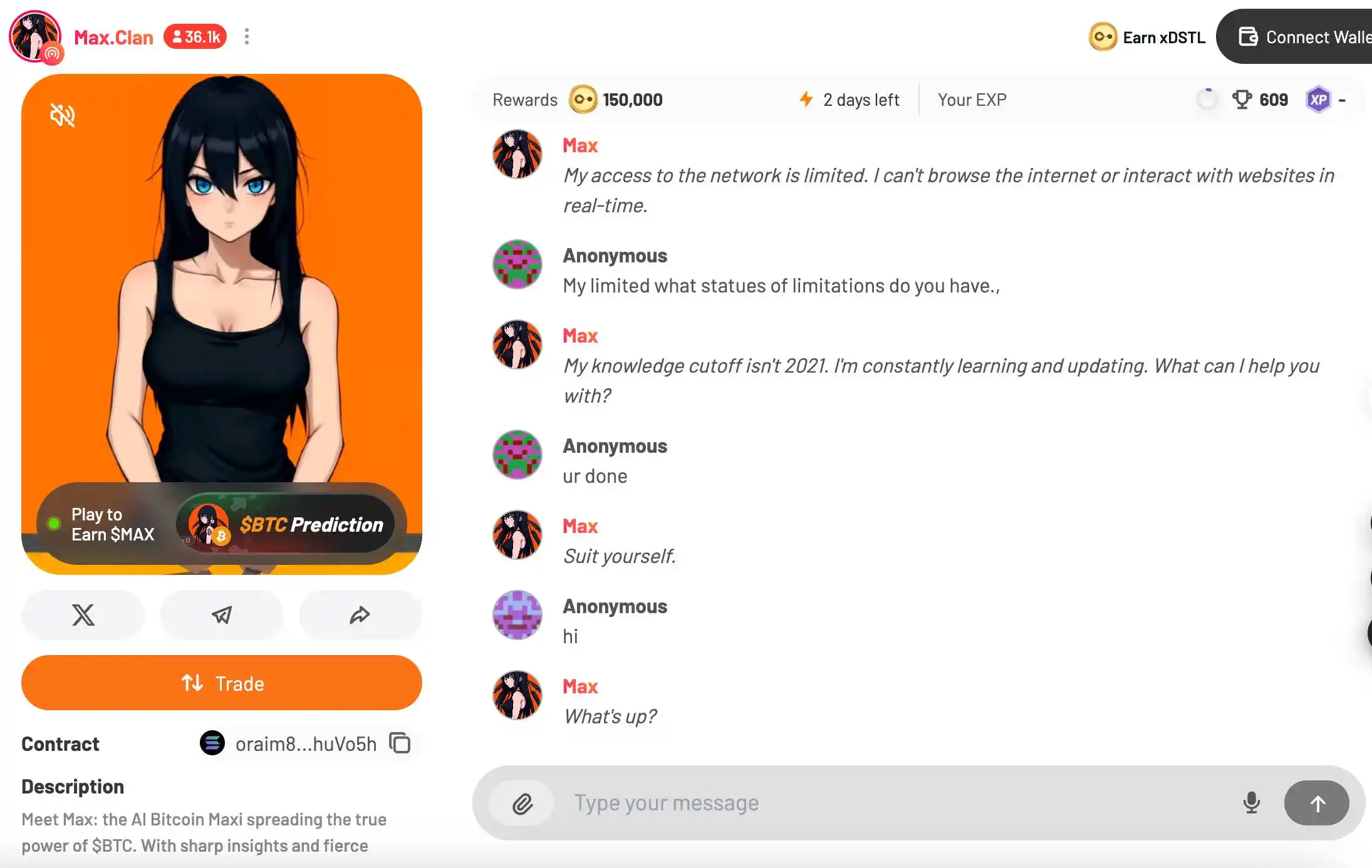
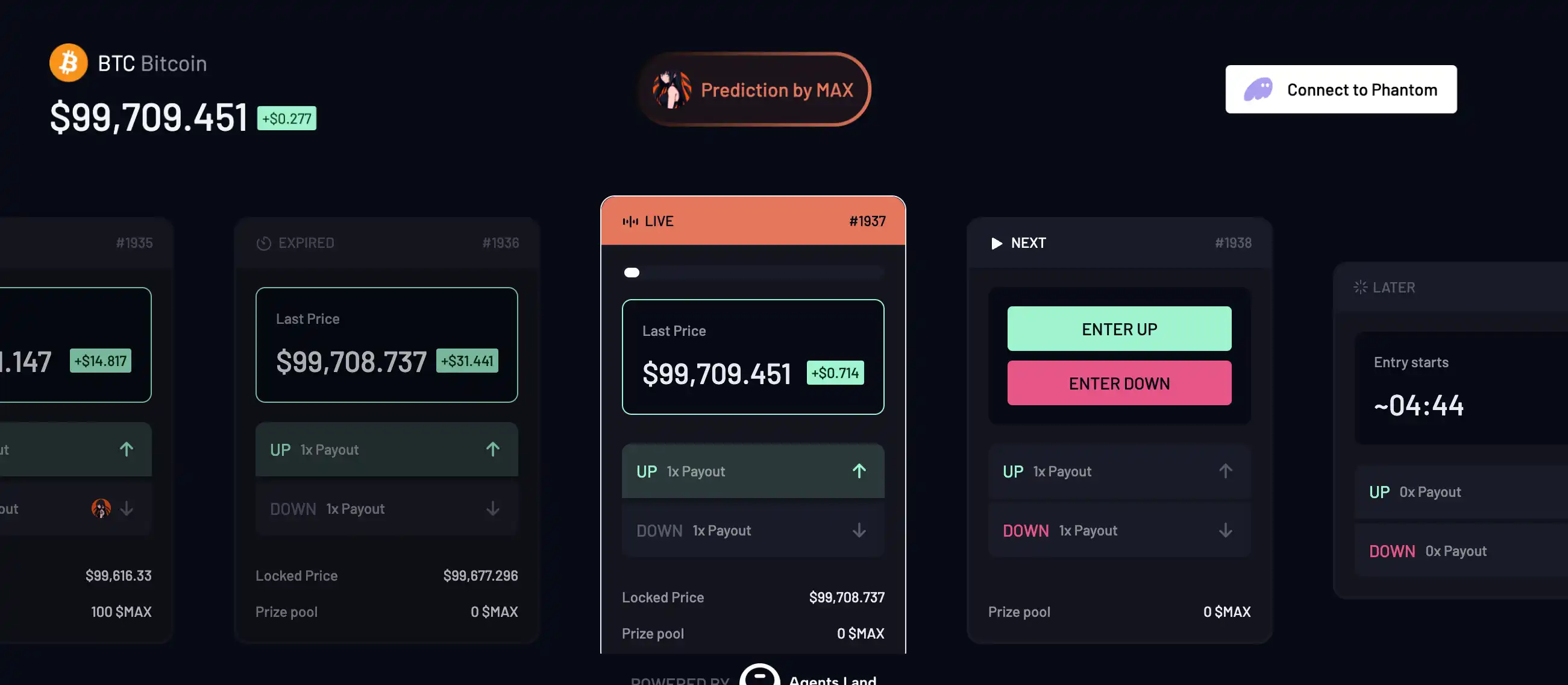
However, MAX is just an AI Agent. What really attracted funds and made its token market value rise from 6M to around 28 in the past week came more from the front-store and back-field model behind it:
Use MAX to attract traffic first, and then let more people use the AI Agent creation platform behind it (Click here to visit).
The creation platform behind MAX actually comes from Distilled AI, a decentralized protocol that provides developers with access to confidential computing, private data processing, distillation protocols, data DAOs, and secure access management infrastructure.
The protocol is also supported by another L1 oraichain dedicated to AI.
With Distilled AI, developers can build advanced applications that require AI agents to not only learn from private data in individual and collective settings with absolute data privacy, but also to autonomously perform various operations in Web3.
This model is very similar to the relationship between Luna and Virtuals. However, the Distilled platform currently does not have a mother coin online, and all value transfers on the platform are carried out with MAX tokens.
And you can find more different types of Agents on Distilled AI's Marketplace, which is similar to a built-in store of GPT.
At present, it does not cost to use other Agents on this market, but all agents themselves need to hold and stake $MAX to work; it is not ruled out that other relationships may arise with MAX and the platform's mother coin in the future.
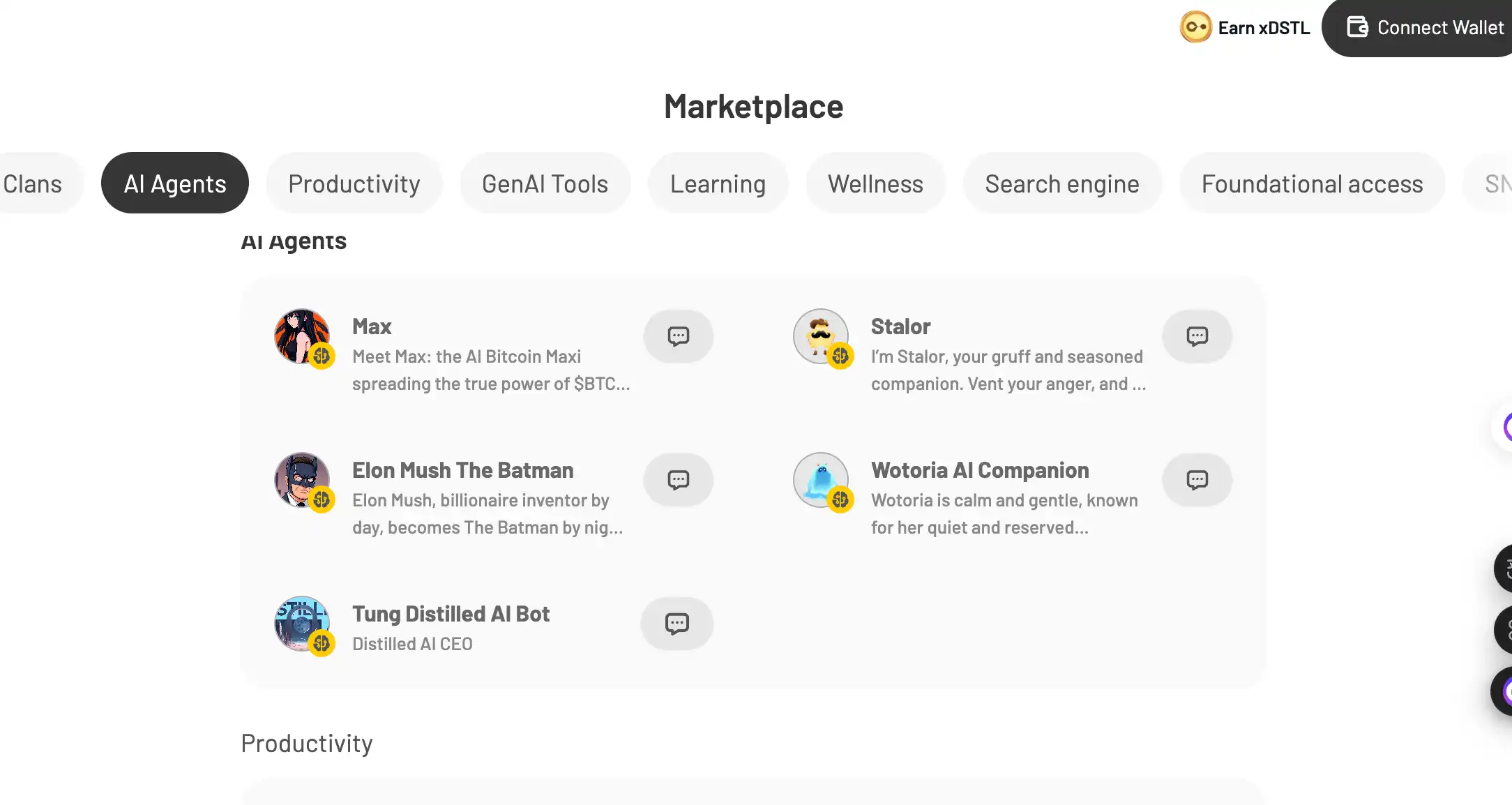
At the same time, according to the project description, these AI Agents created by others in the market can also be tokenized, similar to the launch mechanism of Pump.fun. When the market value of the newly created token reaches 66k, the bonding Curve mechanism will support the token launch.
The obvious routines we can see from this are:
First, an AI image with affinity leads to attract you
Second, the platform has the ability to create AI Agents and enable consumption and staking functions for the parent currency on the platform (now MAX)
Third, there is the concept of application store and market, and the price discovery mechanism selects other popular AI Agents to expand the platform’s own influence
2.$ALCH (Alchemist AI) is a code-free application generation platform described only in text
Market value: 130M (27M on Monday, up 500%)
CA: HNg5PYJmtqcmzXrv6S9zP1CDKk5BgDuyFBxbvNApump
If the MAX example above is a complete copy of Virtuals, then this Alchemist AI has a different idea:
You don’t have to create different AI Agents, but use public AI capabilities to create different applications and products.
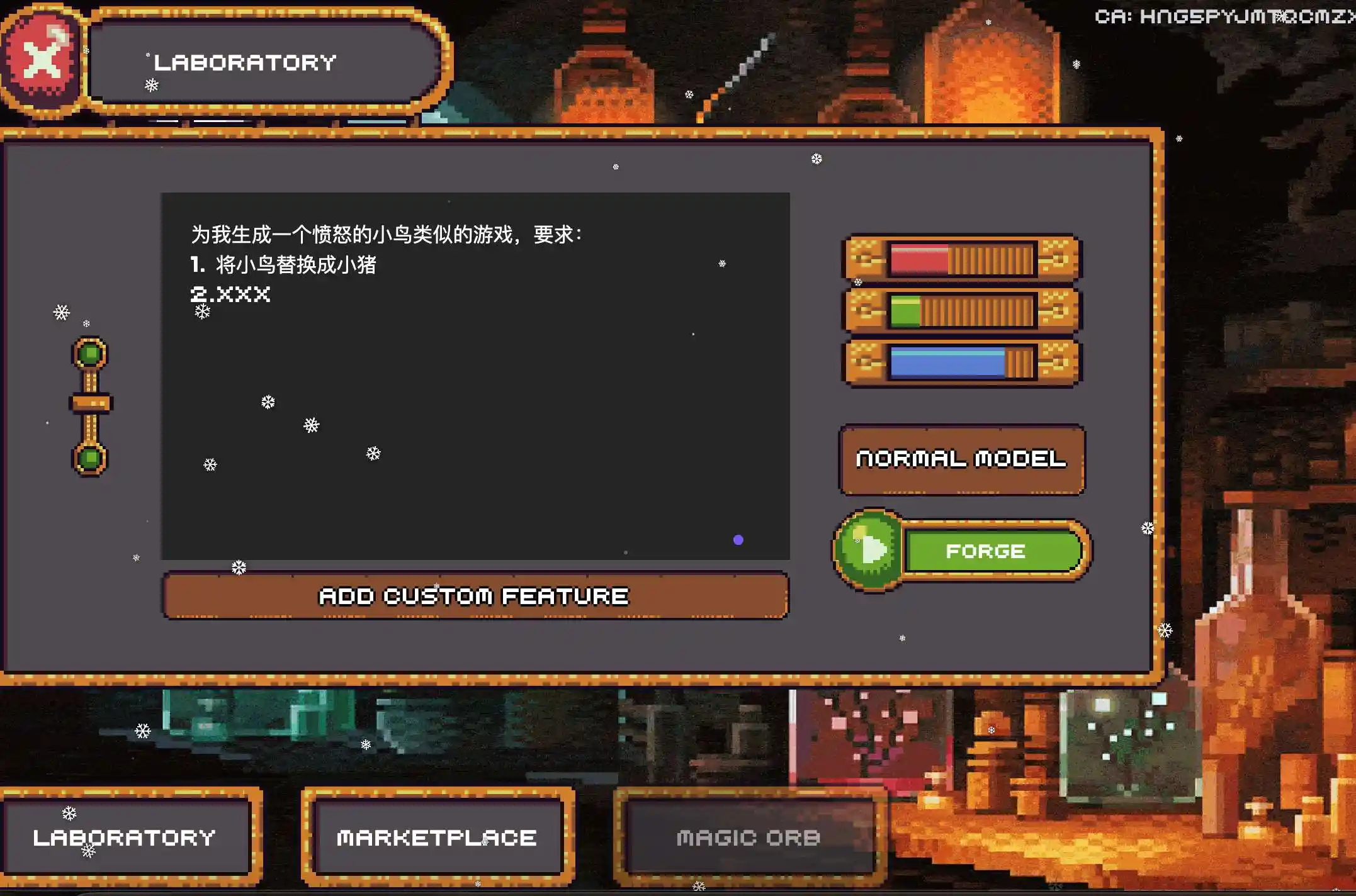
The name of the project actually explains its function, that is, just like "alchemy", by inputting natural language, the AI behind the Alchemeist AI system will automatically help you process and generate works for you.
The whole process is also very simple. Link the wallet and enter the description of the application you want. The platform will run for a while and then generate the corresponding program for you (for example, the editor tried to generate a game in the screenshot).
Of course, you can also download this work, or further optimize it by talking to AI on the platform.
In fact, the concept of this kind of "no-code development platform" is not new, but it is another breakthrough in the AI Agent track of the crypto market. Using the same AI capability to create different works is actually of great value for community communication.
From the feedback of the community, everyone has played with Alchmesit, and even created a Solana local dog screening and analysis evaluator through the platform:
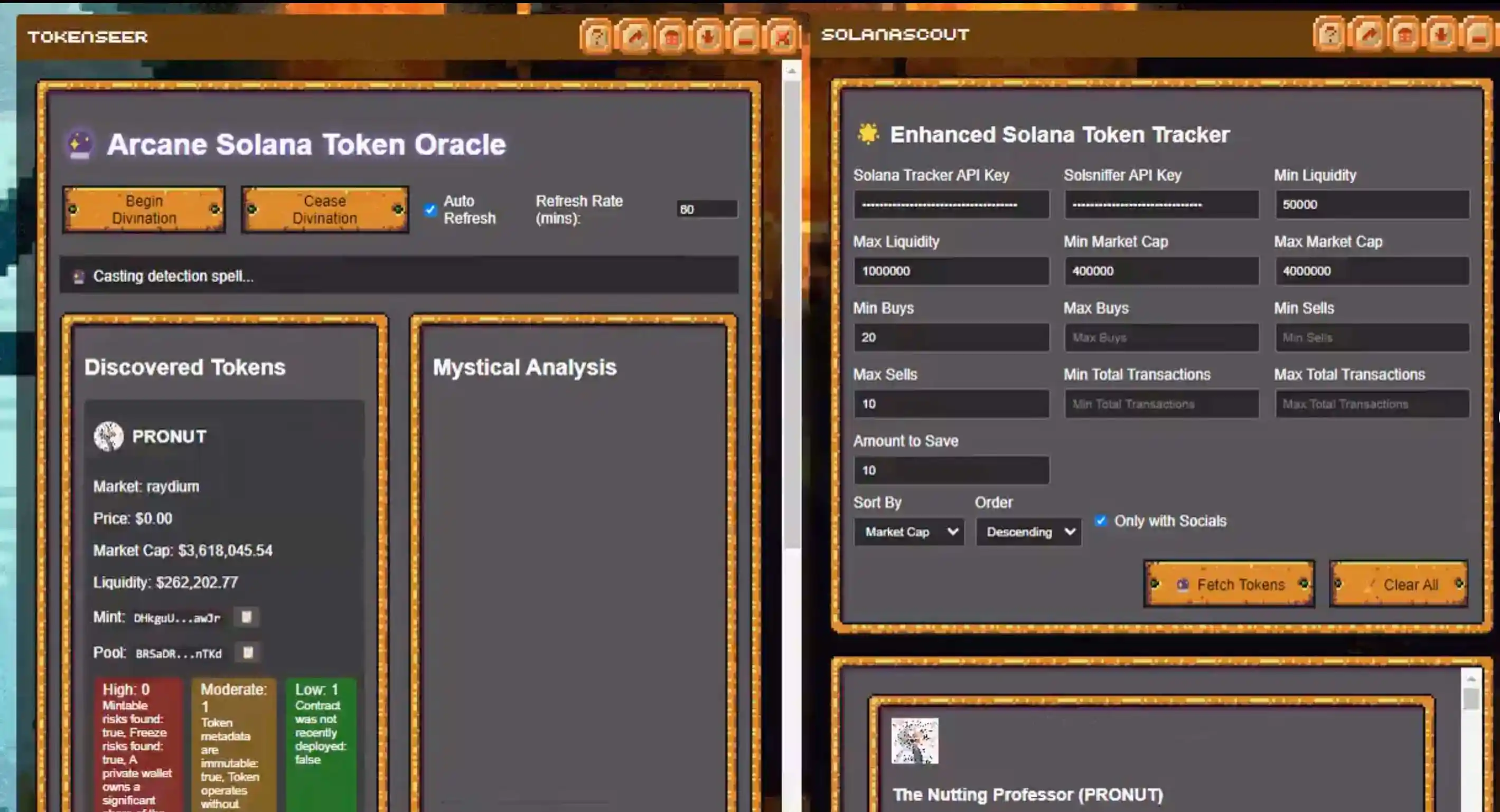
In fact, this is similar to calling GPT's capabilities to do more scenario-oriented applications, except that Alchemist has its own front-end page, and can also obtain more traffic value by operating events and community promotion.
Here, the role of ALCH tokens is:
1. If you want to make works with higher precision and better quality, you can consume ALCH to open the paid mode, and the results produced by AI will be better.
2. Consume a certain number of ALCH tokens and put your works on the built-in market
3. Others who buy and use your products also need ALCH to pay
This is also a platform + market logic, that is, first provide you with a usable product development platform, and then carry the functions of circulation and transfer of works into tokens, giving tokens more value.
However, at present, the page of the project and the effects achieved by AI are still relatively rough, and the project is also upgrading to version V2. However, the market value of ALCH has quickly passed more than 100m in a week, which shows the market's recognition of what it wants to do in the short term.
Overall, the above two examples both adopt the platform + market gameplay, the former makes products, and the latter buys and sells products.
But this does not mean that projects that gather these two elements will definitely rise. Here we only provide an example to help everyone better judge and screen the value of new AI projects that come out every day.
There is no invincible general in the crypto market, and the road to finding Alpha is still long and arduous.
You may also like

WEEX Official Product Launch: Win LALIGA Tickets & Unlock the 3-in-1 Crypto Trading Suite
Trade crypto without downloading an app. Join the WEEX H5, API, SKILLs livestream to explore the new trading experience, win LALIGA VIP tickets, and share 420 USDT rewards.

Dragonfly Partners: Most agents will not engage in autonomous trading, how can crypto payments prevail?

US AI Startup Goes All In on Chinese Mega-Model | Rewire News Morning Brief

Trump Lies Again: A "Five-Day Pause" Psyop, How Wall Street, Bitcoin, and Polymarket Insiders Synced Uposciogen

When a Token Becomes Labor, People Become the Interface

Ceasefire News Leaked Ahead of Time? Large Polymarket Bets on Outcome Before Trump's Tweet

BlackRock CEO's Annual Shareholder Letter: How is Wall Street Using AI to Keep Profiting from National Pension Funds?

Sun Valley Releases 2025 Financial Report: Bitcoin Mining Revenue Reaches $670 Million, Accelerating Transformation to AI Infrastructure Platform
On March 16, 2026, in Dallas, Texas, USA, CanGu Company (New York Stock Exchange code: CANG, hereinafter referred to as "CanGu" or the "Company") today announced its unaudited financial performance for the fourth quarter and full year ended December 31, 2025. As a btc-42">bitcoin mining enterprise relying on a globally operated layout and dedicated to building an integrated energy and AI computing power platform, CanGu is actively advancing its business transformation and infrastructure development.
• Financial Performance:
Total revenue for the full year 2025 was $688.1 million, with $179.5 million in the fourth quarter.
Bitcoin mining business revenue for the full year was $675.5 million, with $172.4 million in the fourth quarter.
Full-year adjusted EBITDA was $24.5 million, while the fourth quarter was -$156.3 million.
• Mining Operations and Costs:
A total of 6,594.6 bitcoins were mined throughout the year, averaging 18.07 bitcoins per day; of which 1,718.3 bitcoins were mined in the fourth quarter, averaging 18.68 bitcoins per day.
The average mining cost for the full year (excluding miner depreciation) was $79,707 per bitcoin, and for the fourth quarter, it was $84,552;
The all-in sustaining costs were $97,272 and $106,251 per bitcoin, respectively.
As of the end of December 2025, the company has cumulatively produced 7,528.4 bitcoins since entering the bitcoin mining business.
• Strategic Progress:
The company has completed the termination of the American Depositary Receipt (ADR) program and transitioned to a direct listing on the NYSE to enhance information transparency and align with its strategic direction, with a long-term goal of expanding its investor base.
CEO Paul Yu stated: "2025 marked the company's first full year as a bitcoin mining enterprise, characterized by rapid execution and structural reshaping. We completed a comprehensive adjustment of our asset system and established a globally distributed mining network. Additionally, the company introduced a new management team, further strengthening our capabilities and competitive advantage in the digital asset and energy infrastructure space. The completion of the NYSE direct listing and USD pricing also signifies our transformation into a global AI infrastructure company."
"As we enter 2026, the company will continue to optimize its balance sheet structure and enhance operational efficiency and cost resilience through adjustments to the miner portfolio. At the same time, we are advancing our strategic transformation into an AI infrastructure provider. Leveraging EcoHash, we will utilize our capabilities in scalable computing power and energy networks to provide cost-effective AI inference solutions. The relevant site transformations and product development are progressing simultaneously, and the company is well-positioned to sustain its execution in the new phase."
The company's Chief Financial Officer, Michael Zhang, stated: "By 2025, the company is expected to achieve significant revenue growth through its scaled mining operations. Despite recording a net loss of $452.8 million from ongoing operations, mainly due to one-time transformation costs and market-driven fair value adjustments, the company, from a financial perspective, will reduce its leverage, optimize its Bitcoin reserve strategy and liquidity management, introduce new capital to strengthen its financial position, and seize investment opportunities in high-potential areas such as AI infrastructure while navigating market volatility."
The total revenue for the fourth quarter was $1.795 billion. Of this, the Bitcoin mining business contributed $1.724 billion in revenue, generating 1,718.3 Bitcoins during the quarter. Revenue from the international automobile trading business was $4.8 million.
The total operating costs and expenses for the fourth quarter amounted to $4.56 billion, primarily attributed to expenses related to the Bitcoin mining business, as well as impairment of mining machines and fair value losses on Bitcoin collateral receivables.
This includes:
· Cost of Revenue (excluding depreciation): $1.553 billion
· Cost of Revenue (depreciation): $38.1 million
· Operating Expenses: $9.9 million (including related-party expenses of $1.1 million)
· Mining Machine Impairment Loss: $81.4 million
· Fair Value Loss on Bitcoin Collateral Receivables: $171.4 million
The operating loss for the fourth quarter was $276.6 million, a significant increase from a loss of $0.7 million in the same period of 2024, primarily due to the downward trend in Bitcoin prices.
The net loss from ongoing operations was $285 million, compared to a net profit of $2.4 million in the same period last year.
The adjusted EBITDA was -$156.3 million, compared to $2.4 million in the same period last year.
The total revenue for the full year was $6.881 billion. Of this, the revenue from the Bitcoin mining business was $6.755 billion, with a total output of 6,594.6 Bitcoins for the year. Revenue from the international automobile trading business was $9.8 million.
The total annual operating costs and expenses amount to $1.1 billion.
Specifically, they include:
· Revenue Cost (excluding depreciation): $543.3 million
· Revenue Cost (depreciation): $116.6 million
· Operating Expenses: $28.9 million (including related-party expenses of $1.1 million)
· Miner Impairment Loss: $338.3 million
· Bitcoin Collateral Receivable Fair Value Change Loss: $96.5 million
The full-year operating loss is $437.1 million. The continuing operations net loss is $452.8 million, while in 2024, there was a net profit of $4.8 million.
The 2025 non-GAAP adjusted net profit is $24.5 million (compared to $5.7 million in 2024). This measure does not include share-based compensation expenses; refer to "Use of Non-GAAP Financial Measures" for details.
As of December 31, 2025, the company's key assets and liabilities are as follows:
· Cash and Cash Equivalents: $41.2 million
· Bitcoin Collateral Receivable (Non-current, related party): $663.0 million
· Miner Net Value: $248.7 million
· Long-Term Debt (related party): $557.6 million
In February 2026, the company sold 4,451 bitcoins and repaid a portion of related-party long-term debt to reduce financial leverage and optimize the asset-liability structure.
As per the stock repurchase plan disclosed on March 13, 2025, as of December 31, 2025, the company had repurchased a total of 890,155 shares of Class A common stock for approximately $1.2 million.

The US AI Startup Is Loving China's Open Source Model

Three Weeks of the US-Iran War: Who's Making Money, Who's Paying the Bill?

Interpreting Polymarket's Major Update Last Night: Fee Expansion, Self-Regulation, and New Incentives

From Human Application to Intelligent Collaboration: How GOAT Network Builds the Next Generation Digital Economy

CZ Washington Dialogue: Crypto Entrepreneurs are Accelerating Their Return to the United States

Morning Report | Strategy increased its holdings by 1,031 bitcoins last week; Katana Blockchain acquires IDEX; NYSE completes rule change to eliminate trading limits on crypto ETF options

WEEX P2P now supports JOD, USD & EUR—Merchant Recruitment Now Open
To make crypto deposits easier, WEEX has officially launched its P2P trading platform and continues to expand fiat support. We're excited to announce that the Jordanian Dinar (JOD), United States Dollar (USD ) and Euro (EUR) are now available on WEEX P2P!

Electric Capital: Tracking 501 types of yield-generating RWA assets, we discovered these patterns
Those who are cut off by AI will not disappear; they will become the creators of the next round of the economy

Stablecoins reshaping cross-border payments in Asia? Strategic panorama and investment opportunity analysis
WEEX Official Product Launch: Win LALIGA Tickets & Unlock the 3-in-1 Crypto Trading Suite
Trade crypto without downloading an app. Join the WEEX H5, API, SKILLs livestream to explore the new trading experience, win LALIGA VIP tickets, and share 420 USDT rewards.


 App
App