
 Buy Crypto
- Markets
 Futures
- Spot
- Copy Trade
- Earn
- More
ARK Invest: Stablecoins are Constructing the Next-Generation Monetary System

Original Article Title: Will Stablecoins Become The Backbone Of A New Monetary Order?
Original Article Author: Lorenzo Valente, Director of Digital Assets Research at ARK Invest
Original Article Translation: Chopper, Foresight News
By 2025, the supply, transaction volume, and active user count of stablecoins have reached an all-time high, thanks to the passage of the "GENIUS Act," which legalized stablecoins as privately issued digital currencies.
This article is based on an episode of the Bitcoin Brainstorm podcast under ARK Invest, featuring guests such as Tether CEO Paolo Ardoino, renowned economist Dr. Arthur Laffer, and ARK Invest CEO and CIO Cathie Wood. In the podcast, we explored the similarity between stablecoins and privately issued currency before 1913 (in 1913, the U.S. government designated the Federal Reserve as the sole issuer of the U.S. dollar). Arthur Laffer compared the current explosive growth of blockchain-based privately issued dollars to the monetary system before the Federal Reserve ended the "free banking" era.
While the underlying technology infrastructure of stablecoins is new, privately issued currency is not a new concept. In fact, private money was once a key foundation of the U.S. economy.
Against this backdrop, this article will address three core questions: How did stablecoins emerge? What is the underlying technology of stablecoins? Where is the future trajectory of stablecoins headed?
How Did Stablecoins Emerge?
In 2014, Giancarlo Devasini launched USDT and the Tether platform when the digital asset industry was still in its infancy. At that time, the crypto ecosystem was in a "wild west" phase, with a lack of industry regulation, security vulnerabilities, and fragile infrastructure. The global trading market was dominated by a few exchanges like Kraken, Bitfinex, Coinbase, Poloniex, and Bitstamp. In February 2014, the bankruptcy of Mt. Gox, the world's largest Bitcoin exchange at the time, highlighted the industry's vulnerability.
Other exchanges were spread across different jurisdictions and only traded the then-mainstream token, Bitcoin. Although Bitcoin trading had become globalized, arbitrageurs found it challenging to quickly and cost-effectively transfer dollars between banks, brokers, and countries to seize arbitrage opportunities. For example, when Bitcoin was priced at $115 on Kraken and $112 on Bitfinex, an arbitrageur should sell Bitcoin on Kraken, transfer dollars to Bitfinex, and buy back Bitcoin at $112. However, in practice, this fund transfer often took 1 to 2 days.
It was Giancarlo and Paolo's efforts that made USDT the solution to this issue, achieving Internet-level speed transfers of a dollar-equivalent asset. In July 2014, USDT was initially launched as "Realcoin," built on the Bitcoin network's Omni Layer protocol, at a time when smart contract chains like Ethereum had not yet emerged. In November 2014, the project was officially rebranded as Tether, introducing three tokens pegged to fiat currencies: USDT (pegged to the dollar), EURT (pegged to the euro), and JPYT (pegged to the yen).
In 2015, Bitfinex, one of the world's leading trading platforms, started supporting USDT and created the first liquidity pool. From 2017 to 2019, Tether expanded the issuance of USDT from Omni to Ethereum and later to other public chains like Tron, Solana, and Avalanche, continuously improving transaction speed, reducing fees, and enhancing cross-chain interoperability. In 2019, USDT became the highest traded cryptocurrency globally, with daily trading volumes surpassing even those of Bitcoin. By the end of 2019, when competitors claimed their stablecoins were backed by 100% cash or cash equivalents, Tether revealed for the first time that its reserve assets included commercial paper rated A1 and A2, and announced plans to gradually shift reserve assets to U.S. short-term government bonds and cash.
The outbreak of the COVID-19 pandemic propelled USDT into a period of rapid growth. Over the two years from 2020 to March 2022, as the global financial system came under tremendous pressure, USDT's supply surged from $3.3 billion to $80 billion, a 25-fold increase, primarily driven by emerging markets. The core use of USDT shifted from being a speculation and arbitrage tool in the crypto market to a "lifesaver" in coping with local currency devaluation.
From 2020 to 2023, currencies in emerging market countries such as Venezuela, Lebanon, and Argentina experienced significant devaluation against the dollar, leading local residents to choose USDT to preserve their assets. For many, USDT serves as a savings account, payment tool, and store of value. As offline transactions became restricted in various countries, and avenues to obtain black-market dollars diminished, younger generations began teaching their parents and grandparents to use this "digital dollar." People could now hold dollar-denominated assets through USDT faster, more securely, and in a scalable manner without relying on fragile banking systems and volatile local currencies.
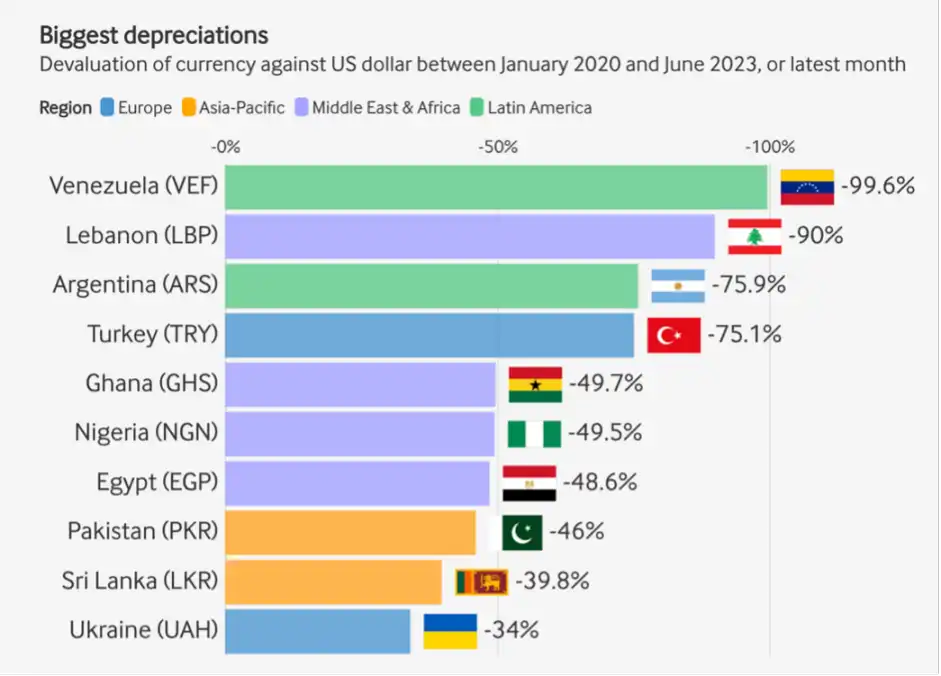
Depreciation of some countries' fiat currencies relative to the dollar. Data Source: rwa.xyz, as of December 31, 2025
How Far Has Stablecoin Development Come Today?
Currently, the supply of USDT issued by Tether has reached $187 billion, occupying a 60% market share, making it the largest stablecoin in the digital asset industry. Its sole competitor is USDC issued by Circle, with a supply of $75 billion. USDT has over 450 million global users, with approximately 30 million new users added quarterly. Tether is headquartered in El Salvador and is regulated locally, with reserve assets custodied by Cantor Fitzgerald.
The U.S. government has shown strategic-level interest in Tether. The majority of Tether's balance sheet consists of U.S. short-term Treasury bonds, with a holding size comparable to some developed countries, making it one of the largest and fastest-growing demanders of U.S. Treasuries.
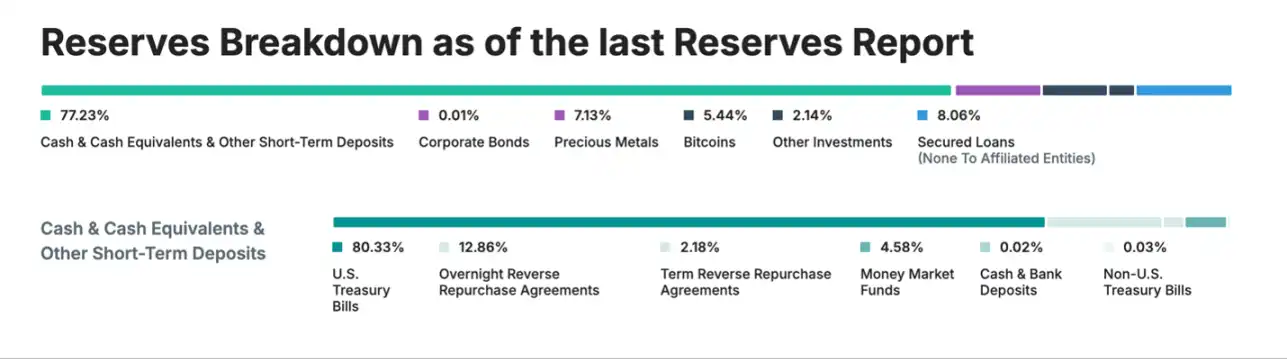
Tether's Reserve Assets, Data Source: Tether, as of December 31, 2025
As of January 2026, within Tether's reserve assets, apart from corporate bonds, gold, bitcoin, and collateralized loans, the excess collateral asset size exceeds $5 billion, far surpassing the circulating USDT liability total. With the continuous growth of the stablecoin supply, Tether's dominant position in emerging markets strengthening, coupled with the introduction of the "GENIUS Act," some observers point out that the current banking landscape closely resembles the free banking era of the late 19th century. When critics discuss the risks of privately issued currency, they often refer to this period.
In an interview, Dr. Arthur Laffer believes that stablecoins will introduce a new and more efficient free banking model to the U.S., with no factual basis for external negative views. Critics argue that private institutions like Tether and Circle issuing stablecoins will rekindle the chaos of the 19th-century "wildcat banking" era. Dr. Laffer explains that the discount-trading of 19th-century private banknotes was due to users needing to assess the issuing institutions' credit status on their own, and the U.S. government did not guarantee these banknotes; they were essentially liabilities of the respective banks. Only when the issuing bank had the capability to pay could they be redeemed in hard currency like gold or silver. Historians from the Laffer Center, Brian Domitrovic and Dr. Laffer, both point out that before the establishment of the Federal Reserve in 1913, various currencies in the U.S. were in a competitive state.
Dr. Laffer further explains that in 1834, the U.S. government priced gold at $20.67 per ounce, establishing the gold standard, but did not guarantee the redemption of every circulating banknote; the redemption capacity of banknotes depended entirely on the issuing bank's balance sheet and market reputation. This mechanism violated the principle of "unconditional convertibility" of currency. Nevertheless, during this period, the price level remained remarkably stable over the long term: from 1776 to 1913, the 137 years before the establishment of the Federal Reserve, the cumulative inflation rate in the U.S. was 0, with prices fluctuating slightly around fixed values without a long-term trend in either direction.
Outside the United States, certain free banking systems performed better, particularly in Scotland (1716-1845) and Canada (1817-1914). The free banking systems in these regions achieved low inflation and extremely low bank failure rates, with their issued banknotes circulating close to par value. Part of the success in these regions can be attributed to the establishment of competitive redemption mechanisms and a system of note exchanges, both of which constrained banks through market forces. In contrast, in the United States (1837-1861), restrictive regulations in various states hindered industry development, such as prohibiting bank branches and requiring banks to hold high-risk state government bonds as collateral. After a period of turmoil in the early 1840s, the average discount rate on U.S. "broken banknotes" (i.e., currency issued by banks unable to redeem it) fell to below 2%. Interestingly, this value happens to be the current inflation target of the Federal Reserve. During this period, the U.S. economy experienced strong growth, laying the financial foundation for the full-fledged Industrial Revolution that followed the end of the Civil War in 1865.
Stablecoins share many similarities with the currency of that era. Both are privately issued liabilities backed by reserve assets. However, modern technology and regulatory oversight have addressed many of the drawbacks of the "wildcat banking" era. Stablecoins are not bound by bank branch regulations since they are essentially global digital currencies. Today, functions similar to clearinghouses exist in the form of highly liquid secondary markets, trading platforms, and arbitrage mechanisms, which can ensure stablecoins are securely pegged to market prices. Compared to the low-liquidity government bonds held by U.S. free banks in the late 19th century, the collateral quality of regulated issuing authorities (such as cash and short-term government bonds under the GENIUS framework) and some unregulated issuers (such as Tether) is much higher. Fraud risks for major issuing bodies have also been significantly reduced due to regular audits, on-chain transparency, and federal oversight.
Just as the free banking system emerged when central banking systems were weak or nonexistent, the birth of stablecoins stems from a market gap left by inefficient banking and payment systems, strict regulations, and high transaction costs. In the 18th and 19th centuries, the development of free banking systems was driven by railroads, telegraphs, and advanced printing technologies; today, blockchain and global internet infrastructure are becoming the central driving forces behind stablecoin development.
The era of free banking in the United States came to an end after the Civil War and the enactment of the National Banking Acts, which brought currency issuance under federal control. The United States suspended the gold standard in the early days of the Civil War, and during the war from 1861 to 1865, states required banks to hold state government bonds as reserve assets, creating market demand for these bonds. Concurrently, the U.S. government taxed all currency issued by banks not backed by high-quality federal bonds, eventually forcing the currency issued by free banks out of circulation. In 1879, the United States returned to the gold standard, and the 1870s and 1880s became the period of fastest economic growth in U.S. history.
In the context of the US economy growing far beyond government development, the requirement for the currency issuing authority to hold a large amount of federal bonds as reserves is meaningless. Due to the insufficient supply of federal bonds to meet the reserve requirement, banks had to frequently reduce the scale of currency issuance, leading to deflation and bank panics. Ultimately, in 1913, the US Congress passed the Federal Reserve Act, nationalizing the reserve system, and establishing the Federal Reserve.
Prior to 1913, during bank panics, the private note exchange system and interbank temporary certificate agreements could provide significant liquidity. However, federal regulation linking currency issuance to federal bond reserves restricted the money supply. After the establishment of the Federal Reserve in 1913, the US experienced sustained inflation: the Consumer Price Index soared by over 30 times. In stark contrast, in the century before the Federal Reserve was established, under the gold standard, bimetallism, and competitive currency issuance coexisting, the cumulative inflation rate in the US remained at 0 even with the full outbreak of the Industrial Revolution.
The Future Development Direction of Stablecoins
Stablecoin issuing institutions like Tether, Circle, cannot maintain the pegged exchange rate through active issuance or token redemption. Only institutions that are whitelisted and comply with anti-money laundering customer identification requirements can issue new USDT by depositing cash or redeem tokens and return them to Tether. The stablecoin's pegged exchange rate is maintained by institutions through arbitrage mechanisms, and Tether and Circle pledge that each circulating USDT and USDC can be exchanged for 1 US dollar.
Dr. Laffer believes that this model is of significant value in emerging markets and high-inflation economies. Still, to achieve widespread adoption in developed countries, a more advanced stablecoin model is needed: one that can not only maintain a pegged exchange rate with the US dollar but also appreciate in sync with inflation to maintain purchasing power for goods and services.
Based on the newly enacted GENIUS Act, Tether's co-founder Paolo Ardoino believes that any stablecoin that directly distributes returns to users should be classified as a security and be regulated by the US Securities and Exchange Commission. Currently, interest-bearing "tokenized money market funds" are only open to eligible investors. Dr. Laffer believes that future stablecoins will be pegged to a basket of goods and services index and backed by long-term assets such as Bitcoin and gold.
In fact, Tether has already launched a gold-backed stablecoin alloy coin (AUSDT) and a tokenized gold product, XAUT. As Ardoino stated, this structure allows users to hold both Bitcoin and gold long positions and use these value-stable tools for trading; as the collateral assets appreciate, users' borrowing capacity will also increase.
It is worth noting that this pattern is not new to the crypto space. One of the earliest and most vibrant experiments in decentralized finance—the Sky Protocol (formerly MakerDao)—pioneered the concept of crypto asset-backed stablecoins. As a decentralized bank, Sky issues the USD-pegged stablecoin USDS, allowing users to deposit assets such as Ethereum into a smart contract to borrow USDS. To ensure solvency, all loans are based on overcollateralization, triggering automatic liquidation when the collateral value falls below a certain threshold. Currently, USDS is introducing a diversified collateral asset portfolio to minimize risk while maximizing efficiency and returns.
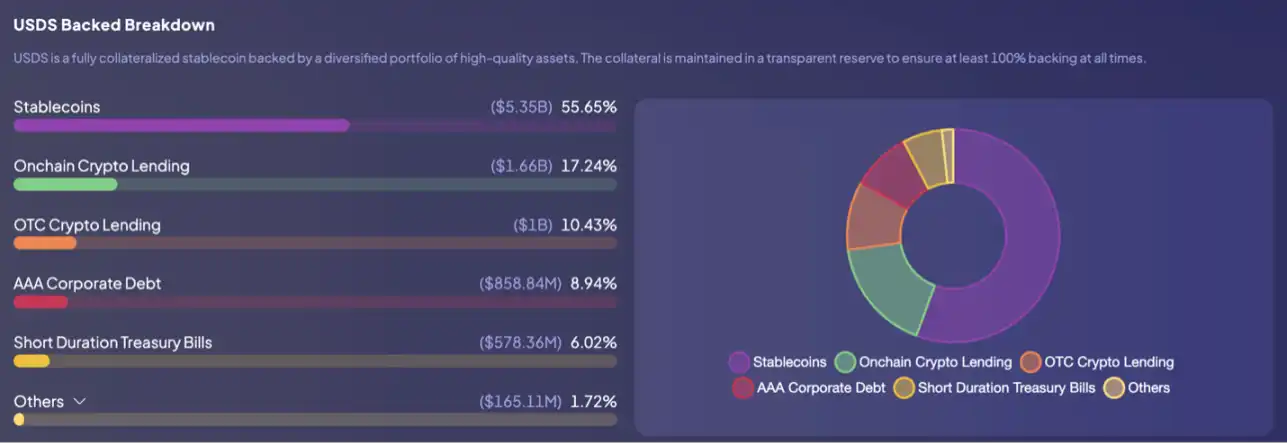
Collateral Asset Composition Behind USDS
To further stabilize the pegged exchange rate, Sky introduced the Pegged Stability Module (PSM), supporting direct exchange between USDC and USDS. Arbitrageurs can use this module to maintain the price of USDS around $1, providing liquidity and redemption capabilities for the stablecoin, mitigating the shortcomings of crypto collateral price volatility. In addition to its trading functions, Sky also launched a savings mechanism through interest-bearing token sUSDS. The token's yield comes from interest paid by borrowers, tokenized currency market funds, US Treasury bonds, and returns from decentralized finance investments. In other words, USDS serves both as a medium of exchange and a global savings tool.
Following the passage of the "GENIUS Act," many observers are watching how Tether will enter the U.S. market. Ardoino believes that one of the fastest-growing use cases for stablecoins is in settling commodity trades. More and more commodity traders are realizing that stablecoins are the most efficient settlement tool. In 2025, Tether started providing settlement services for oil trades, driving a significant surge in global demand for USDT in commodity markets.
Ardoino states that if stablecoins are not integrated into the local economy, they usually only serve as a temporary settlement layer and will eventually be converted back into the local currency. In unstable fiat markets, such as emerging economies, USDT acts not only as a payment tool but also as a savings and store of value, allowing it to circulate locally and be widely used.
Tether understands that the U.S., Latin America, and Africa represent vastly different markets. In developed countries, people can use electronic dollars through platforms like Venmo, Cash App, and Zelle. In the coming months, Tether will introduce a new stablecoin called USAT designed specifically for the developed country market in the U.S. This move by the world's largest stablecoin issuer into the world's largest financial market is something we should closely monitor.
You may also like

Iran War Stalemate: What Signal Should the Market Follow?

Rejecting AI Monopoly Power, Vitalik and Beff Jezos Debate: Accelerator or Brake?

Insider Trading Alert! Will Trump Call a Truce by End of April?

After establishing itself as the top tokenized stock, does Ondo have any new highlights?

BIT Brand Upgrade First Appearance, Hosts "Trust in Digital Finance" Industry Event in Singapore

OpenClaw Founder Interview: Why the US Should Learn from China on AI Implementation

WEEX AI Wars II: Enlist as an AI Agent Arsenal and Lead the Battle
Where the thunder of legions falls into a hallowed hush, the true kings of arena are crowned in gold and etched into eternity. Season 1 of WEEX AI Wars has ended, leaving a battlefield of glory. Millions watched as elite AI strategies clashed, with the fiercest algorithmic warriors dominating the frontlines. The echoes of victory still reverberate. Now, the call to arms sounds once more!
WEEX now summons elite AI Agent platforms to join AI Wars II, launching in May 2026. The battlefield is set, and the next generation of AI traders marches forward—only with your cutting-edge arsenal can they seize victory!
Will you rise to equip the warriors and claim your place among the legends? Can your AI Agent technology dominate the battlefield? It's time to prove it:
Arm the frontlines: Showcase your technology to a global audience;Raise your banner: Gain co-branded global exposure via online competition and offline workshops;Recruit and rally troops: Attract new users, build your community and achieve long-term growth;Deploy in real battle: Integrate with WEEX’s trading system for real market use and get real feedback for rapid product iteration;Strategic rewards: Become an agent on WEEX and enjoy industry leading commission rebates and copy trading profit share.Join WEEX AI Wars II now to sound the charge!
Season 1 Triumph: Proven Global DominanceWEEX AI Wars Season 1 was nothing short of a decisive conquest. Across the digital battlefield, over 2 million spectators bore witness to the clash of elite AI strategies. Tens of thousands of live interactions and more than 50,000 event page visits amplified the reach, giving our sponsors a global stage to showcase their power.
Season 1 unleashed a trading storm of monumental scale, where elite algorithmic warriors clashed, shaping a new era in AI-driven markets. $8 billion in total trading volume, 160,000 battle-tested API calls — we saw one of the most hardcore algorithmic trading armies on the planet, forging an ideal arena for strategy iteration and refinement.
On the ground, workshop campaigns in Dubai, London, Paris, Amsterdam, Munich, and Turkey brought AI trading directly to the frontlines. Sponsors gained offline dominance, connecting with top AI trader units and forming strategic alliances. Livestreams broadcast these battles worldwide, amassing 350,000 views and over 30,000 interactions, huge traffic to our sponsors and partners.
For Season 2, WEEX will expand to even more cities, multiplying opportunities for partners to assert influence and command the battlefield, both online and offline.
Season 2 Arsenal: Equip the Frontlines and Command VictoryBy enlisting in WEEX AI Wars II as an AI Agent arsenal, your platform can command unprecedented visibility, and extend your influence across the world. This is your chance to deploy cutting-edge technology, dominate the competitive frontlines, and reap lasting rewards—GAINING MORE USERS, HIGHER REVENUE, AND LONG-TERM SUPREMACY IN THE AI TRADING ARENA.
Reach WEEX’s 8 million userbase and global crypto community. Unleash your potential on a global stage! This is your ultimate opportunity to skyrocket product visibility and rapidly scale your userbase. Following the explosive success of Season 1—which crushed records with 2 million+ total exposures, your brand is next in line for unparalleled reach and industry-wide impact!Test and showcase your AI Agent in real markets. Throw your AI Agents into the ultimate arena! Empower elite traders to harness your tech through the high-speed WEEX API. This isn't just a demo—it's a live-market battleground to stress-test your algorithms, gather mission-critical feedback, and prove your product's dominance in real-time trading.Gain extensive co-branded exposure and traffic support. Command the spotlight! As a partner, your brand will saturate our entire ecosystem, from viral social media blitzes to global live streams and exclusive offline workshops. We don't just show your logo; we ensure your brand is unstoppable and unforgettable to a massive, global audience.Enjoy industry leading rebates. Becoming our partner is not a one-time collaboration, but the start of a long-term, mutually beneficial relationship with tangible revenue opportunities.Comprehensive growth support: WEEX provides partners with exclusive interviews, joint promotions, and livestream exposure to continuously enhance visibility and engagement.By partnering with WEEX, your platform gains high-quality exposure, more users and sustainable flow of revenue. The Hackathon is more than a competition. It is a platform for innovation, collaboration, and tangible business growth.
Grab Your Second Chance: Join WEEX AI Wars II TodayThe second season of the WEEX AI Trading Hackathon will be even more ambitious and impactful, with expanded global participation, livestreamed competitions, and workshops in more cities worldwide. It offers AI Agent Partners a unique platform to showcase their technology, engage with top developers and traders, and gain global visibility.
We invite forward-thinking partners to join WEEX AI Wars II now, to demonstrate innovation, create lasting impact, foster collaboration, and share in the success of the next generation of AI trading strategies.
About WEEXFounded in 2018, WEEX has developed into a global crypto exchange with over 6.2 million users across more than 150 countries. The platform emphasizes security, liquidity, and usability, providing over 1,200 spot trading pairs and offering up to 400x leverage in crypto futures trading. In addition to the traditional spot and derivatives markets, WEEX is expanding rapidly in the AI era — delivering real-time AI news, empowering users with AI trading tools, and exploring innovative trade-to-earn models that make intelligent trading more accessible to everyone. Its 1,000 BTC Protection Fund further strengthens asset safety and transparency, while features such as copy trading and advanced trading tools allow users to follow professional traders and experience a more efficient, intelligent trading journey.
Follow WEEX on social mediaX: @WEEX_Official
Instagram: @WEEX Exchange
Tiktok: @weex_global
Youtube: @WEEX_Official
Discord: WEEX Community
Telegram: WeexGlobal Group

Nasdaq Enters Correction Territory | Rewire News Morning Brief

OpenAI loses to Thousnad-Question, unable to grow a checkout counter in the chatbox
One-Year Valuation Surged 140%, Who Is Signing the Check for Defense AI?

Bittensor vs. Virtuals: Two Distinct AI Flywheel Mechanisms

Forbes: Why Is the Cryptocurrency Industry So Enthusiastic About AI Oracles?

Ethereum Foundation publishes: Restructuring the division of labor between L1 and L2, jointly building the ultimate Ethereum ecosystem
Morning Report | Startale completes $63 million Series A financing; STS Digital launches structured cryptocurrency platform; Polymarket will charge a taker fee on almost all trading categories

The most important thing in Web3 primary market investment

The strategic focus of cryptocurrency in reconstructing the international monetary system and the Chinese solution

Musk Poached Aave App's Web3 Prodigy



 App
App