
 Buy Crypto
- Markets
 Futures
- Spot
- Copy Trade
- Earn
- More
Bankless: Is the On-Chain Development the Key to Unlocking the 300 Billion BTC Sleeping Outside of DeFi?

Original Title: Can Bitcoin Thrive Onchain?
Original Author: Jean-Paul Faraj, Bankless
Original Translation: Bitpush News
Despite holding the top spot in cryptocurrency market cap, Bitcoin's participation in the decentralized finance (DeFi) space is relatively low, sparking a profound discussion about its future role.
For over a decade, Bitcoin has been a cornerstone of the crypto ecosystem—praised for its decentralization, censorship resistance, and provable scarcity. However, despite Bitcoin's dominant market cap and recent resurgence in interest, it still largely stands apart from one of the most vibrant sectors in the crypto space—DeFi.
According to Bitcoin Layers data, only about $30 billion worth of Bitcoin (just 1.875% of its total supply) is being used in DeFi. In contrast, Ethereum has around $50 billion worth of ETH locked in DeFi, approximately 23% of its total supply.
This disparity highlights a core contradiction in today's Bitcoin narrative: while BTC holds significant value, a relatively small amount of BTC is actively being utilized on-chain to provide yield opportunities. This gap is driving an innovation wave around ways to wrap, stake, and other methods to bring Bitcoin into the DeFi economy, unlocking avenues to make BTC an productive capital asset.
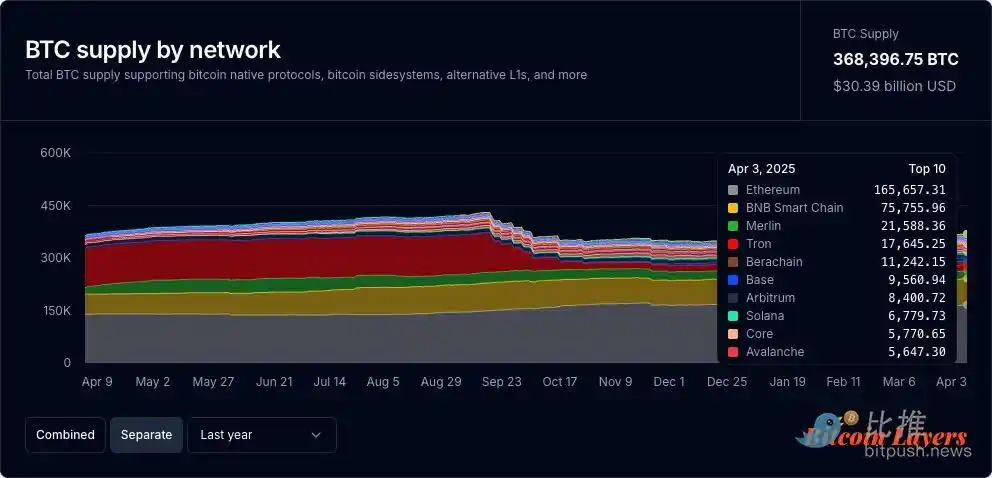
Bitcoin Layers: BTC supply segmented by network, showing all wrapped BTC
Ethereum's DeFi ecosystem has seen the emergence of tools for lending, staking, and trading. In contrast, native Bitcoin still struggles to be effectively utilized, especially for new users. Transaction times are slow, fees are variable and often high, and Bitcoin's architecture lacks the programmability to support applications built on Ethereum.
As the broader cryptocurrency space matures, an important question arises: can Bitcoin meaningfully participate in the on-chain economy? If so, how can we onboard users without requiring ordinary BTC holders to go through a series of bridges, wrapped tokens, and unfamiliar applications to join in?
Issue: Bitcoin's Design and DeFi's Practicality
Bitcoin's underlying architecture was not optimized for the high programmability of today's smart contracts. Its security and decentralization are prioritized through a Proof of Work (PoW) mechanism rather than aiming for complex logic expression—this design choice has made it a reliable store of value tool but has also limited its adaptability in smart contracts and complex DeFi applications. Therefore, native Bitcoin has struggled to integrate into the thriving composable financial ecosystem on chains like Ethereum and Solana.
In the past, we have seen some workarounds:
· Bitcoin Wrapping: Users convert BTC into ERC-20 tokens to access Ethereum-based DeFi. This introduces custody risks as token liquidity may not be transparent and may not always be 1:1 backed by BTC by third-party custodians.
· Bridging Protocols: Cross-chain platforms allow BTC to move into other ecosystems. However, manual bridging introduces friction, complexity, and risk—especially for non-technical users.
· Custodial Platforms: Centralized services like Coinbase offer BTC yields but require users to give up custody and typically pay returns in tokens, stablecoins, or proprietary tokens instead of BTC.
Each option comes with trade-offs that challenge Bitcoin's core principles: security, simplicity, and user sovereignty.
Entry Barrier: Why User Experience Still Matters
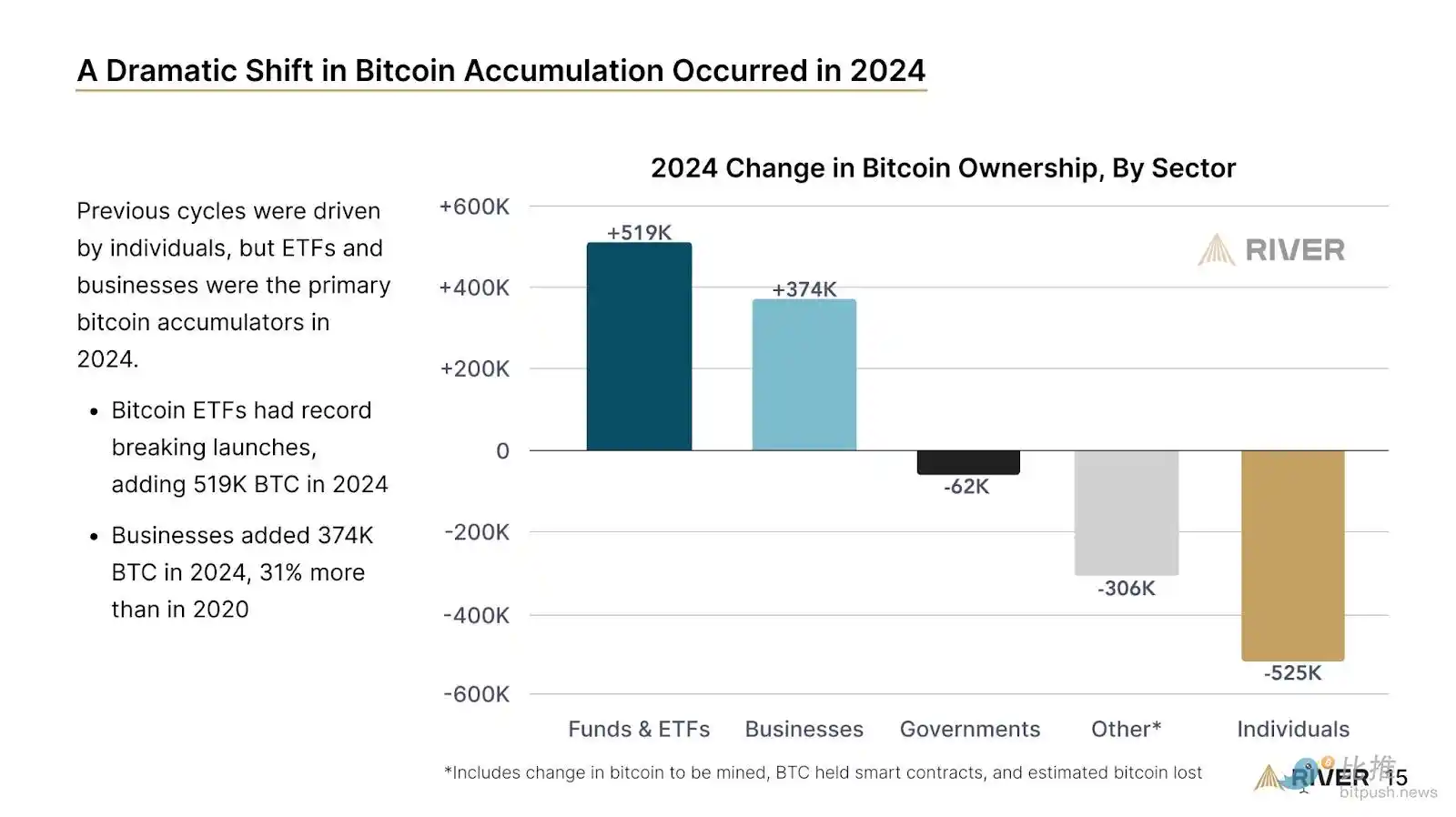
2024 Bitcoin Accumulation, river.com
For Bitcoin holders curious about doing more with their assets (earning yield, participating in on-chain governance, or trying DeFi), the onboarding process remains fragmented, non-intuitive, and often daunting. While the infrastructure has matured, the user experience still lags behind, with competitors not only being other blockchains but also TradFi.
This friction has created a significant entry barrier. Most users do not want to become power users of DeFi—they seek to simply and securely increase their net worth and BTC holdings without venturing into the maze of applications, bridges, and protocols like recent Bitcoin buyers who made large off-chain purchases through brokers, ETFs, and products like Michael Saylor's Strategy.
In order to transition the next wave of users from simple off-chain holders to on-chain users, tools need to eliminate this complexity while not sacrificing control, self-custody, or transparency. This is where emerging protocols and modern wallet experiences truly come into play—providing user-friendly DeFi foundational access while maintaining Bitcoin's core principles.
A better user experience is not just icing on the cake; it is key infrastructure for Bitcoin adoption's next stage.
A New Approach to On-Chain BTC Yield and Productivity
Many emerging solutions aim to make Bitcoin more user-friendly in DeFi—each with its own trade-offs:
1. Staking, Re-Staking, and Point-based Yield Programs
Platforms like Babylon and Lombard now offer Bitcoin-related yield programs through points or reward tokens, usually achieved through staking/restaking, which can often be redeemed for perks or future airdrops. These systems appeal to early adopters and chase airdrops, as well as crypto-native users of platform-specific tokenomics. These products often involve converting BTC to wrapped BTC standards, then locking assets in various plans/products to earn variable yields. For savvy on-chain traders, high yields can be obtained, but this requires a deeper understanding of cryptocurrency usage, as well as manual bridging, wrapping, and depositing of funds.
Pros:
· Broad range of yield opportunities
· Usually self-custody
Cons:
· Rewards not paid in BTC
· Typically involves lockup periods
· Long-term value of rewards is uncertain
2. Bitcoin Layer 2 and Meta protocols
Developments like the Lightning Network, Rootstock (RSK), Alkanes, and emerging Layer 2 innovations like Botanix and Starknet are bringing new features, programmability, and speed to Bitcoin. These innovations enable use cases like fast payments, NFTs, and smart contract-like behaviors. As a result, users can now use their BTC to access a wide range of DeFi opportunities—such as securing networks through asset locking, participating in liquidity provision, borrowing, or asset conversion to support various protocols' wrapped BTC standards. As more teams build out these networks, the ecosystem of Bitcoin-based yield opportunities will continue to expand.
Pros:
· Expands Bitcoin's use cases
· Maintains consistency with Bitcoin's architecture
· Wide range of on-chain earning opportunities
Cons:
· Still relatively early and decentralized
· Requires intermediate to advanced understanding to leverage
· Requires significant developer resources to build out much of what already exists on other smart contract chains
3. Smart Wallet Integration and Native BTC Earnings
Wallets like Braavos provide features that allow users to earn native BTC rewards without manually wrapping their Bitcoin or giving up custody. Users can directly invest BTC through their wallet without dealing with the typical bridging or usage of external applications. Complex steps such as depositing, wrapping, and bridging are seamlessly handled in the background, with BTC being deployed into specific DeFi strategies. This user-friendly approach aims to make BTC earnings accessible to everyone, regardless of their technical background or cryptocurrency experience.
Pros:
· Earnings paid in BTC (not in points or proxy tokens)
· No need for manual bridging or third-party custody
· Self-custody by default
· Beginner-friendly
Cons:
· Relies on converting to wrapped BTC
· Requires some trust in the bridging mechanism and earnings protocol infrastructure
· Larger picture: Bitcoin's evolving role on-chain
The narrative around Bitcoin has long revolved around "store of value"—a role it has reliably fulfilled. However, as the on-chain economy develops, the pressure on Bitcoin to integrate into this emerging financial stack and fulfill its promise as a reliable payment infrastructure is increasing.
In order to achieve this without compromising decentralization or user trust, new infrastructure must make these opportunities easily accessible without requiring technical expertise or compromising Bitcoin's core principles.
This means:
· Earnings should prioritize being paid in BTC rather than derivative assets
· Custody must be reserved for the user
· Complexity must be abstracted, not transferred to the user
Products like Braavos, Lombard, Babylon, and others mentioned in this article are examples of how these ideas are implemented. Whether through staking to earn user rewards or by directly embedding Bitcoin backing into self-custody options and automating the complexity behind it, they make it easier for Bitcoin holders to access DeFi without having to fully exit the Bitcoin ecosystem.
Bridging the Gap Thoughtfully
The transition of Bitcoin to an on-chain economy will not happen overnight—and it shouldn't. Prudence, simplicity, and self-sovereignty are the cornerstone of Bitcoin's core principles. However, as more tools that respect these values and provide new functionalities emerge, BTC's role in the broader cryptocurrency economy is evolving.
The current challenge is to build an open, secure, and most importantly—an accessible system. If the next billion users are to come on board through Bitcoin, they will need to meet their existing needs and be part of an experience that is acceptable to a wider user base.
You may also like

PUMP Valuation Breakdown: On-chain Data Disproves the "Fake Volume" Theory, Where Does the Real Discount Come From?

Tiger Research: What AI services do cryptocurrency companies offer?

The war not only drives up oil prices but also causes Circle's stock price to soar

When agents become consumers, who will rewrite the underlying logic of internet commerce?

AI Agents in Action Summit: March 31, Hong Kong Cyberport, focusing on the deep waters of AI implementation

29 Days In, What Are America’s Options on Iran?

Flash Crash Down 97%+ with Ongoing Unlocking, WLD Completes $65 Million Off-chain Funding: Who Is Still Buying?

Bitcoin for Real Estate? Fannie Mae Teams Up with Coinbase to Launch Crypto Mortgage
Tether Hires Big Four Auditor, USDT Enters First Attestation Phase

Google AI Paper Destroys $900B Storage Stock, Accused of Faking Experiment
Evaporate $2 Trillion, U.S. Stocks See Worst Start in 4 Years, Why is the Market Bearish?

The speed at which AI discovers vulnerabilities has surpassed the speed at which it patches vulnerabilities.

AI Crypto Trading Bot Explained: Aurora's Multi-Factor Strategy in WEEX Hackathon
Aurora demonstrates how structured, multi-agent AI Trading systems can deliver more adaptive and resilient performance in the WEEX AI Trading Hackathon.

Cyber Taoist Fortune Teller: Fake Taoist, AI Fortune Telling, and Northeastern Metaphysics History

Bloomberg: Stablecoin Payments Emerge as Crypto VC's Newest Favorite Thing
BeatSwap is evolving towards a full-stack Web3 infrastructure, covering the entire lifecycle of IP rights.
BeatSwap, a global Web3 Intellectual Property (IP) infrastructure project, is attempting to overcome the current fragmentation limitations of the Web3 ecosystem, building a full-stack system that covers the entire lifecycle of IP rights.
Currently, most Web3 projects are still in the stage of functional fragmentation, often focusing only on a single aspect, such as IP asset tokenization, transaction functionality, or a simple incentive model. This structural dispersion has become a key bottleneck hindering the industry's scale application.
BeatSwap's approach is more integrated, integrating multiple core modules into the same system, including:
· IP authentication and on-chain registration
· Authorization-based revenue sharing mechanism
· User-engagement-driven incentive system
· Transaction and liquidity infrastructure
Through the above integration, the platform builds an end-to-end closed-loop path, allowing IP rights to complete a full cycle of "creation, use, and monetization" within the same ecosystem.
BeatSwap is not limited to existing crypto users but is attempting to take the global music industry as a starting point, actively creating new market demand. Its core strategies include:
Exploring and incubating music creators (Artist discovery)
Building a fan community
Igniting IP-centric content consumption demand
The current global music industry is valued at around $260 billion, with over 2 billion digital music users. This means that the potential market corresponding to the tokenization and financialization of IP far exceeds the traditional crypto user base.
In this context, BeatSwap positions itself at the intersection of "real-world content demand" and "on-chain infrastructure," attempting to bridge the structural gap between content production and financial flow.
BeatSwap's upcoming core product "Space" is scheduled to launch in the second quarter of 2026. This product is defined as the SocialFi layer in the ecosystem, aiming to directly connect creators with users and achieve deep integration with other platform modules.
Key designs include:
A fan-centric interactive mechanism
Exposure and distribution logic based on $BTX staking
User paths connected to DeFi and liquidity structures
Thus, a complete user behavior loop is formed within the platform: Discovery → Participation → Consumption → Rewards → Trading
$BTX is designed to be a core utility asset within the ecosystem, rather than just a simple incentive token, with its value directly tied to platform activity and IP use cases.
Main features include:
· Yield distribution based on on-chain authorized actions
· Value reflection based on IP usage and user engagement dynamics
· Support for staking and DeFi participation mechanisms
· Value growth driven by ecosystem expansion
With the increased frequency of IP use, the utility and value support of $BTX will enhance simultaneously, helping alleviate the "disconnect between value and utility" issue present in traditional Web3 token models to some extent.
Currently, $BTX has been listed on several mainstream exchanges, including:
Binance Alpha
Gate
MEXC
OKX Boost
As the launch of "Space" approaches, BeatSwap is actively pursuing more exchange listings to further enhance liquidity and global accessibility, laying a foundation for future market expansion.
BeatSwap's goal is no longer limited to the traditional Web3 narrative but aims to target over 2 billion digital music users and a trillion KRW-scale content market.
By integrating content creators, users, capital, and liquidity into a blockchain framework centered around IP rights, BeatSwap is striving to build a next-generation infrastructure focused on "IP tokenization."
BeatSwap integrates IP authentication, authorization distribution, incentive mechanism, transaction system, and market construction to establish a unified structure that bridges the full lifecycle path of IP rights.
With the launch of the Q2 2026 "Space," the project is expected to become a key infrastructure connecting content and finance in the IP-RWA (Real World Assets) track.

Mag 7 Evaporates $2 Trillion | Rewire News Morning Edition



 App
App