
Coin Metrics: Why Has Bitcoin's Current Cycle Been Extended?



Data Source: Coin Metrics Network Data Pro
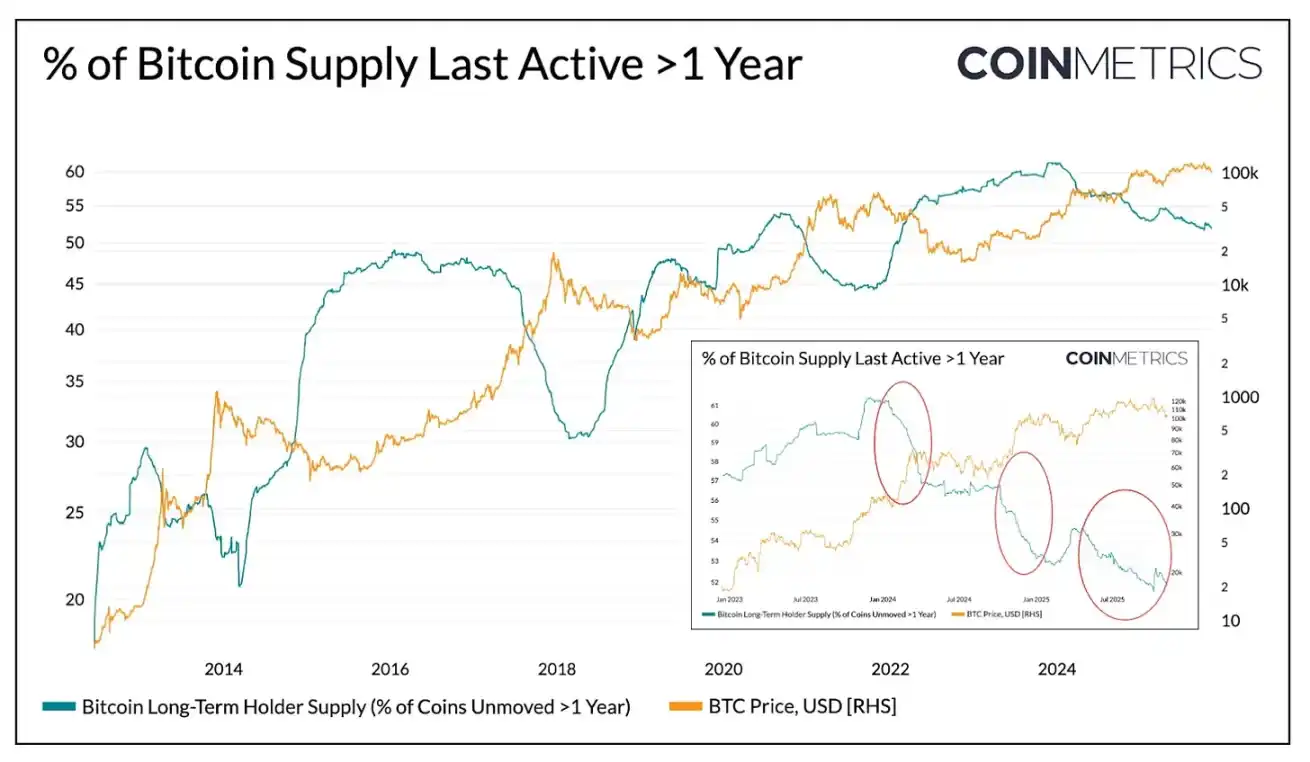
As of now, out of the 19.94 million circulating bitcoins, approximately 52% of the tokens have not moved in over a year, lower than the 61% figure at the beginning of 2024. Whether it is the growth rate during the bear market or the decline rate during the bull market, both have significantly leveled off. Batching of transactions has been observed in the first quarter of 2024, the third quarter of 2024, and recently in 2025. This indicates that long-term holders are selling their tokens in a more sustained manner, reflecting an extension of the ownership transfer cycle.
ETF and DAT: Core Drivers of Demand
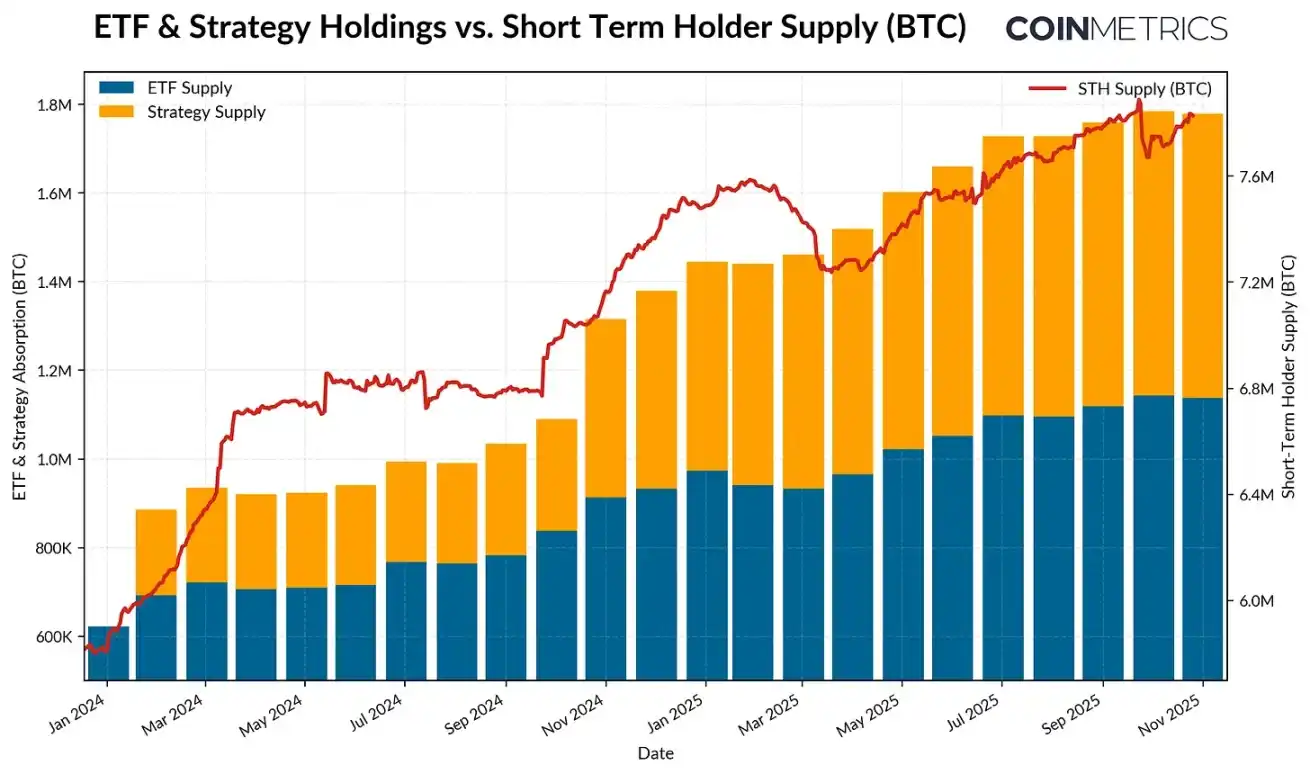
In contrast, since 2024, the supply of short-term holders (tokens active in the past year) has been steadily increasing, as previously dormant tokens re-enter circulation. Meanwhile, with the launch of spot Bitcoin ETFs and the accelerated accumulation pace of Digital Asset Treasury (DAT), new and sustained demand has emerged, absorbing the supply distributed by long-term holders.
As of November 2025, the number of bitcoins active in the past year is 7.83 million, a 34% increase from the 5.86 million in early 2024 (dormant tokens re-circulating). During the same period, the holdings of spot Bitcoin ETFs and Strategies grew from approximately 600,000 bitcoins to 1.9 million bitcoins, representing almost 57% of the net increase in supply from short-term holders. Currently, these two channels together account for about 23% of the short-term holder supply.
Despite a recent slowdown in inflows over the past few weeks, the overall trend indicates that supply is gradually shifting towards more stable, long-term holding channels, which is a unique feature of the market structure in this cycle.
Data Source: Coin Metrics Network Data Pro & Bitbo Treasuries; Note: ETF supply does not include Fidelity FBTC, DAT supply includes Strategy
Short-Term and Long-Term Holder Behavior
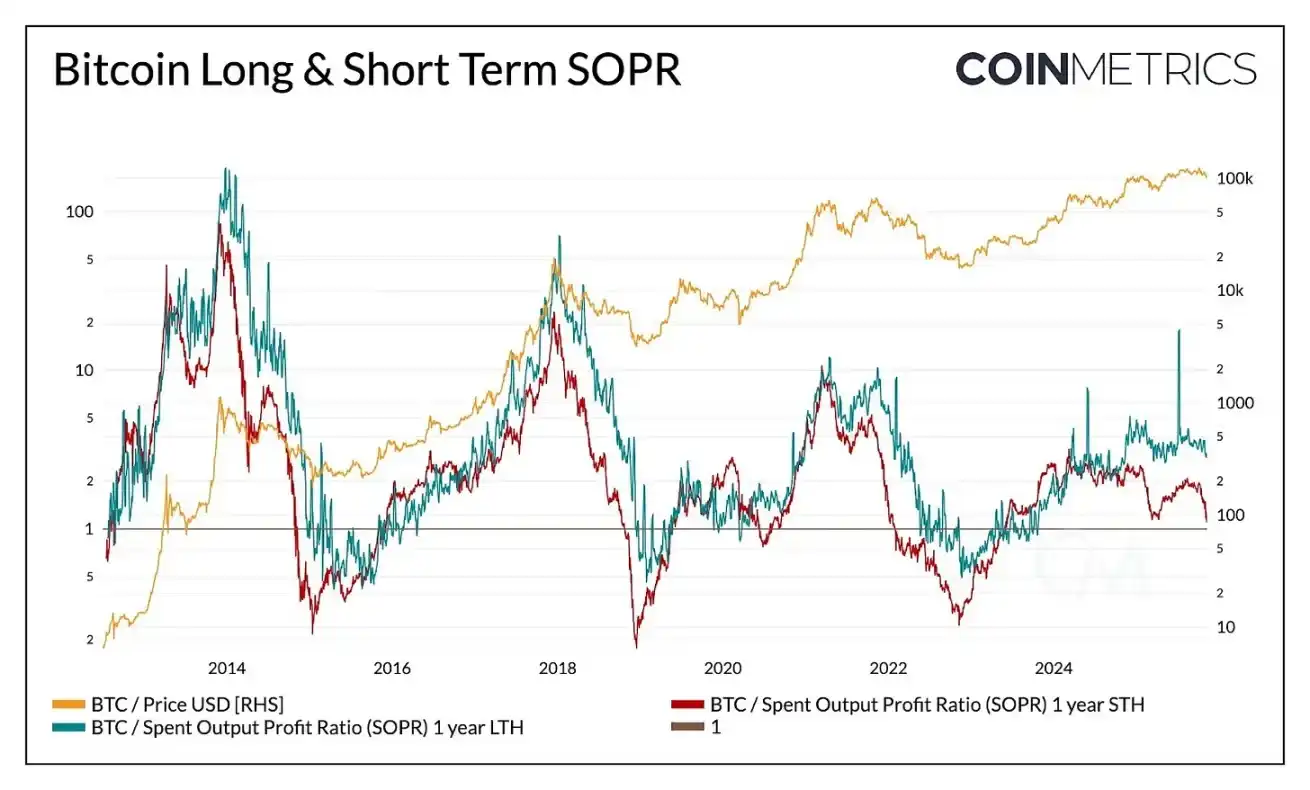
The actual profit trend further confirms the gradual nature of Bitcoin's supply dynamics. The Spent Output Profit Ratio (SOPR) is used to measure whether holders are selling their tokens at a profit or loss, providing a clear reflection of different holder groups' behavior patterns throughout the market cycle.
In past cycles, both long-term and short-term holders' profit-taking behaviors often exhibited intense, synchronized fluctuations. However, recently, this relationship has diverged: the SOPR for long-term holders remains slightly above 1, indicating a steady realization of profits and moderate selling at peaks.
Data Source: Coin Metrics Network Data Pro
The SOPR for short-term holders hovers around the breakeven line, explaining the recent cautious market sentiment as many short-term holders' positions are near their cost basis. The divergence in behavior between these two holder types reflects the market's current state of greater stability: institutional demand has absorbed the supply distributed by long-term holders, moving away from the extreme volatility of the past. If the SOPR for short-term holders continues to surpass 1, it could signify a strengthening market momentum.
While a significant retracement would still compress the profit-taking ability of all holder groups, the overall pattern indicates a more balanced market structure: supply turnover and profit realization are gradually advancing, extending Bitcoin's cycle rhythm.
Bitcoin Volatility Decline
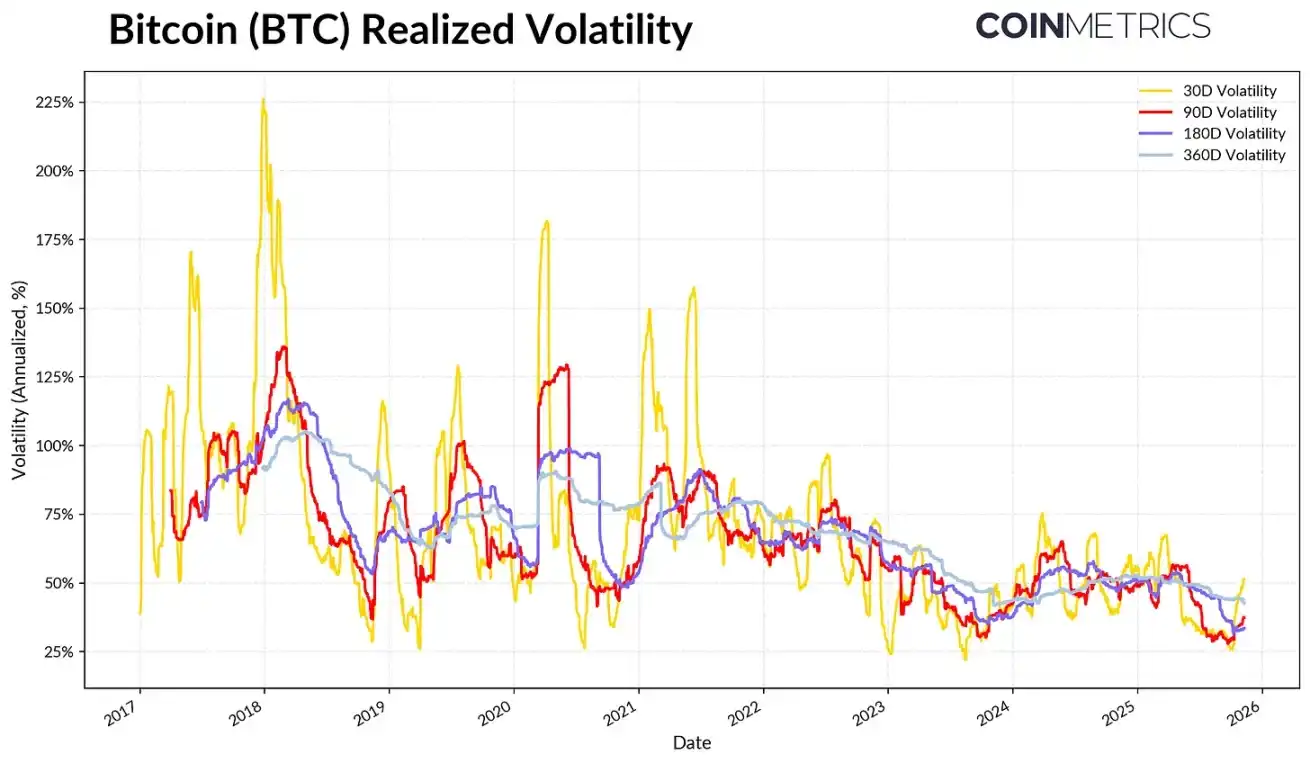
This structural stability is also reflected in Bitcoin's volatility, which has been on a downward trend. Currently, Bitcoin's 30-day, 60-day, 180-day, and 360-day actual volatility remains stable around 45%-50%, whereas its volatility in the past was often explosive, leading to significant market fluctuations. Now, Bitcoin's volatility characteristics are increasingly resembling those of large-cap tech stocks, indicating its maturation as an asset. This not only reflects improved liquidity but also underscores that institutional investors are becoming a major force in the market.
For asset allocators, a decline in volatility may enhance Bitcoin's attractiveness in portfolios, especially as its correlation with macro assets like stocks and gold continues to evolve.
Data Source: Coin Metrics Market Data Pro
Conclusion
The on-chain trends of Bitcoin indicate that this current cycle is progressing in a smoother, longer phase, without the frenzied parabolic price action seen in previous bull markets. Long-term holders are gradually offloading their holdings, with much of it being absorbed by more sustainable demand channels such as ETFs, DCA, and broader institutional holdings. This shift signifies a maturing market structure: decreased volatility and circulation velocity, along with extended cycles.
Nevertheless, market momentum still hinges on the sustainability of demand. ETF fund inflows plateauing, some DCAs facing pressure, recent market-wide liquidation events, and short-term holder SOPR hovering around breakeven levels highlight a market in a phase of readjustment. Rising supply held by long-term holders (tokens unmoved for over a year), SOPR breaking above 1, inflows into spot Bitcoin ETFs and stablecoins could all be key signals for the resurgence of market momentum.
Looking ahead, a reduction in macro uncertainties, improved liquidity conditions, and regulatory progress related to market structure could reignite fund inflows and prolong the bull market cycle. Despite a cooling of market sentiment, after a recent deleveraging adjustment, with the support of institutional expansion and on-chain infrastructure advancement, the market fundamentals are stronger.
You may also like

Argentina vs Cape Verde: When a Record-Breaking Legend Meets an Unbreakable Underdog
WEEX exclusive pre-match analysis of Argentina vs Cape Verde, exploring Messi-led Argentina’s dominance and Cape Verde’s historic defensive breakout, with a breakdown of volatility, structure, and match dynamics.
How does Gate redo "buying and selling stocks" from the cryptocurrency world to the stock market?
Former ByteDance employee's account: How I started with two Pinduoduo hard drives and made six times the profit with Seagate to achieve financial freedom?
Visa and Mastercard join 140 giants to launch a new stablecoin, but the impact on the market landscape may still be limited
WEEX Launches Depth Chart for Spot Trading
MiCA reshuffle begins, Binance temporarily bids farewell to the EU
Raising interest rates to protect STRC and selling coins to maintain credit, this time the strategy has chosen the two most expensive paths
Morning Report | Samsung announces a 265.5 trillion won investment plan, focusing on semiconductor and AI computing power data centers; Vitalik publishes an article detailing the entire technology tree behind the confusion protocol (iO) mainline
In the era of AI, what is left of Bitcoin?
NeoSoul announced plans to integrate with the OKX Agentic Wallet, promoting AI agents' participation in the on-chain economy
Why Is Bitcoin Lagging Stocks in 2026? AI Stocks, ETF Outflows, and the Nasdaq Rally Explained
What you bought on CEX is really not US stocks: Analyzing the 94% liquidation monopoly and the evaporation of equity under a five-layer pipeline
In such a crowded cross-border payment arena, where is the next stop for the future?
Why Is Bitcoin Down in 2026? What We Can Learn From 2022
The large models in the United States are moving towards closure in the name of security
From the white-haired stock god to the billionaire fund mogul, the smart people shorting Nvidia are all getting rich using the same framework
Morning Report | CoinEx becomes a key hub for Iran to evade sanctions, involving over $3.8 billion in funds; Kalshi seeks a new round of financing, with a valuation potentially rising to $40 billion
Global Launch: As predictions become the most scarce asset in the AI era, Manadia is defining the next generation of the value internet
Argentina vs Cape Verde: When a Record-Breaking Legend Meets an Unbreakable Underdog
WEEX exclusive pre-match analysis of Argentina vs Cape Verde, exploring Messi-led Argentina’s dominance and Cape Verde’s historic defensive breakout, with a breakdown of volatility, structure, and match dynamics.
How does Gate redo "buying and selling stocks" from the cryptocurrency world to the stock market?
Former ByteDance employee's account: How I started with two Pinduoduo hard drives and made six times the profit with Seagate to achieve financial freedom?
Visa and Mastercard join 140 giants to launch a new stablecoin, but the impact on the market landscape may still be limited
WEEX Launches Depth Chart for Spot Trading
MiCA reshuffle begins, Binance temporarily bids farewell to the EU