
 Buy Crypto
- Markets
 Futures
- Spot
- Copy Trade
- Earn
- More
Contrarian Breakthrough: Who Is Quietly Leading the Exchange Platform Token Race?

Source: Cointelegraph
Reporter: Eva Xiang

Recently, the global cryptocurrency market has experienced significant volatility and adjustment, with most assets facing downward pressure. However, in the niche track of native tokens issued by mainstream exchanges, we have observed significant performance divergence. Among them, Gate.io's native token GateToken (GT) has demonstrated remarkable relative strength, becoming the focus of market attention.
1. Data Comparison: GT's Price Increase Takes the Lead Among Mainstream Exchange Tokens
The most intuitive way to measure asset performance is through price trends. According to public data, in the past 90 days, the performance of several major exchange tokens has shown significant differences:
GateToken (GT): Achieved a price increase of approximately +20.68%
OKX Token (OKB): Recorded a price increase of approximately +10.5%
Binance Coin (BNB): Experienced a price decrease of approximately -19.05%
Bitget Token (BGB): Underwent a significant decline of approximately -35.53%
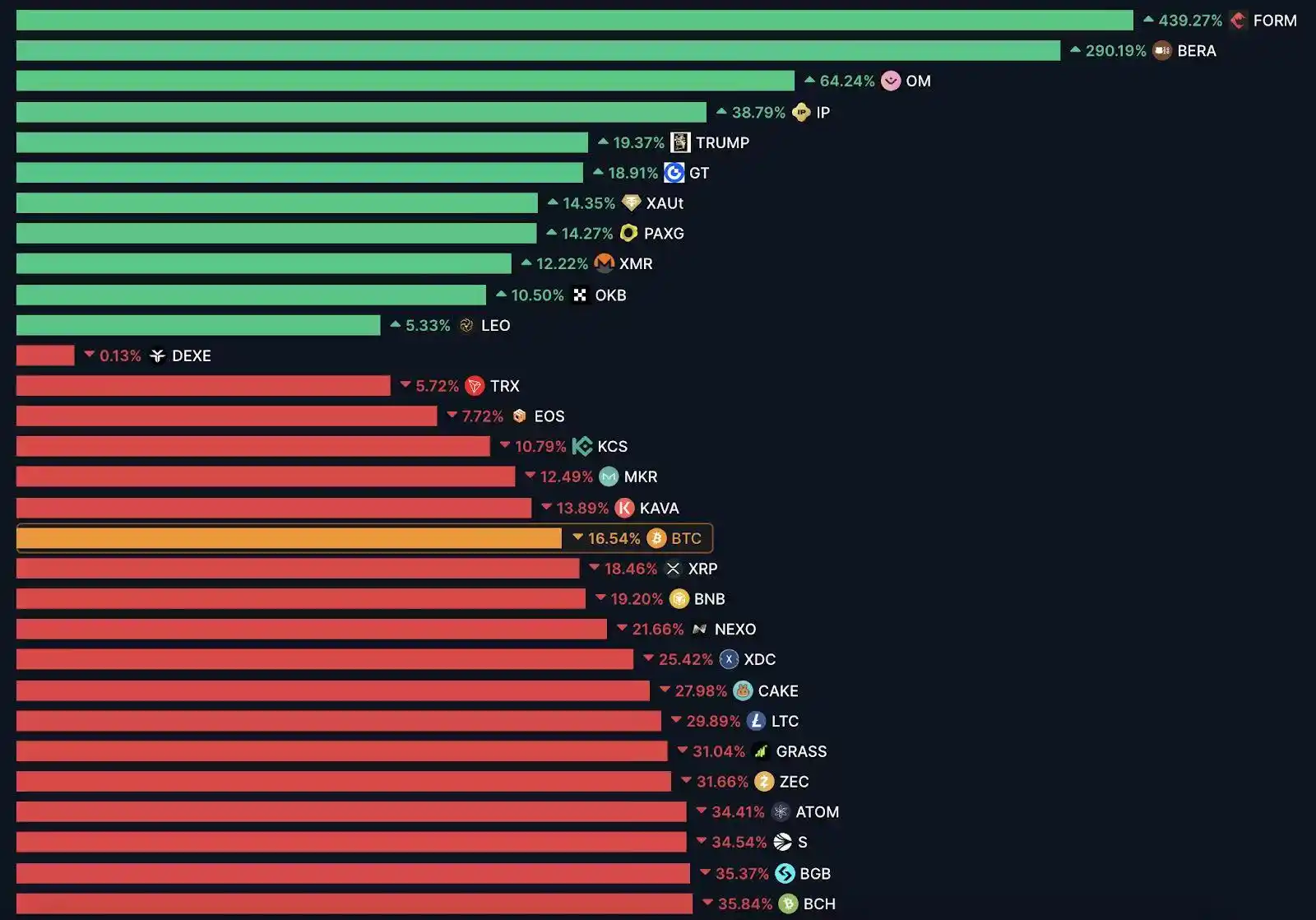
This set of data clearly outlines the recent landscape of the exchange token market: in the same market cycle and macro environment, GT not only achieved positive growth but also surpassed the modest increase of OKB significantly, standing in stark contrast to the sharp declines of BNB and BGB. With a price increase of over 20%, GT undoubtedly takes the lead among mainstream exchange tokens, and its relative strength is particularly prominent in the current market environment.
2. Analysis of GT's Competitive Advantages: Why Can It Stand Out in a Correcting Market?
For GT to achieve such a remarkable price increase amid a market-wide correction, there must be factors supporting its competitive advantage. Although the value proposition of exchange tokens is complex and diverse, it is usually closely related to the following points, and GT may have demonstrated unique strengths in these areas:
1. Market Confidence and Platform Expectations: The price of a platform token is often a barometer of the market's confidence and expectations for the exchange's future development. The contra-market rise of GT may partially reflect market participants' recognition of Gate.io's long-term stable operation, continuous innovation capabilities, and user base growth. During market downturns, funds tend to gravitate towards assets with a greater safety margin or growth potential. GT's performance may be a manifestation of this risk-averse or value discovery sentiment.
2. Intrinsic Economic Model and Supply-Demand Dynamics: GT has a relatively sound deflationary mechanism (such as using a portion of platform revenue for buyback and burn) and diverse use cases (e.g., fee discounts, Startup participation rights, GateChain fuel, etc.). These mechanisms may provide GT with a more solid value foundation and internal demand during market fluctuations, making its supply-demand dynamics relatively healthier compared to some competitors, thereby demonstrating stronger resilience to price declines and even the ability to rise against the trend.
3. Valuation and Market Positioning: Compared to some platform tokens with already substantial market capitalization, GT may still be in a relatively undervalued position or in a growth period, offering greater elasticity and space for market cap growth. During market rotations or in search of new growth points, some funds may flow from assets with high valuations to targets like GT that exhibit strong growth momentum and have a relatively moderate market cap.
4. User Stickiness and Community Consensus: An active and loyal user community is crucial for the stability of a platform token's value. The user base Gate.io has accumulated over the long term, along with the community consensus formed around GT, may act as stabilizers when market panic spreads, with holders more inclined to long-term holding rather than panic selling.
It is important to emphasize that the above analysis is based on the general market trends and publicly available information about GT, and the specific reasons may be the result of multiple overlapping factors. However, GT's excellent performance does indeed indicate some of its distinctive competitive advantages in the current market environment.
Three, Dollar-Cost Averaging Perspective: Why is GT More Worthy of Attention?
For long-term investors, choosing the right target is crucial. The core logic of dollar-cost averaging is to buy in batches at different market stages to smooth out costs and share in long-term growth. When choosing targets for dollar-cost averaging, factors such as the asset's long-term potential, risk resistance, and performance in market downturns are all important considerations.
From recent performance, GT has exhibited several qualities that are worth attention from dollar-cost averaging investors:
1. Bear Market Resilience: As shown in the previous data, GT demonstrated significant anti-downtrend and even counter-trend abilities during an overall market downturn. This indicates that its value support is relatively robust and can better protect portfolio value in extreme market conditions. For dollar-cost averaging, this means that chips accumulated in the bottom range of the market may have a higher safety margin and future rebound potential.
2. Relative Strength: Compared to platform coins such as BNB and BGB, which experienced significant declines during the same period, GT's strong performance itself is a signal. Investing funds into relatively stronger assets theoretically allows for faster value recovery and growth when the market heats up. GT's recent leadership trend makes it a notable choice among similar assets.
3. Growth Potential: While past performance is not indicative of the future, GT's continued value capture ability (through its economic model and use cases) and the development potential of the Gate.io platform have laid the foundation for its long-term value growth. Dollar-cost averaging is an effective strategy to capture this long-term value growth.
Of course, any investment decision should be based on comprehensive research and risk assessment. Dollar-cost averaging GT also faces multiple risks such as market volatility, regulatory policy changes, and platform operational risks. However, it is undeniable that based on market data and performance in the past 90 days, GT has indeed exhibited greater resilience and attractiveness compared to some mainstream platform coins, making it an option worth considering for dollar-cost averaging.
Finally:
In the recent cryptocurrency market correction, GateToken (GT) stood out among mainstream platform coins with a 90-day gain of over 20%, outperforming OKB, BNB, and BGB. This differentiated market performance may stem from market confidence in the Gate.io platform, GT's robust economic model and supply-demand dynamics, relatively reasonable valuation, and strong community consensus, among other factors. For investors adopting a dollar-cost averaging strategy, GT's demonstrated bear market resilience and relative strength make it a target worth closely monitoring and researching. In a market full of uncertainty, GT's impressive data provides a clear case study of value and resilience.
Related Recommended: Gate.io Founder Dr. Han: New Tariff Policy Can Be Seen as an Opportunity to Promote the Upgrade and Long-term Development of the Crypto Industry
This article is a contribution and does not represent the views of BlockBeats.
You may also like

Cyber Taoist Fortune Teller: Fake Taoist, AI Fortune Telling, and Northeastern Metaphysics History

Bloomberg: Stablecoin Payments Emerge as Crypto VC's Newest Favorite Thing
BeatSwap is evolving towards a full-stack Web3 infrastructure, covering the entire lifecycle of IP rights.
BeatSwap, a global Web3 Intellectual Property (IP) infrastructure project, is attempting to overcome the current fragmentation limitations of the Web3 ecosystem, building a full-stack system that covers the entire lifecycle of IP rights.
Currently, most Web3 projects are still in the stage of functional fragmentation, often focusing only on a single aspect, such as IP asset tokenization, transaction functionality, or a simple incentive model. This structural dispersion has become a key bottleneck hindering the industry's scale application.
BeatSwap's approach is more integrated, integrating multiple core modules into the same system, including:
· IP authentication and on-chain registration
· Authorization-based revenue sharing mechanism
· User-engagement-driven incentive system
· Transaction and liquidity infrastructure
Through the above integration, the platform builds an end-to-end closed-loop path, allowing IP rights to complete a full cycle of "creation, use, and monetization" within the same ecosystem.
BeatSwap is not limited to existing crypto users but is attempting to take the global music industry as a starting point, actively creating new market demand. Its core strategies include:
Exploring and incubating music creators (Artist discovery)
Building a fan community
Igniting IP-centric content consumption demand
The current global music industry is valued at around $260 billion, with over 2 billion digital music users. This means that the potential market corresponding to the tokenization and financialization of IP far exceeds the traditional crypto user base.
In this context, BeatSwap positions itself at the intersection of "real-world content demand" and "on-chain infrastructure," attempting to bridge the structural gap between content production and financial flow.
BeatSwap's upcoming core product "Space" is scheduled to launch in the second quarter of 2026. This product is defined as the SocialFi layer in the ecosystem, aiming to directly connect creators with users and achieve deep integration with other platform modules.
Key designs include:
A fan-centric interactive mechanism
Exposure and distribution logic based on $BTX staking
User paths connected to DeFi and liquidity structures
Thus, a complete user behavior loop is formed within the platform: Discovery → Participation → Consumption → Rewards → Trading
$BTX is designed to be a core utility asset within the ecosystem, rather than just a simple incentive token, with its value directly tied to platform activity and IP use cases.
Main features include:
· Yield distribution based on on-chain authorized actions
· Value reflection based on IP usage and user engagement dynamics
· Support for staking and DeFi participation mechanisms
· Value growth driven by ecosystem expansion
With the increased frequency of IP use, the utility and value support of $BTX will enhance simultaneously, helping alleviate the "disconnect between value and utility" issue present in traditional Web3 token models to some extent.
Currently, $BTX has been listed on several mainstream exchanges, including:
Binance Alpha
Gate
MEXC
OKX Boost
As the launch of "Space" approaches, BeatSwap is actively pursuing more exchange listings to further enhance liquidity and global accessibility, laying a foundation for future market expansion.
BeatSwap's goal is no longer limited to the traditional Web3 narrative but aims to target over 2 billion digital music users and a trillion KRW-scale content market.
By integrating content creators, users, capital, and liquidity into a blockchain framework centered around IP rights, BeatSwap is striving to build a next-generation infrastructure focused on "IP tokenization."
BeatSwap integrates IP authentication, authorization distribution, incentive mechanism, transaction system, and market construction to establish a unified structure that bridges the full lifecycle path of IP rights.
With the launch of the Q2 2026 "Space," the project is expected to become a key infrastructure connecting content and finance in the IP-RWA (Real World Assets) track.

Mag 7 Evaporates $2 Trillion | Rewire News Morning Edition

Losing $19K per Coin Mined, Bitcoin Mining Firms Collective AI Defection

Morning Report | Tom Lee predicts that the cryptocurrency winter will end in April; xStocks introduces a new on-chain private equity fund; Sui mainnet upgraded to V1.68.1

Polymarket rules have changed, how should airdrop participants respond?

Crypto ETF Weekly | Last week, the net outflow of Bitcoin spot ETFs in the U.S. was $296 million; the net outflow of Ethereum spot ETFs in the U.S. was $206 million

This Week's Key News Preview | The U.S. Releases March Non-Farm Payroll Data; Polymarket Expands Fee Structure

Slow Down, That's the Answer to the Age of the Agent

From Cash to Cryptocurrency: Moving Towards a Unified Regulatory Path for Illegal Payments
Who will own the most Bitcoin in 2026

A private feud lasting 10 years, if not for OpenAI's "hypocrisy," would not have led to the world's strongest AI company, Anthropic

"Crypto Tsar" steps down: 130 days of political performance come to an end, how much of Trump's crypto promise remains?

From Utopian Narratives to Financial Infrastructure: The "Disenchantment" and Shift of Crypto VC
A decade-long personal feud, if not for OpenAI's "hypocrisy," there would be no globally leading AI company Anthropic

a16z: The True Meaning of Strong Chain Quality, Block Space Should Not Be Monopolized
a16z: The True Meaning of Strong Chain Quality, Block Space Should Not Be Monopolized
Cyber Taoist Fortune Teller: Fake Taoist, AI Fortune Telling, and Northeastern Metaphysics History
Bloomberg: Stablecoin Payments Emerge as Crypto VC's Newest Favorite Thing
BeatSwap is evolving towards a full-stack Web3 infrastructure, covering the entire lifecycle of IP rights.
BeatSwap, a global Web3 Intellectual Property (IP) infrastructure project, is attempting to overcome the current fragmentation limitations of the Web3 ecosystem, building a full-stack system that covers the entire lifecycle of IP rights.
Currently, most Web3 projects are still in the stage of functional fragmentation, often focusing only on a single aspect, such as IP asset tokenization, transaction functionality, or a simple incentive model. This structural dispersion has become a key bottleneck hindering the industry's scale application.
BeatSwap's approach is more integrated, integrating multiple core modules into the same system, including:
· IP authentication and on-chain registration
· Authorization-based revenue sharing mechanism
· User-engagement-driven incentive system
· Transaction and liquidity infrastructure
Through the above integration, the platform builds an end-to-end closed-loop path, allowing IP rights to complete a full cycle of "creation, use, and monetization" within the same ecosystem.
BeatSwap is not limited to existing crypto users but is attempting to take the global music industry as a starting point, actively creating new market demand. Its core strategies include:
Exploring and incubating music creators (Artist discovery)
Building a fan community
Igniting IP-centric content consumption demand
The current global music industry is valued at around $260 billion, with over 2 billion digital music users. This means that the potential market corresponding to the tokenization and financialization of IP far exceeds the traditional crypto user base.
In this context, BeatSwap positions itself at the intersection of "real-world content demand" and "on-chain infrastructure," attempting to bridge the structural gap between content production and financial flow.
BeatSwap's upcoming core product "Space" is scheduled to launch in the second quarter of 2026. This product is defined as the SocialFi layer in the ecosystem, aiming to directly connect creators with users and achieve deep integration with other platform modules.
Key designs include:
A fan-centric interactive mechanism
Exposure and distribution logic based on $BTX staking
User paths connected to DeFi and liquidity structures
Thus, a complete user behavior loop is formed within the platform: Discovery → Participation → Consumption → Rewards → Trading
$BTX is designed to be a core utility asset within the ecosystem, rather than just a simple incentive token, with its value directly tied to platform activity and IP use cases.
Main features include:
· Yield distribution based on on-chain authorized actions
· Value reflection based on IP usage and user engagement dynamics
· Support for staking and DeFi participation mechanisms
· Value growth driven by ecosystem expansion
With the increased frequency of IP use, the utility and value support of $BTX will enhance simultaneously, helping alleviate the "disconnect between value and utility" issue present in traditional Web3 token models to some extent.
Currently, $BTX has been listed on several mainstream exchanges, including:
Binance Alpha
Gate
MEXC
OKX Boost
As the launch of "Space" approaches, BeatSwap is actively pursuing more exchange listings to further enhance liquidity and global accessibility, laying a foundation for future market expansion.
BeatSwap's goal is no longer limited to the traditional Web3 narrative but aims to target over 2 billion digital music users and a trillion KRW-scale content market.
By integrating content creators, users, capital, and liquidity into a blockchain framework centered around IP rights, BeatSwap is striving to build a next-generation infrastructure focused on "IP tokenization."
BeatSwap integrates IP authentication, authorization distribution, incentive mechanism, transaction system, and market construction to establish a unified structure that bridges the full lifecycle path of IP rights.
With the launch of the Q2 2026 "Space," the project is expected to become a key infrastructure connecting content and finance in the IP-RWA (Real World Assets) track.


 App
App