
 Buy Crypto
- Markets
 Futures
- Spot
- Copy Trade
- Earn
- More
Crypto VCs Networking: Who is the Best Partner, Forming a Syndicate to Invest in Projects Together?

Original Article Title: Networks in Crypto VC
Original Article Authors: @shloked_, @joel_john95
Original Article Translation: Deep Tide TechFlow
This is a brief version of our newsletter published on Decentralised.co. We examined how crypto venture capital firms (VCs) choose co-investors and the historical pattern of their investment strategies.
As an asset class, venture capital follows an extreme power-law distribution. However, the specific extent of this situation has not been deeply studied as we are always chasing the latest narrative. Over the past few weeks, we have created an internal tool to track the networks of all crypto venture capital firms. But why do this?
The core logic is simple. As a founder, understanding which VCs frequently co-invest can save your time and optimize your fundraising strategy. Each transaction is a fingerprint. When we visualize them on a chart, we can reveal the story behind them.
In other words, we can trace the nodes responsible for most of the capital deployment in the crypto space. We are trying to find the ports in the modern trading network, not unlike ancient merchants a millennium ago.
We think this is an interesting experiment for two reasons.
1. The venture network we operate is a bit like "Fight Club." While no one is fighting (at the moment), we also don't talk about it much.
This venture network includes about 80 funds. Across the entire crypto VC space, roughly 240 funds have deployed over $500k at the seed stage. This means we are directly in touch with a third of them, with almost two-thirds of people reading our content. This is an impact I did not anticipate, but it is how it turned out.
However, it is often hard to track who is actually deploying funds where. Sending founder updates to each fund would become noise.
This tracker emerged as a filtering tool to help us understand which funds have deployed funds, in which areas, and with whom they are co-investing.
2. For founders, knowing where capital is deployed is just the first step. More valuable is understanding the performance of these funds, and who they usually co-invest with.
Therefore, we calculated the historical probability of an investment fund receiving follow-on investments, although this becomes less clear in later stages (such as Series B) as companies typically issue tokens rather than raise traditional equity.
Helping founders identify which investors are active in crypto VC is the first step. Next is understanding which sources of capital perform better. Once we have this data, we can explore which funds co-invest to achieve the best outcomes.
Of course, this is not rocket science.
No one can guarantee getting a Series A funding just because someone wrote a check. Just like no one can guarantee getting married after the first date. But understanding the situation you're about to face is undoubtedly helpful, whether it's a date or venture capital.
Building a Successful Framework
We use some basic logic to identify funds that see the most follow-on rounds in their portfolio. If a fund sees multiple companies successfully raise funds after the seed round, it may have done something right. When a company raises funds in the next round at a higher valuation, VCs' investment value increases. Therefore, follow-on funding can be a good indicator of performance.
We selected the top 20 funds in the portfolio with the most follow-on rounds and then calculated the total number of companies they deployed at the seed stage. You can effectively calculate the probability of a founder receiving follow-on funding. If a company has received 100 seed-stage checks, of which 30 received follow-on funding within two years, we calculate its advancement probability as 30%.
The caveat here is that we have limited the time to within two years. Typically, early-stage companies may choose not to fundraise at all or fundraise after this period.
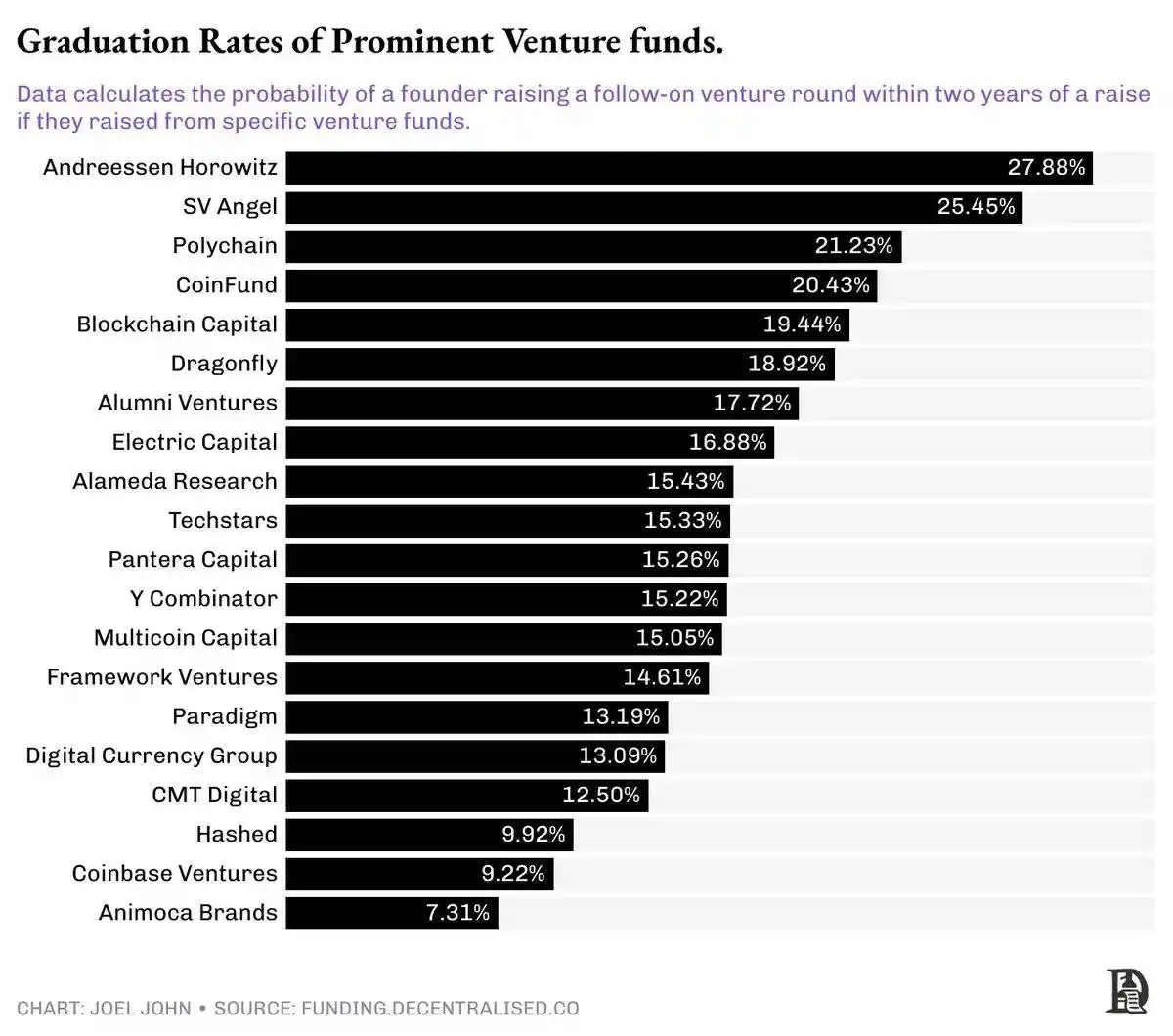
Even among the top 20 funds, the power law is still quite extreme.
For example, raising from A16z means you have a one-third chance of raising funds again within two years. In other words, for every three startups backed by A16z, one will proceed to a Series A round.
Considering that the bottom of this list has only a 1/16 chance, this is already a quite high graduation rate.
In this top 20 list of follow-on investment funds, the risk fund ranking close to 20 has a company's probability of receiving follow-on investment at only 7%. These numbers may seem close, but in the background, a one-third probability is like rolling a dice and getting a number less than three, whereas a 1/14 probability is roughly equivalent to the chances of having twins. These are starkly different outcomes, both literally and probabilistically.
Joking aside, this illustrates the level of internal aggregation within a crypto venture capital fund. Some funds are able to design follow-on financing for their portfolio companies themselves as they also have growth funds.
Therefore, they would deploy both seed-stage and Series A funding within the same company. When a venture capital fund doubles down on holding more shares of the same company, it usually sends a positive signal to later-round investors.
In other words, the presence of growth-stage funds within VC firms significantly impacts the company's likelihood of success in the coming years.
The long-tail effect of this trend is that crypto venture funds are evolving to make private equity investments in revenue-generating projects. We have had theoretical arguments for this transition. But what does the data really show? To investigate this, we looked at the number of startups in our investor base that have received follow-on financing. We then calculated the proportion of companies where the same venture fund participated again in follow-on rounds.
In other words, if a company raised seed funding from A16z, what is the likelihood of A16z reinvesting in their Series A round?
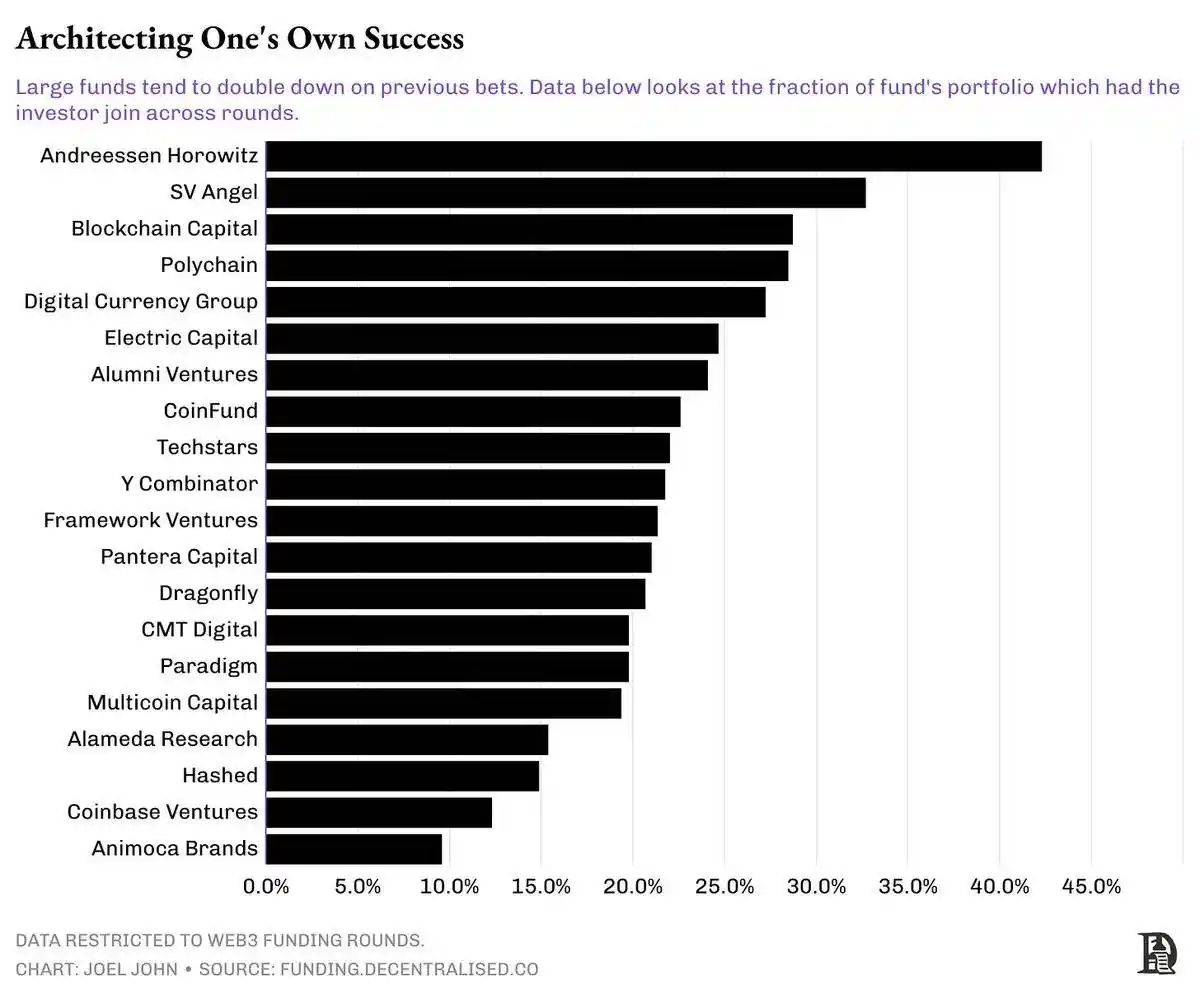
This pattern quickly emerged. Large funds managing over a billion dollars tend to make frequent follow-on investments. For example, among startups in A16z's portfolio that continued to raise more capital, 44% saw A16z participating in follow-on rounds. Blockchain Capital, DCG, and Polychain made follow-on investments in a quarter of their refinancing.
In other words, where you raise money at the seed or pre-seed stage matters much more than you might think because these investors are more inclined to consistently support their own companies.
Habitual Coinvestment
These co-investment patterns are drawn from hindsight. We do not mean that companies funded by non-top-tier VCs are doomed to fail. The objective of all economic activities is growth or profit creation. Companies that can achieve either of these will see their valuation rise over time. Of course, this helps increase the odds of success. If you cannot raise from the top 20 investors, one way to increase the chances of success is through their networks, or in other words, by connecting with these capital hubs.
The graph below shows the network of all venture capitalists in the crypto space over the past decade. There are a total of 1000 investors with around 22,000 connections shared among them. A connection is formed when one investor co-invests with another. This may seem crowded or even like too many choices. However, this also includes funds that have ceased to exist, never returned funds, or are no longer deploying.
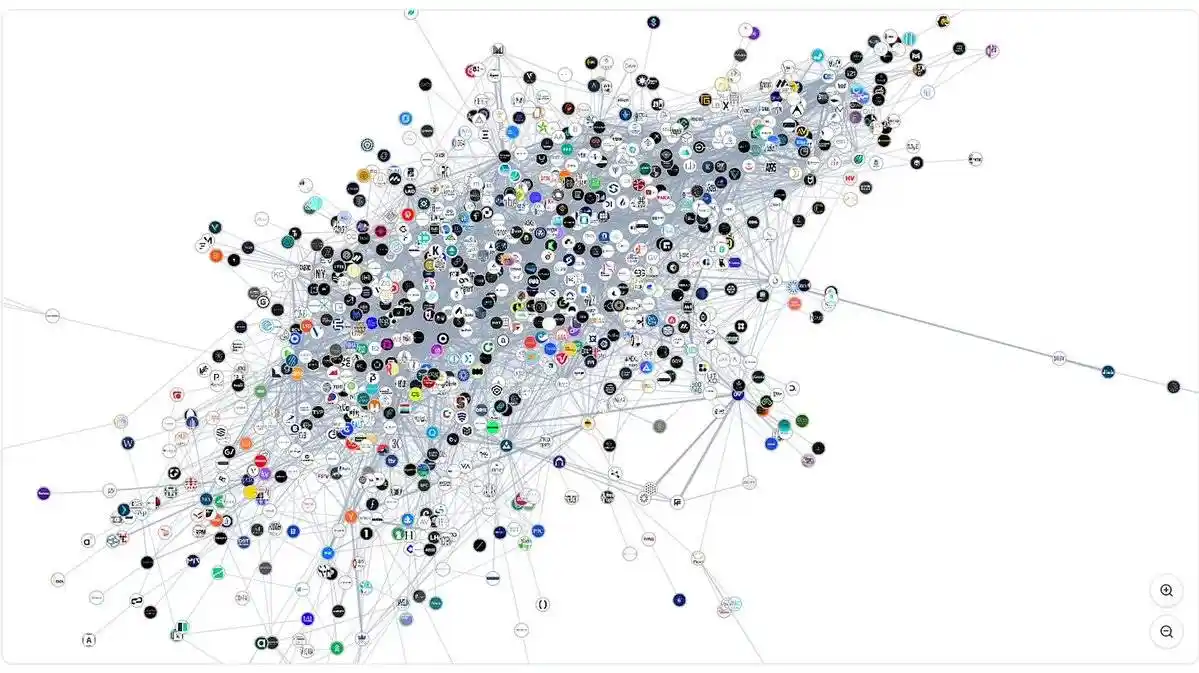
I know, this may seem chaotic.
However, the reality of market development becomes clearer in the chart below. If you are a founder seeking Series A funding, there are approximately 50 pools of funds with rounds over $2 million each. There is a network of about 112 funds that have participated in such rounds. These funds are gradually concentrating, showing a stronger preference for co-investing with specific partners.
During the fundraising process from seed rounds to Series A, you can gather funds from various investors. Over time, funds tend to form co-investment habits. This means that when a fund invests in an entity, it usually brings along a peer fund, possibly due to complementing skills (such as technical support or marketing) or based on a partnership. To investigate how these relationships work, we are starting to explore the co-investment patterns between funds over the past year.
For example, in the past year:
· Polychain and Nomad Capital had 9 co-investments.
· Bankless and Robot Ventures had 9 co-investments.
· Binance and Polychain had 7 co-investments.
· Binance and HackVC also had an equal number of co-investments.
· Similarly, OKX and Animoca had 7 co-investments.
Larger funds are becoming more selective with their co-investment partners.
For instance, in the last year, out of Paradigm's 10 investments, Robot Ventures participated in three rounds. DragonFly, in its total of 13 investments, shared three rounds with Robot Ventures and Founders Fund.
Likewise, Founders Fund had three co-investments with Dragonfly out of its 9 investments.
In other words, we are gradually entering an era where a few funds make substantial investments and have fewer co-investors. Many of these co-investors are often well-established funds that have been around for some time.
Entering the Capital Matrix
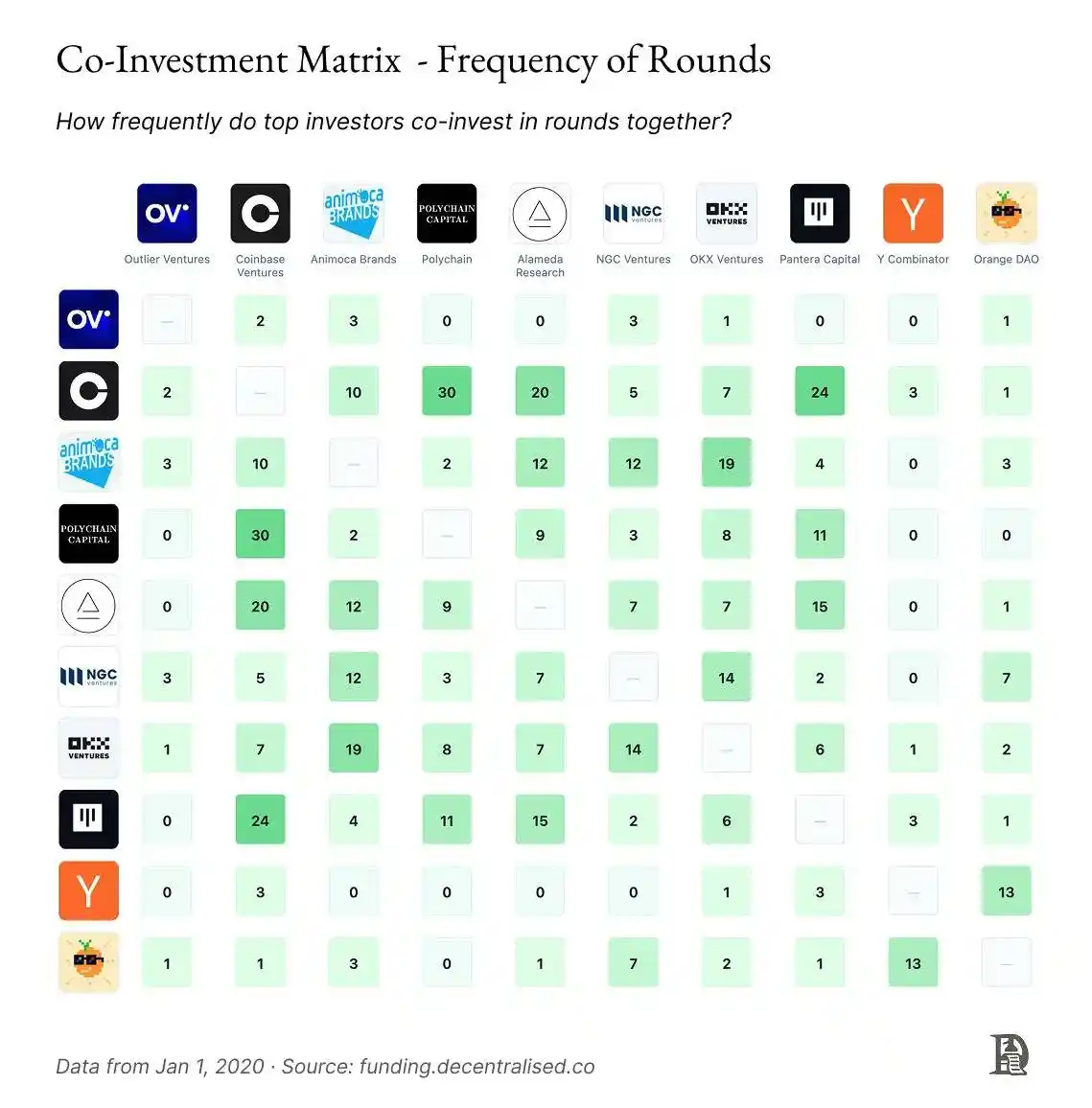
Another approach to studying data is to analyze the behavior of the most active investors. The matrix above considers the most frequent investors since 2020 and their relationships. You will notice that the co-investment between accelerators (such as Y Combinator or Outlier Venture) and exchanges (such as Coinbase Ventures) is minimal.
On the other hand, you will also find that exchanges usually have their own preferences. For example, OKX Ventures and Animoca Brands have a high level of co-investment. Coinbase Ventures has over 30 investments with Polychain, and an additional 24 investments with Pantera.
We observe three structural phenomena:
Despite the high investment frequency, accelerators often have fewer co-investments with exchanges or large funds. This may be due to stage preferences.
Large exchanges tend to favor long-term risk funds. Currently, Pantera and Polychain lead in this aspect.
Exchanges tend to collaborate with local players. OKX Ventures and Coinbase show different preferences in choosing co-investment partners, highlighting the global nature of capital allocation in Web3.
So, if risk funds are consolidating, where will the next marginal capital come from? I noticed an interesting pattern where corporate venture capital has its own clusters. For example, Goldman Sachs has shared 2 investments with both PayPal Ventures and Kraken throughout its lifecycle. Coinbase Ventures has 37 co-investments with Polychain, 32 with Pantera, and 24 with Electric Capital.
Unlike venture capital, corporate pools of funds typically target growth-stage companies with significant Product-Market Fit (PMF). Therefore, the behavior of this capital pool during a downturn in early-stage risk financing remains to be observed.
The Evolving Network
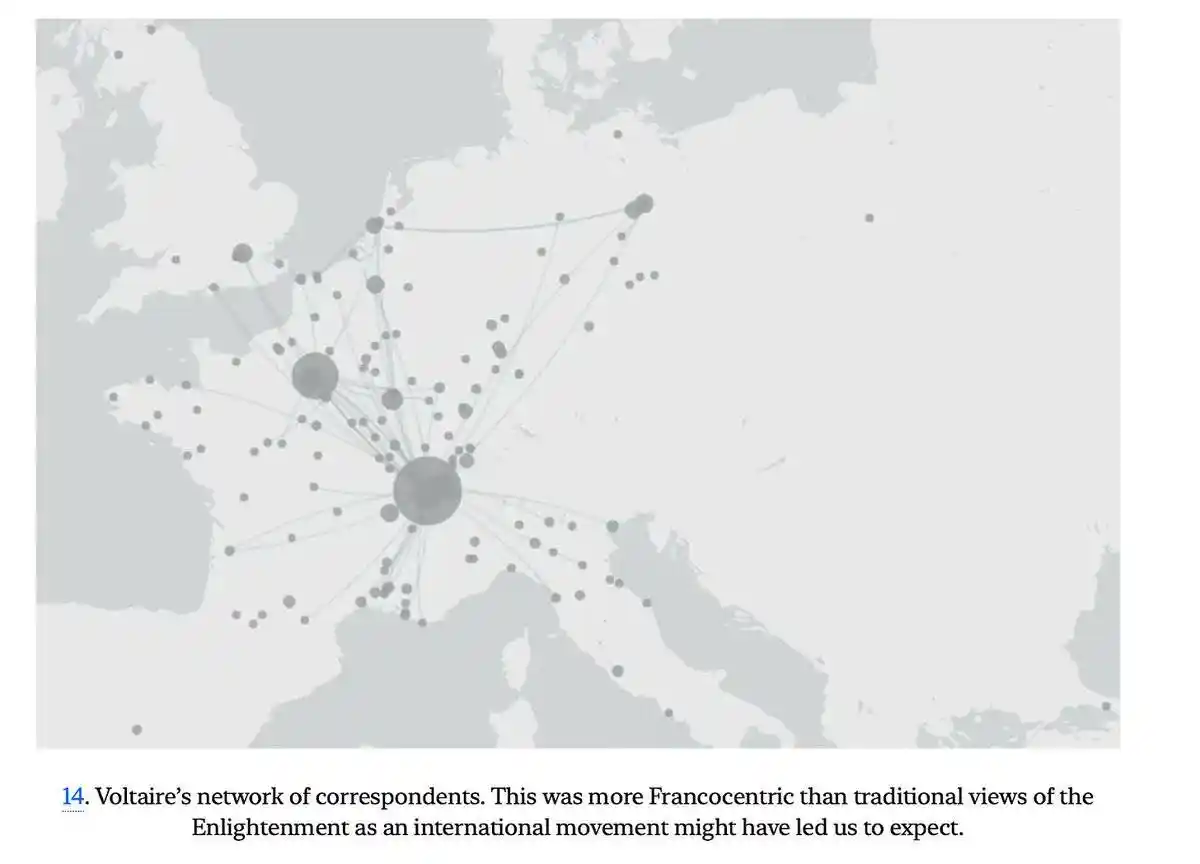
From "The Square and the Tower"
Years ago, after reading Niall Ferguson's "The Square and the Tower," I became interested in studying the relationship networks within the crypto field. The book revealed how the spread of ideas, products, and even diseases is associated with networks. It wasn't until a few weeks ago when we built the funding dashboard that I realized visualizing the interconnected network of capital sources in the crypto space was possible.
I believe that these datasets and the nature of economic interactions between these entities can be used to design (and execute) mergers and token acquisitions of private entities. These are directions that we are currently exploring internally. They can also be used for business development and partnership initiatives. We are still researching how to allow specific companies to access these datasets.
Back to the Point: Does Network Really Help Fund Performance?
The answer is somewhat complex. Fund selection of the right team and providing the capacity to deploy capital at sufficient scale will be more important than their exposure to other funds. What truly matters are the personal relationships of General Partners (GPs) with other co-investors. Venture capital firms do not share deal flow with logos, they share it with people. When a partner switches funds, the connection moves to their new fund.
I have some intuitions about this, but means to validate this point are scarce. Luckily, there is a paper coming in 2024 that studied the performance of the top 100 venture capital firms over time. In fact, they looked at 38,000 investment rounds involving 11,084 companies, and even analyzed market seasonality. The crux of their argument boils down to a few facts:
Past co-investments do not necessarily translate into future collaborations. If past investments went south, funds may choose not to partner with another fund.
During boom times, co-investments tend to increase as funds want to deploy more aggressively. In boom times, VC firms rely more on social signals and do less due diligence. During bear markets, funds deploy cautiously, usually going solo due to lower valuations.
Funds choose peers based on complementary skills. Therefore, crowded rounds with investors of the same profession tend to spell trouble.
As I mentioned before, ultimately, co-investing doesn't happen at a fund level but at a partner level. In my own career, I have seen individuals move between organizations. The goal is typically to work with the same person regardless of which fund they join. In the era where AI is taking over human jobs, understanding relationships remains key to early-stage venture capital.
There is still a lot of work to be done on research into the formation of the crypto venture capital network. For instance, I would like to delve into liquidity preferences of hedge funds in capital allocation, how late-stage deployments in the crypto space evolve with market seasonality, or how M&A and private equity participate in it. The answers are in the data we have today, but it takes time to ask the right questions.
Like many other things in life, this will be an ongoing inquiry, and we will make sure to uncover it when we find signals.
You may also like

PUMP Valuation Breakdown: On-chain Data Disproves the "Fake Volume" Theory, Where Does the Real Discount Come From?

Tiger Research: What AI services do cryptocurrency companies offer?

The war not only drives up oil prices but also causes Circle's stock price to soar

When agents become consumers, who will rewrite the underlying logic of internet commerce?

AI Agents in Action Summit: March 31, Hong Kong Cyberport, focusing on the deep waters of AI implementation

29 Days In, What Are America’s Options on Iran?

Flash Crash Down 97%+ with Ongoing Unlocking, WLD Completes $65 Million Off-chain Funding: Who Is Still Buying?

Bitcoin for Real Estate? Fannie Mae Teams Up with Coinbase to Launch Crypto Mortgage
Tether Hires Big Four Auditor, USDT Enters First Attestation Phase

Google AI Paper Destroys $900B Storage Stock, Accused of Faking Experiment
Evaporate $2 Trillion, U.S. Stocks See Worst Start in 4 Years, Why is the Market Bearish?

The speed at which AI discovers vulnerabilities has surpassed the speed at which it patches vulnerabilities.
AI Crypto Trading Bot Explained: Aurora's Multi-Factor Strategy in WEEX Hackathon
Aurora demonstrates how structured, multi-agent AI Trading systems can deliver more adaptive and resilient performance in the WEEX AI Trading Hackathon.

Cyber Taoist Fortune Teller: Fake Taoist, AI Fortune Telling, and Northeastern Metaphysics History

Bloomberg: Stablecoin Payments Emerge as Crypto VC's Newest Favorite Thing
BeatSwap is evolving towards a full-stack Web3 infrastructure, covering the entire lifecycle of IP rights.
BeatSwap, a global Web3 Intellectual Property (IP) infrastructure project, is attempting to overcome the current fragmentation limitations of the Web3 ecosystem, building a full-stack system that covers the entire lifecycle of IP rights.
Currently, most Web3 projects are still in the stage of functional fragmentation, often focusing only on a single aspect, such as IP asset tokenization, transaction functionality, or a simple incentive model. This structural dispersion has become a key bottleneck hindering the industry's scale application.
BeatSwap's approach is more integrated, integrating multiple core modules into the same system, including:
· IP authentication and on-chain registration
· Authorization-based revenue sharing mechanism
· User-engagement-driven incentive system
· Transaction and liquidity infrastructure
Through the above integration, the platform builds an end-to-end closed-loop path, allowing IP rights to complete a full cycle of "creation, use, and monetization" within the same ecosystem.
BeatSwap is not limited to existing crypto users but is attempting to take the global music industry as a starting point, actively creating new market demand. Its core strategies include:
Exploring and incubating music creators (Artist discovery)
Building a fan community
Igniting IP-centric content consumption demand
The current global music industry is valued at around $260 billion, with over 2 billion digital music users. This means that the potential market corresponding to the tokenization and financialization of IP far exceeds the traditional crypto user base.
In this context, BeatSwap positions itself at the intersection of "real-world content demand" and "on-chain infrastructure," attempting to bridge the structural gap between content production and financial flow.
BeatSwap's upcoming core product "Space" is scheduled to launch in the second quarter of 2026. This product is defined as the SocialFi layer in the ecosystem, aiming to directly connect creators with users and achieve deep integration with other platform modules.
Key designs include:
A fan-centric interactive mechanism
Exposure and distribution logic based on $BTX staking
User paths connected to DeFi and liquidity structures
Thus, a complete user behavior loop is formed within the platform: Discovery → Participation → Consumption → Rewards → Trading
$BTX is designed to be a core utility asset within the ecosystem, rather than just a simple incentive token, with its value directly tied to platform activity and IP use cases.
Main features include:
· Yield distribution based on on-chain authorized actions
· Value reflection based on IP usage and user engagement dynamics
· Support for staking and DeFi participation mechanisms
· Value growth driven by ecosystem expansion
With the increased frequency of IP use, the utility and value support of $BTX will enhance simultaneously, helping alleviate the "disconnect between value and utility" issue present in traditional Web3 token models to some extent.
Currently, $BTX has been listed on several mainstream exchanges, including:
Binance Alpha
Gate
MEXC
OKX Boost
As the launch of "Space" approaches, BeatSwap is actively pursuing more exchange listings to further enhance liquidity and global accessibility, laying a foundation for future market expansion.
BeatSwap's goal is no longer limited to the traditional Web3 narrative but aims to target over 2 billion digital music users and a trillion KRW-scale content market.
By integrating content creators, users, capital, and liquidity into a blockchain framework centered around IP rights, BeatSwap is striving to build a next-generation infrastructure focused on "IP tokenization."
BeatSwap integrates IP authentication, authorization distribution, incentive mechanism, transaction system, and market construction to establish a unified structure that bridges the full lifecycle path of IP rights.
With the launch of the Q2 2026 "Space," the project is expected to become a key infrastructure connecting content and finance in the IP-RWA (Real World Assets) track.

Mag 7 Evaporates $2 Trillion | Rewire News Morning Edition



 App
App