
 Buy Crypto
- Markets
 Futures
- Spot
- Copy Trade
- Earn
- More
Decentralized Discord? Will Towns' new a16z funding break the curse of on-chain social?

Original Article Title: "Decentralized Discord? Towns Receives Further Investment from a16z, Can It Break the On-Chain Social Curse?"
Original Article Author: 1912212.eth, Foresight News
On April 11, the Web3 social protocol Towns Protocol completed a $10 million Series B funding round, with a16z crypto leading the round. This round of funding was led by a16z crypto, with Coinbase Ventures participating for the first time, and Benchmark continuing to invest. Back in February 2023, Towns had already completed a $25.5 million Series A funding round, also led by a16z.
In the current crypto market downturn where funding in niche projects has almost disappeared and even funding in popular projects has significantly decreased, many funds are playing it safe and reluctant to invest. Why is a16z still betting on the underdog social track? What exactly does Towns bring to the table?
Real-Time Messaging App Open-Source Protocol
The Towns Protocol is an open-source protocol for building decentralized real-time messaging applications. It consists of an EVM-compatible L2 chain, decentralized off-chain flow nodes, deployed on Base. Towns allows users to create programmable communication use cases in a permissionless manner, referred to as Spaces. These Spaces are ownable, support on-chain subscriptions (membership), an extensible reputation system, and end-to-end message encryption.
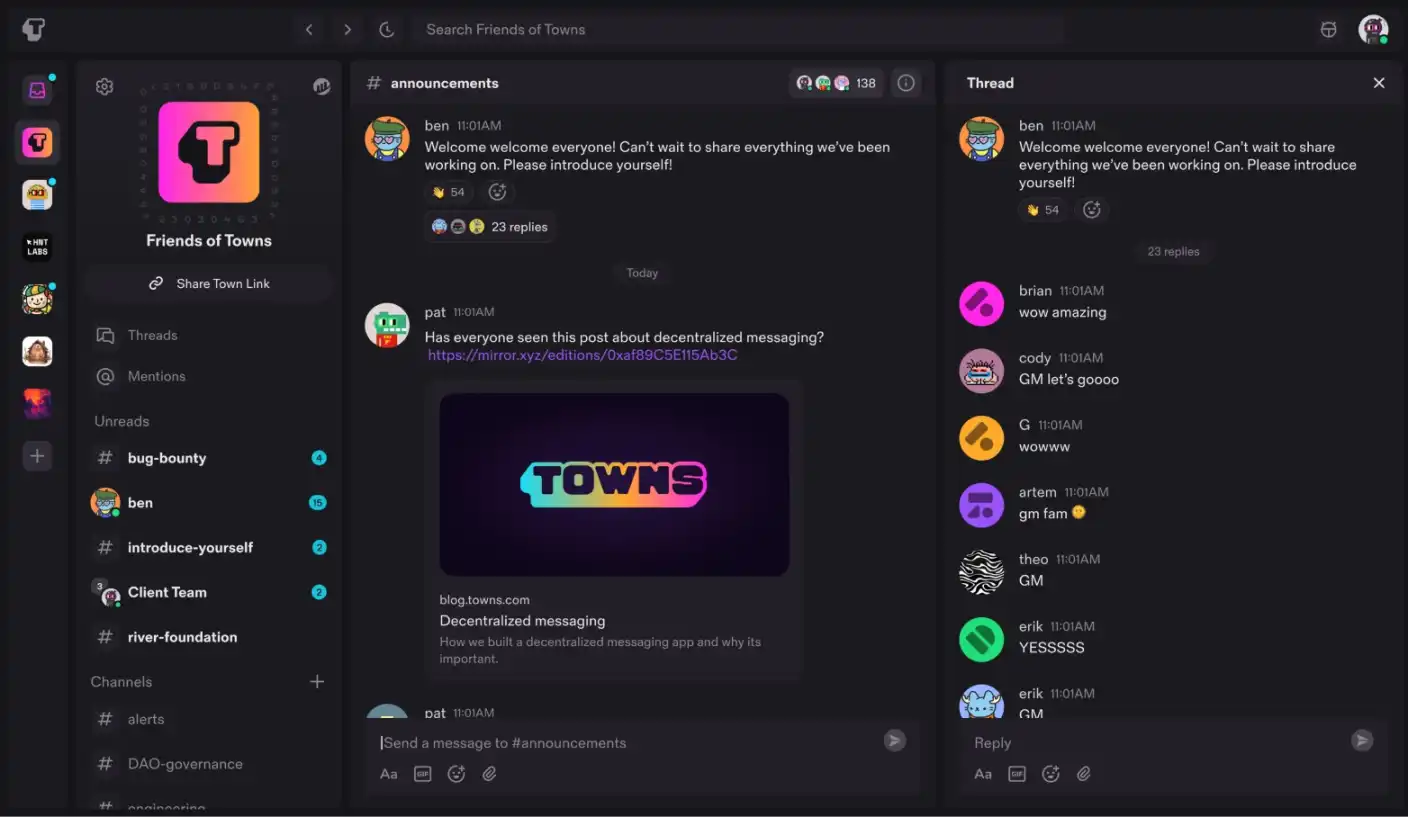
The Towns Protocol ecosystem aims to empower people to create, manage, and participate in digital communities in a secure and permissionless manner. Its primary goal is to provide a powerful, secure, and decentralized platform that gives people full control over their data, privacy, and interactions in these digital spaces while safeguarding their reputation.
The Towns Messaging Protocol is the core infrastructure for verifying and transmitting encrypted messages between users. It introduces an innovative approach to achieving secure, private group message delivery. The protocol is designed to seamlessly operate within blockchain infrastructure, leveraging the robustness of decentralized technology to provide a high-quality permissionless messaging experience.
Read/write access is protected on Base, allowing Towns to make trade-offs in liveliness, enabling it to send messages to thousands of participants at a speed comparable to existing centralized social networks. The Towns Protocol was initially built for a broad chat application scenario, including the chat business logic, but in the future, the protocol will be abstracted to serve as the foundational layer for any form of encrypted message delivery use case.
What Are the Key Features?
The Towns ecosystem consists of three main components. Firstly, the Towns Chain, a Layer 2 blockchain solution (built on OP-Stack) that serves as the foundation of the Towns Messaging Protocol, providing a consensus mechanism and security. Secondly, the Flow Nodes, responsible for managing message flow within the protocol, handling tasks such as message validation, storage, and encryption. And thirdly, the Permission Management, used to oversee user permissions and access control within the space, ensuring the security and organization of the communication environment.
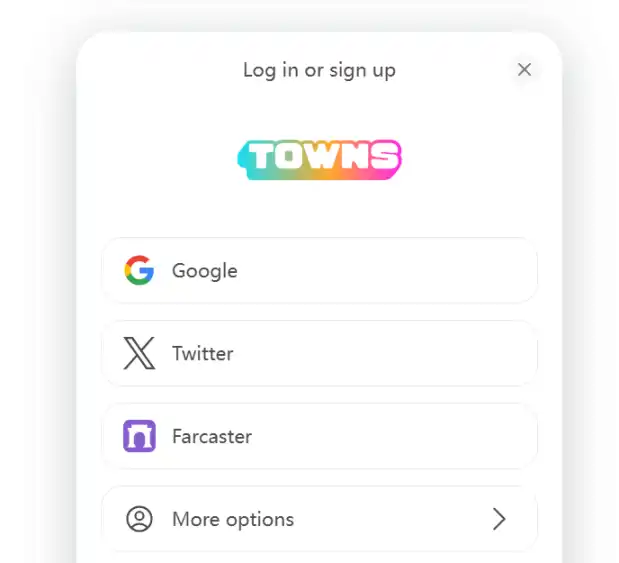
Its interface style is similar to Discord, but Towns has its own unique features. Its login interface supports Google and Twitter accounts and even includes integration with competitors like Farcaster, eliminating the need for a native wallet.
An Application Chain Designed for Social Networking
The Towns Protocol is an application chain designed specifically for social networking, protecting read/write permissions on Base. The application chain can make trade-offs in terms of liveliness, allowing it to quickly send messages to thousands of participants, similar to existing centralized social networks.
Ownable Communication Space
Space creators truly own the spaces they create, which exist as on-chain assets.
Programmable Space
Spaces are deployed on-chain via a programmable interface, allowing for custom rules such as who can read/write and integration with any other EVM-compatible external contract.
On-Chain Membership with Built-in Protocol Fees
Users need to hold a valid membership token to send and receive messages within a space. The membership pricing includes protocol fees to cover network operating costs.
On-Chain Social Graph
Membership tokens and spaces can be discovered on-chain, forming a transparent social network structure.
Scalable Reputation System
Towns' communication spaces are programmable, allowing members to maintain reputation scores specific to a space peer-to-peer, which can be discovered on-chain.
End-to-End Encrypted Messaging
Ensures secure and private communication through advanced encryption technology, protecting the security of messages between the sender and authorized users.
Tokenomics
As per its official documentation, the Towns token is deployed on the Ethereum mainnet with an initial token supply of 10 billion tokens. The Towns token serves multiple purposes within the Towns Protocol ecosystem, including delegation to node operators, space address delegation, and participation in governance.
The Towns token can be delegated to node operators, who are a critical part of the network operation. To receive DAO approval and commence operations, node operators must obtain a minimum token delegation to ensure they have sufficient vested interest in the success and security of the network. Token delegation can point directly to a node operator's address or to any valid space address within the network. The space can then redirect the delegated tokens received to specific node operators, providing flexibility in delegation strategies. Apart from its role in delegation and network operation, the Towns token also plays a significant role in Towns DAO governance. Token holders can participate in the decision-making process, influencing the direction and policies of the DAO.
Concerning the inflation mechanism, the Towns token has an initial annual inflation rate of 8%, set to linearly decrease over 20 years to eventually reach a 2% inflation rate. Inflation rewards are distributed evenly among all active node operators at the end of each period, which occurs biweekly. Therefore, the biweekly allocation of inflation rewards is calculated using the following formula: (annual inflation rate / 26).
Regarding reward distribution fees, each node operator has the autonomy to set the percentage fee for their services. This fee is deducted from the total inflation reward for that operator's node. After deducting the node operator's fee, the remaining inflation reward is proportionally distributed to the operator's delegators. Towns will also introduce its staking feature in the future.
Currently, Towns has not disclosed any information regarding airdrops.
Summary
The CEO of Towns Protocol is Ben Rubin. He is an experienced entrepreneur, having been the co-founder and CEO of the popular video social networking app Houseparty and the live streaming app Meerkat.

(Rubin as the Middleman)
Rubin is known for his achievements in building innovative online communities and real-time communication tools, with his career focusing on enhancing user connection and interaction through technology.
According to his official introduction, Towns currently has nearly 1 million members, with consumer spending through spatial conversations exceeding $500,000. Its protocol revenue has also been steadily growing since the beginning of this year.
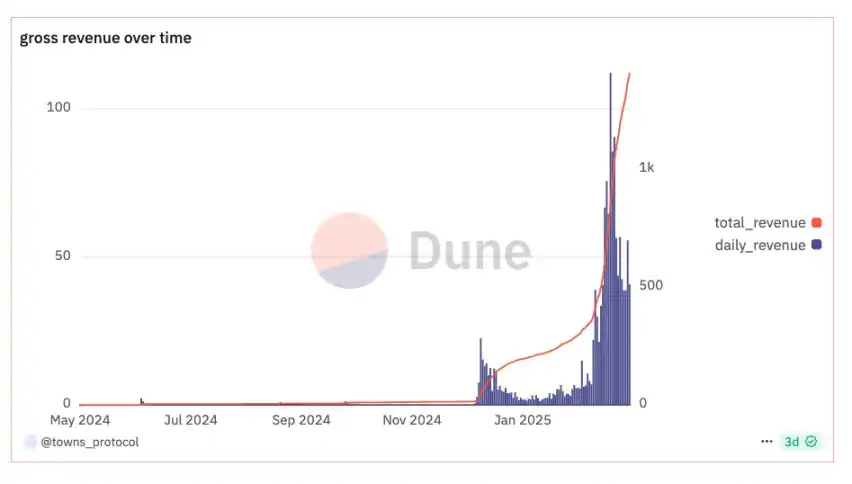
The Web3 social track has witnessed numerous protocols' meteoric rises and falls—they have dazzlingly debuted with promises to disrupt the status quo, only to quickly fade away due to technical bottlenecks, user attrition, or ecosystem insularity. In the midst of a sluggish crypto market, how to attract more users to create and join group chats, and how to incentivize user retention, remain real challenges that social protocols have to face.
You may also like

Tiger Research: What AI services do cryptocurrency companies offer?

The war not only drives up oil prices but also causes Circle's stock price to soar

When agents become consumers, who will rewrite the underlying logic of internet commerce?

AI Agents in Action Summit: March 31, Hong Kong Cyberport, focusing on the deep waters of AI implementation

29 Days In, What Are America’s Options on Iran?

Flash Crash Down 97%+ with Ongoing Unlocking, WLD Completes $65 Million Off-chain Funding: Who Is Still Buying?

Bitcoin for Real Estate? Fannie Mae Teams Up with Coinbase to Launch Crypto Mortgage
Tether Hires Big Four Auditor, USDT Enters First Attestation Phase

Google AI Paper Destroys $900B Storage Stock, Accused of Faking Experiment
Evaporate $2 Trillion, U.S. Stocks See Worst Start in 4 Years, Why is the Market Bearish?

The speed at which AI discovers vulnerabilities has surpassed the speed at which it patches vulnerabilities.
AI Crypto Trading Bot Explained: Aurora's Multi-Factor Strategy in WEEX Hackathon
Aurora demonstrates how structured, multi-agent AI Trading systems can deliver more adaptive and resilient performance in the WEEX AI Trading Hackathon.

Cyber Taoist Fortune Teller: Fake Taoist, AI Fortune Telling, and Northeastern Metaphysics History

Bloomberg: Stablecoin Payments Emerge as Crypto VC's Newest Favorite Thing
BeatSwap is evolving towards a full-stack Web3 infrastructure, covering the entire lifecycle of IP rights.
BeatSwap, a global Web3 Intellectual Property (IP) infrastructure project, is attempting to overcome the current fragmentation limitations of the Web3 ecosystem, building a full-stack system that covers the entire lifecycle of IP rights.
Currently, most Web3 projects are still in the stage of functional fragmentation, often focusing only on a single aspect, such as IP asset tokenization, transaction functionality, or a simple incentive model. This structural dispersion has become a key bottleneck hindering the industry's scale application.
BeatSwap's approach is more integrated, integrating multiple core modules into the same system, including:
· IP authentication and on-chain registration
· Authorization-based revenue sharing mechanism
· User-engagement-driven incentive system
· Transaction and liquidity infrastructure
Through the above integration, the platform builds an end-to-end closed-loop path, allowing IP rights to complete a full cycle of "creation, use, and monetization" within the same ecosystem.
BeatSwap is not limited to existing crypto users but is attempting to take the global music industry as a starting point, actively creating new market demand. Its core strategies include:
Exploring and incubating music creators (Artist discovery)
Building a fan community
Igniting IP-centric content consumption demand
The current global music industry is valued at around $260 billion, with over 2 billion digital music users. This means that the potential market corresponding to the tokenization and financialization of IP far exceeds the traditional crypto user base.
In this context, BeatSwap positions itself at the intersection of "real-world content demand" and "on-chain infrastructure," attempting to bridge the structural gap between content production and financial flow.
BeatSwap's upcoming core product "Space" is scheduled to launch in the second quarter of 2026. This product is defined as the SocialFi layer in the ecosystem, aiming to directly connect creators with users and achieve deep integration with other platform modules.
Key designs include:
A fan-centric interactive mechanism
Exposure and distribution logic based on $BTX staking
User paths connected to DeFi and liquidity structures
Thus, a complete user behavior loop is formed within the platform: Discovery → Participation → Consumption → Rewards → Trading
$BTX is designed to be a core utility asset within the ecosystem, rather than just a simple incentive token, with its value directly tied to platform activity and IP use cases.
Main features include:
· Yield distribution based on on-chain authorized actions
· Value reflection based on IP usage and user engagement dynamics
· Support for staking and DeFi participation mechanisms
· Value growth driven by ecosystem expansion
With the increased frequency of IP use, the utility and value support of $BTX will enhance simultaneously, helping alleviate the "disconnect between value and utility" issue present in traditional Web3 token models to some extent.
Currently, $BTX has been listed on several mainstream exchanges, including:
Binance Alpha
Gate
MEXC
OKX Boost
As the launch of "Space" approaches, BeatSwap is actively pursuing more exchange listings to further enhance liquidity and global accessibility, laying a foundation for future market expansion.
BeatSwap's goal is no longer limited to the traditional Web3 narrative but aims to target over 2 billion digital music users and a trillion KRW-scale content market.
By integrating content creators, users, capital, and liquidity into a blockchain framework centered around IP rights, BeatSwap is striving to build a next-generation infrastructure focused on "IP tokenization."
BeatSwap integrates IP authentication, authorization distribution, incentive mechanism, transaction system, and market construction to establish a unified structure that bridges the full lifecycle path of IP rights.
With the launch of the Q2 2026 "Space," the project is expected to become a key infrastructure connecting content and finance in the IP-RWA (Real World Assets) track.

Mag 7 Evaporates $2 Trillion | Rewire News Morning Edition

Losing $19K per Coin Mined, Bitcoin Mining Firms Collective AI Defection



 App
App