
 Buy Crypto
- Markets
 Futures
- Spot
- Copy Trade
- Earn
- More
Due to the trade war, Trump lost over 5 billion dollars in a week

Since April 3 when Trump announced the imposition of "reciprocal tariffs" on major trading partners including China, Japan, Vietnam, and others, global stock markets have started to experience varying degrees of turbulence—a historic stock market crash in the U.S. After the policy announcement, Nasdaq futures saw a one-day drop of 4.7%, S&P 500 futures dropped 5%, and DJIA futures plummeted by as much as 1822 points. As of April 9, the S&P 500 index had fallen by 18.9% from its February high, causing a $5.8 trillion market cap wipeout, marking the most severe four-day consecutive decline since 1950; Tech stocks became the "hardest-hit area" in this stock disaster, with Apple's stock price plunging 23% in four days, and the combined market cap of seven major tech giants such as Microsoft and Nvidia evaporating by $1.65 trillion. This impact directly stemmed from the risk of supply chain disruption—Apple's 75% of components rely on Asia for production, creating immense tariff cost pressure; Bloomberg data shows that the total global stock market capitalization shrank by $10 trillion, with the Vietnamese stock market plunging by over 6% in a single day, the Nikkei 225 index plummeting nearly 3%, and the three major European stock indices all dropping by over 1%.
In the midst of global investors' heartache, Trump himself could not escape unscathed from this global crash.
Personal Wealth Hit by a $500 Million "Backlash"
According to Forbes' report on April 8, when Trump announced a massive tariff plan on April 2, his net worth was estimated at $4.7 billion. However, in less than a week, his assets fell to $4.2 billion, evaporating $500 million in a week. The largest portion of his personal wealth loss came from his Trump Media and Technology Group company, whose stock price has dropped by about 5% since April 3. Trump holds 114.75 million shares, causing a total asset loss of about $170 million just from this holding.
In addition, Trump also holds a significant amount of shares in tech giants. According to the Federal Election Commission (FEC) regulations, presidential candidates must submit a personal financial disclosure report by May 15 each year, covering their assets, liabilities, sources of income, including stock investments, etc. As a presidential candidate, Trump is required to comply with this regulation for disclosure purposes. His latest disclosed report for the year 2024 shows that Trump holds stocks in Apple, Microsoft, Nvidia, Amazon, Alphabet (Google), Meta Platforms, Berkshire Hathaway, PepsiCo, JPMorgan, and others, with values ranging from $100,000 to $1,000,000, where the holdings in Apple, Microsoft, and Nvidia are all valued at over $500,000. The total value of the aforementioned shares alone ranges from $2.25 million to $4.75 million. If Trump has not significantly altered his stock positions in the 8 months following the disclosure, the crash will have a considerable impact on his net worth.
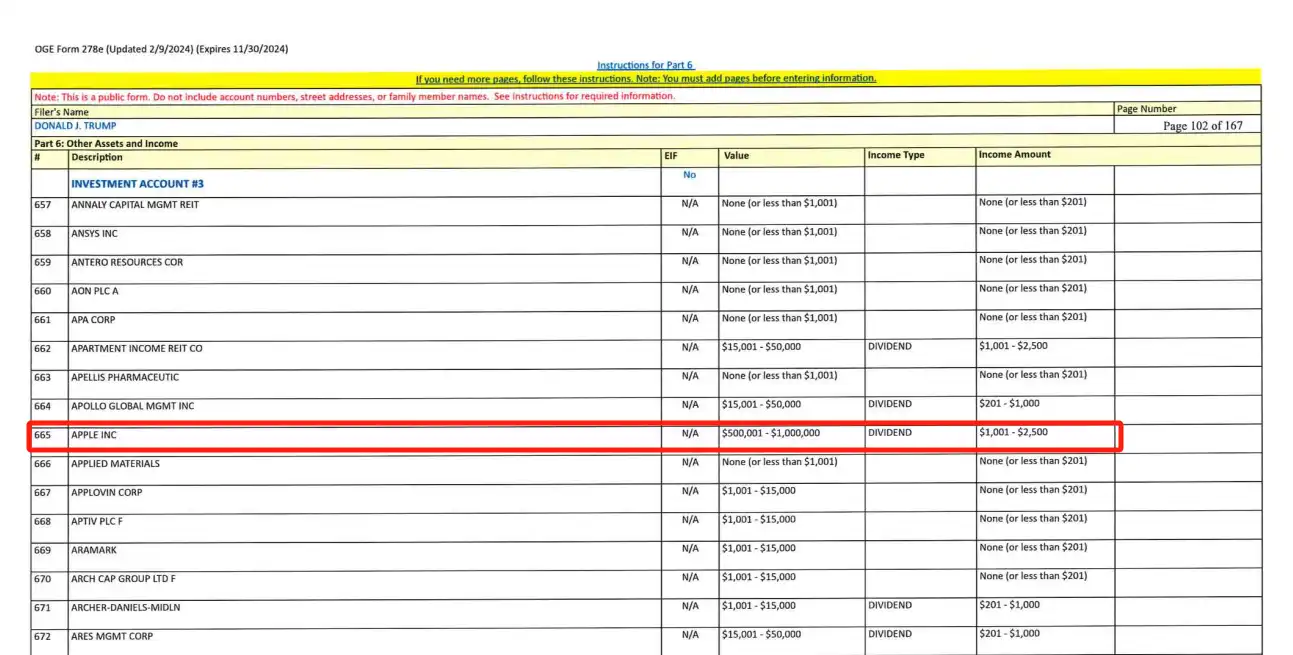
Image Source: Personal Financial Disclosure Report of Donald Trump
In addition, the real estate asset portfolio held by the U.S. President also shrank during this period, from $660 million to $570 million, a decrease of approximately $90 million. His golf-related assets also suffered losses, as many golf balls, clubs, and apparel sold in the pro shop relied on imports.
Furthermore, Trump's family crypto project WLFI incurred a huge loss due to an ETH transaction. On April 9, according to Lookonchain's monitoring, a wallet suspected to be related to WLFI sold 5,471 ETH at an average price of $1,465, receiving $8.01 million. This address had previously spent about $210 million to buy 67,498 ETH at an average price of $3,259. The current mark-to-market loss is approximately $125 million.
World's Richest Individuals Experience Billions in Losses
The Guardian reported that following Trump's announcement of tariff hikes on April 3, by the close of trading on April 4, the world's top 500 billionaires collectively lost $536 billion over the first two days of stock market trading. This marked the largest two-day wealth loss ever recorded by the Bloomberg Billionaires Index. Several billionaires who supported or participated in Trump's January inauguration suffered varying degrees of wealth reduction, with Elon Musk, Mark Zuckerberg, and others being among the most affected. The following image shows the real-time Bloomberg Billionaires Index (as of April 9).
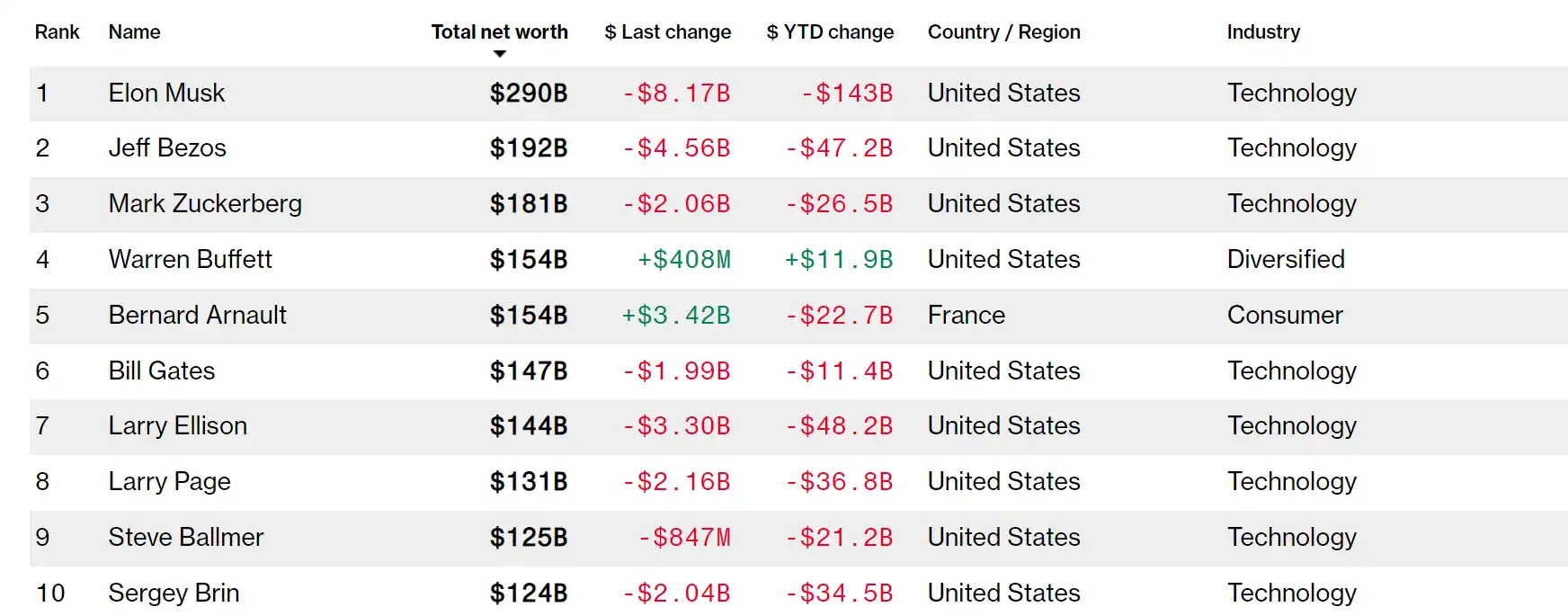
Image of Bloomberg Billionaires Ranking on April 9
The world's richest person and CEO of Tesla, Musk, has seen a significant decline in wealth since becoming a prominent and controversial figure in the Trump administration. His wealth took the hardest hit, with a net asset loss of $31 billion by last Friday's close due to a stock price plunge. From the beginning of this year until now, Musk's wealth has shrunk by about $143 billion, yet he still holds the title of the world's richest person with a net worth of $290 billion.
Facebook founder and owner of Instagram and WhatsApp, Zuckerberg, suffered the second-largest loss, totaling over $27 billion. The net worth of this global third richest person is estimated at $181 billion, heavily impacted by the sharp decline in Meta's market value. As the tariff war particularly hit tech companies hard, Meta's stock fell by nearly 14% in two days. Many of the world's largest companies rely on the Asian market for manufacturing, computer chips, and IT services, and Asia is one of the countries where Trump's tariffs are most severe. Just weeks before Trump took office, Zuckerberg made a notable "Trump pivot" regarding Meta. So far this year, his personal wealth has evaporated by over $26.5 billion.
Amazon founder and Washington Post owner Jeff Bezos saw a two-day loss of $235 billion, ranking third on the list. As the world's leading importer of goods, Amazon's market value has already shrunk by billions of dollars this year. Chinese sellers occupy over 50% of Amazon's third-party marketplace, and its cloud services business heavily relies on technology produced by Asian manufacturers. In February this year, Bezos' $10 billion climate and biodiversity fund stopped funding one of the world's most important climate certification organizations, with some seeing this move as a "surrender" to Trump and his anti-climate action stance. Bezos is the world's second-richest person, with an estimated net worth of $1920 billion, of which $472 billion has evaporated this year.
Despite experiencing a two-day plunge, not all billionaires have seen a reduction in their net worth. Buffett, the savvy chairman and largest shareholder of investment company Berkshire Hathaway, has seen his wealth rise to $154 billion this year. While his fortune did suffer a $25.7 billion loss during the two-day stock market crash, his net worth has increased by $119 billion year-to-date.
Trump's tariff policy is a high-risk experiment that tightly binds personal political agendas to the financial markets. Trump and other world's richest individuals saw massive wealth evaporation in just a few days, not only exposing the conflict of interest between policymakers and the capital markets but also revealing the self-contradiction of "protectionism" in the era of globalization — when politicians try to build walls with tariffs, the first to collapse is often their own wealth empire. For investors, this storm once again confirms an iron rule: in a highly interconnected global market, no one can truly stand alone.
You may also like

Tiger Research: What AI services do cryptocurrency companies offer?

The war not only drives up oil prices but also causes Circle's stock price to soar

When agents become consumers, who will rewrite the underlying logic of internet commerce?

AI Agents in Action Summit: March 31, Hong Kong Cyberport, focusing on the deep waters of AI implementation

29 Days In, What Are America’s Options on Iran?

Flash Crash Down 97%+ with Ongoing Unlocking, WLD Completes $65 Million Off-chain Funding: Who Is Still Buying?

Bitcoin for Real Estate? Fannie Mae Teams Up with Coinbase to Launch Crypto Mortgage
Tether Hires Big Four Auditor, USDT Enters First Attestation Phase

Google AI Paper Destroys $900B Storage Stock, Accused of Faking Experiment
Evaporate $2 Trillion, U.S. Stocks See Worst Start in 4 Years, Why is the Market Bearish?

The speed at which AI discovers vulnerabilities has surpassed the speed at which it patches vulnerabilities.

AI Crypto Trading Bot Explained: Aurora's Multi-Factor Strategy in WEEX Hackathon
Aurora demonstrates how structured, multi-agent AI Trading systems can deliver more adaptive and resilient performance in the WEEX AI Trading Hackathon.

Cyber Taoist Fortune Teller: Fake Taoist, AI Fortune Telling, and Northeastern Metaphysics History

Bloomberg: Stablecoin Payments Emerge as Crypto VC's Newest Favorite Thing
BeatSwap is evolving towards a full-stack Web3 infrastructure, covering the entire lifecycle of IP rights.
BeatSwap, a global Web3 Intellectual Property (IP) infrastructure project, is attempting to overcome the current fragmentation limitations of the Web3 ecosystem, building a full-stack system that covers the entire lifecycle of IP rights.
Currently, most Web3 projects are still in the stage of functional fragmentation, often focusing only on a single aspect, such as IP asset tokenization, transaction functionality, or a simple incentive model. This structural dispersion has become a key bottleneck hindering the industry's scale application.
BeatSwap's approach is more integrated, integrating multiple core modules into the same system, including:
· IP authentication and on-chain registration
· Authorization-based revenue sharing mechanism
· User-engagement-driven incentive system
· Transaction and liquidity infrastructure
Through the above integration, the platform builds an end-to-end closed-loop path, allowing IP rights to complete a full cycle of "creation, use, and monetization" within the same ecosystem.
BeatSwap is not limited to existing crypto users but is attempting to take the global music industry as a starting point, actively creating new market demand. Its core strategies include:
Exploring and incubating music creators (Artist discovery)
Building a fan community
Igniting IP-centric content consumption demand
The current global music industry is valued at around $260 billion, with over 2 billion digital music users. This means that the potential market corresponding to the tokenization and financialization of IP far exceeds the traditional crypto user base.
In this context, BeatSwap positions itself at the intersection of "real-world content demand" and "on-chain infrastructure," attempting to bridge the structural gap between content production and financial flow.
BeatSwap's upcoming core product "Space" is scheduled to launch in the second quarter of 2026. This product is defined as the SocialFi layer in the ecosystem, aiming to directly connect creators with users and achieve deep integration with other platform modules.
Key designs include:
A fan-centric interactive mechanism
Exposure and distribution logic based on $BTX staking
User paths connected to DeFi and liquidity structures
Thus, a complete user behavior loop is formed within the platform: Discovery → Participation → Consumption → Rewards → Trading
$BTX is designed to be a core utility asset within the ecosystem, rather than just a simple incentive token, with its value directly tied to platform activity and IP use cases.
Main features include:
· Yield distribution based on on-chain authorized actions
· Value reflection based on IP usage and user engagement dynamics
· Support for staking and DeFi participation mechanisms
· Value growth driven by ecosystem expansion
With the increased frequency of IP use, the utility and value support of $BTX will enhance simultaneously, helping alleviate the "disconnect between value and utility" issue present in traditional Web3 token models to some extent.
Currently, $BTX has been listed on several mainstream exchanges, including:
Binance Alpha
Gate
MEXC
OKX Boost
As the launch of "Space" approaches, BeatSwap is actively pursuing more exchange listings to further enhance liquidity and global accessibility, laying a foundation for future market expansion.
BeatSwap's goal is no longer limited to the traditional Web3 narrative but aims to target over 2 billion digital music users and a trillion KRW-scale content market.
By integrating content creators, users, capital, and liquidity into a blockchain framework centered around IP rights, BeatSwap is striving to build a next-generation infrastructure focused on "IP tokenization."
BeatSwap integrates IP authentication, authorization distribution, incentive mechanism, transaction system, and market construction to establish a unified structure that bridges the full lifecycle path of IP rights.
With the launch of the Q2 2026 "Space," the project is expected to become a key infrastructure connecting content and finance in the IP-RWA (Real World Assets) track.

Mag 7 Evaporates $2 Trillion | Rewire News Morning Edition

Losing $19K per Coin Mined, Bitcoin Mining Firms Collective AI Defection



 App
App