
 Buy Crypto
- Markets
 Futures
- Spot
- Copy Trade
- Earn
- More
Ethereal, the first airdrop project in the Ethena ecosystem: to be launched on the mainnet in Q1 next year; 15% of tokens are planned to be airdropped to ENA stakers

Original title: "Can Ethereal, the first airdrop project of Ethena ecosystem, replicate the miracle of Hyperliquid?"
Original author: Azuma, Odaily Planet Daily
Ethena (ENA) may be one of the most outstanding tokens in the past period of time.
Bitget market shows that since hitting the bottom at 0.194 USDT in early September, until yesterday's rebound to 1.33 USDT, ENA has achieved a nearly 600% increase in the past two months.
There are many answers to the reasons. For example, the contract funding rate rose in the bull market, driving Ethena's protocol revenue to rise sharply, and the supply of USDe also increased significantly; another example is the Trump family project World Liberty's support for ENA's purchase; and the expectation of the ENA fee switch being turned on by Wintermute; coupled with the direct cooperation with BlackRock BUIDL, a new stablecoin product USDtb was launched... In addition, the expectation of open airdrops for holding and staking ENA is also seen as a key reason for the continued rise of the token.
Previously, two major projects with a high degree of business relevance to USDe, Ethereal and Derive (formerly Lyra), have successively announced that they will airdrop to sENA holders (ie ENA staking users), of which Ethereal plans to airdrop 15% of the token supply and Derive plans to airdrop 5% of the token supply. Currently, users who hold sENA on the chain can directly view the "mining" status of these two projects on the Ethena homepage.
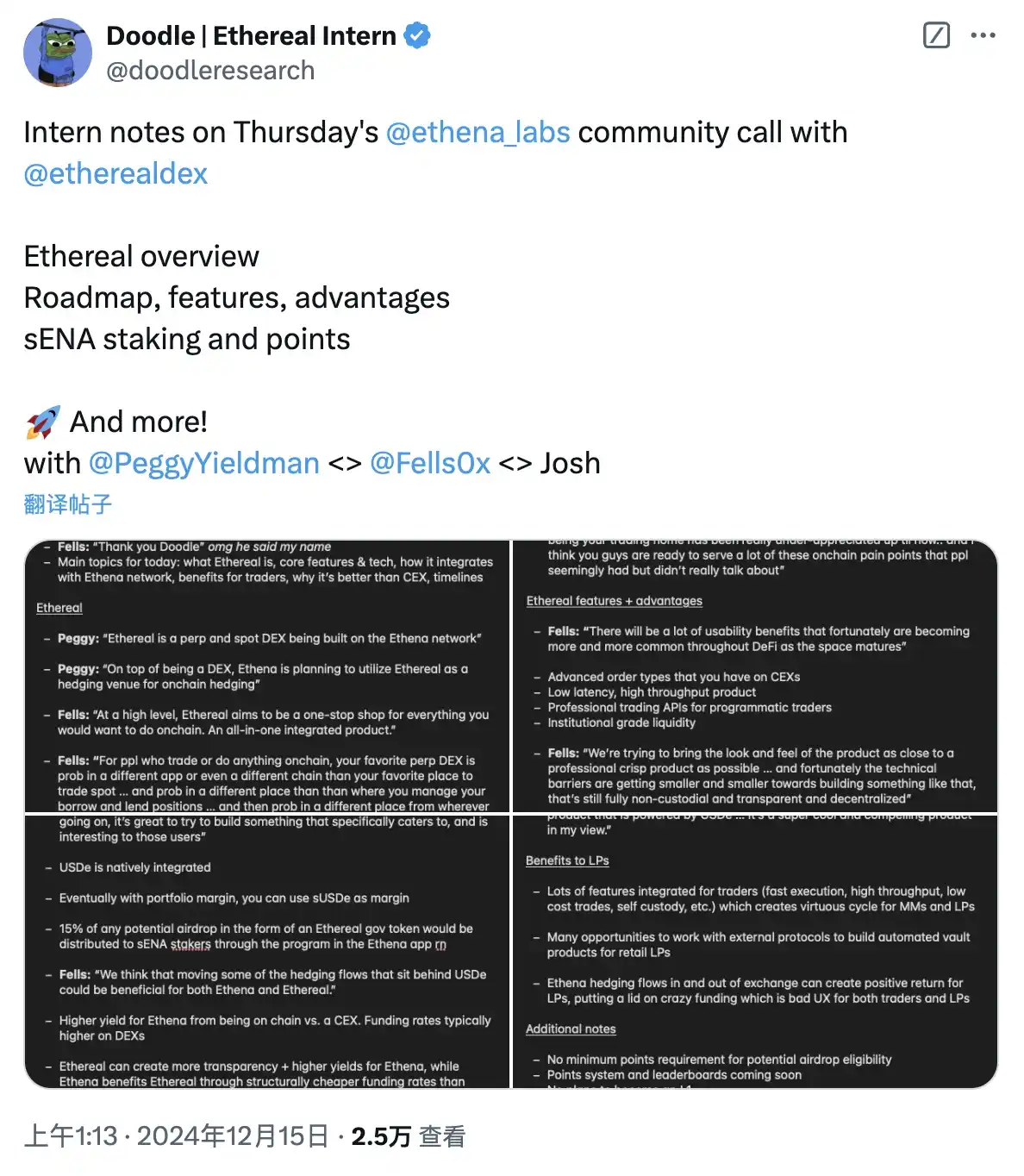
Last week, Ethereal officials held a community conference call, at which Ethereal's roadmap, functions, advantages and airdrops were outlined. It is worth mentioning that Ethereal's developers have obviously noticed the stunning performance of another strong project Hyperliquid in recent times, and mentioned that Ethereal hopes to build a "one-stop trading service" similar to Hyperliquid.
Ethereal: The first airdrop project of the Ethena ecosystem
Ethereal made its debut on September 30 this year.
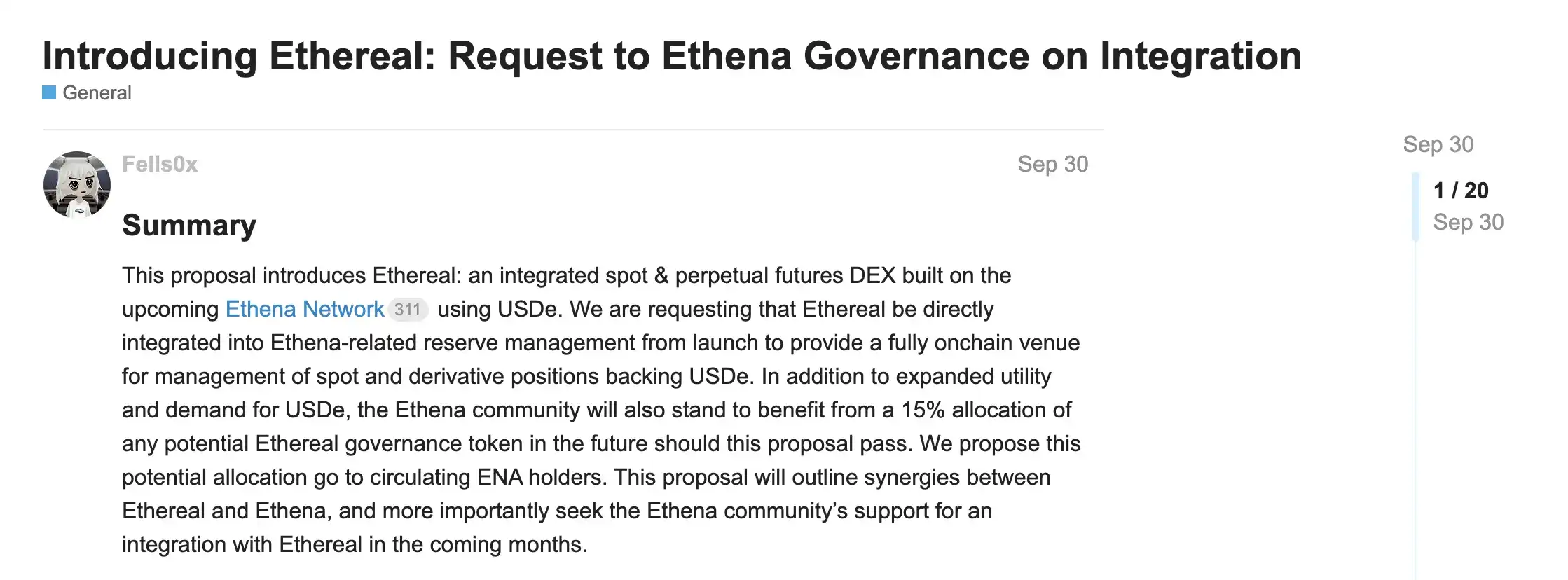
At that time, Fells, the founder of Ethereal, initiated a related proposal on Ethena, proposing to build an on-chain trading venue around USDe that supports spot and derivative transactions. On the one hand, Ethena can profit from the expansion of USDe's utility, and on the other hand, Ethereal can seize the ecological hub position in advance in the early stage of USDe's growth.
From the perspective of architecture, Ethereal will serve as Layer 3 based on the Ethena network; from the perspective of business, in addition to being equipped with a complete trading system, Ethereal also supports the deployment of other USDe-related applications (such as lending).
In order to gain the support of the Ethena community and deepen the binding relationship, Ethereal stated in the initial version of the proposal that 15% of the tokens will be given as airdrops to ENA's pledge users.
Latest News: Learn from Hyperliquid
In the latest community conference call, Ethereal team members emphasized Hyperliquid and believed that the key factor for the project's success was "providing a complete set of trading services", solving the hidden pain point that users need to switch between different applications when performing different operations, which is more conducive to the retention of users and funds.
In this regard, Ethereal founder Fells also re-described Ethereal's positioning as "a one-stop product that supports all DeFi operations", where users can conduct spot or contract transactions, rate arbitrage, lending, options and even forecasting operations, and can use sUSDe (staking USDe) to obtain stable interest-bearing income.
Fells added that he hopes to make Ethereal a platform similar to CEX in terms of user experience, but at the same time Ethereal will remain completely non-custodial and decentralized. For example, Ethereal will abstract the payment of gas through a specific design, so users do not have to sign or pay gas fees for each transaction.
Timeline: Q1 mainnet launch
According to the timeline mentioned in the conference call, Ethereal expects the following development rhythm:
· Testnet release: expected next month;
· Test gateway shutdown;
· Mainnet launch: expected in the first quarter of 2025;
Falls also mentioned that Ethereal's concrete functions will be launched in stages, starting with USDe perpetual contract trading, followed by combined margin model, lending and spot trading. Related businesses are likely to be launched in the first half of 2025. In addition, Ethereal will only support the trading of a few blue-chip tokens at the beginning of its launch. After users and liquidity accumulate, a new batch of trading pairs will be launched every week.
Ethena's ecological expansion
Ethena's ecological landscape is expanding rapidly. In addition to Ethereal mentioned in this article, Derive, a derivative project formerly known as the options protocol Lyra, will also issue coins in the first quarter of next year, and will also airdrop 5% of tokens to sENA holders.
Benefiting from the positive sentiment of the bull market, the funding rate in the contract market continues to be high, driving up the yield of the Ethena protocol itself and sUSDe. As of the time of writing, the supply of USDe has approached the $6 billion mark, with a real-time yield of 27%.
At the same time, the new stablecoin product USDtb launched by Ethena and BlackRock BUIDL also made up for Ethena's biggest shortcoming - the protocol itself and sUSDe will temporarily show negative returns under the negative rate cycle. The structure of USDtb is similar to that of traditional RWA stablecoins. Its stability is supported by reserve assets, and its income comes from treasury bond interest rates. In the future, after the supply of this stablecoin increases, Ethena will obtain a reliable safe-haven window in the negative rate cycle or when the rate income is lower than the treasury bond income, thereby solving the hidden danger of the protocol being susceptible to negative rates.
Arthur Hayes, the well-known milk king and founder of BitMEX, predicted earlier this year that "USDe will surpass USDT to become the largest dollar stablecoin." Although the supply scale of the two parties is still dozens of times different, considering Ethena's current sustained high yield and ecological expansion speed, this is not impossible. If this expectation can be realized, ecological sub-projects such as Ethereal, which have seized the position of ecological hub in the early stage, will inevitably benefit, and then form value feedback to ENA again.
You may also like

From x402 to MPP: Cloudflare's crucial vote, will it go to Coinbase or Stripe?

BlackRock CEO issues annual open letter: The wave of tokenization has arrived, and we will lead this trend

When Backpack backstabs the community

When gold is no longer a safe haven, and Bitcoin continues to panic

Trump, the World's Largest Oil Trader

If the US and Iran have not reached an agreement in 5 days, what other cards does Trump have?

Tether Whale Dumps £12 Million, Backing Crypto’s ‘British Trump’
Ethereum Foundation Post: Rethinking the Division of Work Between L1 and L2 to Build the Ultimate Ethereum Ecosystem

Two Major Prediction Market Platforms Unite Rarely, What Is the Story Behind This New Fund?
Dragonfly Partners: Most agents will not engage in autonomous trading, how can crypto payments prevail?

US AI Startup Goes All In on Chinese Mega-Model | Rewire News Morning Brief

Trump Lies Again: A "Five-Day Pause" Psyop, How Wall Street, Bitcoin, and Polymarket Insiders Synced Uposciogen

When a Token Becomes Labor, People Become the Interface

Ceasefire News Leaked Ahead of Time? Large Polymarket Bets on Outcome Before Trump's Tweet
BlackRock CEO's Annual Shareholder Letter: How is Wall Street Using AI to Keep Profiting from National Pension Funds?

Sun Valley Releases 2025 Financial Report: Bitcoin Mining Revenue Reaches $670 Million, Accelerating Transformation to AI Infrastructure Platform
On March 16, 2026, in Dallas, Texas, USA, CanGu Company (New York Stock Exchange code: CANG, hereinafter referred to as "CanGu" or the "Company") today announced its unaudited financial performance for the fourth quarter and full year ended December 31, 2025. As a btc-42">bitcoin mining enterprise relying on a globally operated layout and dedicated to building an integrated energy and AI computing power platform, CanGu is actively advancing its business transformation and infrastructure development.
• Financial Performance:
Total revenue for the full year 2025 was $688.1 million, with $179.5 million in the fourth quarter.
Bitcoin mining business revenue for the full year was $675.5 million, with $172.4 million in the fourth quarter.
Full-year adjusted EBITDA was $24.5 million, while the fourth quarter was -$156.3 million.
• Mining Operations and Costs:
A total of 6,594.6 bitcoins were mined throughout the year, averaging 18.07 bitcoins per day; of which 1,718.3 bitcoins were mined in the fourth quarter, averaging 18.68 bitcoins per day.
The average mining cost for the full year (excluding miner depreciation) was $79,707 per bitcoin, and for the fourth quarter, it was $84,552;
The all-in sustaining costs were $97,272 and $106,251 per bitcoin, respectively.
As of the end of December 2025, the company has cumulatively produced 7,528.4 bitcoins since entering the bitcoin mining business.
• Strategic Progress:
The company has completed the termination of the American Depositary Receipt (ADR) program and transitioned to a direct listing on the NYSE to enhance information transparency and align with its strategic direction, with a long-term goal of expanding its investor base.
CEO Paul Yu stated: "2025 marked the company's first full year as a bitcoin mining enterprise, characterized by rapid execution and structural reshaping. We completed a comprehensive adjustment of our asset system and established a globally distributed mining network. Additionally, the company introduced a new management team, further strengthening our capabilities and competitive advantage in the digital asset and energy infrastructure space. The completion of the NYSE direct listing and USD pricing also signifies our transformation into a global AI infrastructure company."
"As we enter 2026, the company will continue to optimize its balance sheet structure and enhance operational efficiency and cost resilience through adjustments to the miner portfolio. At the same time, we are advancing our strategic transformation into an AI infrastructure provider. Leveraging EcoHash, we will utilize our capabilities in scalable computing power and energy networks to provide cost-effective AI inference solutions. The relevant site transformations and product development are progressing simultaneously, and the company is well-positioned to sustain its execution in the new phase."
The company's Chief Financial Officer, Michael Zhang, stated: "By 2025, the company is expected to achieve significant revenue growth through its scaled mining operations. Despite recording a net loss of $452.8 million from ongoing operations, mainly due to one-time transformation costs and market-driven fair value adjustments, the company, from a financial perspective, will reduce its leverage, optimize its Bitcoin reserve strategy and liquidity management, introduce new capital to strengthen its financial position, and seize investment opportunities in high-potential areas such as AI infrastructure while navigating market volatility."
The total revenue for the fourth quarter was $1.795 billion. Of this, the Bitcoin mining business contributed $1.724 billion in revenue, generating 1,718.3 Bitcoins during the quarter. Revenue from the international automobile trading business was $4.8 million.
The total operating costs and expenses for the fourth quarter amounted to $4.56 billion, primarily attributed to expenses related to the Bitcoin mining business, as well as impairment of mining machines and fair value losses on Bitcoin collateral receivables.
This includes:
· Cost of Revenue (excluding depreciation): $1.553 billion
· Cost of Revenue (depreciation): $38.1 million
· Operating Expenses: $9.9 million (including related-party expenses of $1.1 million)
· Mining Machine Impairment Loss: $81.4 million
· Fair Value Loss on Bitcoin Collateral Receivables: $171.4 million
The operating loss for the fourth quarter was $276.6 million, a significant increase from a loss of $0.7 million in the same period of 2024, primarily due to the downward trend in Bitcoin prices.
The net loss from ongoing operations was $285 million, compared to a net profit of $2.4 million in the same period last year.
The adjusted EBITDA was -$156.3 million, compared to $2.4 million in the same period last year.
The total revenue for the full year was $6.881 billion. Of this, the revenue from the Bitcoin mining business was $6.755 billion, with a total output of 6,594.6 Bitcoins for the year. Revenue from the international automobile trading business was $9.8 million.
The total annual operating costs and expenses amount to $1.1 billion.
Specifically, they include:
· Revenue Cost (excluding depreciation): $543.3 million
· Revenue Cost (depreciation): $116.6 million
· Operating Expenses: $28.9 million (including related-party expenses of $1.1 million)
· Miner Impairment Loss: $338.3 million
· Bitcoin Collateral Receivable Fair Value Change Loss: $96.5 million
The full-year operating loss is $437.1 million. The continuing operations net loss is $452.8 million, while in 2024, there was a net profit of $4.8 million.
The 2025 non-GAAP adjusted net profit is $24.5 million (compared to $5.7 million in 2024). This measure does not include share-based compensation expenses; refer to "Use of Non-GAAP Financial Measures" for details.
As of December 31, 2025, the company's key assets and liabilities are as follows:
· Cash and Cash Equivalents: $41.2 million
· Bitcoin Collateral Receivable (Non-current, related party): $663.0 million
· Miner Net Value: $248.7 million
· Long-Term Debt (related party): $557.6 million
In February 2026, the company sold 4,451 bitcoins and repaid a portion of related-party long-term debt to reduce financial leverage and optimize the asset-liability structure.
As per the stock repurchase plan disclosed on March 13, 2025, as of December 31, 2025, the company had repurchased a total of 890,155 shares of Class A common stock for approximately $1.2 million.

The US AI Startup Is Loving China's Open Source Model



 App
App