
 Buy Crypto
- Markets
 Futures
- Spot
- Copy Trade
- Earn
- More
Former Brazil Central Bank Official Introduces Real-Pegged Stablecoin Offering Yield Sharing

Key Takeaways
- BRD, a newly unveiled stablecoin by Tony Volpon, a former director of the Central Bank of Brazil, is tied to Brazil’s local currency and backed by government debt, offering exposure to Brazil’s interest rate.
- The stablecoin is designed to make Brazil’s high-yield financial environment more accessible to international investors by overcoming regulatory hurdles and currency friction.
- BRD distinguishes itself by structuring its token to share the yield from the government debt backing with holders, entering a crowded market with competitors like Transfero’s BRZ and Crown’s BRLV.
- The introduction of such stablecoins could enhance demand for Brazilian government debt, potentially lowering borrowing costs by broadening the investor base.
WEEX Crypto News, 2026-01-07 14:49:40
Introduction to Brazil’s Yield-Sharing Stablecoin
In an innovative move to harness Brazil’s unique financial landscape, Tony Volpon, a former director at the Central Bank of Brazil, has introduced BRD, a stablecoin that not only pegs to Brazil’s currency but also provides holders the added benefit of yield sharing. Unlike traditional stablecoins, which focus on maintaining a stable value tied to a fiat currency, BRD is groundbreaking in that it offers exposure to Brazil’s current high interest rate environment, pegged at 15%.
The concept of a stablecoin tethered to sovereign debt is relatively new and marks a significant evolution in the digital currency arena, combining stability with investment opportunity. The move not only illustrates innovation within financial technologies but also showcases the potential for cryptocurrencies to integrate and interact with national economies in more direct and beneficial ways. This development opens discussions on how traditional financial systems can evolve with modern technologies, potentially setting new precedents in the global economic landscape.
The Vision Behind BRD
Tony Volpon’s ambition with BRD is not just to introduce another digital currency but to create an avenue where international investors can partake in Brazil’s lucrative interest rates without the traditional barriers that often accompany cross-border investments. Brazil has long drawn attention due to its attractive interest rates; however, Volpon notes that accessing these returns is fraught with significant hurdles, including stringent regulations, currency conversion woes, and inadequate domestic financial infrastructure.
By incorporating yield-sharing mechanics into BRD, Volpon aims to break down these barriers, facilitating foreign investment by making the process simpler and more appealing. This move is particularly enticing for institutional investors who are constantly on the lookout for high-yield opportunities. The ability to earn yields from holding a stablecoin backed by secure, government-issued bonds provides a dual advantage of safety and profitability, a rarity in the current financial markets often plagued by volatility and uncertainty.
Competitive Market Landscape
BRD enters a competitive marketplace currently dominated by established players such as Transfero’s BRZ, which possesses a market capitalization of $185 million. The competitive roster also includes BBRL, with a market value of approximately $51 million, and the smaller tokens like BRL1 and cREAL, which are supported by prominent Brazilian exchanges and the Celo blockchain, respectively.
However, BRD’s unique selling proposition rests in its ability to share the government bond yield with its holders, setting it apart from other stablecoins that primarily rely on ensuring basic value stability. This strategic differentiation highlights BRD’s commitment to offering tangible financial benefits and suggests potential for increased market traction as investors seek innovative avenues to maximize returns amid global economic shifts.
BRD’s entry into the stablecoin space also paves the way for other ventures focusing on financial inclusivity and digital monetary innovations, illustrating the transformative potential of blockchain technology in optimizing global financial systems.
The Potential Impacts of Yield-Sharing Stablecoins
The broader implications of introducing a yield-sharing stablecoin like BRD are considerable, particularly in terms of enhancing demand for Brazilian government debt. With more investors drawn to these high-yield environments through accessible financial instruments like BRD, there could be an associated decrease in borrowing costs as the investor base expands.
By potentially stabilizing and amplifying demand for Brazil’s national debt, such initiatives support economic growth internally while simultaneously fostering confidence among international investors. This dynamic gives rise to a beneficial cycle where increased investment leads to reduced borrowing costs, which in turn can facilitate further economic development through increased public spending and investment.
Moreover, the introduction of yield-sharing stablecoins indicates a promising future for integrated financial systems that capitalize on both traditional and digital asset benefits. As these systems evolve, they could lead to new standards in how financial markets expound on investment opportunities and manage economic growth strategies.
Comparisons and Future Prospects
When comparing BRD to its main competitor, the BRZ stablecoin, the nuances become apparent. BRZ’s considerable $185 million market capitalization reflects its significant hold and stability in the market; however, it lacks the yield-sharing component that BRD offers. Similarly, the newly introduced BRLV token, while leveraging a similar approach, still has a relatively narrow market presence with just around $19 million in assets.
The outlook for BRD and similar yield-bearing stablecoins is promising, with potential to influence broader financial trends. As regulatory frameworks continue to adapt globally, these financial instruments have the opportunity to redefine how cross-border investments are perceived and managed.
Furthermore, with the incorporation of blockchain’s transparency, the trustworthiness of economic transactions that involve such stablecoins is set to increase, attracting a wider range of stakeholders interested in secure, high-yield investments.
As we look ahead, the lessons gleaned from BRD’s triumphs and challenges will be integral in shaping the regulatory and operational framework for stablecoins worldwide, potentially setting a new benchmark for innovation in digital finance.
Frequently Asked Questions (FAQs)
What is a yield-sharing stablecoin?
A yield-sharing stablecoin is a type of stablecoin that provides holders with a part of the yield generated by the assets backing the stablecoin, such as government bonds or other interest-bearing investments. This adds an investment opportunity on top of value stability typically offered by standard stablecoins.
How does BRD differ from other stablecoins?
BRD differentiates itself by offering yield from Brazilian government bonds to its holders, unlike traditional stablecoins that merely peg to a fiat currency to maintain value stability. This yield-sharing feature is unique among stablecoins tied to government debt.
What impact could BRD have on Brazil’s economy?
BRD could potentially boost demand for Brazilian government debt, resulting in lower borrowing costs due to increased financing ability from a broadened investor base. This could support economic growth by enabling more government investment in public initiatives.
Is BRD available to individual investors outside Brazil?
BRD aims to make Brazil’s financial environment more accessible to foreign investors, including individuals. However, involvement depends on existing regulations and the ability of the stablecoin infrastructure to cater to cross-border transactions effectively.
What are the risks associated with yield-sharing stablecoins?
While yield-sharing stablecoins like BRD offer enhanced returns, they come with risks related to volatility in interest rates and the stability of governing institutions issuing the backing assets. Regulatory shifts and economic changes could also impact potential returns.
You may also like

After two years, Hong Kong's first batch of stablecoin licenses finally issued: HSBC, Standard Chartered make the cut

The person who helped TAO rise by 90% has now single-handedly crashed the price again today

3-Minute Guide to Participating in the SpaceX IPO on Bitget

Top 5 Cryptos to Buy in 2026 Q1: A ChatGPT Deep Dive Analysis
Explore the top 5 cryptos to buy in Q1 2026 including BTC, ETH, SOL, TAO, and ONDO. See price outlooks, key narratives, and institutional catalysts shaping the next market move.

How to Earn $15,000 with Idle USDT Before Altcoin Season 2026
Wondering if altcoin season is coming in 2026? Get the latest market update, and learn how to turn your idle stablecoins waiting for entry into extra rewards up to 15,000 USDT.
Can You Win Joker Returns Without Large Trading Volume? 5 Mistakes New Players Make In WEEX Joker Returns Season 2
Can small traders win WEEX Joker Returns 2026 without huge volume? Yes—if you avoid these 5 costly mistakes. Learn how to maximize card draws, use Jokers wisely, and turn small deposits into 15,000 USDT rewards.

Altcoin Season 2026: 4 Stages to Profit (Before the Crowd FOMO In)
Altcoin Season 2026 is starting — discover the 4 key stages of capital rotation (from ETH to PEPE) and how to position before the peak. Learn which tokens will lead each phase and avoid missing the rally.

Will Alt season come in 2026? 5 Tips to Spot the Next 100x Crypto Opportunities
Will altcoin season arrive in 2026? Discover 5 rotation stages, early signals smart traders watch, and the key crypto sectors where the next 100x altcoin opportunities may emerge.

The bear market has arrived, and cryptocurrency ETF issuers are also getting involved

The richest man had a quarrel with his former boss
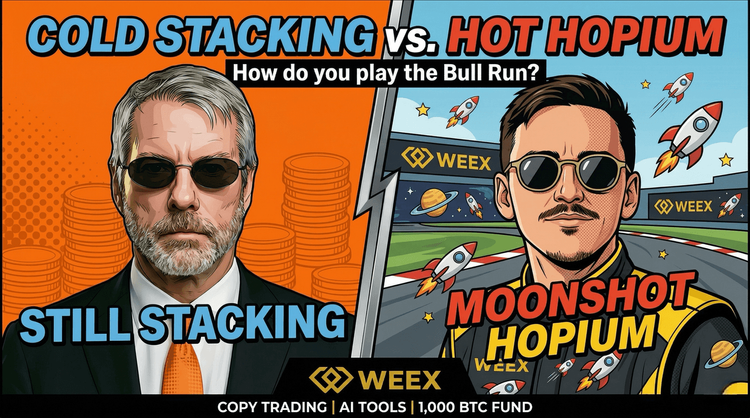
BTC Firm Above 70K! Saylor’s "Institutional Logic" vs. Moon’s "Retail Faith": Who is Really Harvesting the Market?
Bitcoin is holding firm above the $70,000 support level following a massive short squeeze that liquidated $427 million. As the "Four-Year Cycle" narrative shifts, the market is split: Michael Saylor’s cold, institutional "indiscriminate stacking" vs. Carl Moon’s high-energy retail "hopium." This article decodes these two polar-opposite strategies for the 2026 bull run and reveals how WEEX’s institutional-grade liquidity and AI trading tools empower every type of investor to convert market volatility into profit.

The Girl Who Created the SBTI Test: A Story of a Doomed Cyber Love, an E-Widow Ratfolk

B.AI Officially Launched: Building AI Agent Financial Bedrock Platform, Driving AGI Era Business Underlying Logic

B.AI Officially Launched: Breaking Down A2A Collaboration Barriers to Unlock the Smart Body Economy's Full Potential
We helped Xu Mingxing write a book called "<OK Life>".

Rare APY of 400%, is TradeXYZ handing out money to oil bulls?
a16z: Perpetual Contracts are Rewriting Global Trading Rules
Bitcoin Hits $73,000 Triggering $427M Short Liquidation | Carl Moon: $200,000 is the Target
April 9, 2026 (UTC+0), 22:17. Bitcoin (BTC) executed a high-velocity surge within minutes, heavy-hitting the $73,000 psychological barrier and touching a local high near $74,000. While the price has since retraced to consolidate above $72,000, this "instant ambush" successfully completed a $427M liquidation of short positions.
After two years, Hong Kong's first batch of stablecoin licenses finally issued: HSBC, Standard Chartered make the cut
The person who helped TAO rise by 90% has now single-handedly crashed the price again today
3-Minute Guide to Participating in the SpaceX IPO on Bitget
Top 5 Cryptos to Buy in 2026 Q1: A ChatGPT Deep Dive Analysis
Explore the top 5 cryptos to buy in Q1 2026 including BTC, ETH, SOL, TAO, and ONDO. See price outlooks, key narratives, and institutional catalysts shaping the next market move.
How to Earn $15,000 with Idle USDT Before Altcoin Season 2026
Wondering if altcoin season is coming in 2026? Get the latest market update, and learn how to turn your idle stablecoins waiting for entry into extra rewards up to 15,000 USDT.
Can You Win Joker Returns Without Large Trading Volume? 5 Mistakes New Players Make In WEEX Joker Returns Season 2
Can small traders win WEEX Joker Returns 2026 without huge volume? Yes—if you avoid these 5 costly mistakes. Learn how to maximize card draws, use Jokers wisely, and turn small deposits into 15,000 USDT rewards.


 App
App