
 Buy Crypto
- Markets
 Futures
- Spot
- Copy Trade
- Earn
- More
From the on-chain data perspective, explore the cyclical nature of BTC gradually disappearing

Original Article Title: "Exploring the Gradual Disappearance Cycle of BTC from an On-Chain Data Perspective"
Original Article Author: Mr. Berg, On-Chain Data Analyst
The BTC, bearing the name of digital gold, is still young, and the four-year cycle of disappearance is an inevitable path to follow.
Key Points:
· BTC's strong periodicity is inevitably gradually disappearing
· 2021's two tops: a complete failure of the SWORD philosophy
· A first in history: significant changes in the URPD chip structure
· Analysis methods and strategies post-periodic disappearance
The Inevitable Disappearing Periodicity
I believe most people in the crypto community are no strangers to BTC's strong periodicity. Stemming from the design of a halving in production every four years, BTC's price trend appears to correspond perfectly to it.
At the end of 2013, 2017, and 2021, there were three precise periodicity tops, each corresponding perfectly to the four-year cycle, making it a benchmark for countless market participants.
However, from a scientific perspective, relying solely on historical patterns clearly cannot lead to rigorous conclusions.
As the impact of the halving diminishes step by step and market valuation grows, there is currently no viewpoint supporting the four-year cycle theory that can withstand scientific scrutiny.
If periodicity disappears in the future, how should we, as traders, respond?
The Strongest Group: Participants Holding for 1 to 3 Years
In history, there has been a group whose behavior always perfectly aligns with BTC's bull and bear cycles, and that group is the market participants holding for "1 to 3 years."
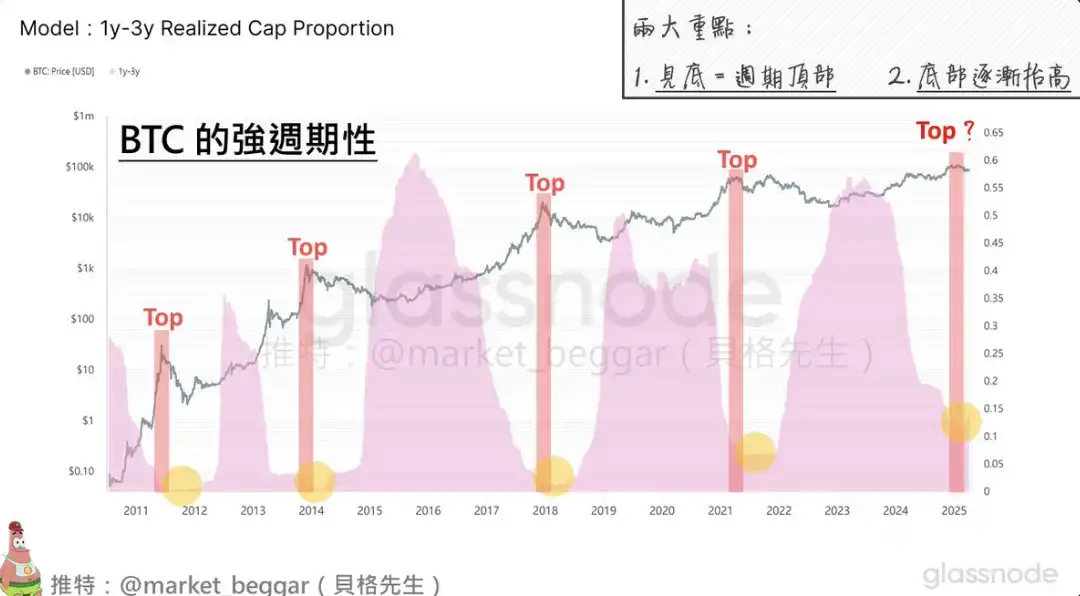
(Chart Description: Percentage of Market Participants Holding for 1-3 Years)
We can clearly see:
· Whenever this percentage hits a bottom, it always corresponds to the cycle's price top
· Whenever this dominance reaches its peak, it always corresponds to the price's cycle bottom.
In simple terms: Whenever the BTC price peaks, they have just sold everything; and whenever the BTC price bottoms out, they have just accumulated a large number of chips.
Which is the cause and which is the effect, currently cannot be answered, but obviously the appearance of the bull-bear cycle is closely related to them.
In this chart, three points are worth noting:
1. After each cycle, the lowest value of this dominance is increasing year by year, and the reason behind it is not difficult to guess: more and more participants choose to hold BTC long-term.
2. Currently, the dominance of this group is beginning to shift towards "increase," echoing the logic of my bearish view on BTC since the end of last year. For more details, please refer to my previous post (there are follow-up updates in the comments section):
On-chain data in-depth analysis: Perhaps you need to be prepared to sell at the top at any time. https://x.com/market_beggar/status/1878653495311839475
3. It can be reasonably inferred that in the future, the bottom value of this dominance will only grow larger along the way, from obscurity to listing on a U.S. ETF, competing with gold, as BTC gradually enters the public eye, more people willing to hold BTC will also increase.
Two Peaks in 2021: The Complete Failure of the Carving Boat Seekers
Previously, I have written several articles specifically discussing the double top of 2021.
Among them, in the article "Revisiting the Double Top of 2021: What is 'Future Data Leakage'?" I clearly pointed out the uniqueness of the 2021 double top and elaborated on why you cannot seek a sword by carving a boat.
Article link: https://x.com/market_beggar/status/1891335031177851380
Combining today's theme, I will approach the analysis from another perspective:
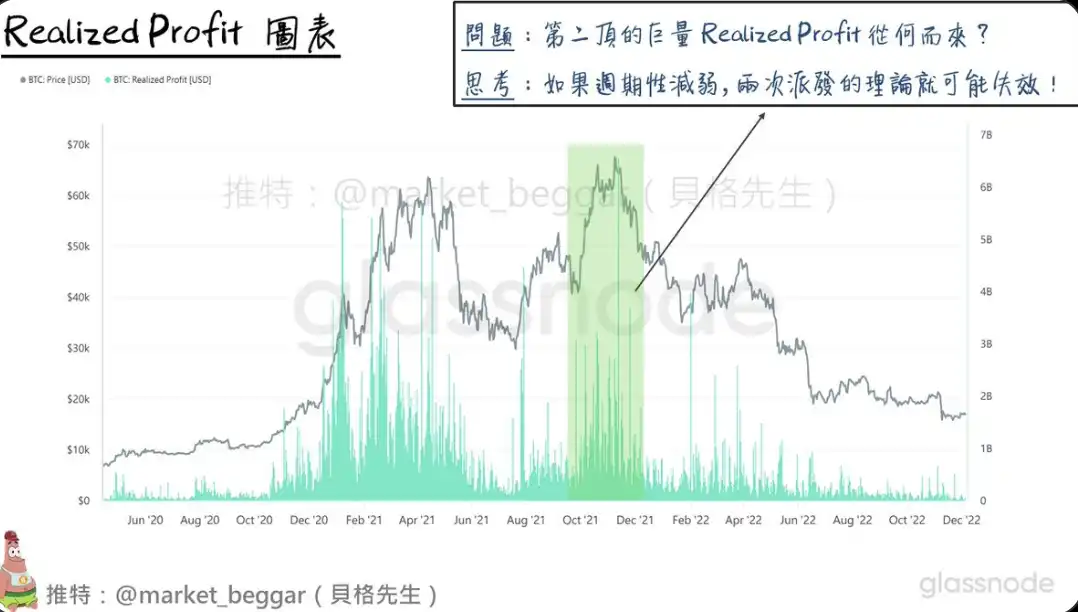
(Chart Description: Realized Profit)
The so-called Realized Profit is based on the on-chain UTXO accounting principle, which calculates the daily profit that has been realized.
In a pinned post of mine, it was also mentioned that whenever centralized, massive Realized Profit appears, it indicates a large amount of low-cost chips being sold off for cashing out, serving as a major warning signal.
For a detailed analysis logic, please refer to the following text:
Top Signal Tracking: Massive Realized Profit Recap https://x.com/market_beggar/status/1882645089786450368
From the perspective of on-chain data, in fact, the cycle had already ended in April 2021 (the first peak) (https://x.com/market_beggar/status/1889878465056481309); however, subsequently, due to various factors, BTC made the second peak in November 2021.
As shown in the above chart, at the time of the second peak, it was also accompanied by a massive Realized Profit. So, the question arises: "Where did this massive Realized Profit come from?"
Combining the first chart, the group with a holding period of 1 to 3 years actually bottomed out in April 2021, so the massive Realized Profit at the second peak can only come from the group that accumulated chips from "May to July 2021."
The point worth pondering is right here:
If cyclical bottoms gradually disappear in the future, will there be more instances of this kind of "brief bottoming" followed by the beginning of a new major uptrend?
As mentioned in my previous articles, past peaks often accompanied two large-scale distributions, and indeed, this cycle also saw the second large-scale distribution in December of last year. But if, with the decreasing volatility in the future, only one distribution is needed to complete BTC's new-style bull-bear cycle transition
It's worth a deep thought.
First in History: Massive Transformation of URPD Chip Structure
Next, let's discuss this topic from the perspective of chip structure.
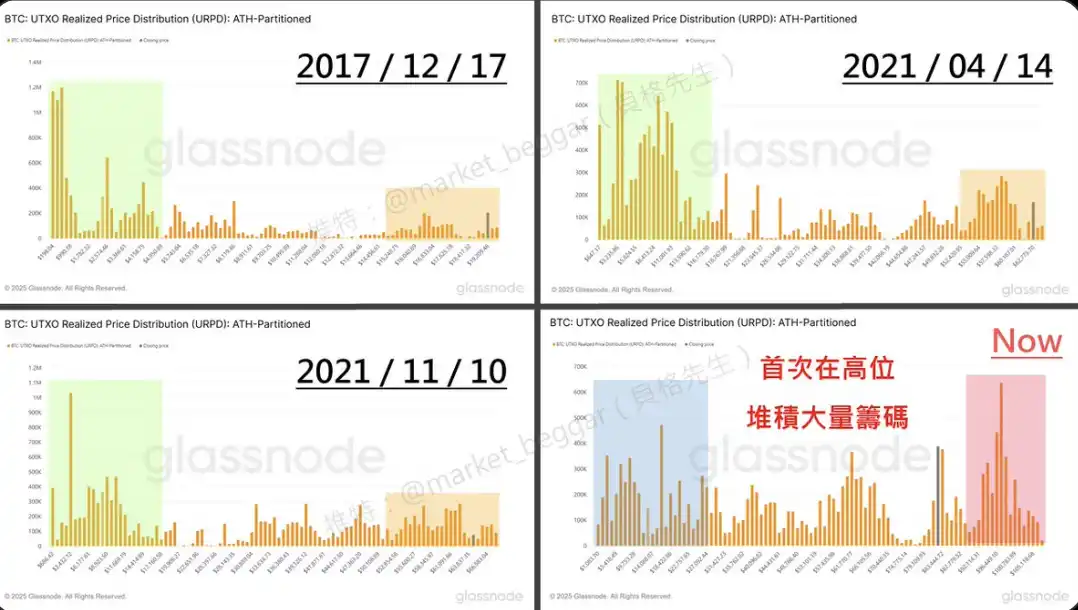
(Chart Description: Comparison of URPD Chip Structure at Previous Three Cycle Peaks)
You can see: This cycle is the most special one so far.
We say this because:
This is the first time in history that a massive amount of chips has accumulated in the top area of the cycle after the second large-scale distribution.
Previously, I have also written about this topic, detailed views can be seen in the following article:
BTC Chip Analysis: Discussing the Biggest Potential Chip Structure Risk on URPD https://x.com/market_beggar/status/1887430338009567304
Based on this, we may have to admit: BTC is entering a new era.
Analysis Approach & Response Strategy After Cycle Disappearance
If in the future, cycle behavior does indeed continue to weaken as expected,
how should we, as traders, interpret the market situation?
First, the conclusion: Never be dogmatic, and analyze using deductive logic
In BTC's young lifespan, the sample size is severely insufficient,
which has caused numerous dogmatic theories to be overturned one after another.
Season of Altcoins, New Year Pump, Pump n days after Halving... the list is endless,
not to mention all the indicators that were knocked out in 2021.
Therefore, to overcome the problem of insufficient sample size, we must ensure the presence of logic as much as possible
in the research process.
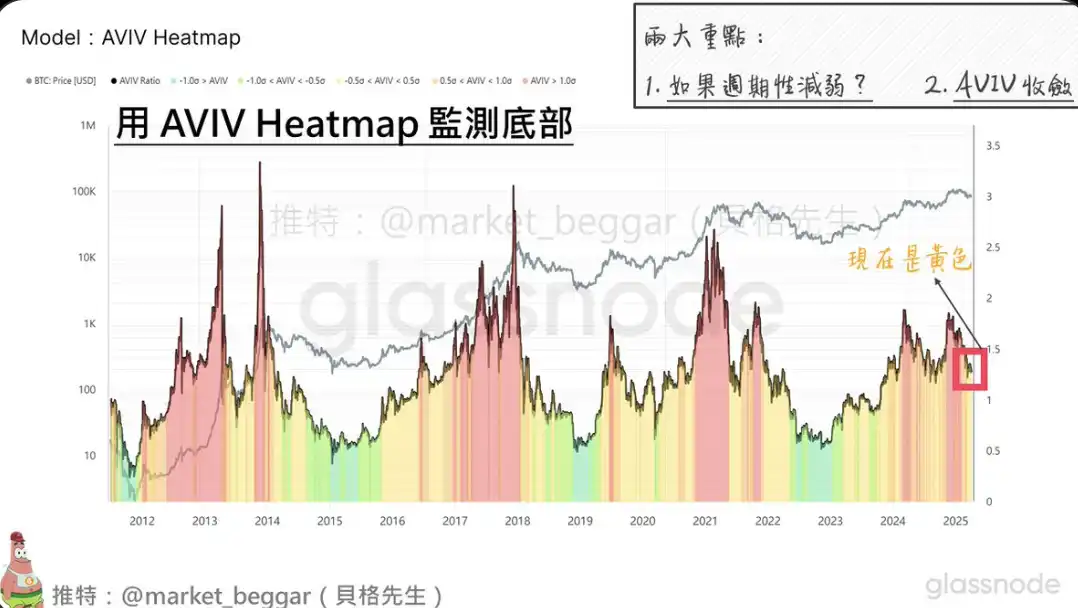
Let's take an example: AVIV Heatmap.
AVIV, seen as an optimized version of MVRV,
calculates based on active (rather than completely dormant) chips, excluding the influence of miners.
And AVIV Heatmap is one of the models I personally designed,
utilizing the mean reversion property of AVIV and coloring based on its deviation.
The advantage of this analysis method is that deviation calculation considers the "standard deviation,"
which directly reflects the BTC volatility index.
Therefore, as volatility decreases, the standards for defining extreme values in the AVIV Heatmap will also loosen.
Conclusion
Let's summarize briefly:
1. As the market matures, the disappearance of cyclicity is an inevitable path.
2. Chips held for 1 to 3 years have historically dominated the bull and bear cycles.
3. The double top in 2021 marked the failure of the "seeking a sword in a boat" methodology.
4. There has been a huge change in the chip structure that has never happened before.
5. As a trader, it is essential to ensure logical reasoning in the research process to guarantee the usability of the results.
BTC is still young, moving at an unprecedented pace towards the world's eyes,
and both you and I will be witnesses to this historic feast.
You may also like

Tiger Research: What AI services do cryptocurrency companies offer?

The war not only drives up oil prices but also causes Circle's stock price to soar

When agents become consumers, who will rewrite the underlying logic of internet commerce?

AI Agents in Action Summit: March 31, Hong Kong Cyberport, focusing on the deep waters of AI implementation

29 Days In, What Are America’s Options on Iran?

Flash Crash Down 97%+ with Ongoing Unlocking, WLD Completes $65 Million Off-chain Funding: Who Is Still Buying?

Bitcoin for Real Estate? Fannie Mae Teams Up with Coinbase to Launch Crypto Mortgage
Tether Hires Big Four Auditor, USDT Enters First Attestation Phase

Google AI Paper Destroys $900B Storage Stock, Accused of Faking Experiment
Evaporate $2 Trillion, U.S. Stocks See Worst Start in 4 Years, Why is the Market Bearish?

The speed at which AI discovers vulnerabilities has surpassed the speed at which it patches vulnerabilities.

AI Crypto Trading Bot Explained: Aurora's Multi-Factor Strategy in WEEX Hackathon
Aurora demonstrates how structured, multi-agent AI Trading systems can deliver more adaptive and resilient performance in the WEEX AI Trading Hackathon.

Cyber Taoist Fortune Teller: Fake Taoist, AI Fortune Telling, and Northeastern Metaphysics History

Bloomberg: Stablecoin Payments Emerge as Crypto VC's Newest Favorite Thing
BeatSwap is evolving towards a full-stack Web3 infrastructure, covering the entire lifecycle of IP rights.
BeatSwap, a global Web3 Intellectual Property (IP) infrastructure project, is attempting to overcome the current fragmentation limitations of the Web3 ecosystem, building a full-stack system that covers the entire lifecycle of IP rights.
Currently, most Web3 projects are still in the stage of functional fragmentation, often focusing only on a single aspect, such as IP asset tokenization, transaction functionality, or a simple incentive model. This structural dispersion has become a key bottleneck hindering the industry's scale application.
BeatSwap's approach is more integrated, integrating multiple core modules into the same system, including:
· IP authentication and on-chain registration
· Authorization-based revenue sharing mechanism
· User-engagement-driven incentive system
· Transaction and liquidity infrastructure
Through the above integration, the platform builds an end-to-end closed-loop path, allowing IP rights to complete a full cycle of "creation, use, and monetization" within the same ecosystem.
BeatSwap is not limited to existing crypto users but is attempting to take the global music industry as a starting point, actively creating new market demand. Its core strategies include:
Exploring and incubating music creators (Artist discovery)
Building a fan community
Igniting IP-centric content consumption demand
The current global music industry is valued at around $260 billion, with over 2 billion digital music users. This means that the potential market corresponding to the tokenization and financialization of IP far exceeds the traditional crypto user base.
In this context, BeatSwap positions itself at the intersection of "real-world content demand" and "on-chain infrastructure," attempting to bridge the structural gap between content production and financial flow.
BeatSwap's upcoming core product "Space" is scheduled to launch in the second quarter of 2026. This product is defined as the SocialFi layer in the ecosystem, aiming to directly connect creators with users and achieve deep integration with other platform modules.
Key designs include:
A fan-centric interactive mechanism
Exposure and distribution logic based on $BTX staking
User paths connected to DeFi and liquidity structures
Thus, a complete user behavior loop is formed within the platform: Discovery → Participation → Consumption → Rewards → Trading
$BTX is designed to be a core utility asset within the ecosystem, rather than just a simple incentive token, with its value directly tied to platform activity and IP use cases.
Main features include:
· Yield distribution based on on-chain authorized actions
· Value reflection based on IP usage and user engagement dynamics
· Support for staking and DeFi participation mechanisms
· Value growth driven by ecosystem expansion
With the increased frequency of IP use, the utility and value support of $BTX will enhance simultaneously, helping alleviate the "disconnect between value and utility" issue present in traditional Web3 token models to some extent.
Currently, $BTX has been listed on several mainstream exchanges, including:
Binance Alpha
Gate
MEXC
OKX Boost
As the launch of "Space" approaches, BeatSwap is actively pursuing more exchange listings to further enhance liquidity and global accessibility, laying a foundation for future market expansion.
BeatSwap's goal is no longer limited to the traditional Web3 narrative but aims to target over 2 billion digital music users and a trillion KRW-scale content market.
By integrating content creators, users, capital, and liquidity into a blockchain framework centered around IP rights, BeatSwap is striving to build a next-generation infrastructure focused on "IP tokenization."
BeatSwap integrates IP authentication, authorization distribution, incentive mechanism, transaction system, and market construction to establish a unified structure that bridges the full lifecycle path of IP rights.
With the launch of the Q2 2026 "Space," the project is expected to become a key infrastructure connecting content and finance in the IP-RWA (Real World Assets) track.

Mag 7 Evaporates $2 Trillion | Rewire News Morning Edition

Losing $19K per Coin Mined, Bitcoin Mining Firms Collective AI Defection



 App
App