
 Buy Crypto
- Markets
 Futures
- Spot
- Copy Trade
- Earn
- More
Huma Finance 2.0 Officially Launches on Solana, Bringing Composable Yield to DeFi Users

Source: Huma Finance
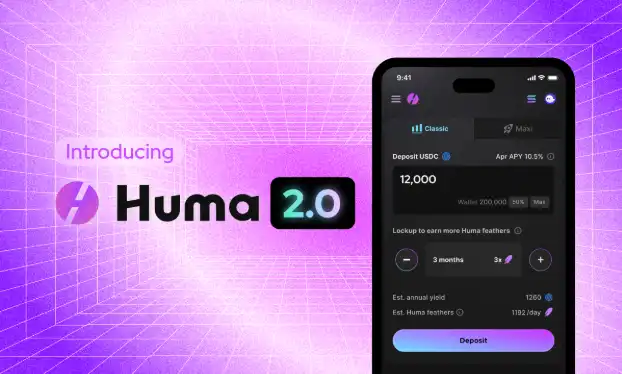
The first Payment Financial Network, Huma Finance, today announced the launch of Huma 2.0, a permissionless, compliant, and composable yield platform built on Solana. This platform opens up stable real yield generated from global payment financing derived from everyday commercial trading activities to users worldwide, marking a significant advancement where the previously elusive double-digit stable yield category, outside the realm of institutional finance, is now widely accessible to individual users. The existing permissioned service has been concurrently rebranded as Huma Institutional, continuing to serve institutions and accredited investors. Users can immediately start depositing on the brand-new Huma 2.0 platform.
Huma 2.0 provides users with diversified liquidity provision participation modes, launching two primary modes to cater to different needs: Classic Mode is designed for users seeking a stable double-digit USDC yield (currently at 10.5% APY, updated monthly) while offering a base reward called Huma Feathers; Maxi Mode is suited for users looking to maximize their accumulation of Huma Feathers, offering a 5x baseline reward rate (but without receiving USDC yield). Users can switch the mode of their existing positions at any time.
DeFi composability is a core feature of Huma 2.0 achieved through the PayFi Strategy Token (PST). This liquid interest LP token enables holders to integrate their Huma positions with leading Solana ecosystem protocols. At launch, users can swap PST for USDC through the aggregator Jupiter, marking the initial step of the integration plan with top Solana DeFi platforms. Subsequently, support will quickly follow on Kamino to use $PST as collateral and to trade future yields via RateX. Participation does not require locking, but users can opt for a 3-month or 6-month term that significantly boosts Huma Feather rewards through a multiplier. It is noteworthy that in the early stages of launch, these reward multipliers will see a substantial increase as part of a limited-time promotion, with particularly attractive bonuses in the Maxi Mode. These features provide users with enhanced flexibility and choice in managing their positions.
In just two years, Huma Finance's Payment Financial Network has rapidly scaled, processing over $3.8 billion in transactions, generating $8 million in annualized revenue. Huma assists partners in earning revenue from its payment finance business. Unlike DeFi yields relying on token incentives, market speculation, or traditional finance's low rates, payment finance yield directly stems from the fees paid by enterprise usage of the network for payment financing and settlement liquidity. Funds typically circulate rapidly within a few days, compounding continuously from fees generated by real-world economic activities. This mechanism enables Huma to consistently offer a stable double-digit USDC yield. Its sustainable model has garnered endorsements from top investors and been recognized by industry analysts such as Messari—payment finance is poised to leverage a $30 trillion market scale.
"Huma 2.0 is not just another yield product—it represents a structural shift." Huma Finance Co-Founder Erbil Karaman stated, "By providing payment institutions with a 24/7 operational and remarkably capital-efficient novel liquidity source, we are creating a new form of yield rooted in real economic activity, with composability and transparency. It finally allows DeFi to tap into a long-standing institutional-exclusive yield source without compromising DeFi's core strengths."
The launch of Huma 2.0 comes at a significant transformation period for the global financial and DeFi ecosystem. As traditional payment infrastructures like SWIFT face challenges in speed and transparency, with trillions of dollars still inefficiently deployed, the demand for blockchain-based modern solutions is increasingly evident—reportedly, stablecoin annual transaction volumes have surpassed $35 trillion. Seizing the opportunity, Huma 2.0 provides efficient settlement liquidity, enabling individuals worldwide to benefit from foundational financial activities—a realm previously dominated by institutions.
Crucially, the revenue generated by payment finance does not fluctuate with the crypto market cycle. Regardless of market boom or slump, underlying economic activities like payment and trade continue to operate, providing a stable source of revenue for Huma. This stability makes double-digit fixed income particularly valuable in bear markets, shining even brighter when speculative gains fade. As DeFi matures, the market is now prepared for such revenue rooted in real-world business (rather than token speculation). Payment finance as the foundational layer is fostering new DeFi strategies, such as Solmate, recently launched by Splyce—combining Huma's $PST yield with SOL liquidity staking, bridging DeFi and productive economic purposes.
Huma 2.0 marks a crucial step in building the new financial future, fundamentally expanding the scope of the financial revolution through an open and inclusive participation model. Early participants can enjoy various reward multipliers, including historical deposit user bonuses and promotion bonuses. As the platform expands more DeFi integrations and plans to become the launch platform's first major project for Jupiter's LFG 2.0—Huma continues to build a truly inclusive financial system.
To learn more about Huma 2.0 or get involved, please visit this link or follow @humafinance on X platform.
About Huma Finance
Huma is the first Payment Finance (PayFi) network, utilizing an open liquidity protocol stack, covering key areas such as cross-border payments, stablecoin debit cards, and trade financing applications. The network targets a market exceeding $30 trillion in total size, aiming to accelerate fund movement in an ever-active world.
This article is a contribution and does not represent the views of BlockBeats.
You may also like

Tiger Research: What AI services do cryptocurrency companies offer?

The war not only drives up oil prices but also causes Circle's stock price to soar

When agents become consumers, who will rewrite the underlying logic of internet commerce?

AI Agents in Action Summit: March 31, Hong Kong Cyberport, focusing on the deep waters of AI implementation

29 Days In, What Are America’s Options on Iran?

Flash Crash Down 97%+ with Ongoing Unlocking, WLD Completes $65 Million Off-chain Funding: Who Is Still Buying?

Bitcoin for Real Estate? Fannie Mae Teams Up with Coinbase to Launch Crypto Mortgage
Tether Hires Big Four Auditor, USDT Enters First Attestation Phase

Google AI Paper Destroys $900B Storage Stock, Accused of Faking Experiment
Evaporate $2 Trillion, U.S. Stocks See Worst Start in 4 Years, Why is the Market Bearish?

The speed at which AI discovers vulnerabilities has surpassed the speed at which it patches vulnerabilities.

AI Crypto Trading Bot Explained: Aurora's Multi-Factor Strategy in WEEX Hackathon
Aurora demonstrates how structured, multi-agent AI Trading systems can deliver more adaptive and resilient performance in the WEEX AI Trading Hackathon.

Cyber Taoist Fortune Teller: Fake Taoist, AI Fortune Telling, and Northeastern Metaphysics History

Bloomberg: Stablecoin Payments Emerge as Crypto VC's Newest Favorite Thing
BeatSwap is evolving towards a full-stack Web3 infrastructure, covering the entire lifecycle of IP rights.
BeatSwap, a global Web3 Intellectual Property (IP) infrastructure project, is attempting to overcome the current fragmentation limitations of the Web3 ecosystem, building a full-stack system that covers the entire lifecycle of IP rights.
Currently, most Web3 projects are still in the stage of functional fragmentation, often focusing only on a single aspect, such as IP asset tokenization, transaction functionality, or a simple incentive model. This structural dispersion has become a key bottleneck hindering the industry's scale application.
BeatSwap's approach is more integrated, integrating multiple core modules into the same system, including:
· IP authentication and on-chain registration
· Authorization-based revenue sharing mechanism
· User-engagement-driven incentive system
· Transaction and liquidity infrastructure
Through the above integration, the platform builds an end-to-end closed-loop path, allowing IP rights to complete a full cycle of "creation, use, and monetization" within the same ecosystem.
BeatSwap is not limited to existing crypto users but is attempting to take the global music industry as a starting point, actively creating new market demand. Its core strategies include:
Exploring and incubating music creators (Artist discovery)
Building a fan community
Igniting IP-centric content consumption demand
The current global music industry is valued at around $260 billion, with over 2 billion digital music users. This means that the potential market corresponding to the tokenization and financialization of IP far exceeds the traditional crypto user base.
In this context, BeatSwap positions itself at the intersection of "real-world content demand" and "on-chain infrastructure," attempting to bridge the structural gap between content production and financial flow.
BeatSwap's upcoming core product "Space" is scheduled to launch in the second quarter of 2026. This product is defined as the SocialFi layer in the ecosystem, aiming to directly connect creators with users and achieve deep integration with other platform modules.
Key designs include:
A fan-centric interactive mechanism
Exposure and distribution logic based on $BTX staking
User paths connected to DeFi and liquidity structures
Thus, a complete user behavior loop is formed within the platform: Discovery → Participation → Consumption → Rewards → Trading
$BTX is designed to be a core utility asset within the ecosystem, rather than just a simple incentive token, with its value directly tied to platform activity and IP use cases.
Main features include:
· Yield distribution based on on-chain authorized actions
· Value reflection based on IP usage and user engagement dynamics
· Support for staking and DeFi participation mechanisms
· Value growth driven by ecosystem expansion
With the increased frequency of IP use, the utility and value support of $BTX will enhance simultaneously, helping alleviate the "disconnect between value and utility" issue present in traditional Web3 token models to some extent.
Currently, $BTX has been listed on several mainstream exchanges, including:
Binance Alpha
Gate
MEXC
OKX Boost
As the launch of "Space" approaches, BeatSwap is actively pursuing more exchange listings to further enhance liquidity and global accessibility, laying a foundation for future market expansion.
BeatSwap's goal is no longer limited to the traditional Web3 narrative but aims to target over 2 billion digital music users and a trillion KRW-scale content market.
By integrating content creators, users, capital, and liquidity into a blockchain framework centered around IP rights, BeatSwap is striving to build a next-generation infrastructure focused on "IP tokenization."
BeatSwap integrates IP authentication, authorization distribution, incentive mechanism, transaction system, and market construction to establish a unified structure that bridges the full lifecycle path of IP rights.
With the launch of the Q2 2026 "Space," the project is expected to become a key infrastructure connecting content and finance in the IP-RWA (Real World Assets) track.

Mag 7 Evaporates $2 Trillion | Rewire News Morning Edition

Losing $19K per Coin Mined, Bitcoin Mining Firms Collective AI Defection



 App
App