
 Buy Crypto
- Markets
 Futures
- Spot
- Copy Trade
- Earn
- More
Interpreting the on-chain data timestamp: an important basis for judging the transition of the bull market cycle

Original title: "Important basis for judging the transition of the bull market cycle - the timestamp of on-chain data"
Original author: Murphy, on-chain data analyst
There are 2 core concepts in the on-chain data analysis of BTC, namely "timestamp" and "price stamp". The transparency of the blockchain allows us to observe each on-chain transaction and identify two key details: 1. The time when the chip movement occurs: timestamp; 2. The price when the transaction occurs: price stamp;
When we analyze the transition of stage trends, the data used, such as turnover cost, profit realization, demand inflow, hot supply, etc., are mainly based on "price stamp". If we want to observe and analyze the timeliness of the BTC cycle, we need to use "timestamp" more.
Each BTC exists in a certain UTXO, and the timestamp function of UTXO means that each BTC has an age, which does not refer to the time when it was mined, but the time from the last move to the present.
We can distinguish BTCs of different ages by the length of time, for example, they can be divided into 1 week-1 month (1w-1m), or 1-2 years (1-2y), etc. Usually we classify BTCs that have not been moved for more than 6 months (more than 155 days to be precise) or more as long-term holders (LTH) chips, and the rest are classified as short-term holders (STH) chips.
Looking back at the entire development history of BTC, every time there is a bull market cycle, LTH distributes chips to STH; at this time, the proportion of wealth owned by the "old coin group" begins to gradually decline (as shown by the green dotted line in Figure 1);
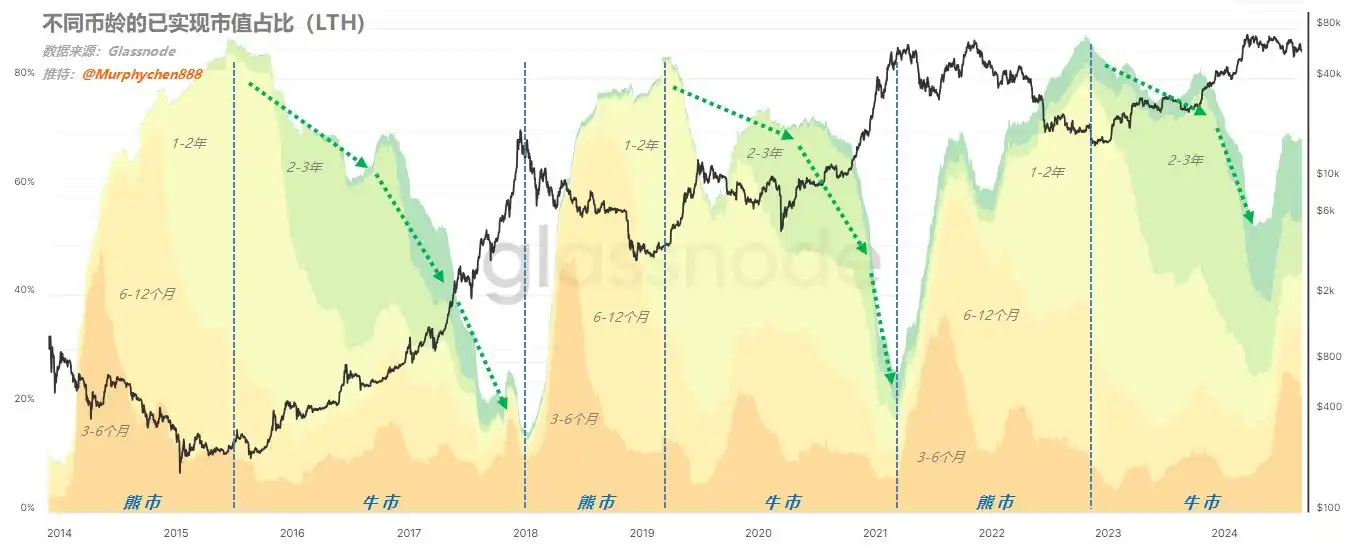
(Figure 1)
In the bear market, the chips return from STH to LTH, and the proportion of wealth owned by the "new coin group" begins to gradually decline (as shown by the green dotted line in Figure 2);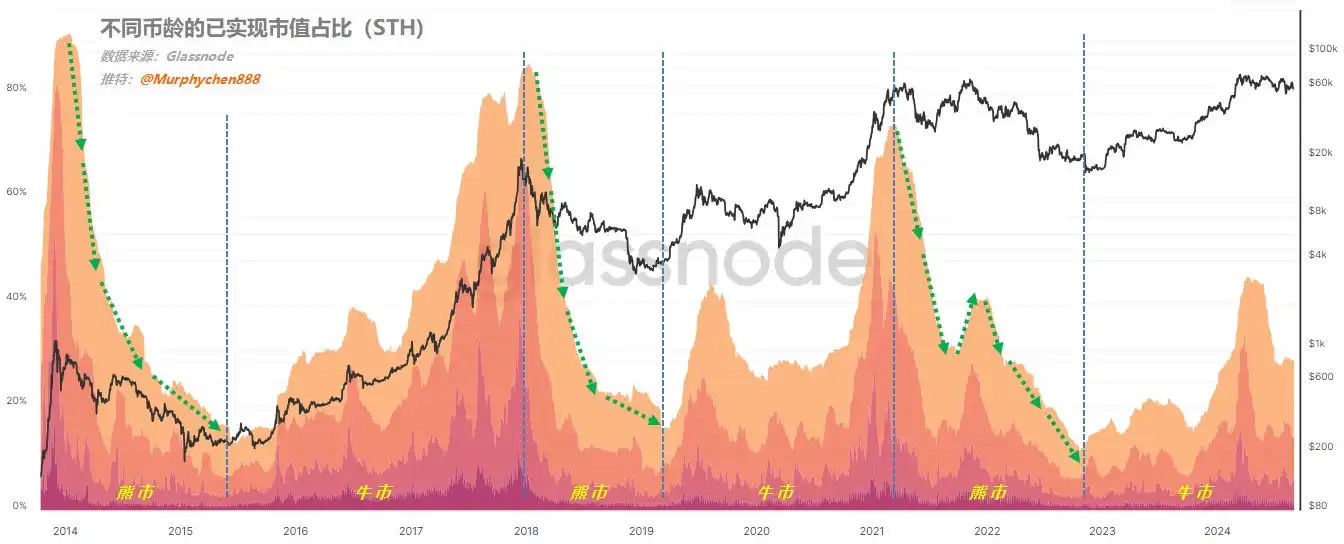
(Figure 2)
It can be seen that the waveforms in Figure 1 (old coin) and Figure 2 (new coin) are exactly opposite, I call this BTC The "pendulum effect" of the big cycle; the market always follows this endogenous law under the transformation of supply and demand, just like a pendulum, repeating over and over again.
In the large LTH group, the group that has the greatest impact on the cycle transition and even plays a decisive role is the 1-2y and 2-3y coin age chips (diamond hands in the cycle). We can roughly infer the "timestamp" of this round of bull market cycle by observing the changing trend of this data.
Figure 3 below is the realized market value share data of 1-2y & 2-3y. Let's take a look at the overall situation first. Whenever the yellow (1-2y) and green (2-3y) waveforms reach their peaks, it means that the market is about to exit the bear market and enter the early stages of the bull market. As time goes by, the waveform begins to gradually decline, indicating that the group is distributing chips to new investors entering the market.
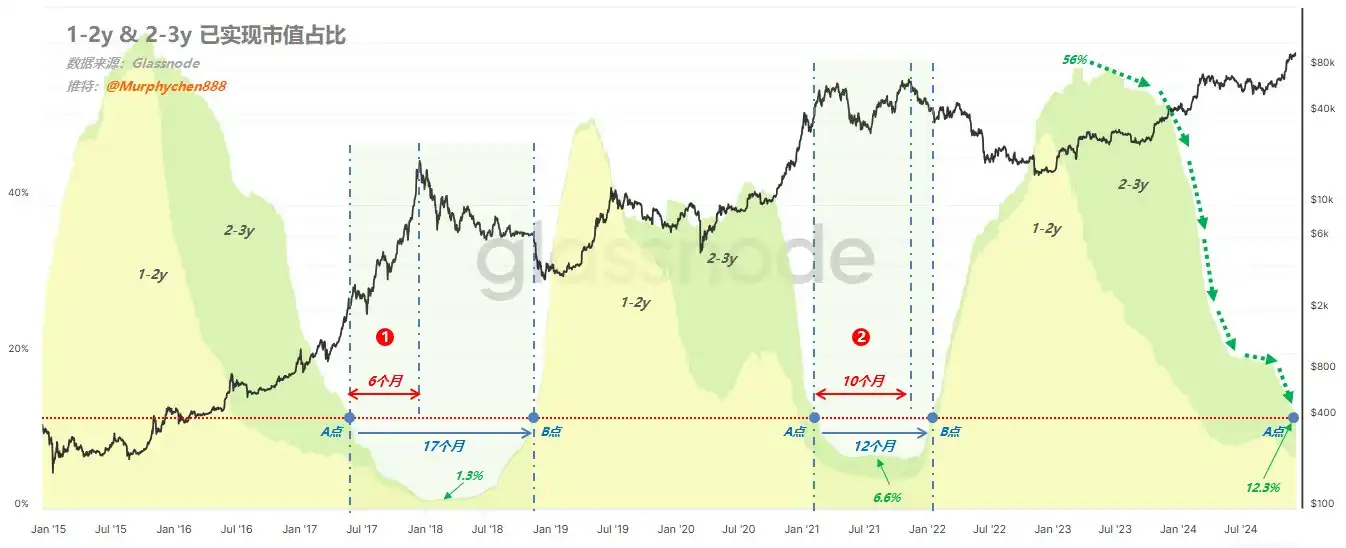
(Figure 3)
When the waveform drops to the bottom and the slope begins to slow down, it means that the market is in the middle and late stages of the bull market, which can also be considered the "top range" of the bull market. It should be noted that these two groups are the most experienced investors in the market. For example, the BTC purchased by MSTR three years ago, from December 2021 to January 2022, belongs to this group. When I bought it, it was STH, and today it has become LTH.
The current data has dropped from a peak of 56% to 12.3% (green dotted line in the figure), while the lowest values of the ratio in the previous two cycles were 1.3% (17-18 cycles) and 6.6% (21-22 cycles). Considering that more and more cross-cycle institutional investors like MSTR are joining the coin holding group, I think the lowest value of 1-2y & 2-3y in this cycle should be higher than 6.6% in the previous cycle, and it is expected to be between 7% and 10% with a high probability.
If we draw a standard line based on the current value (point A) (see the red dotted line in Figure 1), we can see that in the first two cycles, when the indicator dropped to the same position, the price of BTC was in the top range, and the relative position was in the middle and late stages of the bull market. As time goes by, the curve gradually hits the bottom and starts to turn upward, and when it returns to the original height again (point B), it usually means that the bull market is over.
From A to B is a "smile curve". The whole process took 17 months in the 17-18 cycle, and 12 months in the 21-22 cycle. According to the above analysis, the bottom of this cycle is likely to be higher than 6.6%. Therefore, I think the total duration of the "smile curve" is less than or equal to 12 months (entering a bear market) is more likely.
At the same time, we can see that in the 17-18 cycle, the time from point A to the last high point of the cycle is 6 months (Figure 3 Mark 1); the time from point A to the last high point of the cycle in the 21-22 cycle is 10 months (Figure 3 Mark 2).
Since the 17-18 cycle is a very special sharp-angled top, it is less referenceable; the 21-22 cycle double top cycle should be more worthy of reference; therefore, I think that the time period from the current point A to the future point B in this cycle is less than/equal to 10 months, perhaps about 9-10 months.
If this inference is true, then the end of this round of bull market cycle will roughly occur between September and October 2025.
Note! All the above probabilistic inferences are only my personal subjective opinions, not objective feedback from data!
After talking about the relationship between currency age conversion and cycle, let's observe from another angle - metaphysics! Three-line co-frequency resonance curve
I roughly counted that the frequency of mentioning the "three-line integration" indicator was the highest in the questions sent to me in the background. Friends seem to be very obsessed with this; although I know that this indicator has shown magical accuracy many times in this cycle, I still think that we should not put the cart before the horse. We should look at the objective data first, and then use the "three lines in one" for reference.
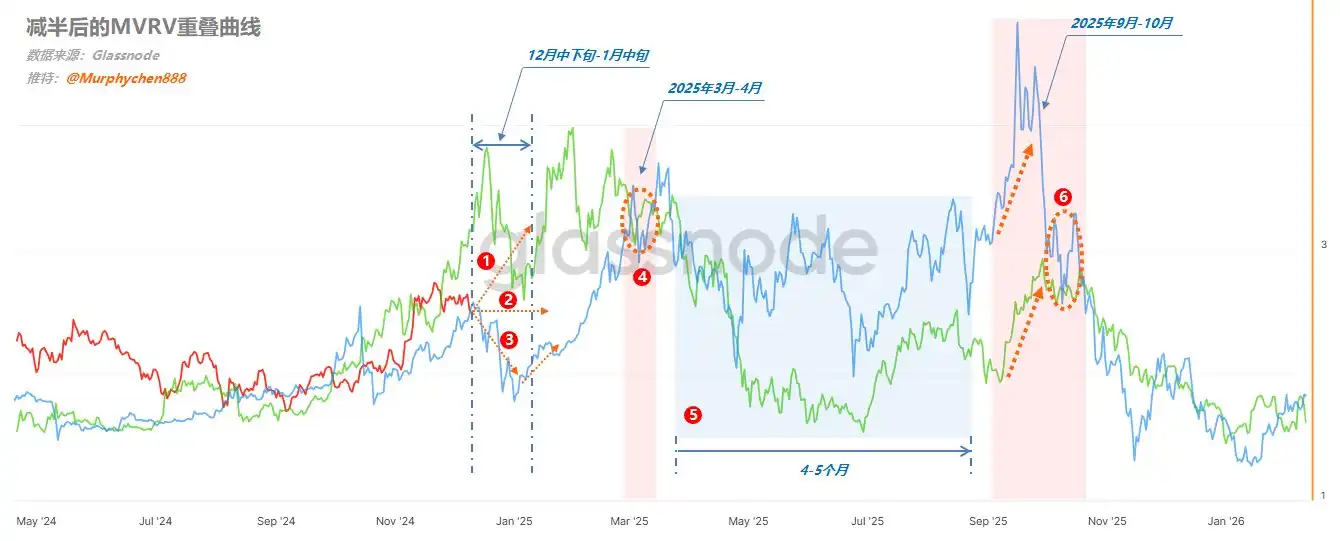
(Figure 4)
Based on the information feedback in the figure, I give the following more subjective interpretations. Friends, please look at it rationally and should not use it as the only basis for judgment!
1. At present, the red line has reached a critical turning point. From the position point of view, the red line is closer to the blue line, and it is a little distance away from the upper green line, and there is no consistency in the adhesion of the three lines.
That is to say, from mid-to-late December to mid-January, there will be 3 possible deviations: continue to break new highs (Figure 4 Mark 1)/consolidation (Figure 4 Mark 2)/pullback (Figure 4 Mark 3); but from the overall trend, the green line and the blue line are both in a pullback state during this stage. Therefore, I personally think that the probability of 3 and 2 is greater than 1;
Emotionally, I prefer 2, and 1 is the least likely; of course, a moderate pullback will also be more conducive to the continuation of this round of trends.
2. Many of you may remember that in my previous analysis of the "three-line integration" indicator, I mentioned: "Around 2024.12-2025.1, MVRV will have a sharp correction." At present, from the comprehensive observation of other on-chain data, this so-called "significant" may not be as big as imagined. There are two reasons:
a. In the current on-chain chip structure distribution, a huge column of 600,000 BTC is formed at $97,000, and there are nearly 2 million BTC accumulation in the 9.4w-10w US dollar range, creating a potential support range.
b. Judging from the current new demand data, although there has been a decline, it has not dropped below the zero axis quickly. In other words, there is still a certain scale of demand in the market, and it can maintain a certain degree of balance.
3. The green and blue lines in the figure are glued at the mark 4, and the glued position is significantly higher than the current (mark 4 in Figure 4), which means that there will be another wave of market in March-April 2025.
According to the current "on-chain average turnover cost" and "active investor average cost" data, I calculated that the price of BTC in March-April has a certain probability of reaching more than 120,000 US dollars, but not more than 150,000 US dollars (since the turnover cost will change, this calculation needs to be calibrated every 2 weeks).
4. If this wave of rebound occurs in March-April, it may be the end of this round of trend market, and the future depends on the changes in macro policies.
5. After this, the market may enter a 4-5 month long consolidation period (as marked 5 in the figure). In the early stage of this stage, the green line and the blue line are consistent and downward; but in the middle, they begin to separate, so there is also great uncertainty here. But in general, the high point of the wide range of consolidation will not exceed the peak of March-April.
6. There will be the last wave of this cycle in September-October 2025 (marked 6 in the figure). At the beginning of this stage, the green line and the blue line are separated greatly. If the red line is close to the blue line at that time, the high point of this wave of market will be higher than the peak of March-April; if the red line is close to the green line, the high point will be lower than the peak of March-April.
At the same time, we can see that the green and blue lines are glued together in the part circled by the red dotted line, and the position here is lower than the peak of March-April. Perhaps it means that the high point of September-October is more likely to be lower than the high point of March-April.
Interestingly, the conclusion of observing the "metaphysical indicator" is highly consistent with the conclusion of the temporal inference of currency age conversion mentioned above. If this is true, it means that the highest point of this cycle will appear in March-April 2025, and the high point in September-October 2025 will be the last "top" of this cycle, and the height may not be higher than the previous one (I personally prefer to be close to the previous high, not necessarily much higher).
From a trading perspective, once entering the top range, I still insist on firmly implementing trading discipline and making a batch profit-taking plan as long as there is a signal of phased attenuation, even if there may be higher highs later (this is a matter of probability). After BTC stops profit, some of the positions vacated may be considered to switch to some high-quality ALTs, and strive to find a second growth curve that outperforms the big cake in the second half of the bull market.
The data shared in this article is only for learning and research, not as investment advice.
You may also like

WEEX Official Product Launch: Win LALIGA Tickets & Unlock the 3-in-1 Crypto Trading Suite
Trade crypto without downloading an app. Join the WEEX H5, API, SKILLs livestream to explore the new trading experience, win LALIGA VIP tickets, and share 420 USDT rewards.

Dragonfly Partners: Most agents will not engage in autonomous trading, how can crypto payments prevail?

US AI Startup Goes All In on Chinese Mega-Model | Rewire News Morning Brief

Trump Lies Again: A "Five-Day Pause" Psyop, How Wall Street, Bitcoin, and Polymarket Insiders Synced Uposciogen

When a Token Becomes Labor, People Become the Interface

Ceasefire News Leaked Ahead of Time? Large Polymarket Bets on Outcome Before Trump's Tweet

BlackRock CEO's Annual Shareholder Letter: How is Wall Street Using AI to Keep Profiting from National Pension Funds?

Sun Valley Releases 2025 Financial Report: Bitcoin Mining Revenue Reaches $670 Million, Accelerating Transformation to AI Infrastructure Platform
On March 16, 2026, in Dallas, Texas, USA, CanGu Company (New York Stock Exchange code: CANG, hereinafter referred to as "CanGu" or the "Company") today announced its unaudited financial performance for the fourth quarter and full year ended December 31, 2025. As a btc-42">bitcoin mining enterprise relying on a globally operated layout and dedicated to building an integrated energy and AI computing power platform, CanGu is actively advancing its business transformation and infrastructure development.
• Financial Performance:
Total revenue for the full year 2025 was $688.1 million, with $179.5 million in the fourth quarter.
Bitcoin mining business revenue for the full year was $675.5 million, with $172.4 million in the fourth quarter.
Full-year adjusted EBITDA was $24.5 million, while the fourth quarter was -$156.3 million.
• Mining Operations and Costs:
A total of 6,594.6 bitcoins were mined throughout the year, averaging 18.07 bitcoins per day; of which 1,718.3 bitcoins were mined in the fourth quarter, averaging 18.68 bitcoins per day.
The average mining cost for the full year (excluding miner depreciation) was $79,707 per bitcoin, and for the fourth quarter, it was $84,552;
The all-in sustaining costs were $97,272 and $106,251 per bitcoin, respectively.
As of the end of December 2025, the company has cumulatively produced 7,528.4 bitcoins since entering the bitcoin mining business.
• Strategic Progress:
The company has completed the termination of the American Depositary Receipt (ADR) program and transitioned to a direct listing on the NYSE to enhance information transparency and align with its strategic direction, with a long-term goal of expanding its investor base.
CEO Paul Yu stated: "2025 marked the company's first full year as a bitcoin mining enterprise, characterized by rapid execution and structural reshaping. We completed a comprehensive adjustment of our asset system and established a globally distributed mining network. Additionally, the company introduced a new management team, further strengthening our capabilities and competitive advantage in the digital asset and energy infrastructure space. The completion of the NYSE direct listing and USD pricing also signifies our transformation into a global AI infrastructure company."
"As we enter 2026, the company will continue to optimize its balance sheet structure and enhance operational efficiency and cost resilience through adjustments to the miner portfolio. At the same time, we are advancing our strategic transformation into an AI infrastructure provider. Leveraging EcoHash, we will utilize our capabilities in scalable computing power and energy networks to provide cost-effective AI inference solutions. The relevant site transformations and product development are progressing simultaneously, and the company is well-positioned to sustain its execution in the new phase."
The company's Chief Financial Officer, Michael Zhang, stated: "By 2025, the company is expected to achieve significant revenue growth through its scaled mining operations. Despite recording a net loss of $452.8 million from ongoing operations, mainly due to one-time transformation costs and market-driven fair value adjustments, the company, from a financial perspective, will reduce its leverage, optimize its Bitcoin reserve strategy and liquidity management, introduce new capital to strengthen its financial position, and seize investment opportunities in high-potential areas such as AI infrastructure while navigating market volatility."
The total revenue for the fourth quarter was $1.795 billion. Of this, the Bitcoin mining business contributed $1.724 billion in revenue, generating 1,718.3 Bitcoins during the quarter. Revenue from the international automobile trading business was $4.8 million.
The total operating costs and expenses for the fourth quarter amounted to $4.56 billion, primarily attributed to expenses related to the Bitcoin mining business, as well as impairment of mining machines and fair value losses on Bitcoin collateral receivables.
This includes:
· Cost of Revenue (excluding depreciation): $1.553 billion
· Cost of Revenue (depreciation): $38.1 million
· Operating Expenses: $9.9 million (including related-party expenses of $1.1 million)
· Mining Machine Impairment Loss: $81.4 million
· Fair Value Loss on Bitcoin Collateral Receivables: $171.4 million
The operating loss for the fourth quarter was $276.6 million, a significant increase from a loss of $0.7 million in the same period of 2024, primarily due to the downward trend in Bitcoin prices.
The net loss from ongoing operations was $285 million, compared to a net profit of $2.4 million in the same period last year.
The adjusted EBITDA was -$156.3 million, compared to $2.4 million in the same period last year.
The total revenue for the full year was $6.881 billion. Of this, the revenue from the Bitcoin mining business was $6.755 billion, with a total output of 6,594.6 Bitcoins for the year. Revenue from the international automobile trading business was $9.8 million.
The total annual operating costs and expenses amount to $1.1 billion.
Specifically, they include:
· Revenue Cost (excluding depreciation): $543.3 million
· Revenue Cost (depreciation): $116.6 million
· Operating Expenses: $28.9 million (including related-party expenses of $1.1 million)
· Miner Impairment Loss: $338.3 million
· Bitcoin Collateral Receivable Fair Value Change Loss: $96.5 million
The full-year operating loss is $437.1 million. The continuing operations net loss is $452.8 million, while in 2024, there was a net profit of $4.8 million.
The 2025 non-GAAP adjusted net profit is $24.5 million (compared to $5.7 million in 2024). This measure does not include share-based compensation expenses; refer to "Use of Non-GAAP Financial Measures" for details.
As of December 31, 2025, the company's key assets and liabilities are as follows:
· Cash and Cash Equivalents: $41.2 million
· Bitcoin Collateral Receivable (Non-current, related party): $663.0 million
· Miner Net Value: $248.7 million
· Long-Term Debt (related party): $557.6 million
In February 2026, the company sold 4,451 bitcoins and repaid a portion of related-party long-term debt to reduce financial leverage and optimize the asset-liability structure.
As per the stock repurchase plan disclosed on March 13, 2025, as of December 31, 2025, the company had repurchased a total of 890,155 shares of Class A common stock for approximately $1.2 million.

The US AI Startup Is Loving China's Open Source Model

Three Weeks of the US-Iran War: Who's Making Money, Who's Paying the Bill?

Interpreting Polymarket's Major Update Last Night: Fee Expansion, Self-Regulation, and New Incentives

From Human Application to Intelligent Collaboration: How GOAT Network Builds the Next Generation Digital Economy

CZ Washington Dialogue: Crypto Entrepreneurs are Accelerating Their Return to the United States

Morning Report | Strategy increased its holdings by 1,031 bitcoins last week; Katana Blockchain acquires IDEX; NYSE completes rule change to eliminate trading limits on crypto ETF options

WEEX P2P now supports JOD, USD & EUR—Merchant Recruitment Now Open
To make crypto deposits easier, WEEX has officially launched its P2P trading platform and continues to expand fiat support. We're excited to announce that the Jordanian Dinar (JOD), United States Dollar (USD ) and Euro (EUR) are now available on WEEX P2P!

Electric Capital: Tracking 501 types of yield-generating RWA assets, we discovered these patterns
Those who are cut off by AI will not disappear; they will become the creators of the next round of the economy

Stablecoins reshaping cross-border payments in Asia? Strategic panorama and investment opportunity analysis
WEEX Official Product Launch: Win LALIGA Tickets & Unlock the 3-in-1 Crypto Trading Suite
Trade crypto without downloading an app. Join the WEEX H5, API, SKILLs livestream to explore the new trading experience, win LALIGA VIP tickets, and share 420 USDT rewards.


 App
App