
 Buy Crypto
- Markets
 Futures
- Spot
- Copy Trade
- Earn
- More
IOSG: The Game of No Winner, How Can the Shitcoin Market Break the Deadlock?

Original Title: "IOSG Weekly Brief | The Game with No Winners: How the Shitcoin Market is Breaking Apart"
Original Author: Momir, IOSG Ventures
The shitcoin market has experienced its most difficult period this year. To understand the reasons, we need to go back to decisions made several years ago. The 2021-2022 funding bubble has given rise to a batch of well-funded projects, and now these projects are issuing tokens, leading to a fundamental problem: a massive supply hitting the market with very little demand.
The problem is not just oversupply; what's even worse is that the mechanism causing this problem has remained largely unchanged. Projects are still issuing tokens, regardless of whether the product has a market, treating token issuance as a rite of passage rather than a strategic choice. With VC funding drying up and primary market investments shrinking, many teams have seen token issuance as the only way to raise funds or as a means for insiders to create exit opportunities.
This article will delve into the "Four-Loss Stalemate" that is unraveling the shitcoin market, examine why past repair mechanisms have failed, and propose potential rebalancing strategies.
1. Low Circulation Stalemate: A Four-Loss Game
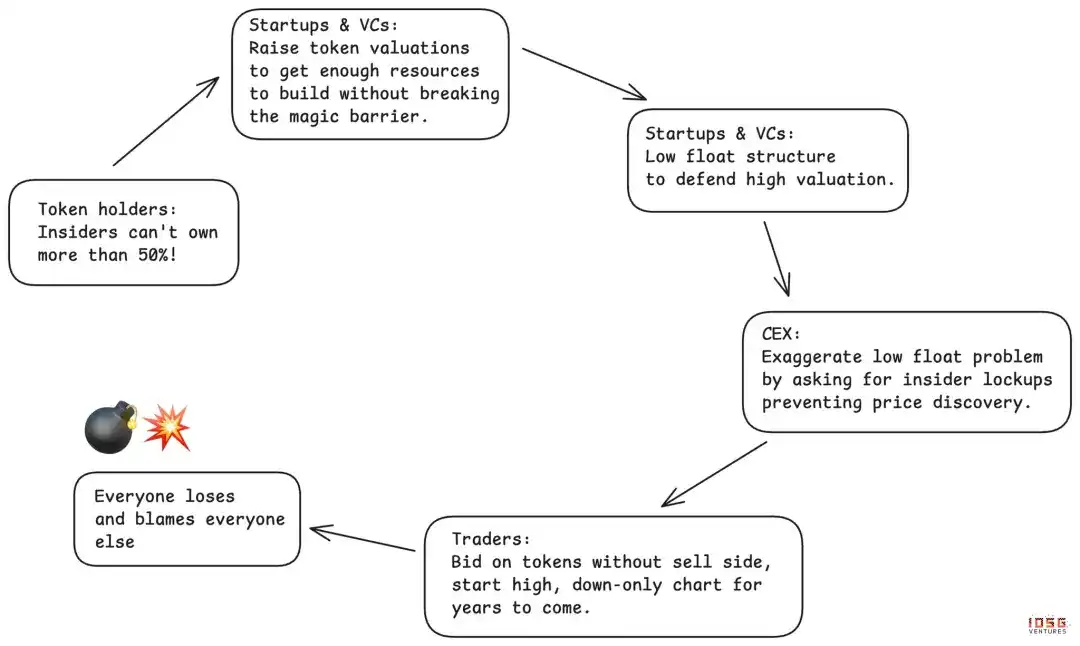
For the past three years, the entire industry has relied on a seriously flawed mechanism: low-circulation token issuance. When projects issue tokens, the circulating supply is extremely low, often only in the single-digit percentages, maintaining a high FDV (Fully Diluted Valuation) artificially. The logic seems reasonable: low supply leads to price stability.
However, low circulation cannot remain low forever. As the supply is gradually released, the price inevitably collapses. Early supporters end up being the sacrificial lambs. Looking at the data, most tokens have performed poorly since their launch.
The most cunning aspect is that low circulation has created a situation where everyone thinks they are getting a bargain but are actually at a loss:
· Centralized exchanges thought that by requiring low circulation and enhancing control to protect retail investors, they ended up facing community backlash and poor token price performance.
· Token holders thought that "low circulation" would prevent insiders from dumping their tokens, but ultimately, they neither saw effective price discovery nor benefited, instead being hit by early supporter sell-offs. When the market demanded that insiders hold no more than 50% of the tokens, primary market valuations were inflated to distorted levels, forcing insiders to rely on the low circulation strategy to maintain surface stability.
· Project teams thought that manipulating low circulation could support a high valuation and reduce dilution, but once this practice becomes a trend, it could ruin the entire industry's fundraising ability.
· Venture Capital thought they could value their holdings based on the market cap of a low-circulating token, continue fundraising, but as the strategy flaw was exposed, their mid- to long-term funding channel was instead cut off.
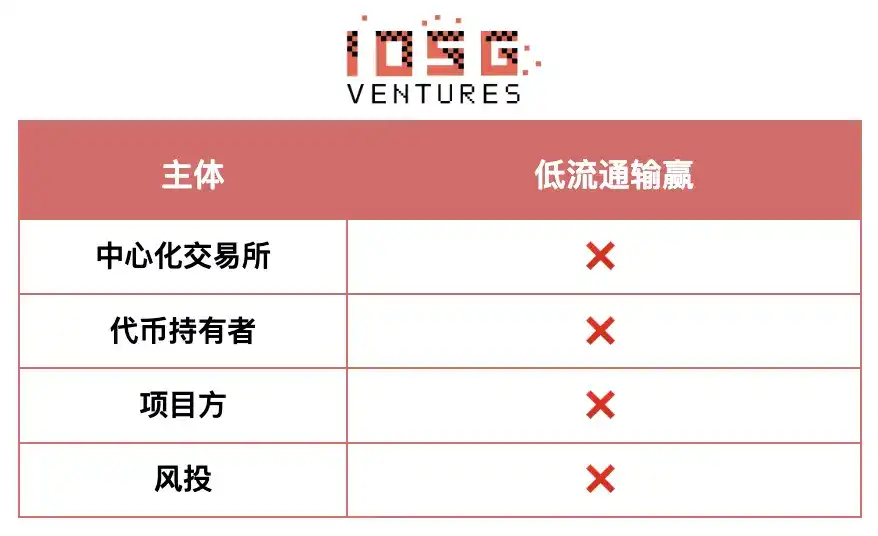
A perfect quadruple-loss matrix. Everyone thinks they are playing a big game, but the game itself is unfavorable to all participants.
2. Market Response: Meme Coin and MetaDAO
The market has attempted to break the game twice, and both attempts have exposed how complex token design can be.
Round One: Meme Coin Experiment
The Meme Coin was a counterattack against venture capital's low-circulating coin issuance. The slogan was simple and enticing: 100% circulation on the first day, no venture capital, entirely fair. Finally, retail investors would not be scammed in this game.
However, reality was much darker. Without a filtering mechanism, the market was flooded with unfiltered tokens. Solo, anonymous operators replaced venture capital teams, which not only did not bring fairness but instead created an environment where over 98% of participants lost money. The token became an exit scam tool, with holders being rugged within minutes or hours of going live.
Centralized exchanges were in a dilemma. If they didn't list Meme Coin, users would go directly to on-chain trading; if they listed Meme Coin and the price crashed, they would take the blame. Token holders suffered the most. The real winners were only the token issuers and platforms like Pump.fun.
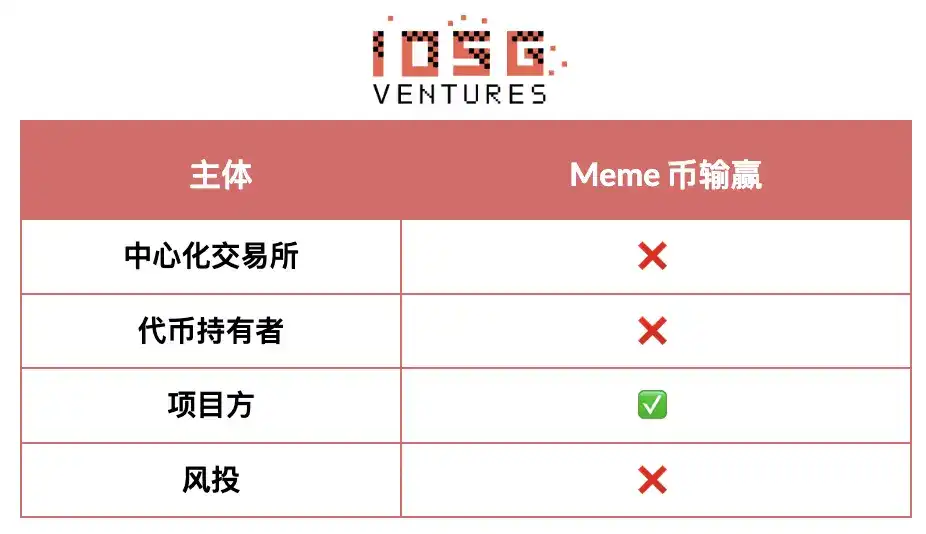
Round Two: MetaDAO Model
MetaDAO was the market's second major attempt, swinging the pendulum to the other extreme — heavily favoring holder protection.
The benefits were indeed:
· Holders gained control, making fund deployment more appealing
· Insiders could only cash out upon reaching specific KPIs
· Pioneered a new fundraising method in a capital-constrained environment
· Had a relatively lower initial valuation, offering fairer access
However, the MetaDAO model went too far and brought new issues:
· Founders lost too much control too early. This led to a "Founder Lemon Market" — teams with strength and choice avoided this model, and only teams with no way out would accept it.
The token went live very early, with huge volatility, but with less filtering mechanism than the venture capital cycle.
· The unlimited issuance mechanism makes it almost impossible for first-tier trading platforms to list the token. MetaDAO and centralized exchanges that control the vast majority of liquidity fundamentally do not match. If it can't be listed on a centralized exchange, the token is stuck in a market with exhausted liquidity.
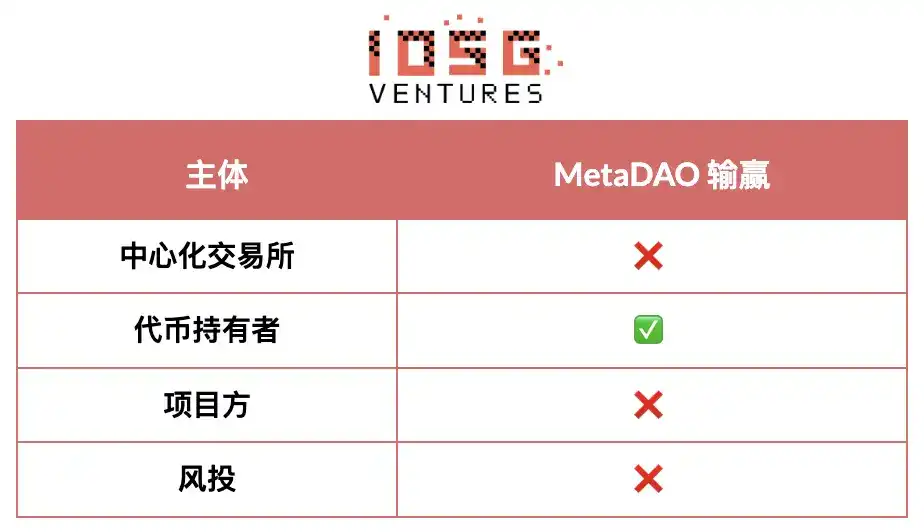
Each iteration aims to solve a problem for a particular party, proving that the market has self-regulating capabilities. But we are still looking for a balanced solution that caters to all key stakeholders: trading platforms, token holders, project teams, and capital providers.
Evolution is ongoing, and there will be no sustainable model until a balance is found. This balance is not about satisfying everyone but about drawing a clear line between harmful practices and legitimate interests.
3. What Should the Balanced Solution Look Like
Centralized Exchanges
What should stop: Requesting extended lock-up periods to hinder normal price discovery. These extended lock-ups, which may seem protective, actually hinder the market from finding a fair price.
What should be demanded: Predictability of token release schedules and effective accountability mechanisms. The focus should shift from arbitrary time locks to KPI-based unlocks, with shorter, more frequent release cycles tied to actual progress.
Token Holders
What should stop: Overcorrection due to a lack of historical rights, excessive control, which scared away top talent, trading platforms, and venture capital. Not all insiders are the same, yet insisting on uniform long-term lock-ups ignores the differences in roles, hindering fair price discovery. Persistence on the so-called magical ownership threshold ("insiders cannot exceed 50%") creates a breeding ground for low float manipulation.
What should be demanded: Strong information rights and operational transparency. Token holders should have a clear understanding of the business operations behind the token, regularly informed of progress and challenges, aware of the true state of fund reserves and resource allocations. They have the right to ensure that value will not be lost through backroom deals or value leakage through substitute structures, and the token should be predominantly owned by the IP holder to ensure that the created value belongs to the token holders. Finally, token holders should have reasonable control over budget allocation, especially for significant expenses, but should not meddle in day-to-day operations.
Project Teams
What should stop: Issuing tokens without clear signals of product-market fit or actual token utility. Too many teams treat tokens as glorified equity with poorer rights—subpar to equity and without legal protection. Token issuance should not be just because "that's how crypto projects do it" or because the money is running out fast.
Must-Have Authority: The ability to make strategic decisions, take bold bets, and handle day-to-day operations without needing approval from the DAO for everything. If you are to be accountable for the outcomes, you must have the power to execute.
Venture Capital
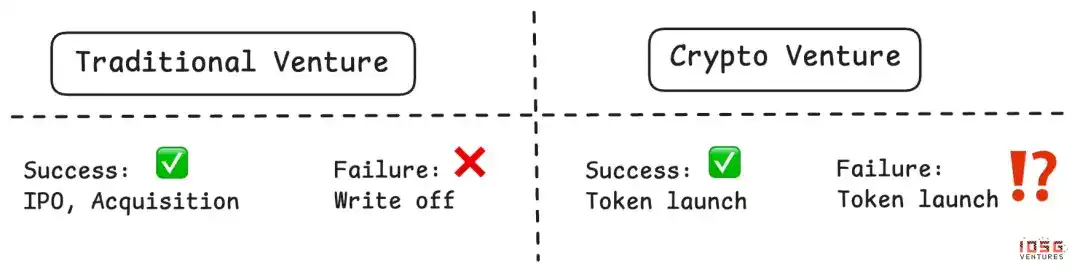
What Needs to Stop: Regardless of reasonability, forcing every funded project to issue a token. Not every crypto company needs a token, and forcibly issuing one to mark ownership or create exit opportunities has led to a market saturated with low-quality projects. Venture capital needs to be more stringent in objectively determining which companies truly fit the token model.
Must-Have Authority: Those taking on extreme risk by investing in early-stage crypto projects deserve a proportional return. High-risk capital should yield high returns when successful. This means a fair ownership stake, a vesting schedule that reflects contributions and risks taken, and the right not to be demonized when a successful investment exits.
Even if a balanced path is found, timing is crucial. The short-term outlook remains bleak.
4. Next 12 Months: The Final Wave of Supply Shock
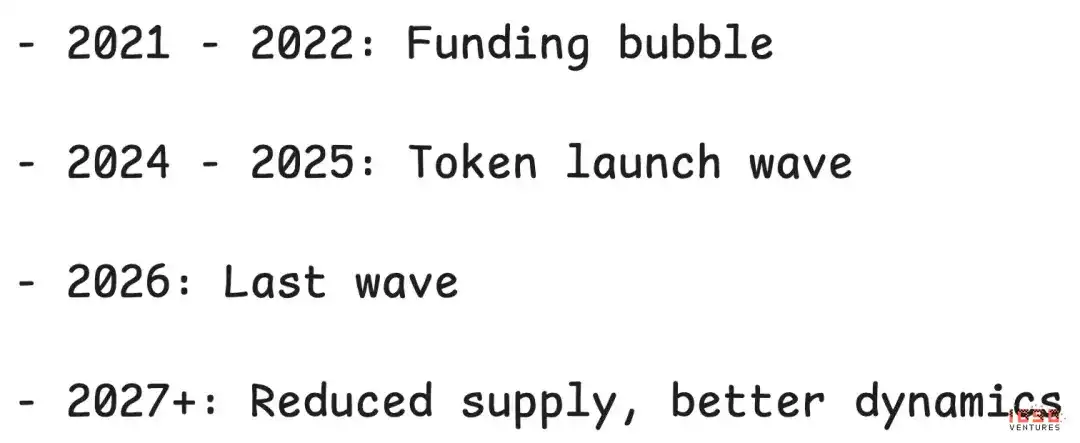
The next 12 months are likely to mark the final wave of supply glut from the last round of venture capital hype.
After weathering this digestion period, the situation is expected to improve:
· By the end of 2026, the last cycle's projects will have either fully issued their tokens or gone under
· Funding costs remain high, limiting the formation of new projects. The pipeline of venture-backed projects waiting to issue tokens significantly diminishes
· Primary market valuations return to rationality, easing the pressure of propped-up valuations on low circulation
Decisions made three years ago shaped today's market landscape. Today's decisions will dictate the market’s trajectory two to three years from now.
However, beyond the supply cycle, the entire token model faces a deeper threat.
5. Existential Crisis: Lemon Market
The biggest long-term threat is for shitcoins to become a "lemon market," where quality participants are shut out, and only those with no other options come in.
Possible evolutionary paths:
· Failed projects continue to issue tokens to gain liquidity or extend their life, even if the product has zero market fit. As long as projects are expected to issue tokens, regardless of success, failed projects will continue to flood the market.
· Successful projects see the writing on the wall and opt for an exit. When a top-notch team witnesses prolonged poor performance of the token, they may pivot to a traditional equity structure. If they can succeed as an equity firm, why endure the token market turmoil? Many projects simply lack a convincing tokenomics rationale, and for most application-layer projects, the token is shifting from a must-have to a nice-to-have.
If this trend continues, the token market will be dominated by those projects that have no other choice — the "lemons" that no one wants.
Despite the heavy risks, I remain optimistic.
6. Why Tokens Can Still Win
Despite significant challenges, I still believe the doomsday "lemon market" won't materialize. The unique game-theoretical mechanisms tokens offer are fundamentally impossible with an equity structure.
Accelerating growth through ownership distribution. Tokens can achieve precise distribution strategies and growth flywheels that traditional equity cannot. Ethena's token-driven mechanics rapidly guide user growth, creating a sustainable protocol economic model, the best proof of concept.
Building a moat of fervent loyal communities. Done right, tokens can forge genuinely vested communities — participants become sticky, high-loyalty ecosystem advocates. Hyperliquid is an example: their trader community has turned into deeply engaged participants, creating network effects and loyalty impossible to replicate without a token.
Tokens can enable growth much faster than an equity model while creating vast game-theoretical design space, unlocking significant opportunities when done right. When these mechanisms truly kick in, they are indeed transformative.
7. Signs of Self-Correction
Despite the myriad challenges, the market is showing signs of adjustment:
Top-tier trading platforms are becoming extremely selective. Issuance and listing requirements are significantly tightened. Trading platforms are enhancing quality control, and assessments before listing new tokens are more stringent.
Investor protection mechanisms are evolving. Innovations like MetaDAO, DAOs holding IP rights (see governance disputes of Uniswap and Aave), and other governance innovations indicate communities are actively seeking better architectures.
The market is learning, albeit slowly and painfully, but indeed learning.
Recognizing the Position in the Cycle
The crypto market exhibits strong cyclicality, and we are currently at a low point. We are digesting the negative consequences of the 2021-2022 VC bull market, hype cycles, overinvestment, and misaligned structures.
But the cycle will always turn. Two years later, after the 2021-2022 batch of projects has been fully digested, after the new token supply has decreased due to fund constraints, after better standards have emerged from trial and error—the market dynamics should see a significant improvement.
The key question is whether successful projects will return to a token model or permanently pivot to an equity structure. The answer depends on whether the industry can address issues of alignment of interests and project selection.
8. The Road to Breakthrough
The altcoin market is at a crossroads. The quadruple loss dilemma—exchanges, hodlers, projects, VCs are all losing, leading to an unsustainable market situation, but this is not a dead end.
The next 12 months will be painful, with the final wave of 2021-2022 supply approaching. However, after this digestion period, three things may drive the recovery: better standards formed from painful trial and error, a mechanism for alignment of interests that all parties can accept, and selective token issuance—only issuing tokens when there is true value addition.
The answer depends on today's choices. Looking back in 2026, three years from now, will be similar to looking back at 2021-2022 today—what are we building?
You may also like

After two years, Hong Kong's first batch of stablecoin licenses finally issued: HSBC, Standard Chartered make the cut

The person who helped TAO rise by 90% has now single-handedly crashed the price again today

3-Minute Guide to Participating in the SpaceX IPO on Bitget

Top 5 Cryptos to Buy in 2026 Q1: A ChatGPT Deep Dive Analysis
Explore the top 5 cryptos to buy in Q1 2026 including BTC, ETH, SOL, TAO, and ONDO. See price outlooks, key narratives, and institutional catalysts shaping the next market move.

How to Earn $15,000 with Idle USDT Before Altcoin Season 2026
Wondering if altcoin season is coming in 2026? Get the latest market update, and learn how to turn your idle stablecoins waiting for entry into extra rewards up to 15,000 USDT.
Can You Win Joker Returns Without Large Trading Volume? 5 Mistakes New Players Make In WEEX Joker Returns Season 2
Can small traders win WEEX Joker Returns 2026 without huge volume? Yes—if you avoid these 5 costly mistakes. Learn how to maximize card draws, use Jokers wisely, and turn small deposits into 15,000 USDT rewards.

Altcoin Season 2026: 4 Stages to Profit (Before the Crowd FOMO In)
Altcoin Season 2026 is starting — discover the 4 key stages of capital rotation (from ETH to PEPE) and how to position before the peak. Learn which tokens will lead each phase and avoid missing the rally.

Will Alt season come in 2026? 5 Tips to Spot the Next 100x Crypto Opportunities
Will altcoin season arrive in 2026? Discover 5 rotation stages, early signals smart traders watch, and the key crypto sectors where the next 100x altcoin opportunities may emerge.

The bear market has arrived, and cryptocurrency ETF issuers are also getting involved

The richest man had a quarrel with his former boss

BTC Firm Above 70K! Saylor’s "Institutional Logic" vs. Moon’s "Retail Faith": Who is Really Harvesting the Market?
Bitcoin is holding firm above the $70,000 support level following a massive short squeeze that liquidated $427 million. As the "Four-Year Cycle" narrative shifts, the market is split: Michael Saylor’s cold, institutional "indiscriminate stacking" vs. Carl Moon’s high-energy retail "hopium." This article decodes these two polar-opposite strategies for the 2026 bull run and reveals how WEEX’s institutional-grade liquidity and AI trading tools empower every type of investor to convert market volatility into profit.

The Girl Who Created the SBTI Test: A Story of a Doomed Cyber Love, an E-Widow Ratfolk

B.AI Officially Launched: Building AI Agent Financial Bedrock Platform, Driving AGI Era Business Underlying Logic

B.AI Officially Launched: Breaking Down A2A Collaboration Barriers to Unlock the Smart Body Economy's Full Potential
We helped Xu Mingxing write a book called "<OK Life>".

Rare APY of 400%, is TradeXYZ handing out money to oil bulls?
a16z: Perpetual Contracts are Rewriting Global Trading Rules
Bitcoin Hits $73,000 Triggering $427M Short Liquidation | Carl Moon: $200,000 is the Target
April 9, 2026 (UTC+0), 22:17. Bitcoin (BTC) executed a high-velocity surge within minutes, heavy-hitting the $73,000 psychological barrier and touching a local high near $74,000. While the price has since retraced to consolidate above $72,000, this "instant ambush" successfully completed a $427M liquidation of short positions.
After two years, Hong Kong's first batch of stablecoin licenses finally issued: HSBC, Standard Chartered make the cut
The person who helped TAO rise by 90% has now single-handedly crashed the price again today
3-Minute Guide to Participating in the SpaceX IPO on Bitget
Top 5 Cryptos to Buy in 2026 Q1: A ChatGPT Deep Dive Analysis
Explore the top 5 cryptos to buy in Q1 2026 including BTC, ETH, SOL, TAO, and ONDO. See price outlooks, key narratives, and institutional catalysts shaping the next market move.
How to Earn $15,000 with Idle USDT Before Altcoin Season 2026
Wondering if altcoin season is coming in 2026? Get the latest market update, and learn how to turn your idle stablecoins waiting for entry into extra rewards up to 15,000 USDT.
Can You Win Joker Returns Without Large Trading Volume? 5 Mistakes New Players Make In WEEX Joker Returns Season 2
Can small traders win WEEX Joker Returns 2026 without huge volume? Yes—if you avoid these 5 costly mistakes. Learn how to maximize card draws, use Jokers wisely, and turn small deposits into 15,000 USDT rewards.


 App
App