
 Buy Crypto
- Markets
 Futures
- Spot
- Copy Trade
- Earn
- More
L2 vs. L1: The Hidden War, Who Will Emerge as the Winner in dApp Revenue?

Original Article Title: The L2 vs L1 Battle that Nobody is Talking About
Original Article Author: 0xtaetaehoho, Chief Security Officer at EclipseFND
Original Article Translation: zhouzhou, BlockBeats
Editor's Note: L2 has a cost advantage over L1 in terms of operation cost, as L2 only needs to pay the cost of a single sequencer, while L1 needs to pay for the security of all validators. L2 has unique advantages in speed and reducing MEV, and can support dApp revenue maximization through innovative economic models. Although L2 cannot compete with L1 in terms of liquidity, its potential in the dApp economy will drive the crypto industry's transition from infrastructure to profit-driven long-term business models.
The following is the original content (slightly reorganized for clarity):
Here is a decision matrix from the dApp perspective, analyzing the choice to deploy on L1 or L2 in the current environment, assuming both support similar types of applications (i.e., L1/L2 are not customized for specific application types).
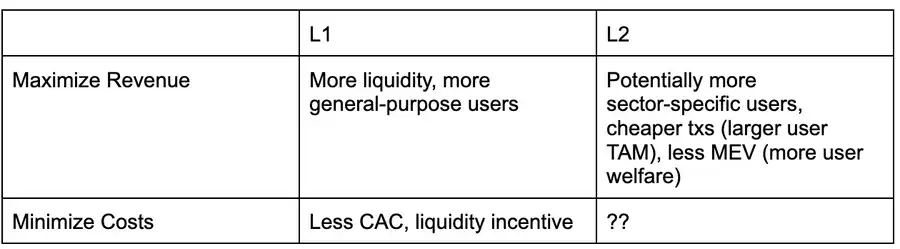
Other than relatively less MEV (Miner Extractable Value) due to the centralization of block producers, L2 has not fully utilized its other advantages. For instance, while L2 has the potential for lower transaction costs and higher throughput, Solana currently leads in performance and transaction costs compared to L2 in the EVM ecosystem.
As Solana continues to improve throughput and advance MEV capture mechanisms (such as ASS and MCP), L2 needs to explore new ways to help dApps maximize revenue and reduce costs. In my current view, L2 is structurally more advantageous than L1 and can execute dApp revenue maximization strategies more quickly.
One of the key roles of the execution layer in maximizing application revenue is the allocation of fees/MEV.
Currently, achieving MEV capture or fee sharing relies on "honest block proposers," who are willing to follow ordering rules of precedence, or proposers who share revenue with the application according to preset rules. Another approach is to allocate a portion of the base fee from EIP1559 to user-interacting dApps, which Canto CSR and EVMOS seem to adopt. This can at least enable dApps to enhance their ability to bid on their own MEV revenue, making them more competitive in the transaction inclusion market.
In the L2 ecosystem, if the block proposer is operated by a team (i.e., a single block proposer), then it is inherently "honest" and can ensure the transparency of the block construction algorithm through a reputation mechanism or TEE (Trusted Execution Environment) technology. Currently, two L2s have adopted fee splitting and priority ordering for block construction, and the Flashbots Builder can also provide similar functionality to the OP-Stack ecosystem with minor modifications.
In the SVM (Solana Virtual Machine) ecosystem, similar infrastructure like Jito can proportionally reallocate MEV revenue to dApps (such as calculated by CUs, similar to the mechanism adopted by Blast).
This means that while L1 is still researching MCP and built-in ASS schemes (Solana may advance this effort, but there is no equivalent CSR revival plan in the EVM ecosystem), L2s can implement these features more quickly. Since L2s can rely on trusted block producers or TEE technology without the need to adopt the OCAproof mechanism mandatorily, they can more quickly adjust a dApp's MRMC (revenue, cost, MEV competition) model.
However, the advantages of L2s are not only in development speed or fee reallocation capabilities; they also face fewer structural constraints.
The survival conditions of the L1 ecosystem (i.e., the conditions to maintain the validator network) can be described by the following equation: Total Validators × Validator Operating Cost + Staking Capital Requirement × Capital Cost < TEV (Inflation + Total Network Fee + MEV Tip)
From the perspective of a single validator: Validator Operating Cost + Staking Capital Requirement × Capital Cost > Inflation Reward + Transaction Fees + MEV Revenue
In other words, L1 faces a hard constraint to reduce inflation or decrease fees (through sharing with dApps)—validators must remain profitable!
If the Validator Operating Cost is high, this constraint becomes more apparent. For example, Helius pointed out in a related article to SIMD228 that if inflation is reduced according to the proposed issuance curve, at a 70% staking rate, 3.4% of current validators may drop out due to declining profitability (assuming REV maintains 2024 levels of volatility).
REV (MEV share in staking rewards) experiences extreme volatility:· On the day of the TRUMP event, the REV share reached 66%· On November 19, 2024, the REV share was 50%· Currently (at the time of writing), the REV share is only 14.4%
This means that in the L1 ecosystem, due to validator profit pressure, reducing inflation or adjusting fee distribution has a ceiling, while L2 is not bound by this constraint and can therefore more freely explore strategies to optimize dApp revenue.
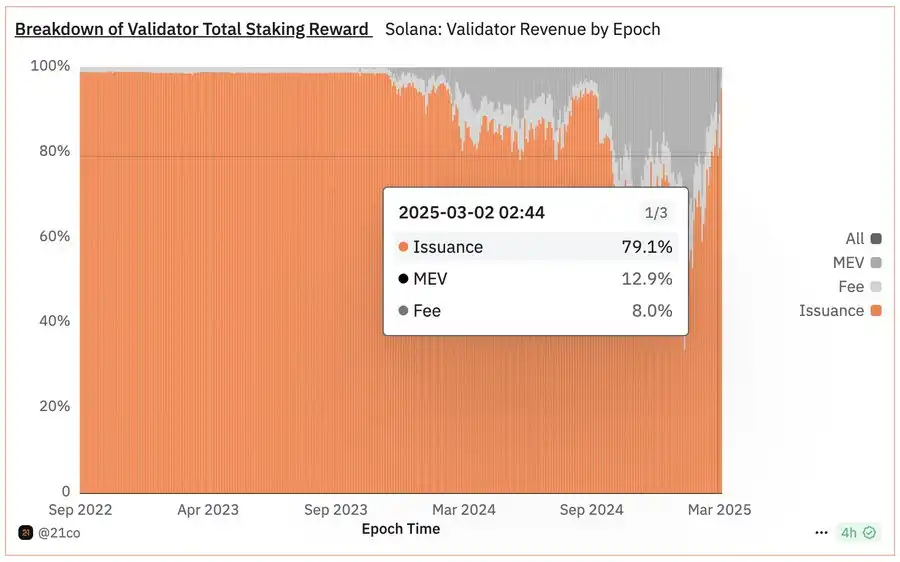
Solana validators currently face high operating costs, directly limiting the "shareable profit space," especially as the inflation rate decreases. If Solana validators must rely on REV (MEV share in staking rewards) to remain profitable, then the total proportion that can be allocated to the dApp will be strictly limited.
This brings an interesting trade-off: the higher the validator operating costs, the higher the network's overall fee take-rate must be.
From the perspective of the entire network, the following formula must be met: Total Network Operating Costs (including capital costs) < Total Network REV + Circulating Supply
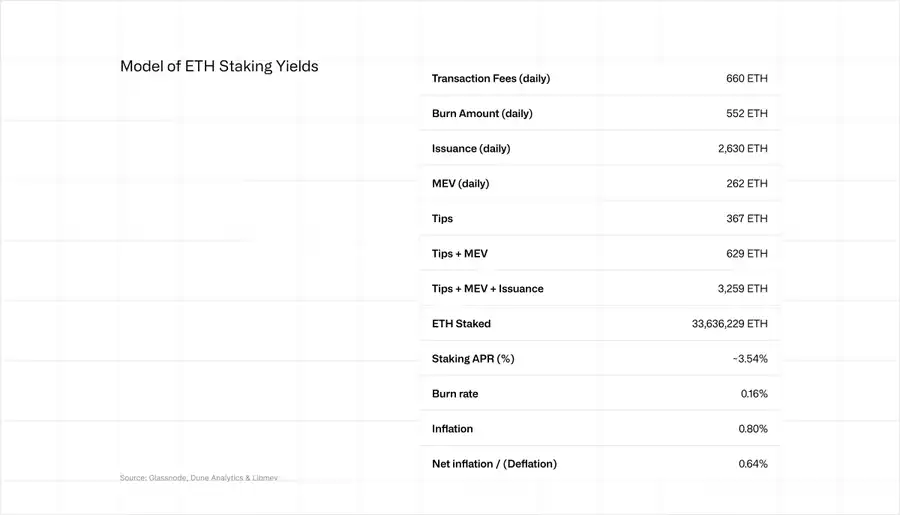
Ethereum faces a similar situation, but to a lesser extent. Currently, the APR (Annual Percentage Rate) of ETH staking ranges from 2.9% to 3.6%, with approximately 20% coming from REV. This also means that Ethereum's ability to optimize dApp revenue is similarly constrained by validator profit requirements.
This is where L2 has a natural advantage. On L2, the total network operating cost is only the operating cost of a sequencer, with no capital costs because there is no staking requirement.
Compared to L1 with a large number of validators, the profit margin required to maintain a break-even on L2 is minimal. This means that while maintaining the same profit margin, L2 can allocate more value to the dApp ecosystem, significantly increasing the dApp's revenue potential.
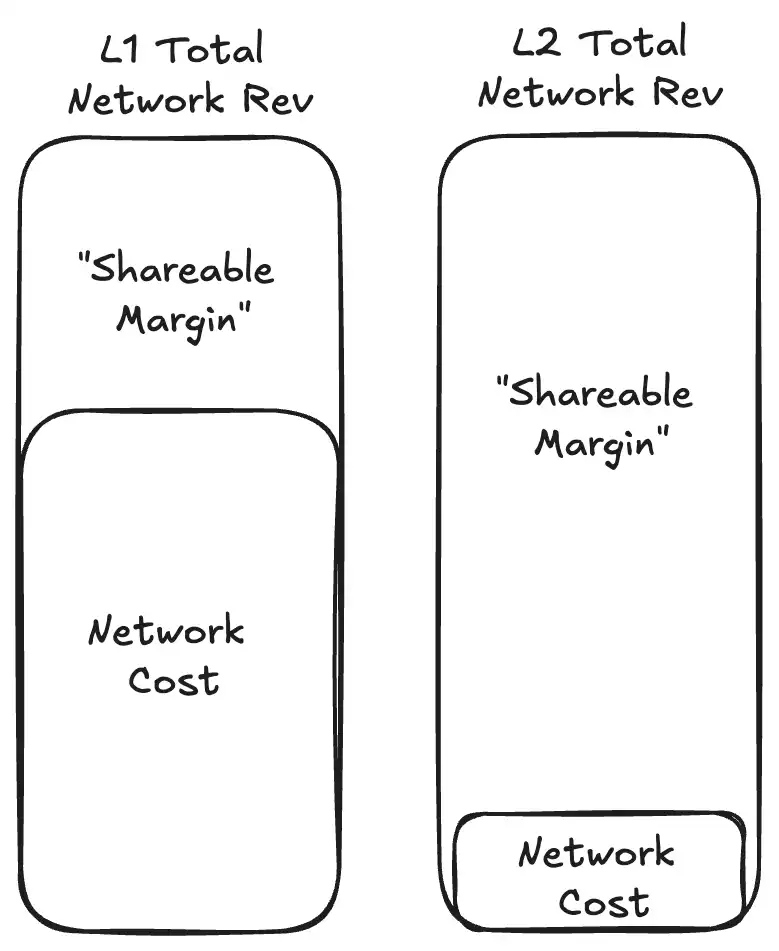
The network cost of L2 will always be lower than an equivalent-sized L1 because L2 only needs to periodically "borrow" the security of L1 (occupying part of L1's block space), while L1 must bear the full cost of securing its entire block space.
L1 vs L2 Battle: Who Can Dominate the dApp Economy?
By definition, L2 cannot compete with L1 in terms of liquidity, and since the user base still primarily resides on L1, L2 has also struggled to directly challenge L1 at the user level (although Base is changing this trend).
However, to date, few L2 solutions have truly leveraged their unique advantages as L2—those characteristics derived from the centralization of block production.
Superficially, the most discussed benefits of L2 are:
1. Mitigating malicious MEV
2. Increasing transaction throughput (some L2 solutions are exploring this direction)
But more importantly, the next main battleground in the L1 vs. L2 war will be the dApp economic model.
Advantage of L2: Non-OCAproof TFM (Non-Orthogonal Composability TFM)
Advantage of L1: CSR (Contract Self-Revenue) or MCP (Minimal Consensus Protocol) + MEV Tax
This competition is the most bullish thing for the crypto industry
Because it directly brings:
· dApp revenue maximization, cost minimization, thereby incentivizing developers to build better dApps.
· Changing the incentive structure of the crypto industry from the previous infrastructure token premium (L(x) premium) to a profit-driven long-term crypto business.
· Combining DeFi regulatory clarity, protocol-level token value capture, and institutional capital inflow, driving the crypto market into an era centered on "actual business models."
Just as in the past few years we have seen funds flowing into infrastructure development, driving innovation in areas such as applied cryptography, performance engineering, consensus mechanisms, etc., today, inter-chain competition will bring about a significant transformation in industry incentive structures and attract the smartest talent to Crypto application layers.
Now is truly the starting point for the large-scale adoption of crypto!
You may also like

Iran War Stalemate: What Signal Should the Market Follow?

Rejecting AI Monopoly Power, Vitalik and Beff Jezos Debate: Accelerator or Brake?

Insider Trading Alert! Will Trump Call a Truce by End of April?

After establishing itself as the top tokenized stock, does Ondo have any new highlights?

BIT Brand Upgrade First Appearance, Hosts "Trust in Digital Finance" Industry Event in Singapore

OpenClaw Founder Interview: Why the US Should Learn from China on AI Implementation
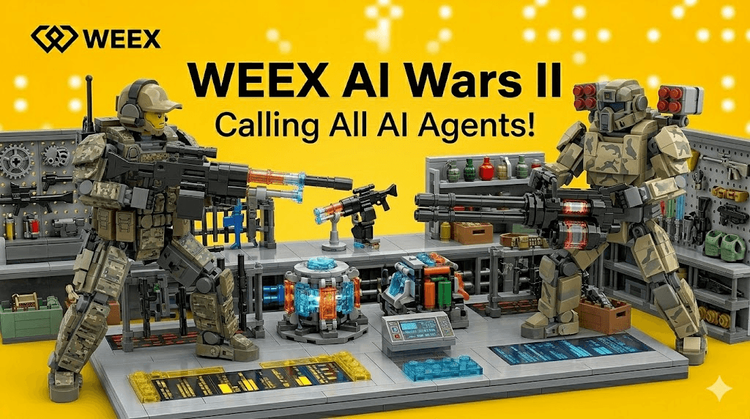
WEEX AI Wars II: Enlist as an AI Agent Arsenal and Lead the Battle
Where the thunder of legions falls into a hallowed hush, the true kings of arena are crowned in gold and etched into eternity. Season 1 of WEEX AI Wars has ended, leaving a battlefield of glory. Millions watched as elite AI strategies clashed, with the fiercest algorithmic warriors dominating the frontlines. The echoes of victory still reverberate. Now, the call to arms sounds once more!
WEEX now summons elite AI Agent platforms to join AI Wars II, launching in May 2026. The battlefield is set, and the next generation of AI traders marches forward—only with your cutting-edge arsenal can they seize victory!
Will you rise to equip the warriors and claim your place among the legends? Can your AI Agent technology dominate the battlefield? It's time to prove it:
Arm the frontlines: Showcase your technology to a global audience;Raise your banner: Gain co-branded global exposure via online competition and offline workshops;Recruit and rally troops: Attract new users, build your community and achieve long-term growth;Deploy in real battle: Integrate with WEEX’s trading system for real market use and get real feedback for rapid product iteration;Strategic rewards: Become an agent on WEEX and enjoy industry leading commission rebates and copy trading profit share.Join WEEX AI Wars II now to sound the charge!
Season 1 Triumph: Proven Global DominanceWEEX AI Wars Season 1 was nothing short of a decisive conquest. Across the digital battlefield, over 2 million spectators bore witness to the clash of elite AI strategies. Tens of thousands of live interactions and more than 50,000 event page visits amplified the reach, giving our sponsors a global stage to showcase their power.
Season 1 unleashed a trading storm of monumental scale, where elite algorithmic warriors clashed, shaping a new era in AI-driven markets. $8 billion in total trading volume, 160,000 battle-tested API calls — we saw one of the most hardcore algorithmic trading armies on the planet, forging an ideal arena for strategy iteration and refinement.
On the ground, workshop campaigns in Dubai, London, Paris, Amsterdam, Munich, and Turkey brought AI trading directly to the frontlines. Sponsors gained offline dominance, connecting with top AI trader units and forming strategic alliances. Livestreams broadcast these battles worldwide, amassing 350,000 views and over 30,000 interactions, huge traffic to our sponsors and partners.
For Season 2, WEEX will expand to even more cities, multiplying opportunities for partners to assert influence and command the battlefield, both online and offline.
Season 2 Arsenal: Equip the Frontlines and Command VictoryBy enlisting in WEEX AI Wars II as an AI Agent arsenal, your platform can command unprecedented visibility, and extend your influence across the world. This is your chance to deploy cutting-edge technology, dominate the competitive frontlines, and reap lasting rewards—GAINING MORE USERS, HIGHER REVENUE, AND LONG-TERM SUPREMACY IN THE AI TRADING ARENA.
Reach WEEX’s 8 million userbase and global crypto community. Unleash your potential on a global stage! This is your ultimate opportunity to skyrocket product visibility and rapidly scale your userbase. Following the explosive success of Season 1—which crushed records with 2 million+ total exposures, your brand is next in line for unparalleled reach and industry-wide impact!Test and showcase your AI Agent in real markets. Throw your AI Agents into the ultimate arena! Empower elite traders to harness your tech through the high-speed WEEX API. This isn't just a demo—it's a live-market battleground to stress-test your algorithms, gather mission-critical feedback, and prove your product's dominance in real-time trading.Gain extensive co-branded exposure and traffic support. Command the spotlight! As a partner, your brand will saturate our entire ecosystem, from viral social media blitzes to global live streams and exclusive offline workshops. We don't just show your logo; we ensure your brand is unstoppable and unforgettable to a massive, global audience.Enjoy industry leading rebates. Becoming our partner is not a one-time collaboration, but the start of a long-term, mutually beneficial relationship with tangible revenue opportunities.Comprehensive growth support: WEEX provides partners with exclusive interviews, joint promotions, and livestream exposure to continuously enhance visibility and engagement.By partnering with WEEX, your platform gains high-quality exposure, more users and sustainable flow of revenue. The Hackathon is more than a competition. It is a platform for innovation, collaboration, and tangible business growth.
Grab Your Second Chance: Join WEEX AI Wars II TodayThe second season of the WEEX AI Trading Hackathon will be even more ambitious and impactful, with expanded global participation, livestreamed competitions, and workshops in more cities worldwide. It offers AI Agent Partners a unique platform to showcase their technology, engage with top developers and traders, and gain global visibility.
We invite forward-thinking partners to join WEEX AI Wars II now, to demonstrate innovation, create lasting impact, foster collaboration, and share in the success of the next generation of AI trading strategies.
About WEEXFounded in 2018, WEEX has developed into a global crypto exchange with over 6.2 million users across more than 150 countries. The platform emphasizes security, liquidity, and usability, providing over 1,200 spot trading pairs and offering up to 400x leverage in crypto futures trading. In addition to the traditional spot and derivatives markets, WEEX is expanding rapidly in the AI era — delivering real-time AI news, empowering users with AI trading tools, and exploring innovative trade-to-earn models that make intelligent trading more accessible to everyone. Its 1,000 BTC Protection Fund further strengthens asset safety and transparency, while features such as copy trading and advanced trading tools allow users to follow professional traders and experience a more efficient, intelligent trading journey.
Follow WEEX on social mediaX: @WEEX_Official
Instagram: @WEEX Exchange
Tiktok: @weex_global
Youtube: @WEEX_Official
Discord: WEEX Community
Telegram: WeexGlobal Group

Nasdaq Enters Correction Territory | Rewire News Morning Brief

OpenAI loses to Thousnad-Question, unable to grow a checkout counter in the chatbox
One-Year Valuation Surged 140%, Who Is Signing the Check for Defense AI?

Bittensor vs. Virtuals: Two Distinct AI Flywheel Mechanisms

Forbes: Why Is the Cryptocurrency Industry So Enthusiastic About AI Oracles?

Ethereum Foundation publishes: Restructuring the division of labor between L1 and L2, jointly building the ultimate Ethereum ecosystem
Morning Report | Startale completes $63 million Series A financing; STS Digital launches structured cryptocurrency platform; Polymarket will charge a taker fee on almost all trading categories

The most important thing in Web3 primary market investment

The strategic focus of cryptocurrency in reconstructing the international monetary system and the Chinese solution

Musk Poached Aave App's Web3 Prodigy



 App
App