
 Buy Crypto
- Markets
 Futures
- Spot
- Copy Trade
- Earn
- More
Make Income Great Again

Article Author: Decentralised.Co
Article Translation: Block Unicorn
This article is inspired by a series of conversations with Ganesh Swami, covering the seasonality of revenue, the evolution of business models, and whether token buybacks are the best use of protocol capital. This is a complement to my previous article on the crypto stagnation.
The private capital markets, such as venture capital, oscillate between liquidity abundance and scarcity. When these assets become liquid and external capital flows in, market frenzy drives up prices. Think of a newly launched IPO or token issuance. Newly found liquidity exposes investors to more risk, which in turn fuels the birth of a new generation of companies. As asset prices rise, investors seek to reallocate funds into early-stage applications, hoping to achieve higher returns than benchmarks like ETH and SOL. This is a feature, not a bug.
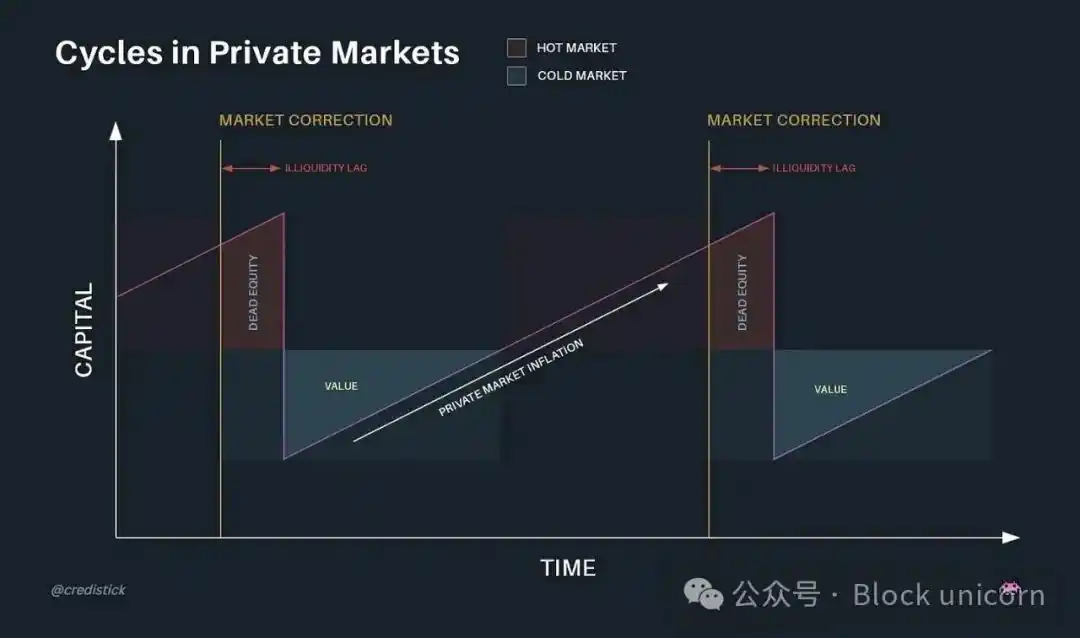
The liquidity of cryptocurrency follows a cyclical pattern similar to Bitcoin halving. Historically, market rebounds have occurred within six months after Bitcoin halving. In 2024, ETF inflows and Saylor's purchases acted as Bitcoin absorbers. Saylor alone spent $22.1 billion last year acquiring Bitcoin. However, last year's surge in Bitcoin price did not translate into a resurgence of small-cap altcoins.
We are witnessing an era where capital allocators face liquidity crunches, attention is scattered across thousands of assets, and founders who have been toiling on tokens for years struggle to find meaning in it. Why bother building real applications when launching meme assets can yield more financial returns? In previous cycles, L2 tokens enjoyed a premium due to listings on trading platforms and venture capital support, driven by perceived value. But as more participants flood the market, this perception (and its valuation premium) is dissipating.
As a result, L2 tokens have seen their valuations decrease, limiting their ability to subsidize small products through grants or token-based revenue. This valuation excess in turn forces founders to pose an age-old question that plagues all economic activities—where does revenue come from?
So Transactional
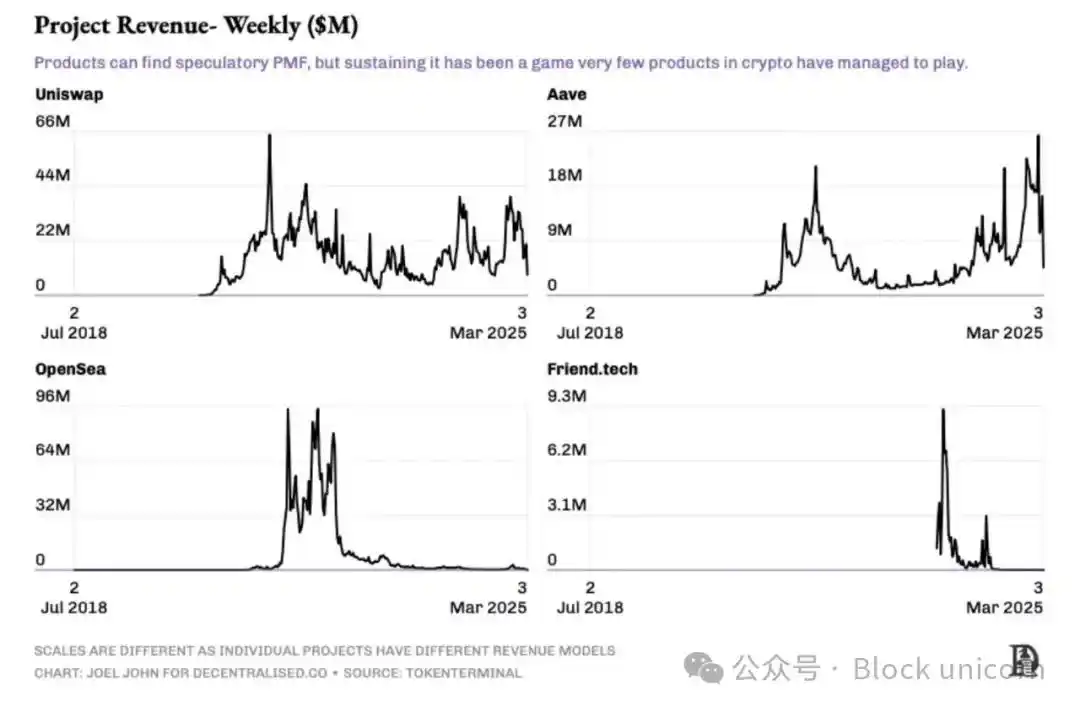
The diagram above illustrates the typical operation of cryptocurrency revenue. For most products, the ideal state is akin to AAVE and Uniswap. Thanks to the Lindy Effect or first-mover advantage, these two products have maintained fees for years. Uniswap can even increase front-end fees and generate revenue. This demonstrates the level of consumer preference definition. Uniswap to decentralized exchanges is like Google to search.
In contrast, friendtech and OpenSea have seasonal revenue. During the NFT summer, the market cycle lasted for two quarters, while social finance speculation only lasted for two months. If the scale of revenue is significant and aligned with the product's intent, the speculative revenue of the product makes sense. Many Meme trading platforms have joined the over $1 billion fee club. The scale of this number is what most founders can expect at best through tokens or acquisition. However, for most founders, this kind of success is rare. They are not building consumer apps; they focus on infrastructure, where the revenue dynamics are different.
Between 2018 and 2021, venture capital heavily funded developer tools, hoping developers would attract a large number of users. However, by 2024, the ecosystem underwent two significant changes. First, smart contracts achieved infinite scalability with limited human intervention. Uniswap or OpenSea do not need to scale their teams in proportion to transaction volume. Secondly, advancements in LLM and AI reduced the investment demand for cryptocurrency developer tools. Therefore, as a category, it is at a reckoning moment.
In Web2, the API-based subscription model was effective due to the massive online user base. However, Web3 is a smaller niche market, with few apps extending to millions of users. Our advantage is the high-income per user metric. Cryptocurrency's average user tends to spend more money more frequently because blockchain enables you to do so—it makes the flow of funds possible. Therefore, over the next 18 months, most businesses will have to redesign their business models to directly derive revenue in the form of transaction fees from users.
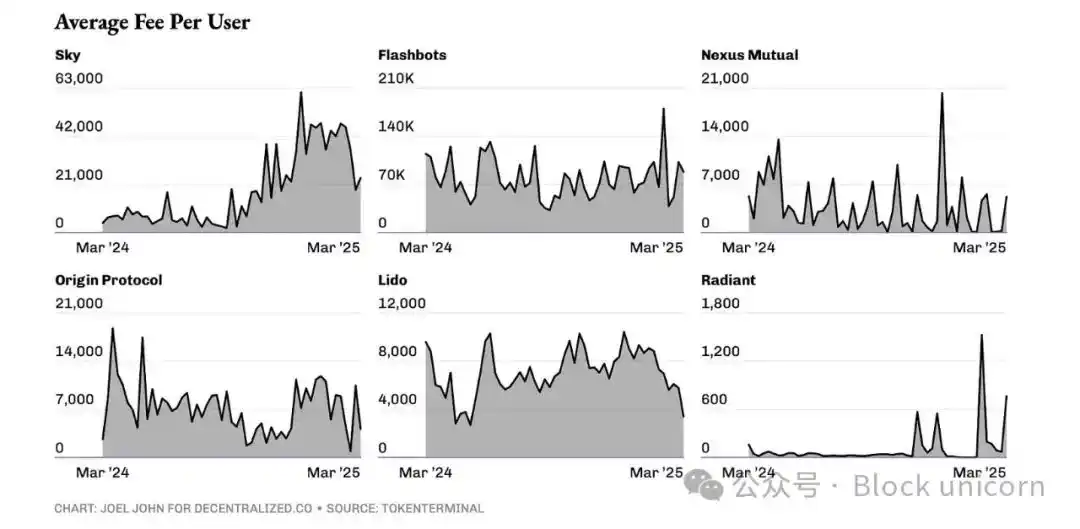
This is not a new concept. Stripe initially charged per API call, Shopify charged fixed fees for subscriptions, and later both shifted to revenue-based fees. For infrastructure providers, this transition in Web3 is quite straightforward. They will eat into the market by competitively pricing in the API arena—perhaps even offering products for free until a certain transaction volume, followed by revenue-sharing negotiations. This is the idealized scenario.
What will this look like in practice? One example is Polymarket. Currently, the UMA protocol's token is used for dispute resolution, with the token tied to disputes. The more markets there are, the higher the probability of disputes occurring. This drives demand for the UMA token. In the transaction model, the required collateral can be a small fraction of the total wager, such as 0.10%. For instance, a $1 billion wager on a presidential election result would bring $1 million in revenue to UMA. Under the assumed scenario, UMA can use this revenue to buy back and burn their tokens. This approach has its benefits and challenges, which we will soon see.
Another participant engaging in such activity is MetaMask. The transaction volume handled through its embedded swap feature is approximately $360 billion. The exchange revenue alone surpasses $3 billion. A similar pattern applies to staking providers like Luganode, where fees are based on the staked asset amount.
But in a market where API call costs are increasingly decreasing, why would developers choose one infrastructure provider over another? If revenue sharing is a requirement, why would one choose an oracle over another? The answer lies in network effects. A data provider that supports multiple blockchains, offers unparalleled data granularity, and can index data from new chains faster will become the preferred choice for new products. The same logic applies to transaction categories such as intent-driven or gasless exchanges. The more chains supported, the lower the profit margin, the faster the speed, the higher the likelihood of attracting new products, as this marginal efficiency helps retain users.
Complete Destruction
The shift to align token value with protocol revenue is not new. In recent weeks, several teams have announced mechanisms to buy back or burn tokens in proportion to revenue. Notable among these are SkyEcosystem, Ronin Network, Jito SOL, Kaito AI, and Gearbox Protocol. Token buyback is similar to stock buyback in the U.S. stock market—it is essentially a way to return value to shareholders (or in this case, token holders) without violating securities laws. In 2024, there were about $790 billion allocated to stock buybacks in the U.S. market alone, compared to $170 billion in 2000. Whether these trends will continue remains to be seen, but we observe a clear market divide between tokens with cash flow willing to invest in their own value and those with neither.
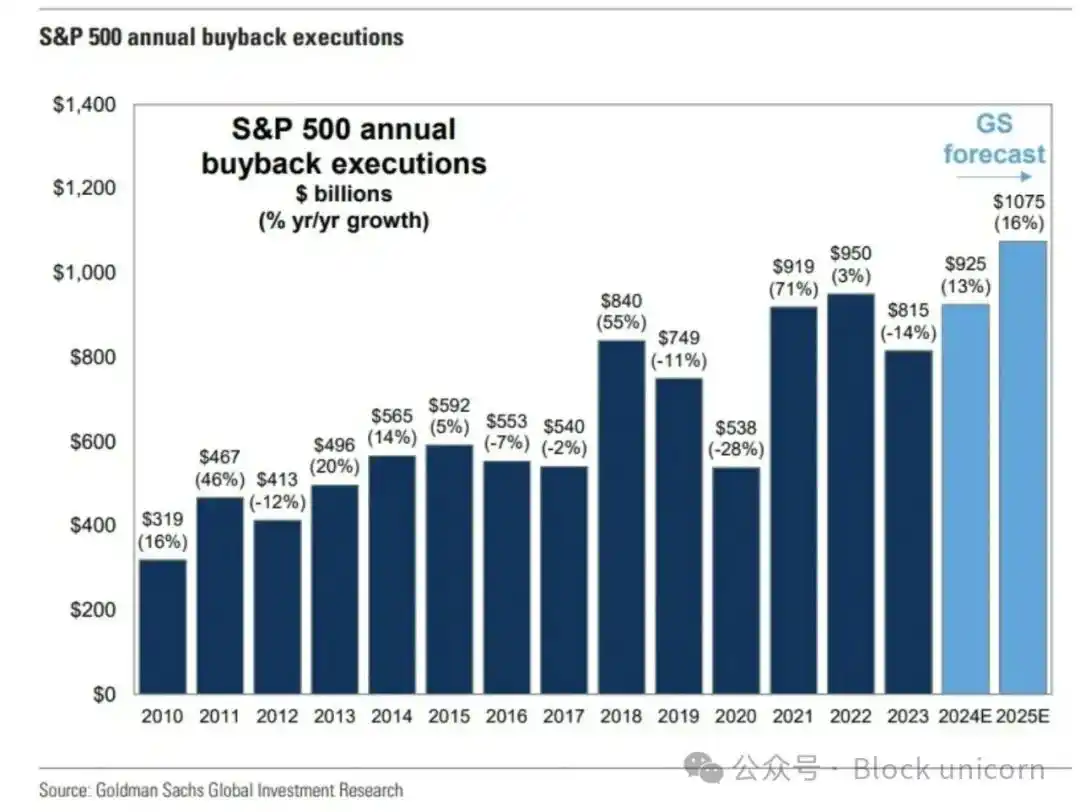
For most early protocols or dApps, using revenue to buy back their own tokens may not be the best use of capital. One way to carry out such an operation is to allocate enough capital to offset the dilution brought about by newly issued tokens. This is the approach the founder of Kaito recently explained about their token buyback method. Kaito is a centralized entity using tokens to incentivize its user base. The company receives centralized cash flow from its corporate clients. They use a portion of the cash flow to execute buybacks through market makers. The quantity purchased is twice the number of newly issued tokens, effectively making the network deflationary.
Ronin, on the other hand, takes a different approach. The blockchain adjusts fees based on the transaction volume per block. During peak usage periods, a portion of the network fees goes into Ronin's treasury. This is a method to control asset supply without necessarily buying back the token itself. In both these cases, founders have designed mechanisms to align value with network economic activity.
In future articles, we will delve into the impact of these operations on the price and on-chain behavior of tokens participating in such activities. However, it is currently evident that as valuations are being suppressed and the amount of venture capital flowing into cryptocurrency diminishes, more teams will have to compete for the marginal funds flowing into our ecosystem. Given that blockchain is fundamentally a money lego, most teams will pivot to a fee-based model proportional to transaction volume. In such a scenario, if a team is tokenized, they will be incentivized to implement a buyback and burn model. Teams executing well on this front will emerge as winners in the liquidity market.
Of course, one day, all these discussions about price, earnings, and revenue will become irrelevant. We will once again spend money on dog pictures and purchase monkey NFTs. However, when I look at the current state of the market, most founder concerns around survival have shifted towards discussions on revenue and burning.
You may also like

Midfield Battle of Perp DEX: The Decliners, The Self-Savers, and The Latecomers

Iran War Stalemate: What Signal Should the Market Follow?

Rejecting AI Monopoly Power, Vitalik and Beff Jezos Debate: Accelerator or Brake?

Insider Trading Alert! Will Trump Call a Truce by End of April?

After establishing itself as the top tokenized stock, does Ondo have any new highlights?

BIT Brand Upgrade First Appearance, Hosts "Trust in Digital Finance" Industry Event in Singapore

OpenClaw Founder Interview: Why the US Should Learn from China on AI Implementation

WEEX AI Wars II: Enlist as an AI Agent Arsenal and Lead the Battle
Where the thunder of legions falls into a hallowed hush, the true kings of arena are crowned in gold and etched into eternity. Season 1 of WEEX AI Wars has ended, leaving a battlefield of glory. Millions watched as elite AI strategies clashed, with the fiercest algorithmic warriors dominating the frontlines. The echoes of victory still reverberate. Now, the call to arms sounds once more!
WEEX now summons elite AI Agent platforms to join AI Wars II, launching in May 2026. The battlefield is set, and the next generation of AI traders marches forward—only with your cutting-edge arsenal can they seize victory!
Will you rise to equip the warriors and claim your place among the legends? Can your AI Agent technology dominate the battlefield? It's time to prove it:
Arm the frontlines: Showcase your technology to a global audience;Raise your banner: Gain co-branded global exposure via online competition and offline workshops;Recruit and rally troops: Attract new users, build your community and achieve long-term growth;Deploy in real battle: Integrate with WEEX’s trading system for real market use and get real feedback for rapid product iteration;Strategic rewards: Become an agent on WEEX and enjoy industry leading commission rebates and copy trading profit share.Join WEEX AI Wars II now to sound the charge!
Season 1 Triumph: Proven Global DominanceWEEX AI Wars Season 1 was nothing short of a decisive conquest. Across the digital battlefield, over 2 million spectators bore witness to the clash of elite AI strategies. Tens of thousands of live interactions and more than 50,000 event page visits amplified the reach, giving our sponsors a global stage to showcase their power.
Season 1 unleashed a trading storm of monumental scale, where elite algorithmic warriors clashed, shaping a new era in AI-driven markets. $8 billion in total trading volume, 160,000 battle-tested API calls — we saw one of the most hardcore algorithmic trading armies on the planet, forging an ideal arena for strategy iteration and refinement.
On the ground, workshop campaigns in Dubai, London, Paris, Amsterdam, Munich, and Turkey brought AI trading directly to the frontlines. Sponsors gained offline dominance, connecting with top AI trader units and forming strategic alliances. Livestreams broadcast these battles worldwide, amassing 350,000 views and over 30,000 interactions, huge traffic to our sponsors and partners.
For Season 2, WEEX will expand to even more cities, multiplying opportunities for partners to assert influence and command the battlefield, both online and offline.
Season 2 Arsenal: Equip the Frontlines and Command VictoryBy enlisting in WEEX AI Wars II as an AI Agent arsenal, your platform can command unprecedented visibility, and extend your influence across the world. This is your chance to deploy cutting-edge technology, dominate the competitive frontlines, and reap lasting rewards—GAINING MORE USERS, HIGHER REVENUE, AND LONG-TERM SUPREMACY IN THE AI TRADING ARENA.
Reach WEEX’s 8 million userbase and global crypto community. Unleash your potential on a global stage! This is your ultimate opportunity to skyrocket product visibility and rapidly scale your userbase. Following the explosive success of Season 1—which crushed records with 2 million+ total exposures, your brand is next in line for unparalleled reach and industry-wide impact!Test and showcase your AI Agent in real markets. Throw your AI Agents into the ultimate arena! Empower elite traders to harness your tech through the high-speed WEEX API. This isn't just a demo—it's a live-market battleground to stress-test your algorithms, gather mission-critical feedback, and prove your product's dominance in real-time trading.Gain extensive co-branded exposure and traffic support. Command the spotlight! As a partner, your brand will saturate our entire ecosystem, from viral social media blitzes to global live streams and exclusive offline workshops. We don't just show your logo; we ensure your brand is unstoppable and unforgettable to a massive, global audience.Enjoy industry leading rebates. Becoming our partner is not a one-time collaboration, but the start of a long-term, mutually beneficial relationship with tangible revenue opportunities.Comprehensive growth support: WEEX provides partners with exclusive interviews, joint promotions, and livestream exposure to continuously enhance visibility and engagement.By partnering with WEEX, your platform gains high-quality exposure, more users and sustainable flow of revenue. The Hackathon is more than a competition. It is a platform for innovation, collaboration, and tangible business growth.
Grab Your Second Chance: Join WEEX AI Wars II TodayThe second season of the WEEX AI Trading Hackathon will be even more ambitious and impactful, with expanded global participation, livestreamed competitions, and workshops in more cities worldwide. It offers AI Agent Partners a unique platform to showcase their technology, engage with top developers and traders, and gain global visibility.
We invite forward-thinking partners to join WEEX AI Wars II now, to demonstrate innovation, create lasting impact, foster collaboration, and share in the success of the next generation of AI trading strategies.
About WEEXFounded in 2018, WEEX has developed into a global crypto exchange with over 6.2 million users across more than 150 countries. The platform emphasizes security, liquidity, and usability, providing over 1,200 spot trading pairs and offering up to 400x leverage in crypto futures trading. In addition to the traditional spot and derivatives markets, WEEX is expanding rapidly in the AI era — delivering real-time AI news, empowering users with AI trading tools, and exploring innovative trade-to-earn models that make intelligent trading more accessible to everyone. Its 1,000 BTC Protection Fund further strengthens asset safety and transparency, while features such as copy trading and advanced trading tools allow users to follow professional traders and experience a more efficient, intelligent trading journey.
Follow WEEX on social mediaX: @WEEX_Official
Instagram: @WEEX Exchange
Tiktok: @weex_global
Youtube: @WEEX_Official
Discord: WEEX Community
Telegram: WeexGlobal Group

Nasdaq Enters Correction Territory | Rewire News Morning Brief

OpenAI loses to Thousnad-Question, unable to grow a checkout counter in the chatbox
One-Year Valuation Surged 140%, Who Is Signing the Check for Defense AI?

Bittensor vs. Virtuals: Two Distinct AI Flywheel Mechanisms

Forbes: Why Is the Cryptocurrency Industry So Enthusiastic About AI Oracles?

Ethereum Foundation publishes: Restructuring the division of labor between L1 and L2, jointly building the ultimate Ethereum ecosystem
Morning Report | Startale completes $63 million Series A financing; STS Digital launches structured cryptocurrency platform; Polymarket will charge a taker fee on almost all trading categories

The most important thing in Web3 primary market investment

The strategic focus of cryptocurrency in reconstructing the international monetary system and the Chinese solution



 App
App