
 Buy Crypto
- Markets
 Futures
- Spot
- Copy Trade
- Earn
- More
New Chair Takes Over, SEC Now Dubbed "Crypto Dad" Within 48 Hours

On April 10, 2025, the SEC welcomed its new Chairman, Paul Atkins. Nominated by President Trump and confirmed by the Senate with a 52-44 vote, this leader took office and promptly announced that establishing a digital asset regulatory framework would be a "top priority," pledging to create a transparently operated SEC that extensively incorporates industry and consumer feedback, fundamentally changing the past closed, high-pressure regulatory style. Paul Atkins quickly became the focus of the crypto industry, and in his first 48 hours in office, a series of regulatory favorable factors emerged. Multiple crypto-related litigations during former SEC Chairman Gary Gensler's tenure were dropped, the SEC issued a statement urging detailed disclosures when issuing cryptocurrency, and personally intervened to guide project teams on coin issuance. Such intense actions have made people curious: Is Trump's SEC going to be the "daddy" of the crypto industry?
SEC's New Chairman's Arrival Brings Frequent Regulative Positives
Paul Atkins is not new to the SEC and is also a veteran in crypto. As early as 2002 to 2008, he served as an SEC Commissioner, accumulating rich regulatory experience. Subsequently, he founded Patomak Global Partners, providing compliance and risk strategy consulting to financial and digital asset companies, including crypto exchanges and DeFi platforms. He has also led the Token Alliance crypto advocacy group, openly supporting digital asset innovation. It was disclosed that he and his spouse hold up to $6 million in crypto-related assets.

On April 9, 2025, the Senate confirmed Atkins' nomination with full Republican support, marking a significant shift for the SEC from former Chairman Gary Gensler's enforcement-focused style to a pro-market orientation. During Gensler's tenure, he initiated over 100 crypto-related enforcement actions, emphasizing that most tokens fall under securities law jurisdiction and adopting a skeptical attitude towards the industry. In contrast, Atkins advocates providing clear and feasible rules for digital assets through a principle-based regulatory framework. During a Senate Banking Committee hearing on March 28, he explicitly stated that digital assets are the SEC's top priority this year, committing to cooperating with the Commodity Futures Trading Commission (CFTC) and Congress to fill regulatory gaps, unleash America's global competitiveness in Bitcoin and blockchain finance.
Atkins succeeded Mark Uyeda, who served as acting chairman after Gensler's resignation in January. Under the "crypto-friendly" Trump administration, Uyeda's brief tenure had already paved the way for the SEC's transformation, such as dismissing multiple crypto-related enforcement cases and abolishing the internal rule SAB 121 restricting public companies from holding crypto assets. Atkins' assumption of office accelerated the trend of regulatory relaxation, and his term will last until June 2026. In a period of over a year, he may advance significant changes to the crypto regulatory policy framework.
Atkins's "first blaze" ignited the financial market, with Atkins's pro-market stance injecting a dose of vitality into the financialization of crypto assets. On her first day in office, April 10th, the SEC approved options trading for a spot Ethereum ETF, a milestone that provided investors with more participation channels. Additionally, Atkins supported simplifying private market rules, proposing to define accredited investors based on financial sophistication rather than net worth, which may further lower the barrier to entry for crypto investments.
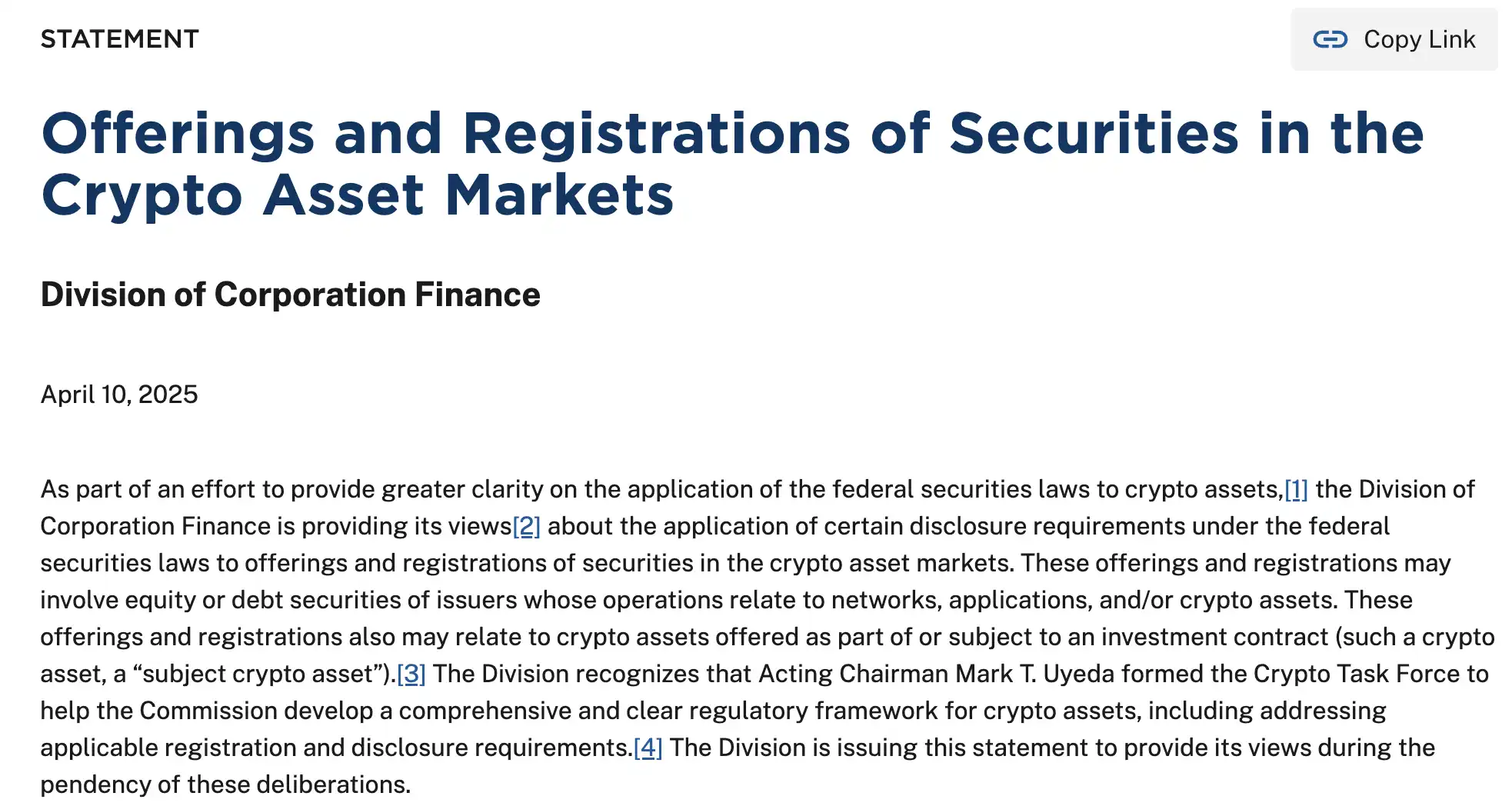
The "second blaze" provided future regulatory guidance. On her second day in office, the SEC issued a non-binding guidance statement, stating: "These issuances and registrations may involve issuers' equity or debt securities related to networks, applications, and/or crypto assets. These issuances and registrations may also involve crypto assets that are part of or subject to investment contracts (such crypto assets referred to as 'underlying crypto assets')." It urged companies issuing or handling tokens that could be considered securities to provide detailed disclosures, including business details, token roles, network development milestones, and token holder rights, among others. Although it is still not clear which cryptocurrencies fall under securities, it is based on the SEC's observation of existing company disclosure information, attempting to provide a more explicit reference framework for the industry. Such detailed "off-the-cuff guidance" also reflects the SEC's shift from "penalty over guidance" to "guidance over enforcement," hoping to reduce market uncertainty through communication and transparency, preventing the industry from teetering on the brink and only able to repeatedly probe.
The "third blaze" melted away the "cold cases" during Gary Gensler's tenure, as the SEC showed a more lenient attitude toward past crypto litigations. On April 11th, Helium network developer Nova Labs announced that the SEC had dismissed charges of selling unregistered securities against it. Previously, the SEC had filed lawsuits against Nova Labs for three tokens—HNT, MOBILE, and IoT. With Atkins taking office, this litigation quietly concluded, setting a positive precedent for similar projects. On the same day, the SEC reached a settlement with Ripple in the long-running litigation, with both parties filing a joint motion to stay the appeal, Ripple paying a $50 million fine, and the remaining $75 million to be refunded to the company.
In addition, to promote regulatory clarity, the SEC's Cryptocurrency Working Group plans to hold four public roundtable discussions from April to June 2025, covering topics such as crypto trading, custody, asset tokenization, and DeFi. Commissioner Hester Peirce referred to this as the "spring sprint toward crypto clarity," marking a shift for the SEC from confrontation to cooperation. The first meeting on April 11 will focus on "tailored regulation for crypto trading," with subsequent meetings exploring the integration of traditional finance and blockchain, as well as the intersection of DeFi and the American ethos.
What Other Moves Does the "Crypto Dad" Have?
Atkins' intensive actions following his appointment are closely tied to the overall policy context of the Trump administration, aligning well with crypto policy.
Upon Trump's return to the White House, policies saw significant relaxation. Firstly, there was notable progress in approving crypto ETFs. Previously stalled ETF applications for assets like XRP and Solana due to Gensler's tough stance are now undergoing more lenient reviews within the SEC, with industry insiders expecting multiple ETF approvals by 2025, significantly enhancing market liquidity. Secondly, market makers such as Citadel Securities and Wintermute have returned, promoting comprehensive improvements in market liquidity, trade efficiency, and regulatory compliance. Simultaneously, stablecoin legislation is rapidly advancing. Trump has publicly supported stablecoins multiple times to increase demand for U.S. Treasury bonds, bolster U.S. digital dollar hegemony, and solidify the dollar's global dominance. In April, the Senate Banking Committee approved the "GENIUS Act" proposed by Republican Senator Bill Hagerty, establishing licensing, reserve, and disclosure requirements for stablecoin issuance, providing a light-touch regulatory framework. Atkins stated that the SEC will coordinate with the CFTC to clarify stablecoins' security and commodity attributes, and support state-level regulatory exemptions for stablecoins with a market cap below $100 billion to encourage innovation.
Furthermore, just today, Trump signed a bill repealing the IRS broker rule for DeFi platforms, removing obstacles for DeFi development. This rule, introduced in 2024, classified DeFi platforms as brokers, requiring them to submit tax forms for users, sparking widespread industry dissatisfaction. Trump, upon signing the bill, stated that the rule "inhibited American innovation" and "invaded the privacy of ordinary Americans." This is the first cryptocurrency-related legislation signed by the Trump administration, once again demonstrating that from nominating a market-friendly SEC chairman to repealing restrictive rules, the Trump administration is actively working to create a relaxed environment for the digital asset industry, aiming to establish the U.S. as a global digital financial center.
Related Reading: "Senate Repeals 'DeFi Broker Rule,' Ushering in US Regulatory Lightning War on DeFi?"
Under the leadership of Trump, the federal government seems to be forming a more relaxed atmosphere for crypto policy, and the SEC also appears to be transitioning from a 'regulatory iron fist' to a 'crypto daddy.' With multiple crypto ETF approvals, dismissals of years-long lawsuits, the return of multiple market makers, and the abolition of the DeFi broker rule, the Trump administration is attempting to stimulate industry growth by reducing regulatory barriers. However, this policy shift has also raised some concerns. Senator Elizabeth Warren criticized Atkins' ties to Wall Street and FTX as advisors, believing that their background may compromise regulatory impartiality. Critics also argue that overly lax regulation could lead to market chaos and increase investor risk.
We must both strictly regulate market order and nurture industry innovation and growth. In the future, whether this 'crypto daddy' can find a balance between innovation and protection to achieve the global status of the US digital asset market remains to be seen. It is foreseeable that with the support of the Trump administration, the SEC's crypto policy will continue to be a focus of global attention, and the future of the US digital asset market may be starting a new chapter from here.
You may also like

Tiger Research: What AI services do cryptocurrency companies offer?

The war not only drives up oil prices but also causes Circle's stock price to soar

When agents become consumers, who will rewrite the underlying logic of internet commerce?

AI Agents in Action Summit: March 31, Hong Kong Cyberport, focusing on the deep waters of AI implementation

29 Days In, What Are America’s Options on Iran?

Flash Crash Down 97%+ with Ongoing Unlocking, WLD Completes $65 Million Off-chain Funding: Who Is Still Buying?

Bitcoin for Real Estate? Fannie Mae Teams Up with Coinbase to Launch Crypto Mortgage
Tether Hires Big Four Auditor, USDT Enters First Attestation Phase

Google AI Paper Destroys $900B Storage Stock, Accused of Faking Experiment
Evaporate $2 Trillion, U.S. Stocks See Worst Start in 4 Years, Why is the Market Bearish?

The speed at which AI discovers vulnerabilities has surpassed the speed at which it patches vulnerabilities.

AI Crypto Trading Bot Explained: Aurora's Multi-Factor Strategy in WEEX Hackathon
Aurora demonstrates how structured, multi-agent AI Trading systems can deliver more adaptive and resilient performance in the WEEX AI Trading Hackathon.

Cyber Taoist Fortune Teller: Fake Taoist, AI Fortune Telling, and Northeastern Metaphysics History

Bloomberg: Stablecoin Payments Emerge as Crypto VC's Newest Favorite Thing
BeatSwap is evolving towards a full-stack Web3 infrastructure, covering the entire lifecycle of IP rights.
BeatSwap, a global Web3 Intellectual Property (IP) infrastructure project, is attempting to overcome the current fragmentation limitations of the Web3 ecosystem, building a full-stack system that covers the entire lifecycle of IP rights.
Currently, most Web3 projects are still in the stage of functional fragmentation, often focusing only on a single aspect, such as IP asset tokenization, transaction functionality, or a simple incentive model. This structural dispersion has become a key bottleneck hindering the industry's scale application.
BeatSwap's approach is more integrated, integrating multiple core modules into the same system, including:
· IP authentication and on-chain registration
· Authorization-based revenue sharing mechanism
· User-engagement-driven incentive system
· Transaction and liquidity infrastructure
Through the above integration, the platform builds an end-to-end closed-loop path, allowing IP rights to complete a full cycle of "creation, use, and monetization" within the same ecosystem.
BeatSwap is not limited to existing crypto users but is attempting to take the global music industry as a starting point, actively creating new market demand. Its core strategies include:
Exploring and incubating music creators (Artist discovery)
Building a fan community
Igniting IP-centric content consumption demand
The current global music industry is valued at around $260 billion, with over 2 billion digital music users. This means that the potential market corresponding to the tokenization and financialization of IP far exceeds the traditional crypto user base.
In this context, BeatSwap positions itself at the intersection of "real-world content demand" and "on-chain infrastructure," attempting to bridge the structural gap between content production and financial flow.
BeatSwap's upcoming core product "Space" is scheduled to launch in the second quarter of 2026. This product is defined as the SocialFi layer in the ecosystem, aiming to directly connect creators with users and achieve deep integration with other platform modules.
Key designs include:
A fan-centric interactive mechanism
Exposure and distribution logic based on $BTX staking
User paths connected to DeFi and liquidity structures
Thus, a complete user behavior loop is formed within the platform: Discovery → Participation → Consumption → Rewards → Trading
$BTX is designed to be a core utility asset within the ecosystem, rather than just a simple incentive token, with its value directly tied to platform activity and IP use cases.
Main features include:
· Yield distribution based on on-chain authorized actions
· Value reflection based on IP usage and user engagement dynamics
· Support for staking and DeFi participation mechanisms
· Value growth driven by ecosystem expansion
With the increased frequency of IP use, the utility and value support of $BTX will enhance simultaneously, helping alleviate the "disconnect between value and utility" issue present in traditional Web3 token models to some extent.
Currently, $BTX has been listed on several mainstream exchanges, including:
Binance Alpha
Gate
MEXC
OKX Boost
As the launch of "Space" approaches, BeatSwap is actively pursuing more exchange listings to further enhance liquidity and global accessibility, laying a foundation for future market expansion.
BeatSwap's goal is no longer limited to the traditional Web3 narrative but aims to target over 2 billion digital music users and a trillion KRW-scale content market.
By integrating content creators, users, capital, and liquidity into a blockchain framework centered around IP rights, BeatSwap is striving to build a next-generation infrastructure focused on "IP tokenization."
BeatSwap integrates IP authentication, authorization distribution, incentive mechanism, transaction system, and market construction to establish a unified structure that bridges the full lifecycle path of IP rights.
With the launch of the Q2 2026 "Space," the project is expected to become a key infrastructure connecting content and finance in the IP-RWA (Real World Assets) track.

Mag 7 Evaporates $2 Trillion | Rewire News Morning Edition

Losing $19K per Coin Mined, Bitcoin Mining Firms Collective AI Defection



 App
App