
 Buy Crypto
- Markets
 Futures
- Spot
- Copy Trade
- Earn
- More
On the Eve of a Significant Dollar Devaluation, Bitcoin is Poised for the Final Spark

Original Article Title: BTC: Onchain Data Update + our views on last week's FOMC and the "big picture"
Original Article Author: Michael Nadeau, The DeFi Report
Original Article Translation: Bitpush News
Last week, the Federal Reserve cut interest rates to a target range of 3.50%–3.75%—this move was fully absorbed by the market and largely expected.
What truly surprised the market was the Federal Reserve's announcement to purchase $400 billion in short-term Treasury bills on a monthly basis, which quickly earned the label of "QE-lite" by some.
In today's report, we will delve into what this policy change really means, what it doesn't change, and why this distinction is crucial for risk assets.
Let's get started.
1. "Short-term" Outlook
The Federal Reserve cut rates as expected. This is the third rate cut this year and the sixth since September 2024, totaling a 175 basis point reduction and pushing the federal funds rate to its lowest level in about three years.
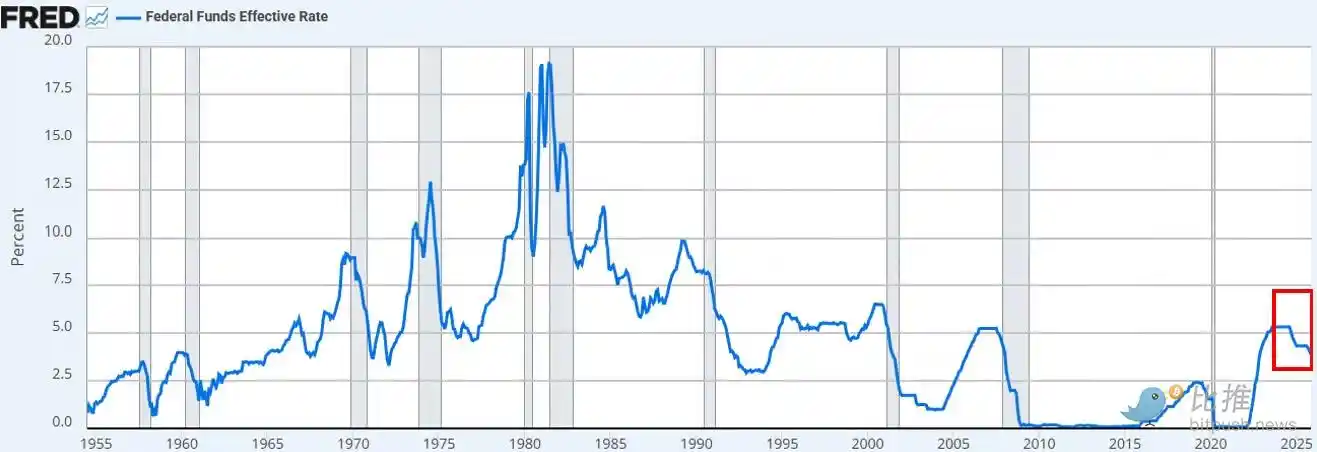
In addition to the rate cut, Powell announced that the Fed will begin "reserve management purchases" of short-term Treasury bills at a pace of $400 billion per month starting in December. Given the ongoing strains in the repo market and bank sector liquidity, this move was entirely within our expectations.
The prevailing market view (whether on X platform or CNBC) is that this is a "dovish" policy shift.
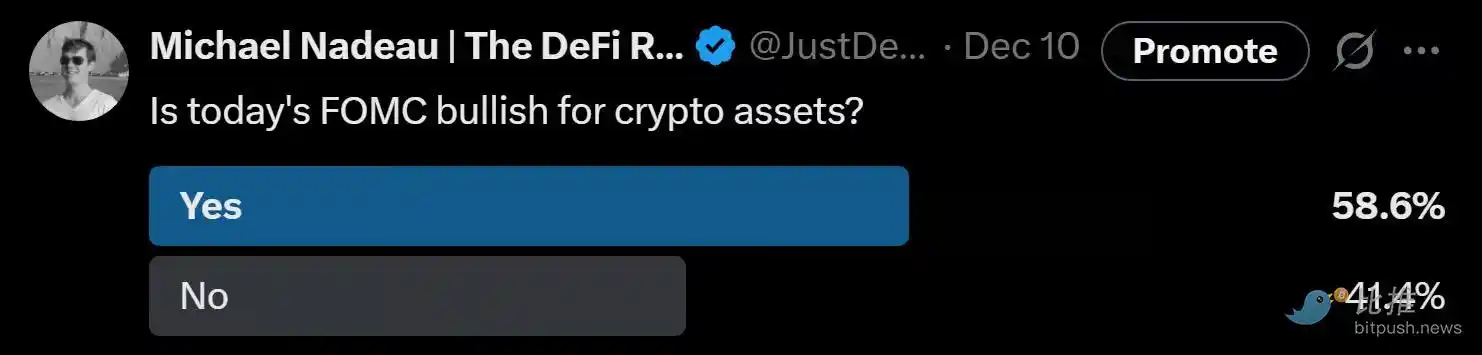
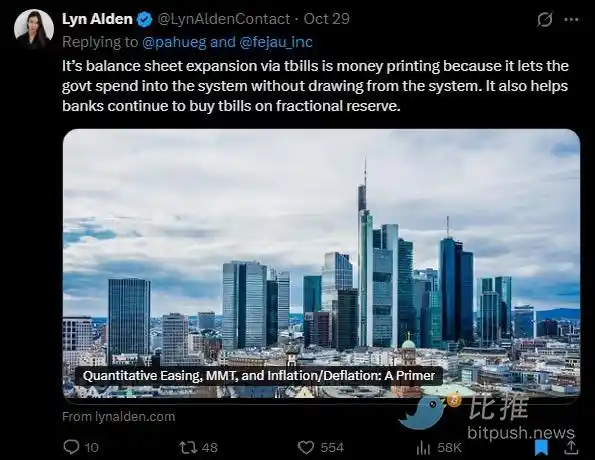
The debate on whether the Fed's announcement is equivalent to "money printing," "QE," or "QE-lite" immediately took over social media timelines.
Our Observation:
As a "market observer," we find that the market's psychological state still tends towards "Risk-on" sentiment. In this state, we expect investors to overly fit policy headlines, trying to piece together a bullish logic while overlooking the specific mechanism of how policy translates into actual financial conditions.
Our view is: The Fed's new policy is favorable for the "financial market plumbing," but not favorable for risk assets.
Where do we differ from the market's general perception?
Our views are as follows:
· Short-Term Treasury Purchases ≠ Absorption of Market Duration
The Fed is purchasing short-term Treasury bills, not long-term coupon bonds. This does not remove the market's interest rate sensitivity (duration).
· Has Not Suppressed Long-Term Yields
Although short-term purchases may marginally reduce future long-term bond issuance, it does not help compress the term premium. Currently, about 84% of Treasury issuances are in short-term notes, so this policy does not substantially alter the duration structure investors face.
· Financial Conditions Are Not Broadly Loosened
These reserve management purchases aimed at stabilizing the repo market and bank liquidity will not systematically lower real interest rates, corporate borrowing costs, mortgage rates, or equity discount rates. Their impact is partial and functional, not a broad-based monetary easing.
Therefore, no, this is not QE. This is not financial repression. What needs to be clear is that the abbreviation does not matter; you can call it money printing if you like, but it does not deliberately suppress long-term yields by removing duration — which would push investors towards the riskier end of the curve.
That scenario has not materialized. The price action of BTC and the Nasdaq index since last Wednesday affirm this point.
What would change our view?
We believe BTC (as well as broader risk assets) will have their time in the sun. But that will come post-QE (or whatever the Fed terms the next phase of financial repression).
That moment will arrive when:
· The Fed artificially suppresses the long end of the yield curve (or signals to the market).
· Real Interest Rates Decrease (Due to Rising Inflation Expectations).
· Corporate Borrowing Costs Decline (Powering Tech Stocks/NASDAQ).
· Term Premium Compression (Long-Term Rates Decrease).
· Stock Discount Rates Decrease (Forcing Investors into Longer Duration Risk Assets).
· Mortgage Rates Decline (Driven by Long-End Rate Suppression).
At that point, investors will smell the scent of "Financial Repression" and adjust their portfolios. We are not yet in that environment, but we believe it is coming. While timing is always difficult, our baseline assumption is: volatility will significantly increase in the first quarter of next year.
This is what we see as the short-term landscape.
2. A More Macro View
The deeper issue is not the Fed's short-term policies but the global trade (currency) war and the tension it is creating at the core of the dollar system.
Why?
The U.S. is moving towards the next stage of its strategy: reshoring manufacturing, reshaping global trade balances, and competing in strategic industries like AI. This goal is in direct conflict with the role of the dollar as the world's reserve currency.
The reserve currency status can only be maintained as long as the U.S. continues to run a trade deficit. Under the current system, the dollar is sent overseas to purchase goods, which then flow back to the U.S. capital markets through treasuries and risk assets. This is the essence of the Triffin Dilemma.
· Since January 1, 2000, the U.S. capital markets have received over $14 trillion (not counting the $9 trillion in bonds currently held by foreigners).
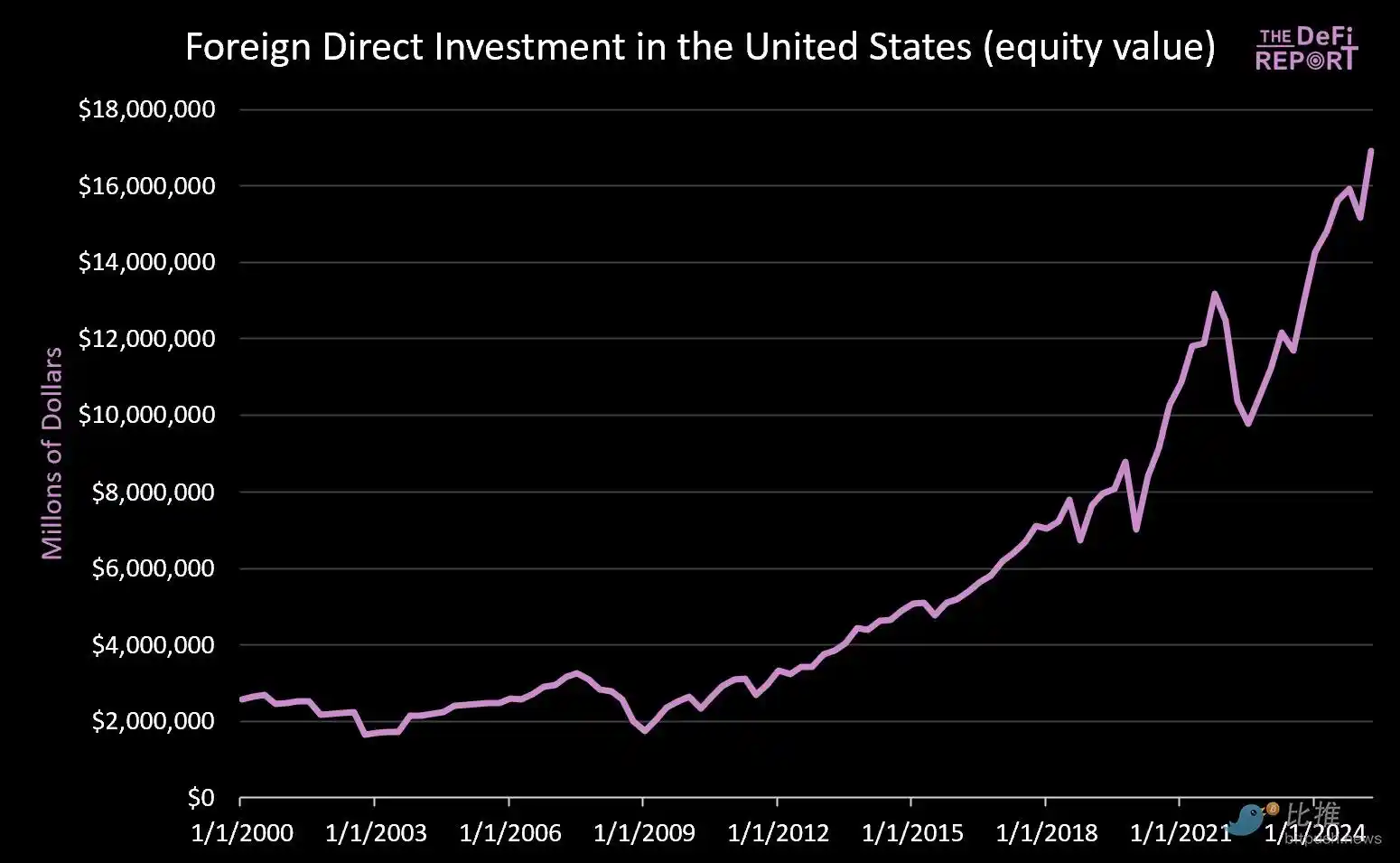
· At the same time, around $16 trillion has flowed offshore to pay for goods.
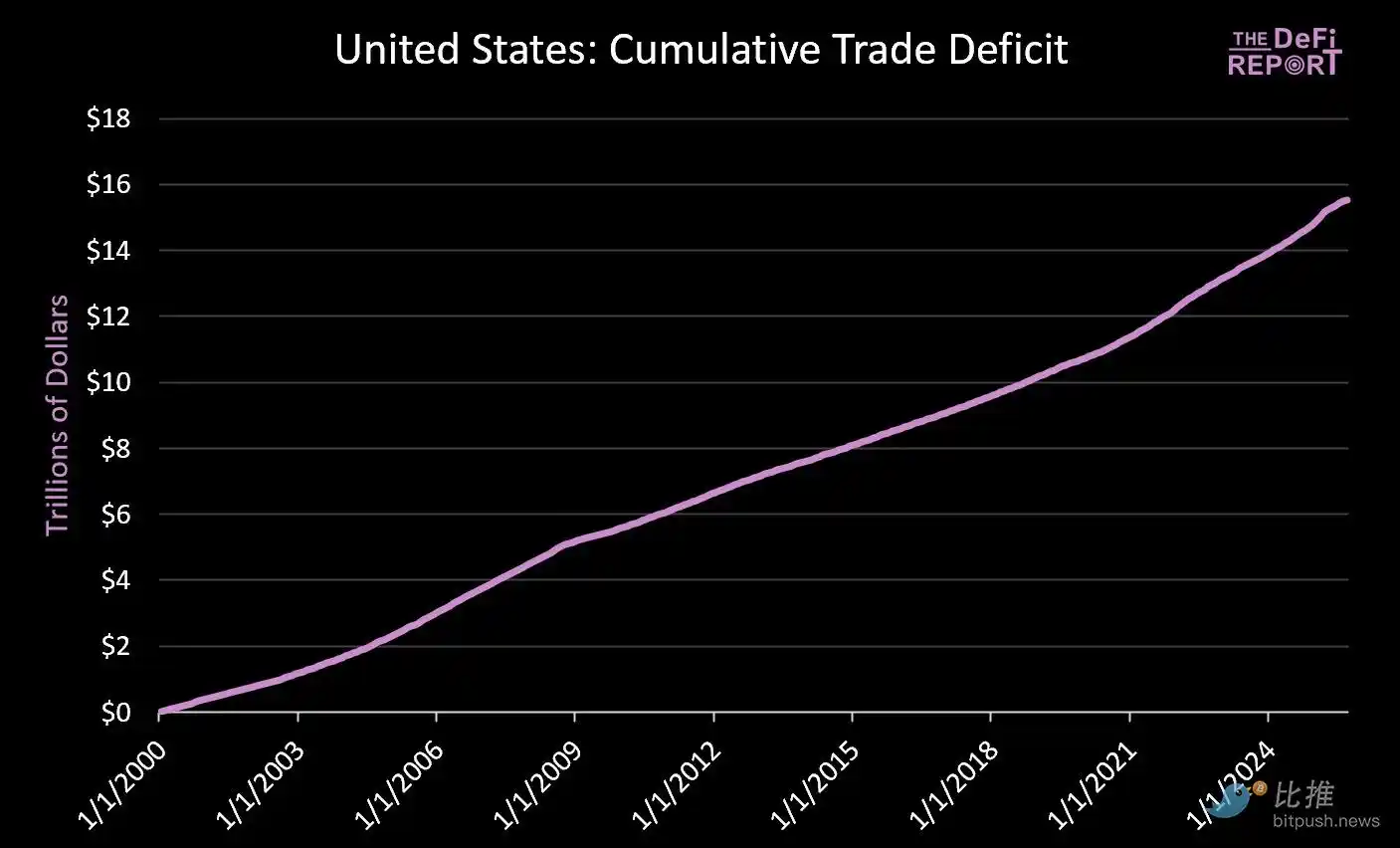
The effort to reduce the trade deficit will necessarily reduce the cyclical capital flowing back to the U.S. market. While Trump touts promises from Japan and other countries to "invest $550 billion in U.S. industry," what he fails to explain is that Japan's (and other countries') capital cannot simultaneously exist in manufacturing and capital markets.
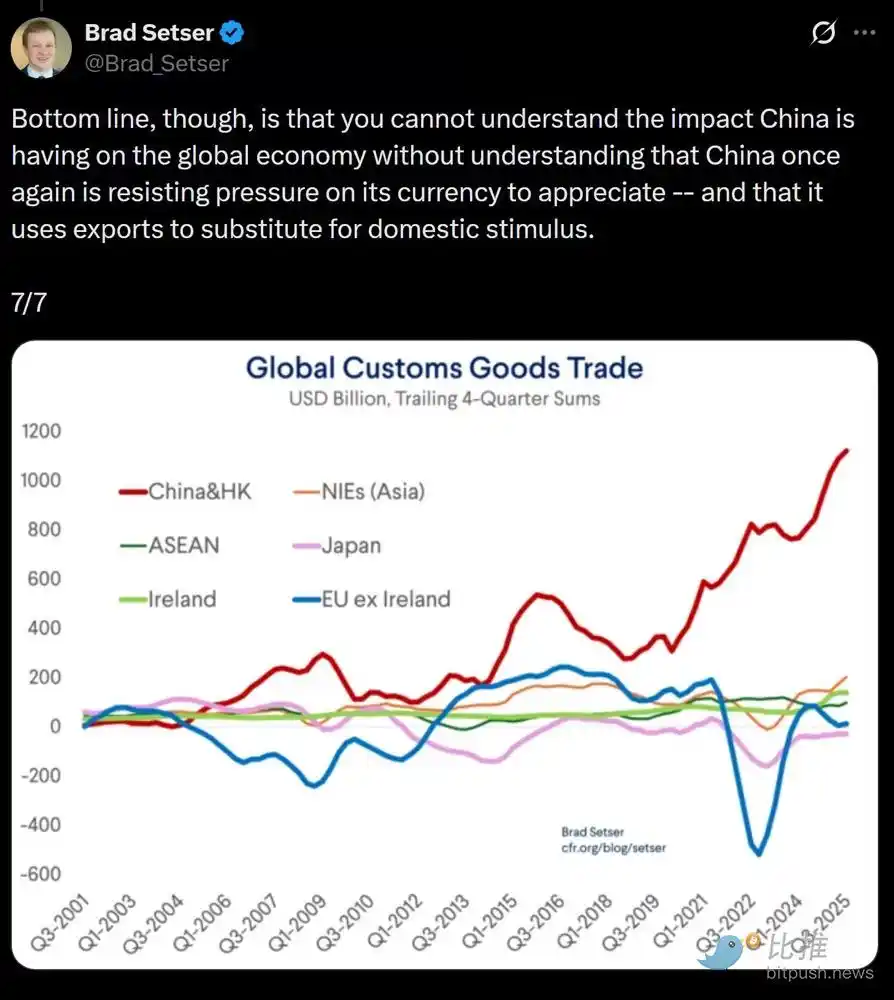
We believe this tension will not be resolved smoothly. Instead, we expect increased volatility, asset repricing, and ultimately a currency adjustment (i.e., dollar devaluation and a shrinkage in the real value of U.S. Treasuries).
The core point is: China is artificially suppressing the value of the Renminbi (providing its export products with an artificial price advantage), while the U.S. dollar is artificially overvalued due to foreign capital inflows (resulting in relatively cheap import prices).
We believe that to address this structural imbalance, a mandatory devaluation of the U.S. dollar may be imminent. In our view, this is the only viable path to resolve the global trade imbalance.
In a new round of financial repression, the market will ultimately determine which assets or markets qualify as a "store of value."
The key question is, when all the dust settles, whether U.S. Treasury bonds can still play the role of a global reserve asset.
We believe that Bitcoin and other global, non-sovereign stores of value (such as gold) will play a far more significant role than they do now. The reason is that they are scarce and do not rely on any policy credit.
This is what we see as the "macro setup" being established.
You may also like

AI multi-agent applications will boost the rise of blockchain payments

2026 Crypto Taxes: Don't Miss These Staking & DeFi Reporting Rules
Stay compliant in 2026. Learn how to report crypto staking rewards, DeFi incentives, and airdrops. Follow our easy WEEX + KoinX workflow to generate accurate tax reports in minutes.

Crypto Tax Deadline 2026: How to Generate 2026 Crypto Tax Reports (WEEX & KoinX Fast Tutorial)
Still filing crypto taxes close to the 2026 deadline? Follow this step-by-step WEEX Tax API + KoinX workflow to export data and generate an accurate crypto tax report quickly.

Hyperliquid Ten Thousand Character Feature: Jeffrey's Billion Dollar Gold Mining Story

SaaS Churn | Rewire Daily News
There may not be a rate cut this year

CoinGecko Spot Report: Overview of 12 Major CEX Spot Markets, Only 32% of New Tokens Outperforming IEO Price

Even with Gunfire Behind Bars, Why Do American Small Towns Oppose AI Data Centers?

The Sky is the Limit: Wearing Only One Outfit, Cutting My Own Hair, and Giving Billions to Strangers — The Story Behind Hyperliquid

Atlético Madrid vs FC Barcelona: 90 Minutes to Destroy a Dream or Write History
Atlético Madrid vs FC Barcelona Champions League second leg is do-or-die. Full Atlético Madrid vs FC Barcelona lineups, stats, timeline — plus who chokes and who conquers.

Chinese-funded institutions retreat from Hong Kong stablecoins

Morning Report | Strategy invested $1 billion to increase its Bitcoin holdings last week; Aave passed a $25 million grant proposal; Coinone was shut down and fined for violating anti-money laundering obligations

Found a "meme coin" that skyrocketed in just a few days. Any tips?

TAO is Elon Musk, who invested in OpenAI, and Subnet is Sam Altman

The era of "mass coin distribution" on public chains comes to an end

Soaring 50 times, with an FDV exceeding 10 billion USD, why RaveDAO?

1 billion DOTs were minted out of thin air, but the hacker only made 230,000 dollars

After the blockade of the Strait of Hormuz, when will the war end?
AI multi-agent applications will boost the rise of blockchain payments
2026 Crypto Taxes: Don't Miss These Staking & DeFi Reporting Rules
Stay compliant in 2026. Learn how to report crypto staking rewards, DeFi incentives, and airdrops. Follow our easy WEEX + KoinX workflow to generate accurate tax reports in minutes.
Crypto Tax Deadline 2026: How to Generate 2026 Crypto Tax Reports (WEEX & KoinX Fast Tutorial)
Still filing crypto taxes close to the 2026 deadline? Follow this step-by-step WEEX Tax API + KoinX workflow to export data and generate an accurate crypto tax report quickly.


 App
App