
 Buy Crypto
- Markets
 Futures
- Spot
- Copy Trade
- Earn
- More
Rate Cut Countdown: $9 Trillion National Debt "Maturity Wall" Could Be the Cryptocurrency Market's Most Powerful Catalyst

Original Title: Why should we be bullish on the crypto market in the mid-to-long term? A bullish thesis
Original Author: DeFi Cheetah, Crypto KOL
Original Translation: Felix, PANews
As previously predicted, the U.S. stock market was expected to experience at least a 20% pullback, bringing the Bitcoin price back to around $50,000. The first target has been met: due to Trump's imposition of higher tariffs on many other countries, the U.S. stock market underwent a 20% pullback with the VIX index at around 55. The Bitcoin price briefly fell to $74,000, showing more resilience than expected based on historical price trends.
Next, it is expected that the Federal Reserve will cut interest rates before June, followed by a rebound in the U.S. stock market and the crypto market. In fact, Trump has just explicitly demanded Fed Chair Powell to cut interest rates. This article will explain in detail why Trump is so obsessed with rate cuts and why he is bullish on the crypto market.
Two Urgent Issues Caused by High Interest Rates
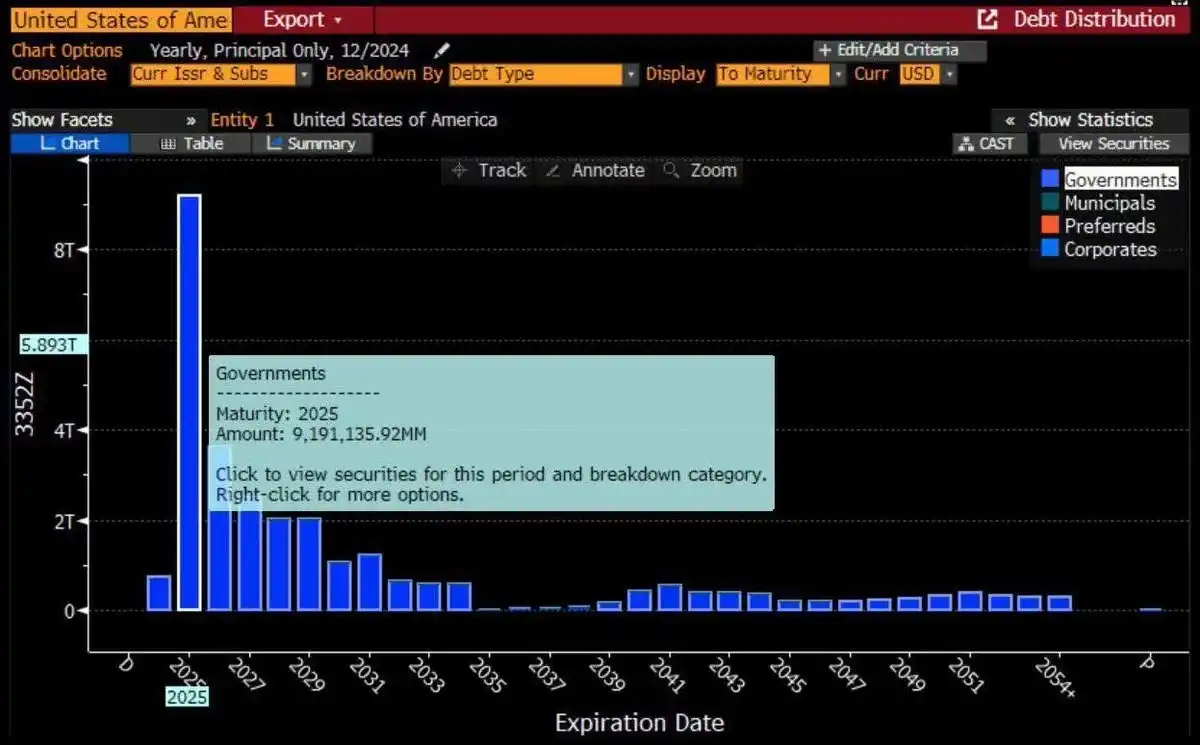
In the coming months, two issues are forcing the Federal Reserve to significantly cut interest rates. First, the "Maturity Wall" of $90 trillion in U.S. Treasury bonds this year is forcing the Trump administration to seek rate cuts aggressively to save trillions of dollars in refinancing costs. However, the Fed sees no room for rapid rate cuts given the current inflation level.
Therefore, for the Trump administration, those seemingly unreasonable aggressive policies and measures (such as tariffs, establishing DOGE, etc.) are best explained as forming a coordinated mechanism to try to force the Fed to cut rates amid macro uncertainty. Otherwise, the U.S. government would have to pay at least 3-4 times more in interest costs after the extension. In fact, the two-year short-term Treasury yield has been declining, reflecting market risk-off sentiment and flows into Treasury bonds.
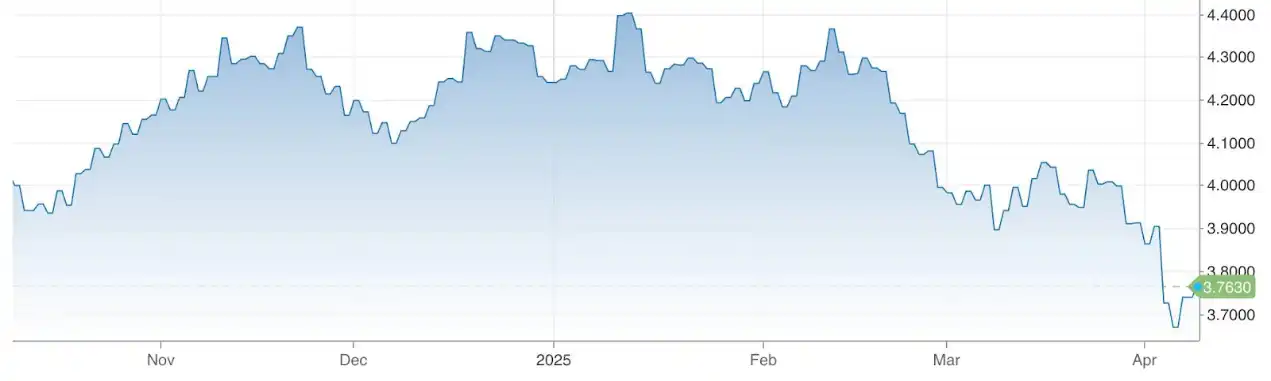
In the eyes of the Trump administration, the urgency of rate cuts can be illustrated by the following chart:
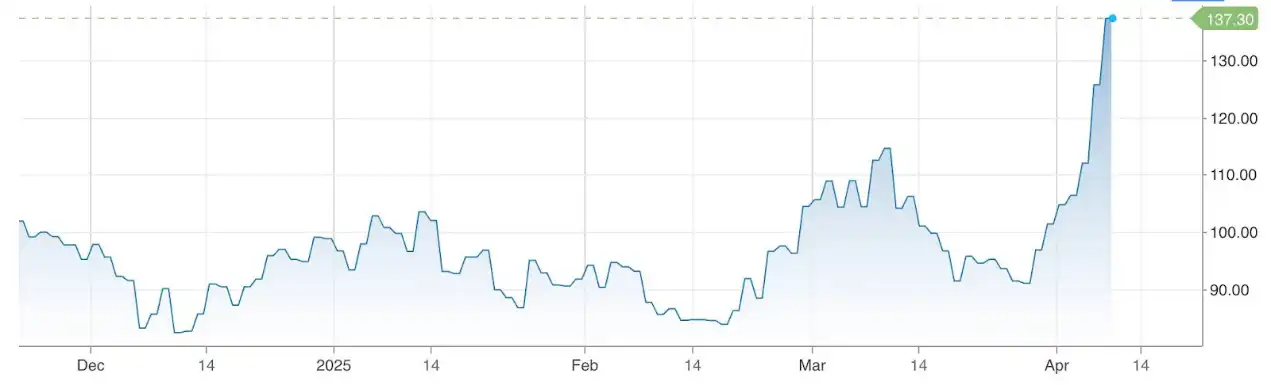
Indeed, the Merrill Option Volatility Estimate Index (MOVE), which measures the volatility of U.S. Treasury market rates, has surged, further indicating the possibility of a Fed rate cut. This index is considered representative of the term premium of U.S. Treasury bonds (i.e., the yield spread between long-term and short-term bonds). As this index rises, anyone involved in U.S. Treasury or corporate bond financing transactions would be forced to sell due to higher margin requirements.
If the MOVE Index continues to rise, especially above 140, it may indicate an extremely unstable market and could potentially force the Federal Reserve to cut interest rates to stabilize the Treasury and corporate bond markets, as these markets are crucial to the normal functioning of the financial system. (Note: The MOVE Index last surged above 140 due to the collapse of a Silicon Valley bank—this was the largest bank failure event since 2008.)
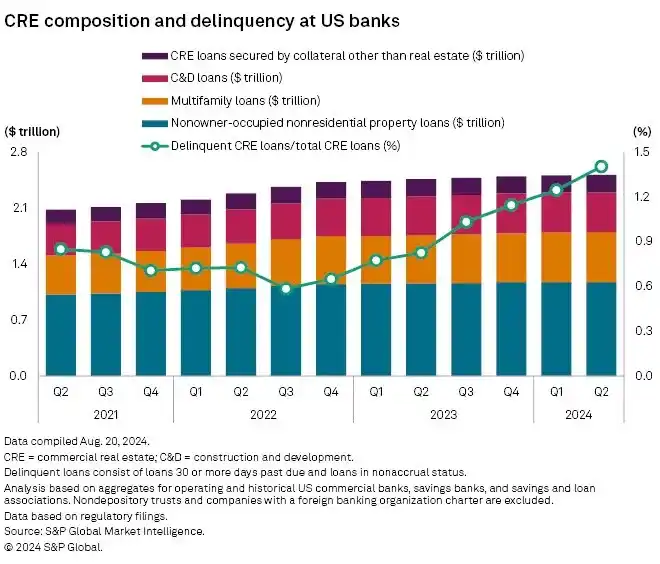
The second reason for a significant rate cut in the coming months is also due to the "maturity wall," but this time it refers to over $500 billion of U.S. Commercial Real Estate (CRE) loans maturing this year. Many CRE loans were underwritten at lower rates during the pandemic and are now facing refinancing challenges in a rising rate environment, which could lead to an increase in default rates, especially for highly leveraged real estate. With the increasing prevalence of telecommuting, structural changes have been triggered, causing a persistently high post-pandemic vacancy rate in housing. In fact, the potential for large-scale CRE loan defaults could drive up the MOVE Index.
By the fourth quarter of 2024, the CRE loan delinquency rate was 1.57%, higher than 1.17% in the fourth quarter of 2023. Historical data indicates that a rate above 1.5% is concerning, especially in a tightening monetary environment. Meanwhile, with a vacancy rate as high as 20%, a continuously rising capitalization rate (approximately 7-8%), and a large number of loans maturing, office values have fallen 31% from their peak, increasing the risk of default.
The logic here is: A high vacancy rate will decrease Net Operating Income (NOI), lower Debt Service Coverage Ratio (DSCR) and Debt Yield, but will increase the capitalization rate. High rates will exacerbate this situation, especially for loans maturing in 2025, where refinancing at higher rates may be unsustainable. Therefore, if commercial real estate loans cannot be refinanced at a reasonable low rate similar to the pandemic period, banks will inevitably face more defaults, which could in turn trigger a "domino effect" of more bank failures (recall the severity of bank failures such as the Silicon Valley Bank due to the 2023 rate spike).
Given these two urgent issues caused by the current high rates, the Trump administration must take aggressive action to cut rates quickly. Otherwise, these debts will need to be extended, leading to higher refinancing costs for the U.S. government, and many commercial real estate loans may not be able to be extended, resulting in a large number of defaults.
The Catalyst for the Next Bull Market—Stablecoins
The most significant factor affecting the crypto market is market liquidity. However, the most influential factors affecting liquidity are (i) monetary policy and (ii) the prevalence of stablecoins. Under a dovish (accommodative) monetary policy, the widespread adoption of stablecoins can further catalyze capital inflows during a bull market. The upside of the bull market depends on the increase in the total supply of stablecoins. In the previous bull market cycle (2019 - 2022), the total supply of stablecoins grew tenfold from its nadir to its peak, while from 2023 to early 2025, it has only increased by about 100%, as shown in the chart below.
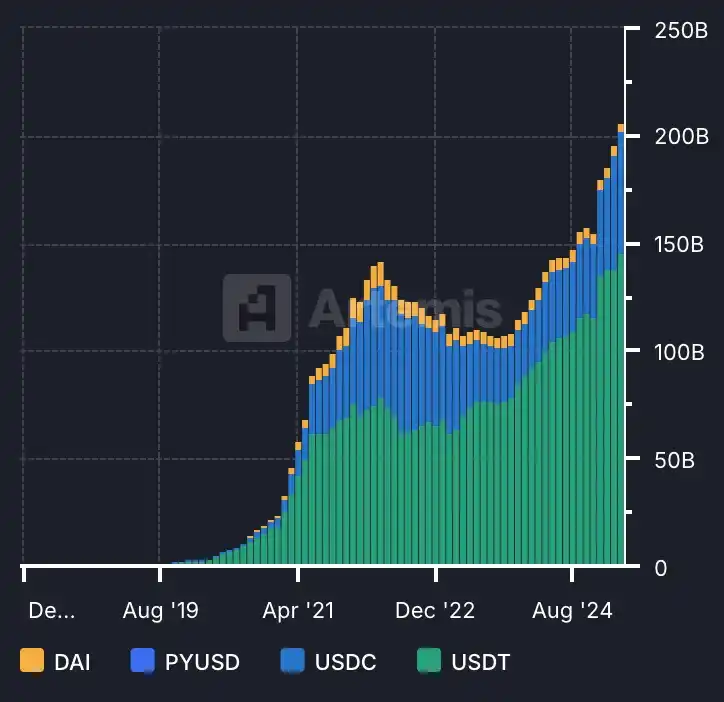
The following highlights key events signaling a rapid increase in stablecoin adoption over the next year:
US Stablecoin Legislation Progress: In the first quarter of 2025, the Senate Banking Committee in the United States approved the Genius Act in March, outlining regulatory and reserve rules for stablecoin issuers. The aim of this act is to integrate stablecoins into the mainstream financial system, reflecting the growing recognition of their role in the crypto market. Additionally, the House Financial Services Committee passed a stablecoin framework bill — the STABLE Act — which stipulates that any non-bank institution can issue stablecoins as long as they obtain approval from federal regulatory agencies. Regulatory transparency has always been considered a key factor influencing stablecoin adoption, thereby affecting capital inflows into the crypto industry through stablecoins.
Accelerated Institutional Adoption: Fidelity Investments began testing a USD-backed stablecoin in late March, marking a significant step for this traditional financial giant entering the crypto space. Meanwhile, Wyoming announced plans to launch a state-backed stablecoin by July, aiming to become the first token issued by a U.S. entity backed by fiat and fully reserved.
World Liberty Financial Stablecoin: World Liberty Financial, associated with Trump, announced on March 25th its plans to launch the USD1 stablecoin pegged to the U.S. dollar, having previously raised $500 million through a separate token sale. This move aligns with the Trump administration's policy of supporting stablecoins as a key infrastructure for cryptocurrency transactions.
USDC Expansion to Japan: On March 26th, Circle partnered with SBI Holdings to launch USDC in Japan, making it the first stablecoin officially approved for use under Japan's regulatory framework. This move reflects Japan's positive stance on integrating stablecoins into its financial system and may set an example for other countries.
PayPal and Gemini Driving Stablecoin Development: Throughout the first quarter, PayPal and Gemini strengthened their positions in the stablecoin market. The adoption rates of PayPal's PYUSD and Gemini's GUSD have increased, with PayPal leveraging its payment network and Gemini focusing on institutional clients. This intensifies the competition in the U.S. stablecoin issuer market.
Rise Payroll Platform's Additional Use Cases: On March 24, the Rise payroll platform expanded its services to offer stablecoin payments to international contractors in over 190 countries. Employers can pay wages in stablecoins, and employees can cash out in local currency.
Circle's IPO: Circle has filed for an IPO. If approved, Circle will become the first stablecoin issuer to be listed on the New York Stock Exchange. This milestone will signify the formal recognition of stablecoin business in the U.S. and incentivize more enterprises to explore the field, especially large institutions, as stablecoin operations rely more on institutional resources, distribution channels, and business development.
Why Is the Trump Administration So Supportive of Stablecoin Development?
This aligns with the viewpoint in the first part: the collateral backing stablecoins in circulation is primarily short-term U.S. Treasury bonds, hence, with the U.S. government rolling over tens of trillions of dollars of maturing Treasuries this year, as stablecoins become more widespread, the demand for short-term bonds increases.
The market trend is clear: in the short term, there may be market turbulence, high volatility, and possibly further declines from current levels. However, looking ahead, it is expected that against the backdrop of dovish monetary policy, significant interest rate cuts, coupled with the proliferation of stablecoins, may trigger another strong bull market, comparable in scale to the previous cycle.
It is currently an ideal time to seek good returns through investment in the crypto market.
You may also like

Tiger Research: What AI services do cryptocurrency companies offer?

The war not only drives up oil prices but also causes Circle's stock price to soar

When agents become consumers, who will rewrite the underlying logic of internet commerce?

AI Agents in Action Summit: March 31, Hong Kong Cyberport, focusing on the deep waters of AI implementation

29 Days In, What Are America’s Options on Iran?

Flash Crash Down 97%+ with Ongoing Unlocking, WLD Completes $65 Million Off-chain Funding: Who Is Still Buying?

Bitcoin for Real Estate? Fannie Mae Teams Up with Coinbase to Launch Crypto Mortgage
Tether Hires Big Four Auditor, USDT Enters First Attestation Phase

Google AI Paper Destroys $900B Storage Stock, Accused of Faking Experiment
Evaporate $2 Trillion, U.S. Stocks See Worst Start in 4 Years, Why is the Market Bearish?

The speed at which AI discovers vulnerabilities has surpassed the speed at which it patches vulnerabilities.

AI Crypto Trading Bot Explained: Aurora's Multi-Factor Strategy in WEEX Hackathon
Aurora demonstrates how structured, multi-agent AI Trading systems can deliver more adaptive and resilient performance in the WEEX AI Trading Hackathon.

Cyber Taoist Fortune Teller: Fake Taoist, AI Fortune Telling, and Northeastern Metaphysics History

Bloomberg: Stablecoin Payments Emerge as Crypto VC's Newest Favorite Thing
BeatSwap is evolving towards a full-stack Web3 infrastructure, covering the entire lifecycle of IP rights.
BeatSwap, a global Web3 Intellectual Property (IP) infrastructure project, is attempting to overcome the current fragmentation limitations of the Web3 ecosystem, building a full-stack system that covers the entire lifecycle of IP rights.
Currently, most Web3 projects are still in the stage of functional fragmentation, often focusing only on a single aspect, such as IP asset tokenization, transaction functionality, or a simple incentive model. This structural dispersion has become a key bottleneck hindering the industry's scale application.
BeatSwap's approach is more integrated, integrating multiple core modules into the same system, including:
· IP authentication and on-chain registration
· Authorization-based revenue sharing mechanism
· User-engagement-driven incentive system
· Transaction and liquidity infrastructure
Through the above integration, the platform builds an end-to-end closed-loop path, allowing IP rights to complete a full cycle of "creation, use, and monetization" within the same ecosystem.
BeatSwap is not limited to existing crypto users but is attempting to take the global music industry as a starting point, actively creating new market demand. Its core strategies include:
Exploring and incubating music creators (Artist discovery)
Building a fan community
Igniting IP-centric content consumption demand
The current global music industry is valued at around $260 billion, with over 2 billion digital music users. This means that the potential market corresponding to the tokenization and financialization of IP far exceeds the traditional crypto user base.
In this context, BeatSwap positions itself at the intersection of "real-world content demand" and "on-chain infrastructure," attempting to bridge the structural gap between content production and financial flow.
BeatSwap's upcoming core product "Space" is scheduled to launch in the second quarter of 2026. This product is defined as the SocialFi layer in the ecosystem, aiming to directly connect creators with users and achieve deep integration with other platform modules.
Key designs include:
A fan-centric interactive mechanism
Exposure and distribution logic based on $BTX staking
User paths connected to DeFi and liquidity structures
Thus, a complete user behavior loop is formed within the platform: Discovery → Participation → Consumption → Rewards → Trading
$BTX is designed to be a core utility asset within the ecosystem, rather than just a simple incentive token, with its value directly tied to platform activity and IP use cases.
Main features include:
· Yield distribution based on on-chain authorized actions
· Value reflection based on IP usage and user engagement dynamics
· Support for staking and DeFi participation mechanisms
· Value growth driven by ecosystem expansion
With the increased frequency of IP use, the utility and value support of $BTX will enhance simultaneously, helping alleviate the "disconnect between value and utility" issue present in traditional Web3 token models to some extent.
Currently, $BTX has been listed on several mainstream exchanges, including:
Binance Alpha
Gate
MEXC
OKX Boost
As the launch of "Space" approaches, BeatSwap is actively pursuing more exchange listings to further enhance liquidity and global accessibility, laying a foundation for future market expansion.
BeatSwap's goal is no longer limited to the traditional Web3 narrative but aims to target over 2 billion digital music users and a trillion KRW-scale content market.
By integrating content creators, users, capital, and liquidity into a blockchain framework centered around IP rights, BeatSwap is striving to build a next-generation infrastructure focused on "IP tokenization."
BeatSwap integrates IP authentication, authorization distribution, incentive mechanism, transaction system, and market construction to establish a unified structure that bridges the full lifecycle path of IP rights.
With the launch of the Q2 2026 "Space," the project is expected to become a key infrastructure connecting content and finance in the IP-RWA (Real World Assets) track.

Mag 7 Evaporates $2 Trillion | Rewire News Morning Edition

Losing $19K per Coin Mined, Bitcoin Mining Firms Collective AI Defection



 App
App