
 Buy Crypto
- Markets
 Futures
- Spot
- Copy Trade
- Earn
- More
SEC Welcomes Crypto Holder-in-Chief: Juris Doctor Paul Atkins to Reshape Crypto Market Landscape

Original Title: "From Law PhD to Crypto Holder, Meet SEC's New Chairman Paul Atkins"
Original Source: DeepTech TechFlow
Trump's extreme tariff policy has stirred a global market storm, with the prices of cryptocurrencies such as Bitcoin searching for direction amidst intense volatility.
Amidst significant uncertainty, what seems like positive news has emerged.
On April 9, the U.S. Senate confirmed Paul Atkins as the new chairman of the U.S. Securities and Exchange Commission (SEC) with a vote of 52 to 44.
Known for his support of innovation and free markets, Atkins's appointment is viewed by the crypto community as a potential turning point in the SEC's stance toward crypto assets.
He has explicitly stated that establishing a clear digital asset regulatory framework is a top priority, contrasting sharply with the strong enforcement approach of former chairman Gary Gensler.
The crypto market is often described by regulators as the "Wild West," with tension between regulation and industry being commonplace.
However, Atkins's arrival may once again foster expectations for a more friendly and collaborative regulatory environment.
Amidst a moment of turmoil and opportunity, Atkins's next moves are eagerly anticipated.
Starting as a Wall Street lawyer, serving as an SEC commissioner, and now as the new chairman deeply involved in the digital asset space, can he bring long-awaited clarity in rules?
Perhaps the answer lies in his life story.

Small Town Boy, Law PhD
Like most, this new chairman was initially a small-town youth passionate about learning.
Paul Atkins's story began in a small town in the southeastern United States. Born in Lillington, North Carolina, he spent his childhood and teenage years in Tampa, Florida, where the sunny city laid a strong foundation for his life.
In 1980, Atkins earned a Bachelor of Arts from Wofford College, achieving an outstanding academic record that led to his induction into the Phi Beta Kappa Honor Society and joining the Kappa Alpha Order fraternity, showcasing his dual talents in academics and social endeavors.
Three years later, he earned his Juris Doctor (J.D.) degree from Vanderbilt Law School, serving as the Senior Student Writing Editor for the Vanderbilt Law Review.
This student-era work may have been the starting point of his legal and regulatory thinking, nurturing his attention to legal details and rigorous mindset.
He has been described as "quiet yet decisive." This trait stems from both the humility of a small town and the thoughtful exploration of the logic behind rules, partly shaping the most distinctive contours of his personality.
Emerging from the small town of Tampa, Atkins, with the solid determination typical of a Southern youth and the courage of a dreamer, underwent the transformation from student to professional.
From Lawyer to Regulatory Seat
Paul Atkins's career kicked off on the legal stage of New York.
Upon graduating from law school in 1983, he joined Davis Polk & Wardwell, a top-tier law firm renowned for its corporate transactions.
Based in the firm's New York headquarters, he focused on legal matters in the securities and financial fields before being dispatched to the Paris office for two and a half years, where he obtained the qualification of French legal advisor (conseil juridique) in 1988.
This international experience exposed him to the complexity of cross-border financial regulation, providing valuable experience for his future work at the SEC.
In the 1990s, he returned to the U.S., assisting financial services companies in complying with SEC regulations and participating in the aftermath of the Bennett Funding Group case, a $1 billion Ponzi scheme that highlighted his crisis management abilities.
Public records show that through stabilizing finances and operations, as well as rebuilding and expanding the business, he increased the stock value of the remaining investors by nearly 2000%.
On July 9, 2002, Atkins's career path reached a milestone. He was appointed by President George W. Bush as an SEC Commissioner, serving until August 1, 2008,
Earlier in his career, he served as Chief of Staff and Counselor to SEC Chairmen Richard C. Breeden and Arthur Levitt, respectively.
He is known for his advocacy of free-market principles and reducing regulatory burdens, explicitly stating in a 2007 speech: "The SEC must not squeeze investors out of the market through burdensome regulation."
After leaving the SEC in 2008, Atkins founded Patomak Global Partners, a financial services consulting firm based in Washington, D.C. and New York, focusing on regulatory compliance and corporate governance advice.
During this time, he served multiple times as an independent compliance consultant for enforcement and settlement matters involving agencies such as the Department of Justice, SEC, and CFTC. From 2012 to 2015, he served as an independent director and non-executive chairman of the board at BATS Global Markets, an electronic securities trading platform later acquired by the Chicago Board Options Exchange (CBOE).
His personal life also remained stable during this period as he and his wife, Sarah Humphreys Atkins, raised three sons together. Sarah is a significant Republican donor, with cumulative donations exceeding $9.9 million (Paul S. Atkins - Wikipedia).
From a lawyer to an SEC commissioner, and then to an authority in the consulting field, Atkins's professional journey has showcased his profound understanding of financial regulation, laying a solid foundation for his return to the position of SEC Chairman in 2025.
Appreciated by Trump, Also a Crypto Holder
Paul Atkins' deep expertise in financial regulation has extended to the digital frontier with the rise of cryptocurrency.
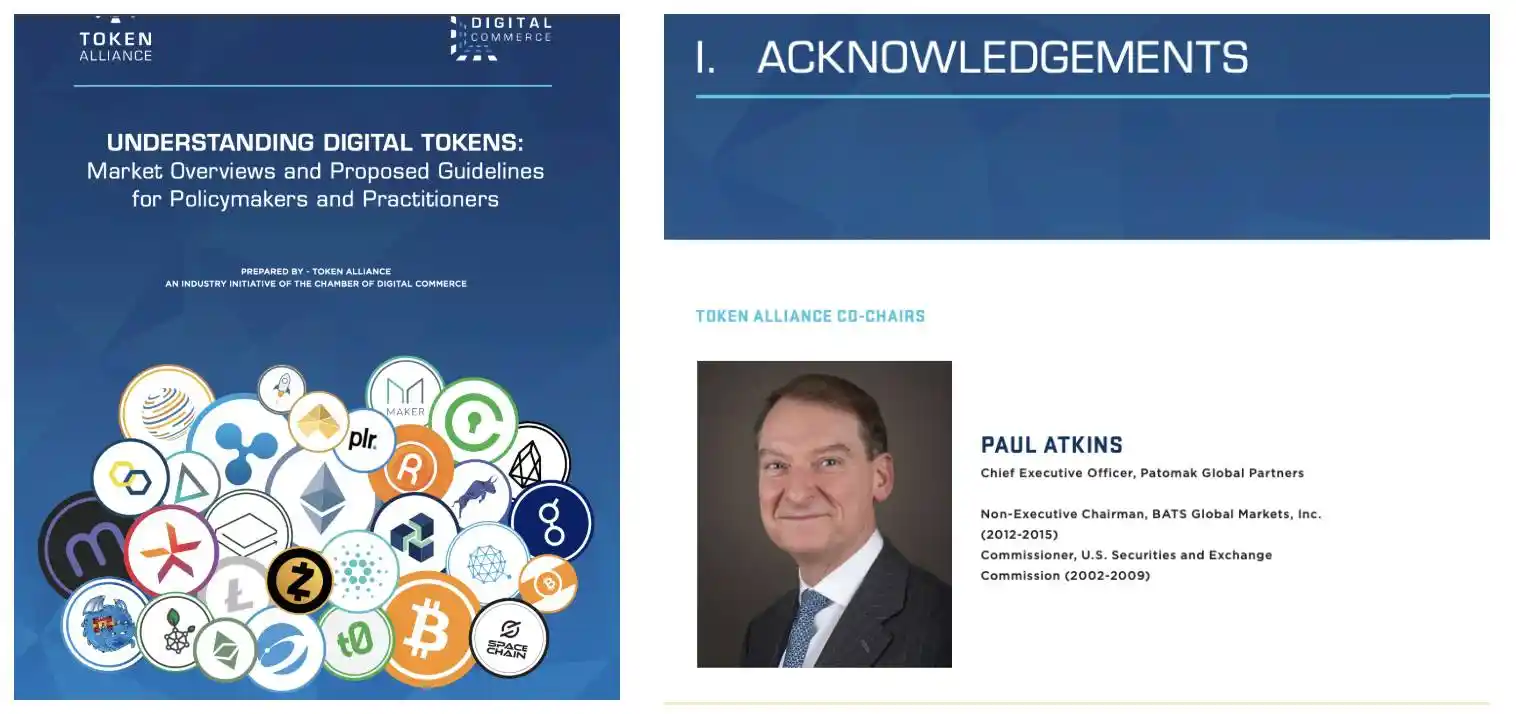
Since 2017, he has served as the Co-Chair of the Digital Chamber's Token Alliance, leading this industry initiative alongside former CFTC Chairman James Newsome.
The Token Alliance aims to establish best practices for the issuance and trading of digital assets. One of its key achievements is the publication of "Understanding Digital Tokens: Market Overview and Policymaker & Practitioner Guidance." This report provides an overview of digital token laws in five countries, analyzes trends in tokenomics, and seeks to promote responsible governance and fraud reduction.
His personal investments further highlight his support for digital assets.
On March 25, 2025, Fortune magazine revealed that Atkins holds up to $6 million in crypto-related assets, including stakes or other investments in the crypto custody firm Anchorage and the tokenization company Securitize, but he does not hold any Bitcoin.
These investments demonstrated his confidence in the crypto ecosystem but also sparked controversy. On March 26, 2025, Senator Elizabeth Warren questioned his potential conflict of interest;
Atkins responded that these assets reflected his optimism about the technology's potential, rather than a speculative attempt, doesn't this sound a bit like the tone when your hodler buddy in the crypto community expresses their stance to you?
In terms of regulation, Atkins also tried to depict a clear path for the crypto industry.
Over the years, Atkins has been clear in stating his support for clearer regulation of cryptocurrency, avoiding stifling innovation or imposing unnecessary oversight. He also criticized the Dodd-Frank Act enacted to control large U.S. banks after the 2008 financial crisis.
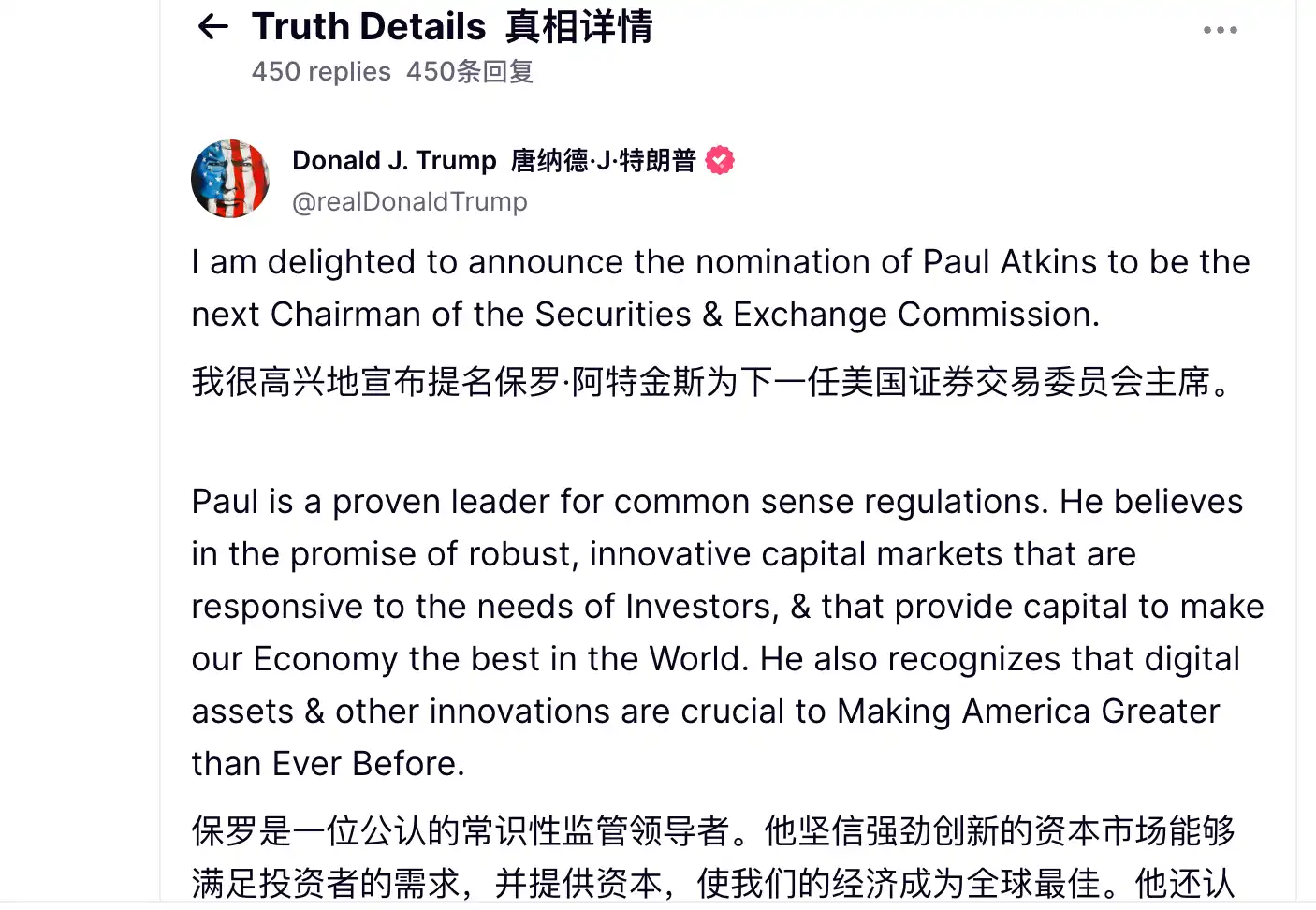
In December of last year, then-President-elect Trump had posted a statement on Truth Social saying that Atkins was a "recognized commonsense regulatory leader" and that he "understands that digital assets and other innovations are crucial to making America greater than ever before."
Firm Hand vs. Inclusivity: The Styles of Two SEC Chairmen
If you put historical information together for a review, you will see that Paul Atkins and Gary Gensler represented two distinctly different paths of SEC regulation of cryptocurrency.
Gensler was nominated by President Joe Biden on April 17, 2021, as SEC chairman, calling the crypto market the "wild west," emphasizing tough regulation to protect investors from fraud and market manipulation.
During his tenure, on October 15, 2021, the SEC approved the first Bitcoin futures ETF but remained cautious about a spot Bitcoin ETF, while launching enforcement actions against multiple crypto companies, such as filing lawsuits against Genesis and Gemini for unregistered securities issuance in January 2023; this iron-fist style has put pressure on the industry.
In contrast, Atkins was nominated by Trump on April 9, 2025, and confirmed as SEC chairman with a 52-44 vote, bringing a more inclusive regulatory approach.
He stated in a podcast in February 2023: "If the SEC is more inclusive and can straightforwardly deal with these [crypto] companies, I think things that happen in the U.S. instead of abroad will be better."
This stance continues his pro-free-market attitude during his tenure as an SEC commissioner (2002-2008). His work with the Token Alliance and investments of up to $6 million in cryptocurrency further indicate his tendency to understand and support industry development.
The two individuals' regulatory philosophies stand in stark contrast.
Gensler focuses on investor protection, tends to view most tokens as securities, and prioritizes enforcement; whereas Atkins advocates for clear rules, emphasizes collaboration with the industry, and may drive more nuanced asset classifications.
Gensler's tough stance has sparked industry discontent, with Coinbase, for example, openly criticizing the "regulatory ambiguity" under his leadership; Atkins' appointment, on the other hand, has been welcomed, with CoinDesk calling it a "victory for the crypto industry."
From iron-fist to inclusivity, this clash foreshadows a significant shift in the SEC's regulatory direction.
Once again, the new SEC chairman has explicitly stated upon taking office that establishing a comprehensive digital asset regulatory framework is a top priority; based on his experience with the Token Alliance and investments in companies like Anchorage and Securitize, he may push for clarifying which crypto assets constitute securities, streamlining the issuance registration process, and creating a more favorable environment for crypto financial products.
Optimistically, this framework may end the long-standing regulatory uncertainty, potentially signaling a turning point for the approval of a spot Bitcoin ETF.
However, given the unpredictable nature of Trump's involvement and the perception of using the crypto industry as a tool, how much beneficial action the SEC chairman can take remains uncertain.
Regardless of the outcome, his regulatory blueprint will be a focal point in the crypto industry. The first steps of this new chairman may determine the next decade of cryptocurrency in the United States and globally.
You may also like

Tiger Research: What AI services do cryptocurrency companies offer?

The war not only drives up oil prices but also causes Circle's stock price to soar

When agents become consumers, who will rewrite the underlying logic of internet commerce?

AI Agents in Action Summit: March 31, Hong Kong Cyberport, focusing on the deep waters of AI implementation

29 Days In, What Are America’s Options on Iran?

Flash Crash Down 97%+ with Ongoing Unlocking, WLD Completes $65 Million Off-chain Funding: Who Is Still Buying?

Bitcoin for Real Estate? Fannie Mae Teams Up with Coinbase to Launch Crypto Mortgage
Tether Hires Big Four Auditor, USDT Enters First Attestation Phase

Google AI Paper Destroys $900B Storage Stock, Accused of Faking Experiment
Evaporate $2 Trillion, U.S. Stocks See Worst Start in 4 Years, Why is the Market Bearish?

The speed at which AI discovers vulnerabilities has surpassed the speed at which it patches vulnerabilities.

AI Crypto Trading Bot Explained: Aurora's Multi-Factor Strategy in WEEX Hackathon
Aurora demonstrates how structured, multi-agent AI Trading systems can deliver more adaptive and resilient performance in the WEEX AI Trading Hackathon.

Cyber Taoist Fortune Teller: Fake Taoist, AI Fortune Telling, and Northeastern Metaphysics History

Bloomberg: Stablecoin Payments Emerge as Crypto VC's Newest Favorite Thing
BeatSwap is evolving towards a full-stack Web3 infrastructure, covering the entire lifecycle of IP rights.
BeatSwap, a global Web3 Intellectual Property (IP) infrastructure project, is attempting to overcome the current fragmentation limitations of the Web3 ecosystem, building a full-stack system that covers the entire lifecycle of IP rights.
Currently, most Web3 projects are still in the stage of functional fragmentation, often focusing only on a single aspect, such as IP asset tokenization, transaction functionality, or a simple incentive model. This structural dispersion has become a key bottleneck hindering the industry's scale application.
BeatSwap's approach is more integrated, integrating multiple core modules into the same system, including:
· IP authentication and on-chain registration
· Authorization-based revenue sharing mechanism
· User-engagement-driven incentive system
· Transaction and liquidity infrastructure
Through the above integration, the platform builds an end-to-end closed-loop path, allowing IP rights to complete a full cycle of "creation, use, and monetization" within the same ecosystem.
BeatSwap is not limited to existing crypto users but is attempting to take the global music industry as a starting point, actively creating new market demand. Its core strategies include:
Exploring and incubating music creators (Artist discovery)
Building a fan community
Igniting IP-centric content consumption demand
The current global music industry is valued at around $260 billion, with over 2 billion digital music users. This means that the potential market corresponding to the tokenization and financialization of IP far exceeds the traditional crypto user base.
In this context, BeatSwap positions itself at the intersection of "real-world content demand" and "on-chain infrastructure," attempting to bridge the structural gap between content production and financial flow.
BeatSwap's upcoming core product "Space" is scheduled to launch in the second quarter of 2026. This product is defined as the SocialFi layer in the ecosystem, aiming to directly connect creators with users and achieve deep integration with other platform modules.
Key designs include:
A fan-centric interactive mechanism
Exposure and distribution logic based on $BTX staking
User paths connected to DeFi and liquidity structures
Thus, a complete user behavior loop is formed within the platform: Discovery → Participation → Consumption → Rewards → Trading
$BTX is designed to be a core utility asset within the ecosystem, rather than just a simple incentive token, with its value directly tied to platform activity and IP use cases.
Main features include:
· Yield distribution based on on-chain authorized actions
· Value reflection based on IP usage and user engagement dynamics
· Support for staking and DeFi participation mechanisms
· Value growth driven by ecosystem expansion
With the increased frequency of IP use, the utility and value support of $BTX will enhance simultaneously, helping alleviate the "disconnect between value and utility" issue present in traditional Web3 token models to some extent.
Currently, $BTX has been listed on several mainstream exchanges, including:
Binance Alpha
Gate
MEXC
OKX Boost
As the launch of "Space" approaches, BeatSwap is actively pursuing more exchange listings to further enhance liquidity and global accessibility, laying a foundation for future market expansion.
BeatSwap's goal is no longer limited to the traditional Web3 narrative but aims to target over 2 billion digital music users and a trillion KRW-scale content market.
By integrating content creators, users, capital, and liquidity into a blockchain framework centered around IP rights, BeatSwap is striving to build a next-generation infrastructure focused on "IP tokenization."
BeatSwap integrates IP authentication, authorization distribution, incentive mechanism, transaction system, and market construction to establish a unified structure that bridges the full lifecycle path of IP rights.
With the launch of the Q2 2026 "Space," the project is expected to become a key infrastructure connecting content and finance in the IP-RWA (Real World Assets) track.

Mag 7 Evaporates $2 Trillion | Rewire News Morning Edition

Losing $19K per Coin Mined, Bitcoin Mining Firms Collective AI Defection



 App
App