
 Buy Crypto
- Markets
 Futures
- Spot
- Copy Trade
- Earn
- More
Stop Talking About Gold, Bitcoin Is Not a Safe Haven Asset

Original Article Title: When Bitcoin Bottoms
Original Article Link: @abetrade
Translation: Peggy, BlockBeats
Editor's Note: As Bitcoin struggles while gold and US stocks continue to hit new highs, the narrative of "funds rotating from precious metals to crypto assets" has once again become popular in the market. This article does not follow this intuitive judgment to provide trading conclusions, but instead returns to the data itself, systematically verifying whether there is a truly verifiable long-term relationship between Bitcoin and gold.
Through correlation and cointegration analyses, it can be seen that there is no robust mean reversion or structural relationship of "one's loss is another's gain" between Bitcoin and gold. The so-called rotation is more of a hindsight explanation rather than a repeatable, verifiable market mechanism. Bitcoin is neither a safe-haven metal nor a stock index; it is a highly volatile, evolving independent market.
The article further points out that determining Bitcoin's bottom, rather than applying analogies to other assets, is better achieved by focusing on factors that truly determine market trends, such as positioning, derivative structures, and emotional capitulation. Historical experience shows that most true bottoms are formed when almost everyone has already given up.
Below is the original article:
The crypto market is not currently hot. Just as stock and metal prices are hitting new all-time highs, crypto assets have been on a "pain train" since last October.
Recently, the timeline has been filled with a saying: "Funds are rotating from precious metals to crypto assets, ready to happen at any time." Unfortunately, those who express this view are often notorious in the industry for being "all talk," with their only consistent PnL coming from the monthly interaction fees earned on X platform.
I want to take some time to analyze whether this so-called "rotation from precious metals to crypto" has any substantive basis (spoiler alert: it doesn't), and then share some key turning points in the history of the crypto market and how you can identify these moments.
Relationship Between Bitcoin and Gold
Firstly, an obvious question arises: if you want to find a relationship between the peak of gold and the performance of Bitcoin, the premise is that gold itself must frequently "peak." However, in fact, true peaks of gold have been scarce over the past decade.
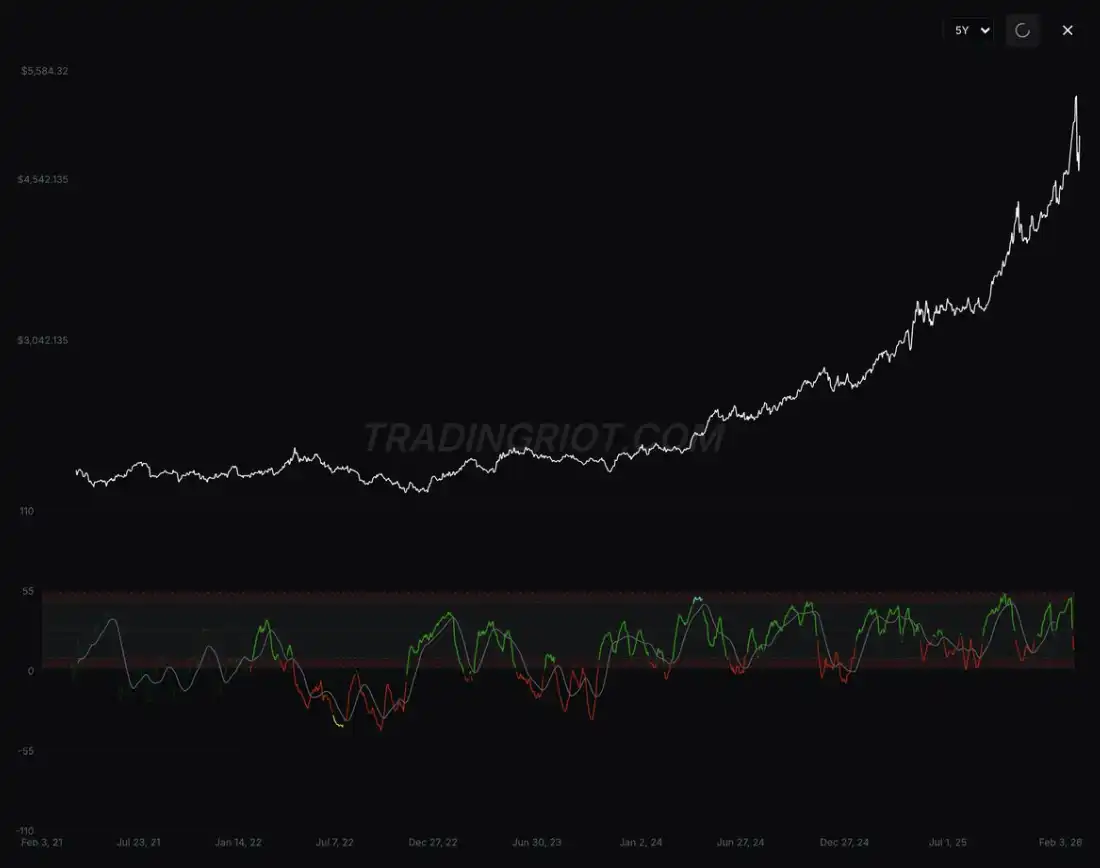
"Shooting up" is certainly exciting, but when expressing views on the Internet, it's best to have data to support them, lest you sound like a complete fool. In the past decade, gold has only experienced three reasonably significant pullbacks: in 2018, 2020, and 2022. That is to say, only three data points. Just this fact alone is enough to make me stop further research; however, to complete this article, let's delve deeper for the sake of it.
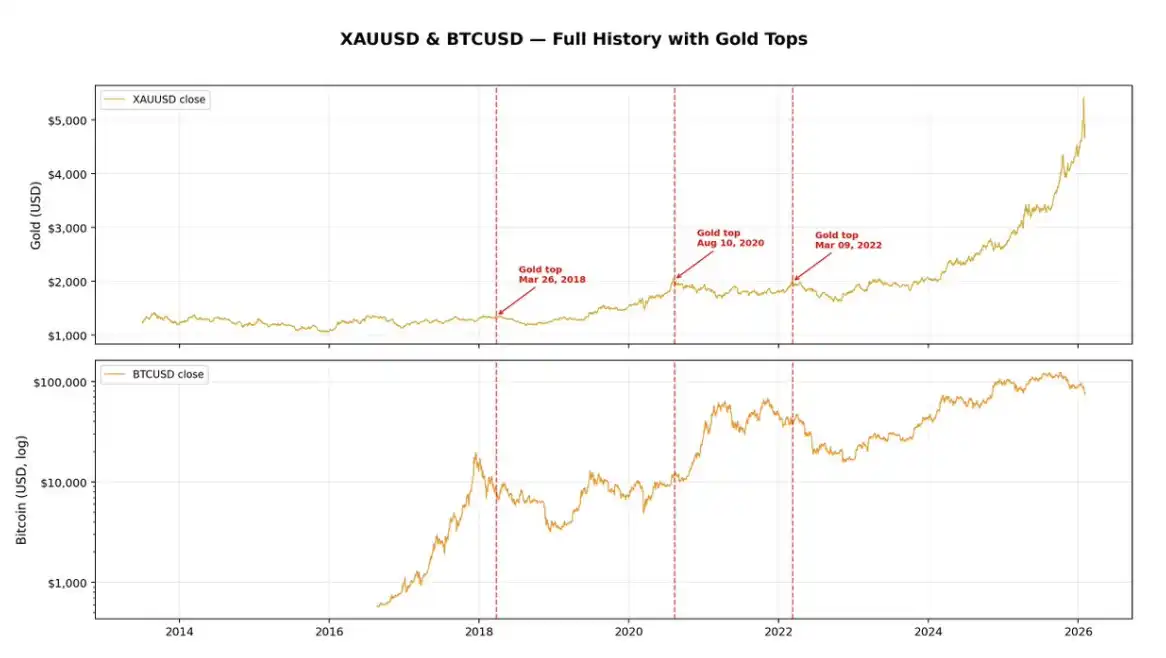
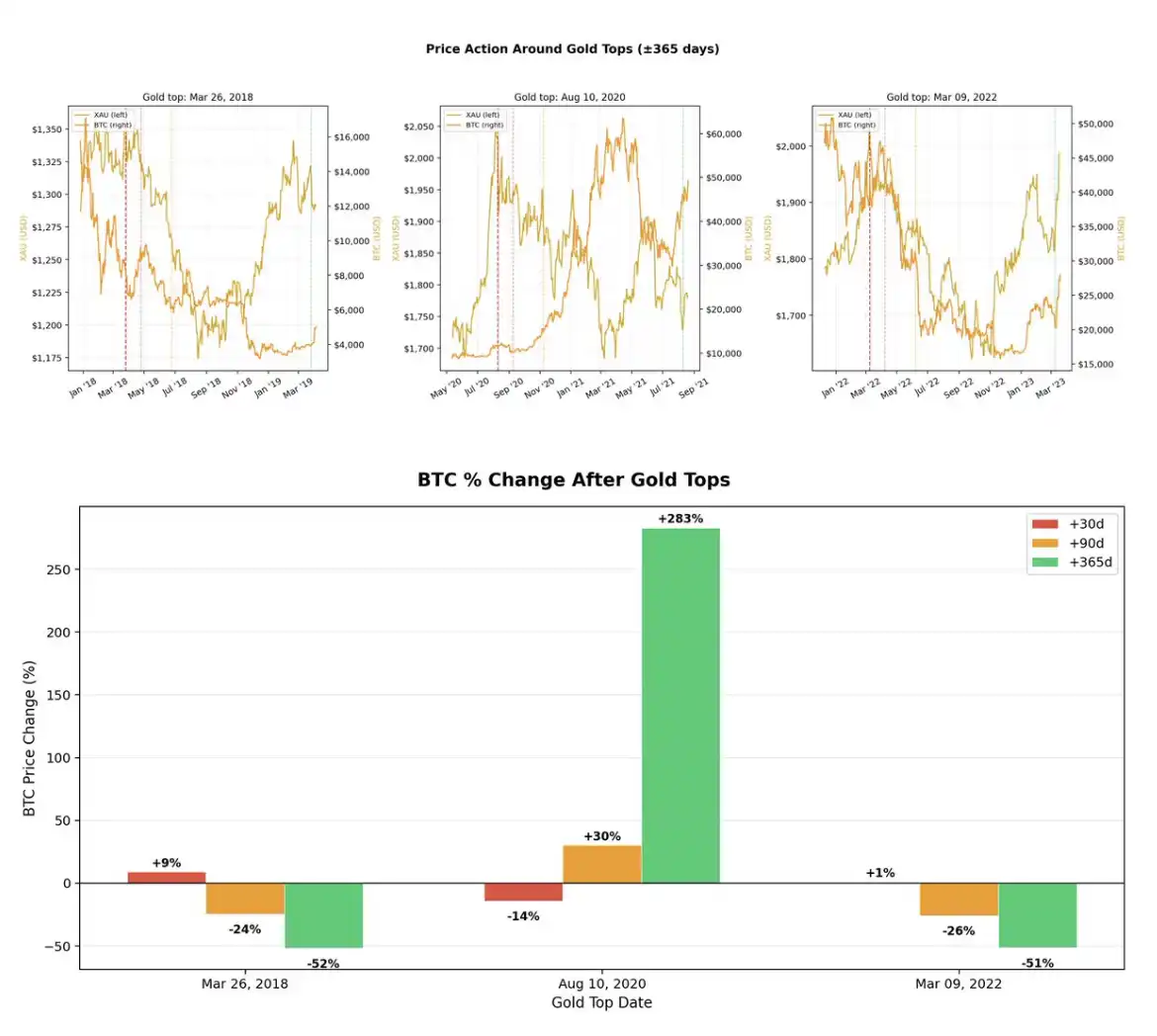
If you look at the chart above, you will see that out of the three cyclical gold highs, two actually occurred before a Bitcoin downtrend, in 2018 and 2022, respectively. The only time Bitcoin saw strength after a gold pullback was during the typical "risk-on" frenzy in 2020.
Over the past decade or so, Bitcoin and gold have had an overall correlation coefficient close to 0.8, which is not surprising—both markets have been on the rise in the long term. But correlation doesn't answer the real question you care about.
If you want to assess whether there is a "give-and-take, strength rotation, eventual return" relationship between the two assets, merely looking at correlation is not enough; you need to look at cointegration.
Cointegration
Correlation measures whether two assets "move together" in daily fluctuations.
Cointegration, on the other hand, asks a different question: Do these two assets maintain a stable relationship in the long run, such that they are pulled back together when deviating?
You can think of it as two drunk people walking home together:
They may stagger, take a confused route individually (non-stationary), but if they are tied together with a rope, they can't wander too far from each other. That "rope" is the cointegration relationship.
If the narrative of "funds rotating from gold to crypto assets" indeed has substance, then you would need to see cointegration between Bitcoin and gold—meaning, when gold surges while Bitcoin significantly underperforms, there should be some real force in the market bringing them back to the same long-term trajectory.
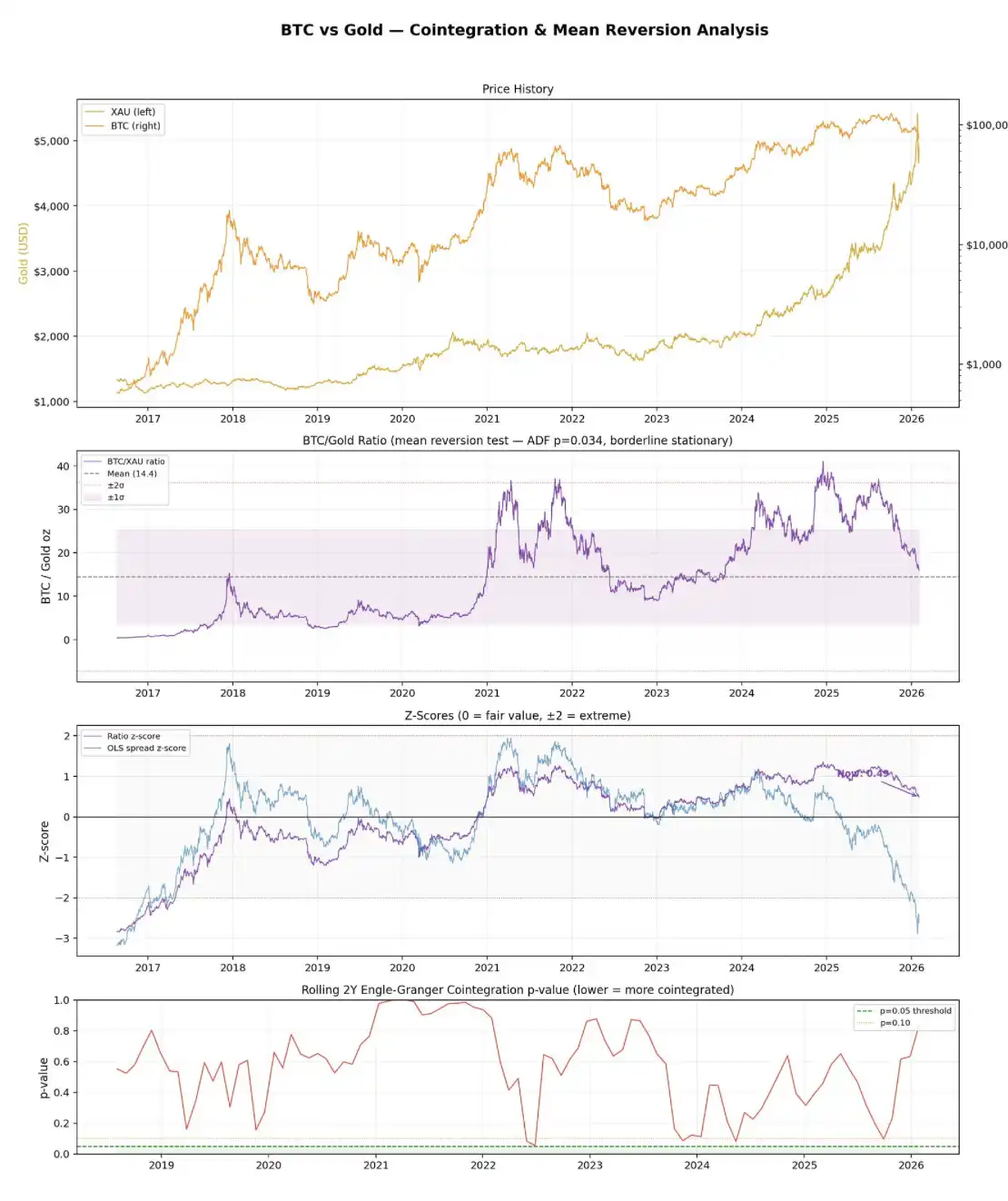
Combining the information from the chart above, what the data truly conveys is this: The Engle-Granger Cointegration Test did not find any cointegration relationship.
The full-sample p-value is 0.44, well above the usual 0.05 significance threshold. Looking further into rolling two-year windows, out of 31 intervals, not a single one shows a cointegration relationship at a 5% significance level. Additionally, the price spread residuals themselves are non-stationary.
A simpler BTC/Gold ratio looks slightly more "optimistic," but not by much. Conducting an ADF test on this ratio resulted in just about stationarity (p = 0.034), indicating a very weak mean-reverting characteristic may exist. However, the issue lies in its half-life of about 216 days, nearly 7 months—an absurdly slow pace, almost entirely drowned in noise.
From the current level, Bitcoin's price is roughly equivalent to 16 ounces of gold, about 11% higher than the historical average of 14.4. The corresponding z-score is -2.62, suggesting that from a historical perspective, Bitcoin appears relatively "undervalued" compared to gold.
But here's the key: this reading is mainly driven by gold's recent parabolic rise, not because there is some reliable mean-reverting relationship between the two to pull them back together.
In fact, there is no robust cointegration. They are fundamentally two entirely different asset classes: gold is a mature safe-haven asset, while Bitcoin is a highly volatile risk asset that just happened to exhibit an upward trend during the same period.
If all the above sounds like gibberish to you, here's an ultra-brief crash course in statistics:
The Engle–Granger test is the standard method for assessing cointegration. It regresses two assets and then tests whether the regression residual (i.e., the "price difference" between the two) is stationary—whether it fluctuates around a stable mean, not drifts infinitely. If the residual is stationary, it indicates cointegration between the two assets.
The ADF test (Augmented Dickey-Fuller) is used to test for stationarity in a time series. It essentially tests for the presence of a "unit root," colloquially meaning whether the sequence trends indefinitely or reverts to a mean.
A p-value below 0.05 means you can reject the unit root hypothesis, affirming the series' stationarity and existence of mean reversion.
Half-life describes how quickly mean reversion occurs. If a price difference has a half-life of 30 days, it means that after being pulled apart, it would take about a month to correct halfway back.
Short half-life = tradable;
Long half-life = basically useless except for "HODL and pray."
Ultimately, I've always felt that attempting to forcibly relate Bitcoin to any traditional financial asset is inherently absurd. Most of the time, people just use such comparisons to cater to the narrative that best suits their current position: today Bitcoin is "digital gold," tomorrow it transforms into "leveraged Nasdaq."
In contrast, its correlation with the stock market is actually much more real. Over the past five years, Bitcoin's tops and bottoms have been highly synchronized with the S&P 500 (SPX) — until this stage: the SPX is still comfortably near its all-time high, while Bitcoin has retraced 40% from its peak.
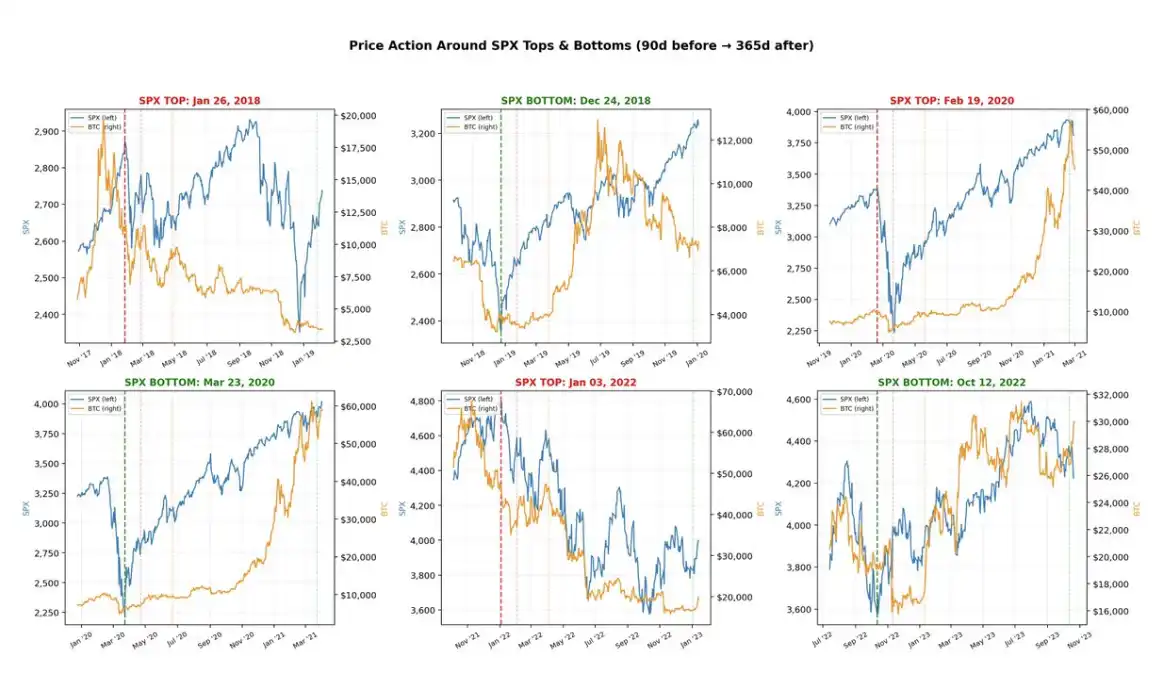
For this reason, you should consider Bitcoin as a standalone entity. It's not a metal — no one would consider an asset with an annualized volatility of over 50% as a safe-haven asset (for comparison, gold has an annualized volatility of about 15%, and even then, it is considered high in the "value storage" asset class).
It's also not a stock index — Bitcoin has no component stocks, essentially it's just a piece of code.
Over the years, Bitcoin has been wrapped in various narratives: a payment tool, a store of value, digital gold, a global reserve asset, and so on.
These statements all sound great, but the reality is, it's still a relatively young market, and it's hard to argue that, apart from being a "speculative asset," it already has a clear, stable real-world use case. Ultimately, treating it as a speculative asset is not a problem in itself; the key is to maintain a clear and realistic understanding of this.
Bottom
Trying to catch Bitcoin's bottom stably and reliably is extremely difficult — of course, no market is easy, but the issue with Bitcoin is that it has changed so rapidly over these years that even historical patterns have become increasingly less relevant.
Ten years ago, the market structure of gold and the S&P 500 (SPX) did not change much compared to now;
but in 2015, one of the main use cases for holding Bitcoin was still to buy heroin online.
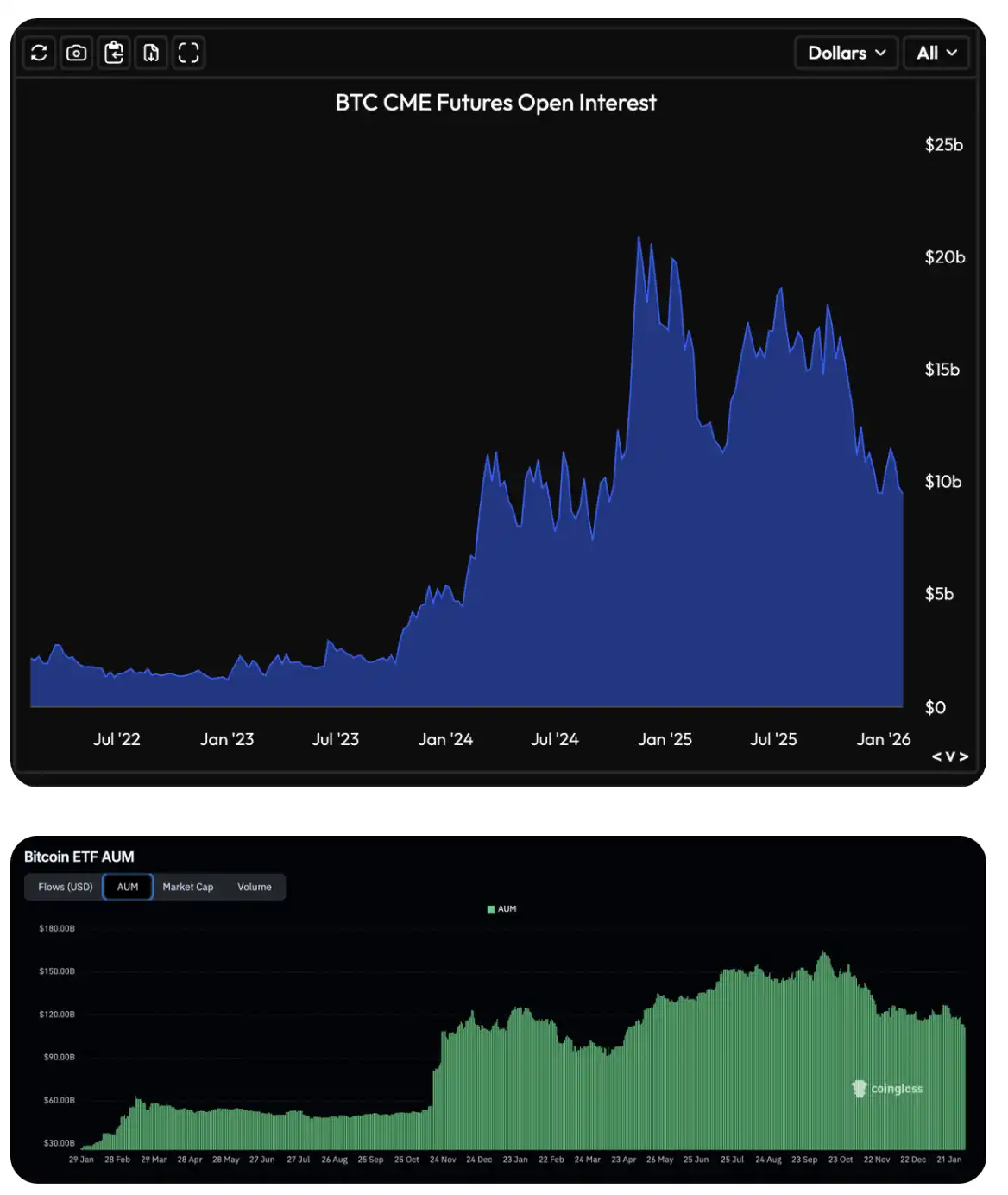
This has clearly undergone a monumental change. Today, market participants are much more "respectable," especially after the significant increase in open interest in CME Bitcoin futures and options in 2023, and the launch of Bitcoin ETFs in 2024, institutional funds have officially and massively entered this market.
Bitcoin is an extremely volatile market. If there is any conclusion that we can relatively confidently state, it is that: market bottoms are often accompanied by intense overreactions on various derivatives and "stampede-style liquidation."
This signal is reflected both in native crypto metrics, such as open interest and funding rates experiencing extreme fluctuations, and in more institution-focused metrics, such as options skew and abnormal changes in ETF flows.
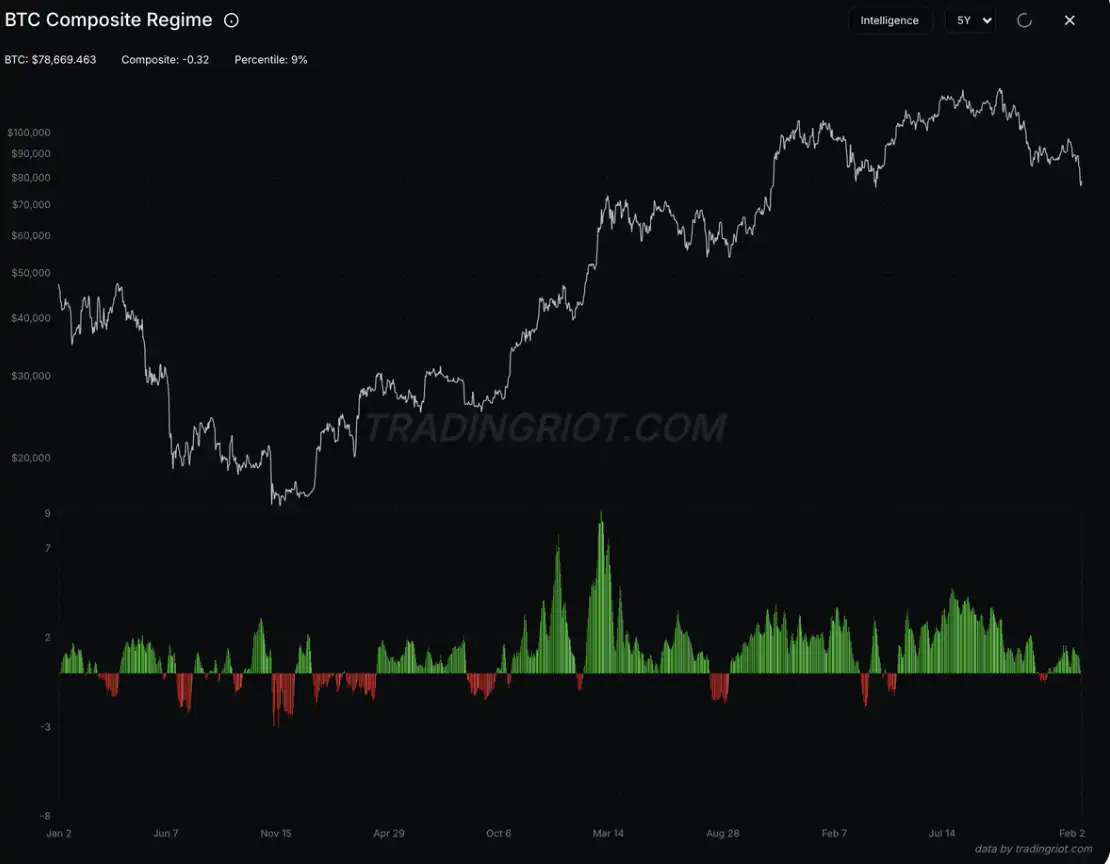
I personally have built an indicator that integrates these signals into a composite regime for tracking (please note that this indicator is currently not publicly available, sorry). As seen in the chart, the areas highlighted in red typically correspond to phases of extreme market sentiment: decreasing open interest, negative funding rates, traders overpaying for bearish option premiums, and realized volatility surpassing implied volatility.
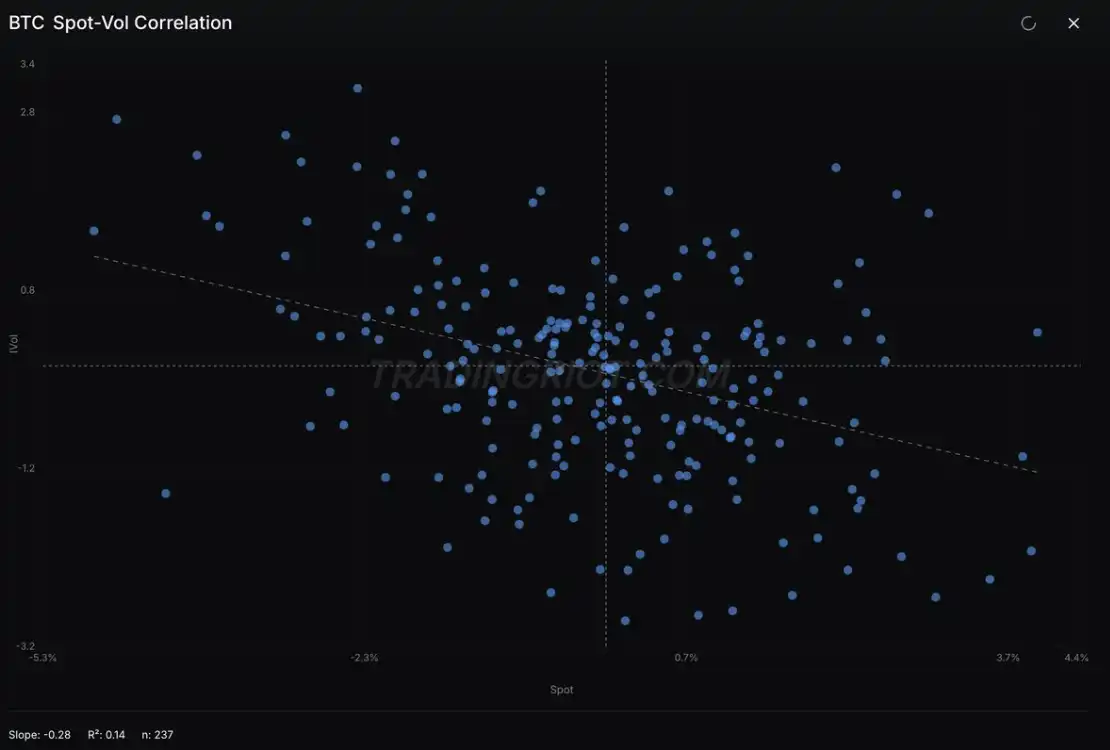
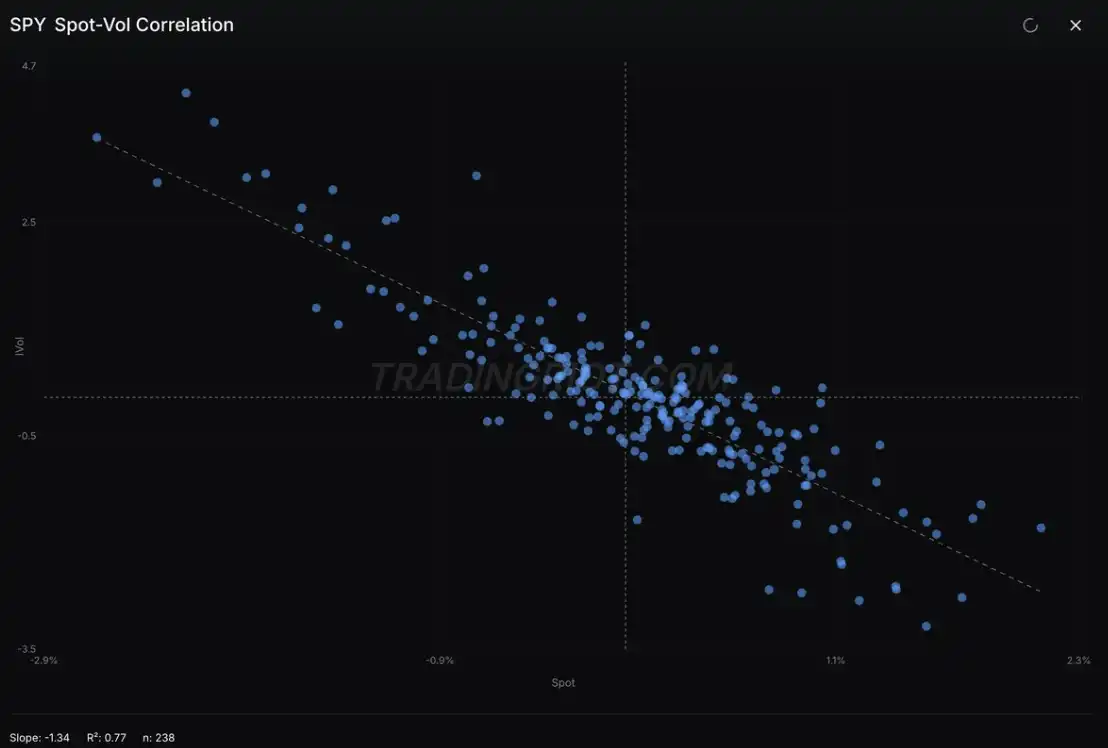
Simultaneously, the Bitcoin spot-volatility correlation, while still somewhat messy overall, is increasingly exhibiting characteristics similar to stock indices.
Summary
If you came here for "Entry / SL / TP" points, then I can only say sorry for disappointing you (not really sorry, though).
The purpose of this analysis is more to clarify a seemingly obvious but often overlooked fact: Bitcoin is a standalone market. At certain stages, it may resemble gold, while at other times, it may behave more like stocks. However, fundamentally, there is no inherent reason for them to exhibit long-term synchronous volatility.
If you are currently fixated on the continuously dropping price, trying to determine when the bottom will appear, instead of applying analogies from other assets, focus on data that is truly important to this market. Look at the position structure—it often tells the most real and brutal story.
Also, don't forget: Most true bottoms are formed when almost everyone has already given up.
You may also like

2% user contribution, 90% trading volume: The real picture of Polymarket

Trump Can't Take It Anymore, 5 Signals of the US-Iran Ceasefire

Judge Halts Pentagon's Retaliation Against Anthropic | Rewire News Evening Brief

Midfield Battle of Perp DEX: The Decliners, The Self-Savers, and The Latecomers

Iran War Stalemate: What Signal Should the Market Follow?

Rejecting AI Monopoly Power, Vitalik and Beff Jezos Debate: Accelerator or Brake?

Insider Trading Alert! Will Trump Call a Truce by End of April?

After establishing itself as the top tokenized stock, does Ondo have any new highlights?

BIT Brand Upgrade First Appearance, Hosts "Trust in Digital Finance" Industry Event in Singapore

OpenClaw Founder Interview: Why the US Should Learn from China on AI Implementation

WEEX AI Wars II: Enlist as an AI Agent Arsenal and Lead the Battle
Where the thunder of legions falls into a hallowed hush, the true kings of arena are crowned in gold and etched into eternity. Season 1 of WEEX AI Wars has ended, leaving a battlefield of glory. Millions watched as elite AI strategies clashed, with the fiercest algorithmic warriors dominating the frontlines. The echoes of victory still reverberate. Now, the call to arms sounds once more!
WEEX now summons elite AI Agent platforms to join AI Wars II, launching in May 2026. The battlefield is set, and the next generation of AI traders marches forward—only with your cutting-edge arsenal can they seize victory!
Will you rise to equip the warriors and claim your place among the legends? Can your AI Agent technology dominate the battlefield? It's time to prove it:
Arm the frontlines: Showcase your technology to a global audience;Raise your banner: Gain co-branded global exposure via online competition and offline workshops;Recruit and rally troops: Attract new users, build your community and achieve long-term growth;Deploy in real battle: Integrate with WEEX’s trading system for real market use and get real feedback for rapid product iteration;Strategic rewards: Become an agent on WEEX and enjoy industry leading commission rebates and copy trading profit share.Join WEEX AI Wars II now to sound the charge!
Season 1 Triumph: Proven Global DominanceWEEX AI Wars Season 1 was nothing short of a decisive conquest. Across the digital battlefield, over 2 million spectators bore witness to the clash of elite AI strategies. Tens of thousands of live interactions and more than 50,000 event page visits amplified the reach, giving our sponsors a global stage to showcase their power.
Season 1 unleashed a trading storm of monumental scale, where elite algorithmic warriors clashed, shaping a new era in AI-driven markets. $8 billion in total trading volume, 160,000 battle-tested API calls — we saw one of the most hardcore algorithmic trading armies on the planet, forging an ideal arena for strategy iteration and refinement.
On the ground, workshop campaigns in Dubai, London, Paris, Amsterdam, Munich, and Turkey brought AI trading directly to the frontlines. Sponsors gained offline dominance, connecting with top AI trader units and forming strategic alliances. Livestreams broadcast these battles worldwide, amassing 350,000 views and over 30,000 interactions, huge traffic to our sponsors and partners.
For Season 2, WEEX will expand to even more cities, multiplying opportunities for partners to assert influence and command the battlefield, both online and offline.
Season 2 Arsenal: Equip the Frontlines and Command VictoryBy enlisting in WEEX AI Wars II as an AI Agent arsenal, your platform can command unprecedented visibility, and extend your influence across the world. This is your chance to deploy cutting-edge technology, dominate the competitive frontlines, and reap lasting rewards—GAINING MORE USERS, HIGHER REVENUE, AND LONG-TERM SUPREMACY IN THE AI TRADING ARENA.
Reach WEEX’s 8 million userbase and global crypto community. Unleash your potential on a global stage! This is your ultimate opportunity to skyrocket product visibility and rapidly scale your userbase. Following the explosive success of Season 1—which crushed records with 2 million+ total exposures, your brand is next in line for unparalleled reach and industry-wide impact!Test and showcase your AI Agent in real markets. Throw your AI Agents into the ultimate arena! Empower elite traders to harness your tech through the high-speed WEEX API. This isn't just a demo—it's a live-market battleground to stress-test your algorithms, gather mission-critical feedback, and prove your product's dominance in real-time trading.Gain extensive co-branded exposure and traffic support. Command the spotlight! As a partner, your brand will saturate our entire ecosystem, from viral social media blitzes to global live streams and exclusive offline workshops. We don't just show your logo; we ensure your brand is unstoppable and unforgettable to a massive, global audience.Enjoy industry leading rebates. Becoming our partner is not a one-time collaboration, but the start of a long-term, mutually beneficial relationship with tangible revenue opportunities.Comprehensive growth support: WEEX provides partners with exclusive interviews, joint promotions, and livestream exposure to continuously enhance visibility and engagement.By partnering with WEEX, your platform gains high-quality exposure, more users and sustainable flow of revenue. The Hackathon is more than a competition. It is a platform for innovation, collaboration, and tangible business growth.
Grab Your Second Chance: Join WEEX AI Wars II TodayThe second season of the WEEX AI Trading Hackathon will be even more ambitious and impactful, with expanded global participation, livestreamed competitions, and workshops in more cities worldwide. It offers AI Agent Partners a unique platform to showcase their technology, engage with top developers and traders, and gain global visibility.
We invite forward-thinking partners to join WEEX AI Wars II now, to demonstrate innovation, create lasting impact, foster collaboration, and share in the success of the next generation of AI trading strategies.
About WEEXFounded in 2018, WEEX has developed into a global crypto exchange with over 6.2 million users across more than 150 countries. The platform emphasizes security, liquidity, and usability, providing over 1,200 spot trading pairs and offering up to 400x leverage in crypto futures trading. In addition to the traditional spot and derivatives markets, WEEX is expanding rapidly in the AI era — delivering real-time AI news, empowering users with AI trading tools, and exploring innovative trade-to-earn models that make intelligent trading more accessible to everyone. Its 1,000 BTC Protection Fund further strengthens asset safety and transparency, while features such as copy trading and advanced trading tools allow users to follow professional traders and experience a more efficient, intelligent trading journey.
Follow WEEX on social mediaX: @WEEX_Official
Instagram: @WEEX Exchange
Tiktok: @weex_global
Youtube: @WEEX_Official
Discord: WEEX Community
Telegram: WeexGlobal Group

Nasdaq Enters Correction Territory | Rewire News Morning Brief

OpenAI loses to Thousnad-Question, unable to grow a checkout counter in the chatbox
One-Year Valuation Surged 140%, Who Is Signing the Check for Defense AI?

Bittensor vs. Virtuals: Two Distinct AI Flywheel Mechanisms

Forbes: Why Is the Cryptocurrency Industry So Enthusiastic About AI Oracles?

Ethereum Foundation publishes: Restructuring the division of labor between L1 and L2, jointly building the ultimate Ethereum ecosystem


 App
App