
 Buy Crypto
- Markets
 Futures
- Spot
- Copy Trade
- Earn
- More
Unlocking Encryption for Consumer-Grade Applications, How Can zkTLS Enable On-Chain "Visa"?

Original Title: zkTLS: Unlocking Crypto Consumer Apps
Original Author: @yeak__, @Delphi_Digital Researcher
Original Translation: zhouzhou, BlockBeats
Editor's Note: TLSNotary verifies communication between the client and server, allowing selective data disclosure while ensuring privacy. Pluto introduces TLSNotary to smart contracts, Primus Labs enhances efficiency and develops zkFHE scheme, Opacity prevents collusion through Eigenlayer AVS and TEE, enhancing security. Opacity requires Web2 account verification, reducing Sybil attack risk, and adopts a verifiable log mechanism. Future optimization directions include vector blinding linear assessment to improve MPC efficiency for faster TLS proofs. HTTPS proxies act as intermediaries to enhance security and privacy protection, commonly used for enterprise traffic monitoring.
The following is the original content (slightly rephrased for better readability):
The encryption industry has always possessed a mindset, talent, and funding to change the world, but often lacks the means to achieve this goal. Currently, most real-world encryption success cases still rely on the support of Web2 giants. We can only hope that Visa and Mastercard continue to support crypto cards, Coinbase, PayPal, and Stripe keep optimizing the compatibility between traditional payment systems and blockchain, BlackRock continues to promote tokenization of government bonds, and Walmart keeps selling Pudgy Penguins.
Today, we have a powerful new tool that allows encryption industry builders to truly drive change. The traditional markets are rife with inefficiencies and limitations, while the encryption industry is in an unprecedentedly advantageous position to offer alternative solutions.
zkTLS (also known as TLS Oracle or Web Proof) enables private data to be extracted from the Web2 closed ecosystem, allowing users to prove various data types such as legal identity, financial records, educational background, and behavioral patterns in a completely privacy-preserving manner. Here is a brief overview of how it works.
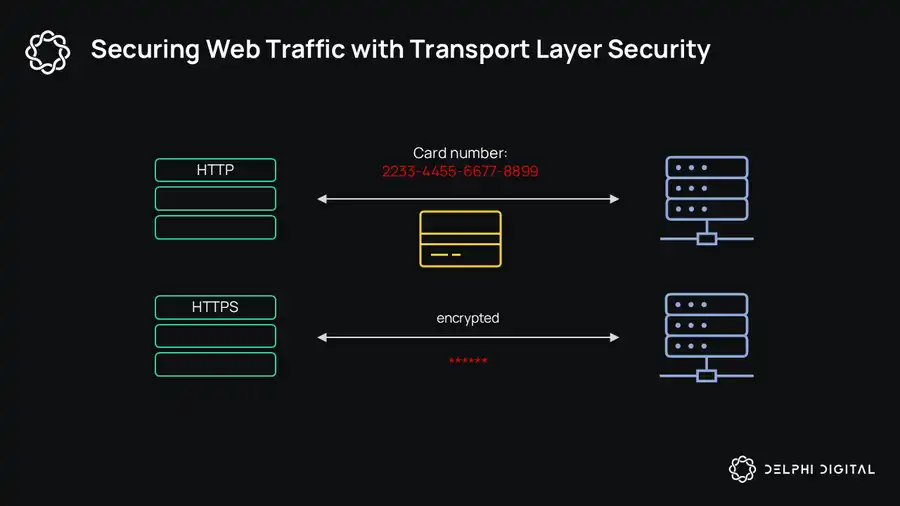
TLS (Transport Layer Security protocol) is a protocol used to encrypt communication between clients and servers. TLS makes up the "S" in HTTPS (HTTPS = HTTP + TLS) and has become a network standard, protecting 95% of network traffic.
TLS is a trusted centralized authority responsible for issuing session keys. When a user accesses a website, the browser and the target server perform a TLS handshake to generate a session key for subsequent data transmission using symmetric encryption. However, the data exchanged between the client and server is not signed, making it impossible to prove its authenticity elsewhere.
Security provided by TLS:
· Authenticity
· Integrity
· Privacy
· Lack of data portability
zkTLS accomplishes identity verification between the client and server during an HTTPS session and brings privacy-preserving proofs onto the chain, addressing the issue of data portability. Importantly, this is often undetectable by the server and cannot be blocked by a firewall. With zkTLS, the entire Internet's database can become a composable building block for blockchain applications, a task that Web2 is almost powerless to achieve.
Various implementations of zkTLS: MPC (Multi-Party Computation), Proxy, TEE (Trusted Execution Environment)
MPC (Multi-Party Computation)
MPC allows multiple participants to jointly perform a computation without revealing their private inputs. MPC provides strong security guarantees but incurs high computational costs and suffers from a collusion problem.
Deco
In 2019, Deco first proposed an MPC-based TLS solution. Deco's maliciously secure two-party computation (2PC) approach has extensive compute overhead; for example, authenticating a 2KB data packet requires 475MB of communication and takes 50 seconds to complete. The solution is highly susceptible to timing out and has not been successfully deployed. Subsequently, Deco was acquired by Chainlink, who, along with Teller, developed a proof-of-concept solution.
TLSNotary
TLSNotary built upon Deco's work, utilizing a 2PC implementation based on garbled circuits and oblivious transfers. Garbled circuits are the simplest and most direct method in MPC.
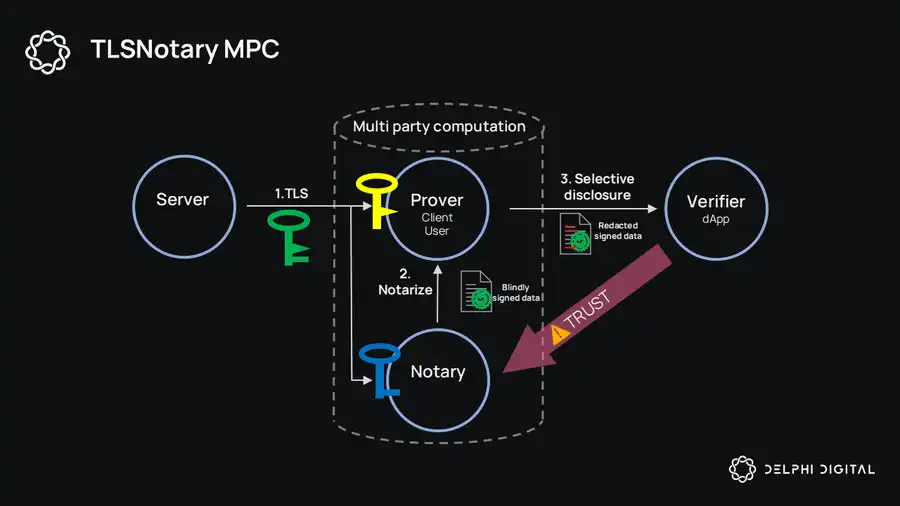
TLS Notary "notarizes" the session between the client and server to prove its authenticity. During the TLS handshake, the prover and verifier collaborate to perform key encryption and decryption. Throughout the process, only the prover communicates with the server, while the verifier only sees encrypted data. The prover cannot forge inputs or responses. In the final stage, the prover can partially obscure the session record before presenting it to the verifier, for example, only proving to the verifier that it is located in a specific jurisdiction while concealing specific latitude and longitude information.
A validator can act as a notary, or outsource the validation role to generate more generic, portable proofs. This introduces an additional trust assumption that the validator must trust the notary not to collude with the prover to produce fake proofs. To mitigate this issue, a validator can request proofs from multiple notaries or define their own trusted notary list. However, these schemes still have various flaws, and the collusion problem remains one of the main challenges of MPC.
The advantage of TLSNotary is that it can maintain data portability, protect privacy, and does not rely on server cooperation. It achieves selectively disclosed authenticated data through circuit obfuscation and key splitting techniques but does not use ZKP. Currently, several projects have introduced zero-knowledge technology based on TLSNotary to make it easier to integrate.
Related Projects
Pluto
Pluto Labs is an open-source zero-knowledge TLSNotary implementation aimed at productizing it, allowing developers to integrate any off-chain data into smart contracts with just five lines of code. A detailed overview of its trust assumptions can be found in the related links.
Primus Labs (formerly PADO Labs)
Primus Labs has enhanced Deco using a garble-then-prove technique, replacing the high-cost malicious secure 2PC. It has achieved a 14x improvement in communication efficiency and up to a 15.5x improvement in execution time, successfully integrated into real-world APIs such as Coinbase and Twitter. Additionally, Primus is developing a zkFHE solution that may support more complex architectures in the future. Primus has also released a browser extension and plans to launch iOS/Android apps.
Opacity
Opacity addresses the collusion problem through a set of mechanisms and employs Eigenlayer AVS to provide economic security, overlaying multiple security measures:
· Sybil resistance based on on-chain Web2 account IDs
· Commit-and-reveal mechanism—users must submit a value before a randomly selected notary node
· Random selection of MPC nodes
· Verifiable attempt logs
Opacity restricts users from colluding using multiple wallets, with each wallet tied to a Web2 account. Additionally, users must submit a proof request before being randomly matched with a notary node, preventing them from changing their position if they attempt collusion without being matched to a colluding node. The verifiable attempt logs can be used to track suspicious proof submissions where a wallet attempts but fails to prove ownership of, for example, $10 million in bank deposits.
In addition, Opacity requires the attestation software to run in a Trusted Execution Environment (TEE) to ensure that unless the TEE is compromised, collusion is not possible. This is crucial because Opacity does not rely entirely on the TEE as a security guarantee.
To forge a proof within the Opacity framework, all of the following conditions must be met:
· User intentionally colludes
· At least one attestation node participates in collusion
· The attestation node runs on a compromised TEE
· The user randomly matches a collusion node within 1-3 attempts
· Verifiers can request proof regeneration multiple times, exponentially reducing the probability of the fourth condition
· Additionally, malicious behavior will face a penalty mechanism
The resistance to Sybil attacks in Opacity remains the weakest link. It can prevent one Web2 account from binding to multiple wallets but cannot prevent one person from creating multiple Web2 accounts. In fact, Opacity effectively outsources Sybil attack protection to Web2 platforms, with some platforms being more reliable than others (e.g., Rippling HR's identity authentication is more trustworthy than a Twitter account). In the future, Opacity may integrate multiple Web2 accounts to enhance security.
Opacity is developing the best practices implementation of zkTLS, making significant progress in decentralization and reducing trust assumptions. Its ability to overcome MPC computation overhead will be a key factor in future success.
In the future, there is still ample room for MPC performance optimization. For example, Vector Oblivious Linear Evaluation can achieve efficient 1-of-N Oblivious Transfer, leading to significant progress in each interaction. This can reduce network overhead by 100 times, making MPC-TLS proofs within 1 second feasible.
Proxy
An HTTPS proxy is an intermediary between a client and a server, responsible for forwarding encrypted traffic and only decrypting data when verifying user identity. Proxies can enhance security, performance, and privacy, particularly common in enterprise environments for monitoring and restricting employee access.
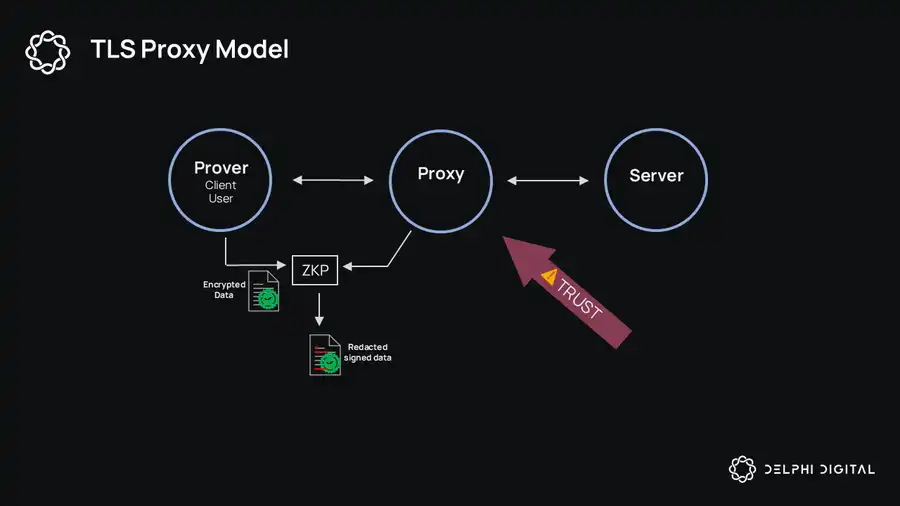
Proxies can also be used for zkTLS. This model inserts a proxy witness between the client and server to prove the legitimacy of communication. The proxy model is fast, cost-effective, and simple in structure, capable of handling large amounts of data. However, issues such as auditing, collusion, and decentralization persist. Additionally, this method can be detected by servers, potentially leading to blocking in widespread applications.
Reclaim Protocol
The Reclaim Protocol is the pioneer of the proxy model, leading the way in all zkTLS projects. Reclaim has broad support across almost all blockchains and boasts 889 community-built oracles. Several projects are built on Reclaim, including the zkP2P ticketing marketplace.
Reclaim is able to generate proofs on a user's mobile device in approximately 2–4 seconds without requiring users to download any apps or extensions. Reclaim employs a residential proxy to circumvent Web2 firewall issues.
Compared to MPC-TLS, Reclaim's proxy model is simpler, resulting in faster speeds. Many concerns about the proxy model have been addressed in the academic paper "Proxying is Enough" and Reclaim's blog. Studies show that the probability of breaking Reclaim's security is 10⁻⁴⁰.
zkPass
zkPass utilizes a hybrid model, originally based on an MPC approach but later transitioning to a proxy-witness model in production while keeping MPC as a fallback. zkPass is currently deployed on networks such as Base, BNB, Scroll, Linea, Arbitrum, zkSync, OP, X Layer, among others. zkPass uses its native TransGate Chrome extension and supports over 70 data sources and 200 data formats.
zkPass focuses primarily on identity verification and protection against Sybil attacks. The project is currently running incentive programs where users can complete challenges to earn ZKP token points. zkPass may become the first zkTLS project to introduce a liquidity token.
TEE
Trusted Execution Environment (TEE) is a tamper-resistant enclave in a processor that can store sensitive data and perform secure computations. TEE provides both hardware and software isolation, with dedicated memory and computational capabilities independent of the rest of the CPU. Intel SGX is currently the most well-known TEE solution. However, TEE has had vulnerabilities in the past and is susceptible to side-channel attacks.
Clique
Clique adopts a TEE-based approach to build zkTLS. This method offers very low computation and network overhead, addressing many issues but introducing a reliance on trusted hardware, shifting risks from notaries to chip manufacturers. In this model, TEE fully takes on the security guarantee responsibilities.
Summary
It is worth noting that zkTLS is just a generic term. Different zkTLS schemes vary in the degree of application of zero-knowledge technology and do not provide the same level of security guarantees as other zero-knowledge technologies like zkEmail. Strictly speaking, zkTLS may be better classified under MPC-TLS (+zkp), TEE-TLS, and zkTLS Proxy.
In the future, discussions in the zkTLS field will revolve around the trade-off between performance and security.
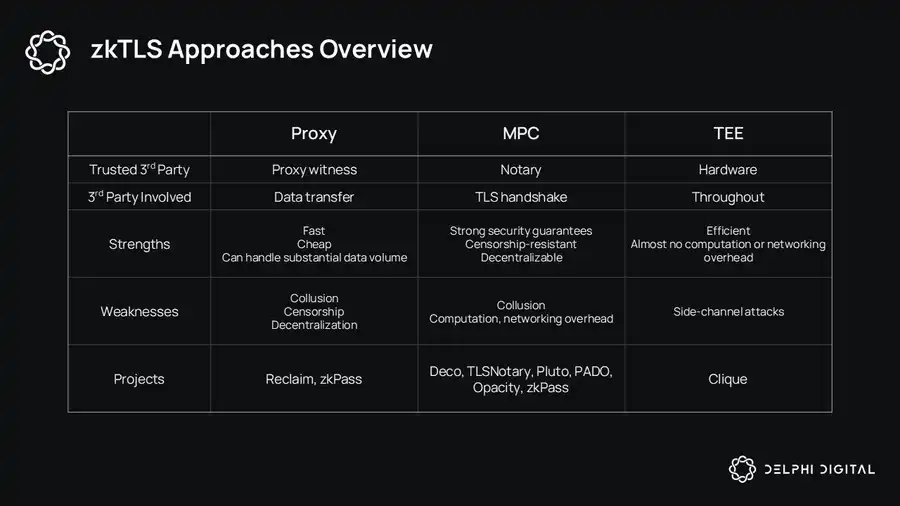
Proxy: This is a more general solution but requires additional trust assumptions, demands that clients can afford a zero-knowledge (ZK) solution, and also requires additional measures to bypass firewalls.
Multi-Party Computation (MPC): This model provides strong security guarantees but entails significant network communication overhead during MPC setup. Due to the high cost of the truth table, MPC methods are more suitable for small request/response interactions and TLS sessions without strict time limits. MPC has anti-censorship properties but faces collusion issues.
Trusted Execution Environment (TEE): The TEE model cleverly addresses most of the issues zkTLS faces, but at the cost of requiring full trust in TEE hardware.
Currently, Reclaim and Opacity are rapidly gaining momentum and seem to be leading the discussions in the zkTLS field. As zkTLS evolves, the trade-off between MPC and proxy models in terms of performance and security will remain a core topic.
Conclusion
zkTLS is an emerging narrative that is changing everything. However, many unresolved issues remain: Will zkTLS providers be commodified? Will the value capture flow to the application layer? How significant is the extractable value of forged proofs? How will these issues impact the discussions on zkTLS scheme trade-offs?
One thing is clear: zkTLS has greatly expanded the design space of decentralized applications and provided new ideas for building new systems. Today, many innovative ideas are already being implemented:
· Ticketing Marketplace – zkP2P (based on Reclaim)
· Web2 Reputation Import (Uber, DoorDash authentication) – Nosh Delivery (based on Opacity)
·KOL Marketing/Promotion Proof – Daisy (based on Opacity)
·Smart Predictions Market – TMR.NEWS (based on Reclaim)
·Low Collateral Loans through Payroll Earn – Earnifi (based on Opacity)
·Precision Targeting with Digital Ad Incentives – EarnOS (based on Opacity)
·Soft Collateral Loans – 3Jane (based on Reclaim)
zkTLS has disrupted the existing market landscape of Web2 by weakening data monopolies. All current inefficient markets are opportunities for cryptographic technology to penetrate and improve society.
You may also like

2% user contribution, 90% trading volume: The real picture of Polymarket

Trump Can't Take It Anymore, 5 Signals of the US-Iran Ceasefire

Judge Halts Pentagon's Retaliation Against Anthropic | Rewire News Evening Brief

Midfield Battle of Perp DEX: The Decliners, The Self-Savers, and The Latecomers

Iran War Stalemate: What Signal Should the Market Follow?

Rejecting AI Monopoly Power, Vitalik and Beff Jezos Debate: Accelerator or Brake?

Insider Trading Alert! Will Trump Call a Truce by End of April?

After establishing itself as the top tokenized stock, does Ondo have any new highlights?

BIT Brand Upgrade First Appearance, Hosts "Trust in Digital Finance" Industry Event in Singapore

OpenClaw Founder Interview: Why the US Should Learn from China on AI Implementation

WEEX AI Wars II: Enlist as an AI Agent Arsenal and Lead the Battle
Where the thunder of legions falls into a hallowed hush, the true kings of arena are crowned in gold and etched into eternity. Season 1 of WEEX AI Wars has ended, leaving a battlefield of glory. Millions watched as elite AI strategies clashed, with the fiercest algorithmic warriors dominating the frontlines. The echoes of victory still reverberate. Now, the call to arms sounds once more!
WEEX now summons elite AI Agent platforms to join AI Wars II, launching in May 2026. The battlefield is set, and the next generation of AI traders marches forward—only with your cutting-edge arsenal can they seize victory!
Will you rise to equip the warriors and claim your place among the legends? Can your AI Agent technology dominate the battlefield? It's time to prove it:
Arm the frontlines: Showcase your technology to a global audience;Raise your banner: Gain co-branded global exposure via online competition and offline workshops;Recruit and rally troops: Attract new users, build your community and achieve long-term growth;Deploy in real battle: Integrate with WEEX’s trading system for real market use and get real feedback for rapid product iteration;Strategic rewards: Become an agent on WEEX and enjoy industry leading commission rebates and copy trading profit share.Join WEEX AI Wars II now to sound the charge!
Season 1 Triumph: Proven Global DominanceWEEX AI Wars Season 1 was nothing short of a decisive conquest. Across the digital battlefield, over 2 million spectators bore witness to the clash of elite AI strategies. Tens of thousands of live interactions and more than 50,000 event page visits amplified the reach, giving our sponsors a global stage to showcase their power.
Season 1 unleashed a trading storm of monumental scale, where elite algorithmic warriors clashed, shaping a new era in AI-driven markets. $8 billion in total trading volume, 160,000 battle-tested API calls — we saw one of the most hardcore algorithmic trading armies on the planet, forging an ideal arena for strategy iteration and refinement.
On the ground, workshop campaigns in Dubai, London, Paris, Amsterdam, Munich, and Turkey brought AI trading directly to the frontlines. Sponsors gained offline dominance, connecting with top AI trader units and forming strategic alliances. Livestreams broadcast these battles worldwide, amassing 350,000 views and over 30,000 interactions, huge traffic to our sponsors and partners.
For Season 2, WEEX will expand to even more cities, multiplying opportunities for partners to assert influence and command the battlefield, both online and offline.
Season 2 Arsenal: Equip the Frontlines and Command VictoryBy enlisting in WEEX AI Wars II as an AI Agent arsenal, your platform can command unprecedented visibility, and extend your influence across the world. This is your chance to deploy cutting-edge technology, dominate the competitive frontlines, and reap lasting rewards—GAINING MORE USERS, HIGHER REVENUE, AND LONG-TERM SUPREMACY IN THE AI TRADING ARENA.
Reach WEEX’s 8 million userbase and global crypto community. Unleash your potential on a global stage! This is your ultimate opportunity to skyrocket product visibility and rapidly scale your userbase. Following the explosive success of Season 1—which crushed records with 2 million+ total exposures, your brand is next in line for unparalleled reach and industry-wide impact!Test and showcase your AI Agent in real markets. Throw your AI Agents into the ultimate arena! Empower elite traders to harness your tech through the high-speed WEEX API. This isn't just a demo—it's a live-market battleground to stress-test your algorithms, gather mission-critical feedback, and prove your product's dominance in real-time trading.Gain extensive co-branded exposure and traffic support. Command the spotlight! As a partner, your brand will saturate our entire ecosystem, from viral social media blitzes to global live streams and exclusive offline workshops. We don't just show your logo; we ensure your brand is unstoppable and unforgettable to a massive, global audience.Enjoy industry leading rebates. Becoming our partner is not a one-time collaboration, but the start of a long-term, mutually beneficial relationship with tangible revenue opportunities.Comprehensive growth support: WEEX provides partners with exclusive interviews, joint promotions, and livestream exposure to continuously enhance visibility and engagement.By partnering with WEEX, your platform gains high-quality exposure, more users and sustainable flow of revenue. The Hackathon is more than a competition. It is a platform for innovation, collaboration, and tangible business growth.
Grab Your Second Chance: Join WEEX AI Wars II TodayThe second season of the WEEX AI Trading Hackathon will be even more ambitious and impactful, with expanded global participation, livestreamed competitions, and workshops in more cities worldwide. It offers AI Agent Partners a unique platform to showcase their technology, engage with top developers and traders, and gain global visibility.
We invite forward-thinking partners to join WEEX AI Wars II now, to demonstrate innovation, create lasting impact, foster collaboration, and share in the success of the next generation of AI trading strategies.
About WEEXFounded in 2018, WEEX has developed into a global crypto exchange with over 6.2 million users across more than 150 countries. The platform emphasizes security, liquidity, and usability, providing over 1,200 spot trading pairs and offering up to 400x leverage in crypto futures trading. In addition to the traditional spot and derivatives markets, WEEX is expanding rapidly in the AI era — delivering real-time AI news, empowering users with AI trading tools, and exploring innovative trade-to-earn models that make intelligent trading more accessible to everyone. Its 1,000 BTC Protection Fund further strengthens asset safety and transparency, while features such as copy trading and advanced trading tools allow users to follow professional traders and experience a more efficient, intelligent trading journey.
Follow WEEX on social mediaX: @WEEX_Official
Instagram: @WEEX Exchange
Tiktok: @weex_global
Youtube: @WEEX_Official
Discord: WEEX Community
Telegram: WeexGlobal Group

Nasdaq Enters Correction Territory | Rewire News Morning Brief

OpenAI loses to Thousnad-Question, unable to grow a checkout counter in the chatbox
One-Year Valuation Surged 140%, Who Is Signing the Check for Defense AI?

Bittensor vs. Virtuals: Two Distinct AI Flywheel Mechanisms

Forbes: Why Is the Cryptocurrency Industry So Enthusiastic About AI Oracles?

Ethereum Foundation publishes: Restructuring the division of labor between L1 and L2, jointly building the ultimate Ethereum ecosystem


 App
App