
 Buy Crypto
- Markets
 Futures
- Spot
- Copy Trade
- Earn
- More
U.S. Tariff Truce Fiasco: BTC Flash Crashes Below $81K, May Rate Cut Expectation Soars

Original Article Title: "Trump Halts Tariff Roller Coaster Event - Bitcoin Surges to $81K, US Stocks on Wild Ride, Fed Rate Cut Expectation Soars in May"
Original Article Author: Joe, BlockTempo
After a "Black Monday" in Asian stock and cryptocurrency markets yesterday, news broke last night that the Trump administration might pause matching tariffs for 90 days, sparking a strong market rebound and pushing Bitcoin above $80,000.
However, the White House quickly denied this as fake news, causing an instant market confidence collapse and a sharp decline in stocks and Bitcoin. Subsequently, US President Trump issued a tough threat to China once again, stating that if China does not withdraw retaliatory tariffs (China announced a 34% retaliatory tariff last night), the US will raise the existing tariff rate to 50% on the 9th, causing another market shock.
The Dow Jones Index plunged more than 1,700 points intraday, although the closing losses narrowed, and the S&P 500 Index also recorded its worst three-day performance since the 2020 pandemic outbreak. Meanwhile, the EU is waving the flag of negotiation priority but is also prepared to counter with tariffs, casting a shadow over the global trade war.
Bitcoin Surges Above $81K Before Retracing
The cryptocurrency market also experienced volatility last night due to the Trump tariff suspension fake news, with Bitcoin reaching a high of $81,213 but quickly falling back after the White House clarification. As of 9:30 am Taipei time on April 8th, the Bitcoin price is around $79,670, and the Ethereum price is around $1,574. Whether the rebound can continue remains to be seen.
Overall, the current market trend highlights the high uncertainty of the current global economic environment, bringing tremendous pressure to the risk market. Investors must be more cautious when assessing risks and opportunities, closely monitoring subsequent policy directions and economic data changes.

US Stocks See Saw Movement, Nvidia Rebounds
As for US stocks, Apple (AAPL-US) closed at $181.46, plummeting 3.67%. The company's stock price has accumulated a 19% decline over the past three trading days, evaporating nearly $640 billion in market value. There are market rumors that, in order to replenish stock ahead of a potential tariff effective date on the 9th, Apple has initiated emergency logistics plans and is using cargo planes to transport a large number of iPhones and other products from India and China to the US.
Nvidia (NVDA) closed at $97.64, up 3.53%. A Bernstein analyst is bullish on Nvidia, reiterating an "outperform" rating with a target price of $185, expecting its AI server products to potentially be exempt from the latest tariffs under the "USMCA" agreement.
The Dow Industrial Average intraday plunged 1703 points, eventually closing down 349.26 points, a decrease of 0.91%, at 37,965.6 points
The S&P 500 Index fell 11.83 points, or 0.23%, to 5,062.25 points, marking a cumulative decline of over 10% in the past three days, the most severe downturn since the market crash triggered by the early 2020 pandemic
Tech stocks showed resilience as bargain hunters stepped in, with the Nasdaq Composite Index rising 15.48 points, or 0.1%, to 15,603.26 points
Benefiting from a strong rebound in semiconductor stocks, the Philadelphia Semiconductor Index surged against the trend by 97.29 points, or 2.70%, to close at 3,694.95 points
Fed's Closed-Door Meeting Adds Suspense, Rate Cut Expectations Soar
Amid market jitters over tariff news, the Federal Reserve unexpectedly held a previously unannounced closed-door board meeting last night. While the specific discussion topics of the meeting have not been disclosed, this rare move at such a sensitive time has intensified market tension and speculation.
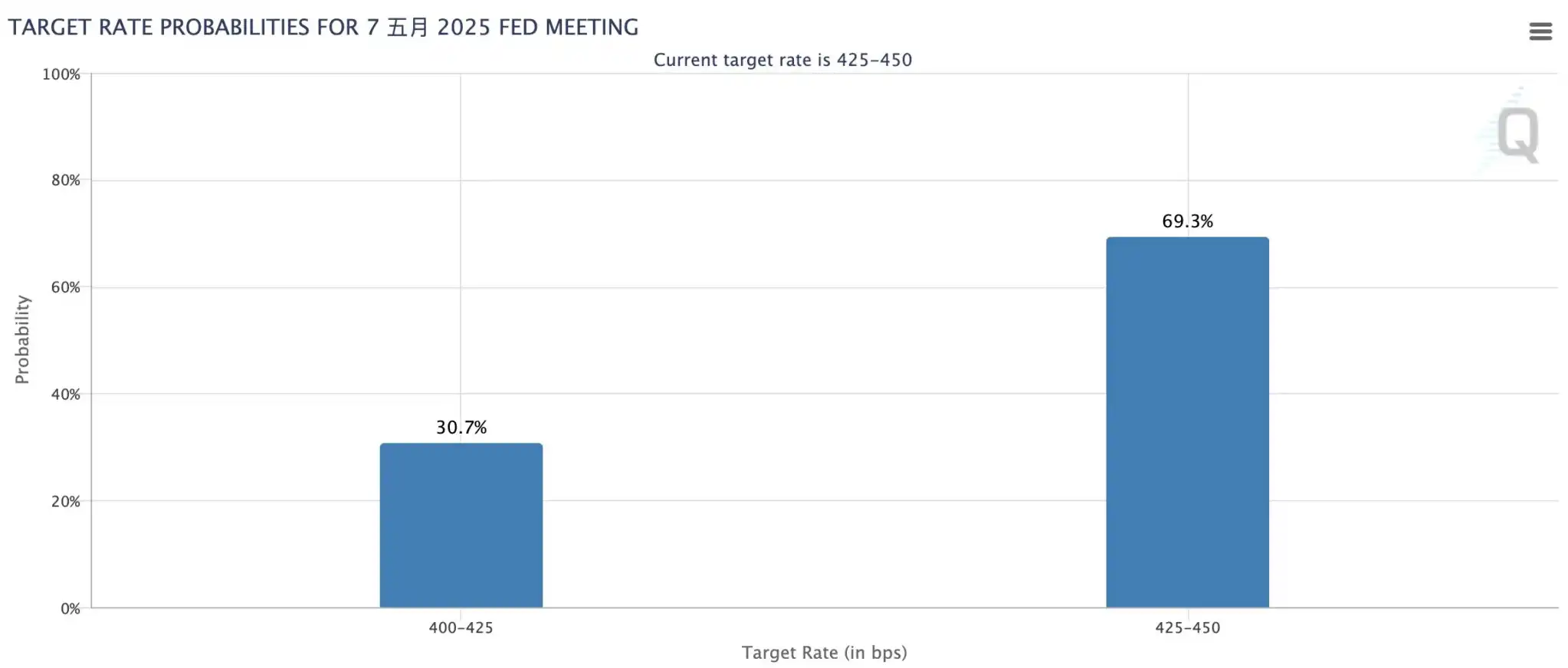
According to the Chicago Mercantile Exchange's (CME) FedWatch tool, market traders currently expect the Fed to cut rates as early as May, with the likelihood increasing from 14% a week ago to 30.7%. This reflects a strong market expectation that, amidst trade war fears and concerns of a potential economic slowdown, the Fed will take a more dovish stance to support the economy.
EU Adopts "Fight-and-Talk" Strategy, Proposes Zero-for-Zero Tariffs
Facing U.S. tariff pressures, the EU reached a consensus at a trade ministers' meeting of the 27 member states held in Luxembourg to prioritize resolving trade disputes through negotiation. EU Trade Commissioner Maros Sefcovic stated that the EU has proposed industrial product "zero-for-zero" tariff negotiations to the U.S., meaning both sides would completely exempt each other from industrial goods tariffs.
However, the EU also made it clear that it would not wait indefinitely. Sefcovic outlined the EU's three key positions:
1. Recognizing the importance of cooperation with the U.S. in strategic areas (such as addressing overcapacity from non-market economies, semiconductor competition, critical raw material supply, etc.)
2. Acknowledging that negotiations with the U.S. will be protracted, currently only in the preliminary stage, as the U.S. sees tariffs as "corrective measures" rather than negotiation chips
3. Pursuing open-ended negotiations while adopting a "three-track approach": defending interests through retaliatory measures, diversifying the market through new trade agreements, and preventing harmful trade diversion effects
In terms of specific actions, regarding the U.S.'s previous tariffs on steel and aluminum products, the European Union is expected to implement the first wave of retaliatory tariffs on April 15, with the related list already submitted to member states and set for a vote on the 9th. The second wave of counterbalancing tariffs is expected to be introduced on May 15.
Currently, the EU's strategy clearly prioritizes "negotiation first, while engaging in talks alongside actions," actively seeking to diversify its trading partners. Dombrovskis specifically mentioned India, Indonesia, Thailand, the Philippines, and Gulf countries, urging to expedite ongoing free trade agreement negotiations. The President of the European Commission vividly expressed that the EU would "focus like a laser beam on 83% of global trade, excluding the United States."
At the same time, the EU is also highly alert to trade diversion risks, especially the potential influx of Chinese products into the EU market due to U.S. tariffs. Dombrovskis recently visited China, with one of the key focuses being on addressing trade imbalances with China, overcapacity, market access, and issues related to Chinese investments in Europe.
You may also like

Cyber Taoist Fortune Teller: Fake Taoist, AI Fortune Telling, and Northeastern Metaphysics History

Bloomberg: Stablecoin Payments Emerge as Crypto VC's Newest Favorite Thing
BeatSwap is evolving towards a full-stack Web3 infrastructure, covering the entire lifecycle of IP rights.
BeatSwap, a global Web3 Intellectual Property (IP) infrastructure project, is attempting to overcome the current fragmentation limitations of the Web3 ecosystem, building a full-stack system that covers the entire lifecycle of IP rights.
Currently, most Web3 projects are still in the stage of functional fragmentation, often focusing only on a single aspect, such as IP asset tokenization, transaction functionality, or a simple incentive model. This structural dispersion has become a key bottleneck hindering the industry's scale application.
BeatSwap's approach is more integrated, integrating multiple core modules into the same system, including:
· IP authentication and on-chain registration
· Authorization-based revenue sharing mechanism
· User-engagement-driven incentive system
· Transaction and liquidity infrastructure
Through the above integration, the platform builds an end-to-end closed-loop path, allowing IP rights to complete a full cycle of "creation, use, and monetization" within the same ecosystem.
BeatSwap is not limited to existing crypto users but is attempting to take the global music industry as a starting point, actively creating new market demand. Its core strategies include:
Exploring and incubating music creators (Artist discovery)
Building a fan community
Igniting IP-centric content consumption demand
The current global music industry is valued at around $260 billion, with over 2 billion digital music users. This means that the potential market corresponding to the tokenization and financialization of IP far exceeds the traditional crypto user base.
In this context, BeatSwap positions itself at the intersection of "real-world content demand" and "on-chain infrastructure," attempting to bridge the structural gap between content production and financial flow.
BeatSwap's upcoming core product "Space" is scheduled to launch in the second quarter of 2026. This product is defined as the SocialFi layer in the ecosystem, aiming to directly connect creators with users and achieve deep integration with other platform modules.
Key designs include:
A fan-centric interactive mechanism
Exposure and distribution logic based on $BTX staking
User paths connected to DeFi and liquidity structures
Thus, a complete user behavior loop is formed within the platform: Discovery → Participation → Consumption → Rewards → Trading
$BTX is designed to be a core utility asset within the ecosystem, rather than just a simple incentive token, with its value directly tied to platform activity and IP use cases.
Main features include:
· Yield distribution based on on-chain authorized actions
· Value reflection based on IP usage and user engagement dynamics
· Support for staking and DeFi participation mechanisms
· Value growth driven by ecosystem expansion
With the increased frequency of IP use, the utility and value support of $BTX will enhance simultaneously, helping alleviate the "disconnect between value and utility" issue present in traditional Web3 token models to some extent.
Currently, $BTX has been listed on several mainstream exchanges, including:
Binance Alpha
Gate
MEXC
OKX Boost
As the launch of "Space" approaches, BeatSwap is actively pursuing more exchange listings to further enhance liquidity and global accessibility, laying a foundation for future market expansion.
BeatSwap's goal is no longer limited to the traditional Web3 narrative but aims to target over 2 billion digital music users and a trillion KRW-scale content market.
By integrating content creators, users, capital, and liquidity into a blockchain framework centered around IP rights, BeatSwap is striving to build a next-generation infrastructure focused on "IP tokenization."
BeatSwap integrates IP authentication, authorization distribution, incentive mechanism, transaction system, and market construction to establish a unified structure that bridges the full lifecycle path of IP rights.
With the launch of the Q2 2026 "Space," the project is expected to become a key infrastructure connecting content and finance in the IP-RWA (Real World Assets) track.

Mag 7 Evaporates $2 Trillion | Rewire News Morning Edition

Losing $19K per Coin Mined, Bitcoin Mining Firms Collective AI Defection

Morning Report | Tom Lee predicts that the cryptocurrency winter will end in April; xStocks introduces a new on-chain private equity fund; Sui mainnet upgraded to V1.68.1

Polymarket rules have changed, how should airdrop participants respond?

Crypto ETF Weekly | Last week, the net outflow of Bitcoin spot ETFs in the U.S. was $296 million; the net outflow of Ethereum spot ETFs in the U.S. was $206 million

This Week's Key News Preview | The U.S. Releases March Non-Farm Payroll Data; Polymarket Expands Fee Structure

Slow Down, That's the Answer to the Age of the Agent

From Cash to Cryptocurrency: Moving Towards a Unified Regulatory Path for Illegal Payments
Who will own the most Bitcoin in 2026

A private feud lasting 10 years, if not for OpenAI's "hypocrisy," would not have led to the world's strongest AI company, Anthropic

"Crypto Tsar" steps down: 130 days of political performance come to an end, how much of Trump's crypto promise remains?

From Utopian Narratives to Financial Infrastructure: The "Disenchantment" and Shift of Crypto VC
A decade-long personal feud, if not for OpenAI's "hypocrisy," there would be no globally leading AI company Anthropic

a16z: The True Meaning of Strong Chain Quality, Block Space Should Not Be Monopolized
a16z: The True Meaning of Strong Chain Quality, Block Space Should Not Be Monopolized
Cyber Taoist Fortune Teller: Fake Taoist, AI Fortune Telling, and Northeastern Metaphysics History
Bloomberg: Stablecoin Payments Emerge as Crypto VC's Newest Favorite Thing
BeatSwap is evolving towards a full-stack Web3 infrastructure, covering the entire lifecycle of IP rights.
BeatSwap, a global Web3 Intellectual Property (IP) infrastructure project, is attempting to overcome the current fragmentation limitations of the Web3 ecosystem, building a full-stack system that covers the entire lifecycle of IP rights.
Currently, most Web3 projects are still in the stage of functional fragmentation, often focusing only on a single aspect, such as IP asset tokenization, transaction functionality, or a simple incentive model. This structural dispersion has become a key bottleneck hindering the industry's scale application.
BeatSwap's approach is more integrated, integrating multiple core modules into the same system, including:
· IP authentication and on-chain registration
· Authorization-based revenue sharing mechanism
· User-engagement-driven incentive system
· Transaction and liquidity infrastructure
Through the above integration, the platform builds an end-to-end closed-loop path, allowing IP rights to complete a full cycle of "creation, use, and monetization" within the same ecosystem.
BeatSwap is not limited to existing crypto users but is attempting to take the global music industry as a starting point, actively creating new market demand. Its core strategies include:
Exploring and incubating music creators (Artist discovery)
Building a fan community
Igniting IP-centric content consumption demand
The current global music industry is valued at around $260 billion, with over 2 billion digital music users. This means that the potential market corresponding to the tokenization and financialization of IP far exceeds the traditional crypto user base.
In this context, BeatSwap positions itself at the intersection of "real-world content demand" and "on-chain infrastructure," attempting to bridge the structural gap between content production and financial flow.
BeatSwap's upcoming core product "Space" is scheduled to launch in the second quarter of 2026. This product is defined as the SocialFi layer in the ecosystem, aiming to directly connect creators with users and achieve deep integration with other platform modules.
Key designs include:
A fan-centric interactive mechanism
Exposure and distribution logic based on $BTX staking
User paths connected to DeFi and liquidity structures
Thus, a complete user behavior loop is formed within the platform: Discovery → Participation → Consumption → Rewards → Trading
$BTX is designed to be a core utility asset within the ecosystem, rather than just a simple incentive token, with its value directly tied to platform activity and IP use cases.
Main features include:
· Yield distribution based on on-chain authorized actions
· Value reflection based on IP usage and user engagement dynamics
· Support for staking and DeFi participation mechanisms
· Value growth driven by ecosystem expansion
With the increased frequency of IP use, the utility and value support of $BTX will enhance simultaneously, helping alleviate the "disconnect between value and utility" issue present in traditional Web3 token models to some extent.
Currently, $BTX has been listed on several mainstream exchanges, including:
Binance Alpha
Gate
MEXC
OKX Boost
As the launch of "Space" approaches, BeatSwap is actively pursuing more exchange listings to further enhance liquidity and global accessibility, laying a foundation for future market expansion.
BeatSwap's goal is no longer limited to the traditional Web3 narrative but aims to target over 2 billion digital music users and a trillion KRW-scale content market.
By integrating content creators, users, capital, and liquidity into a blockchain framework centered around IP rights, BeatSwap is striving to build a next-generation infrastructure focused on "IP tokenization."
BeatSwap integrates IP authentication, authorization distribution, incentive mechanism, transaction system, and market construction to establish a unified structure that bridges the full lifecycle path of IP rights.
With the launch of the Q2 2026 "Space," the project is expected to become a key infrastructure connecting content and finance in the IP-RWA (Real World Assets) track.


 App
App