
 Buy Crypto
- Markets
 Futures
- Spot
- Copy Trade
- Earn
- More
Vitalik's Latest Speech: Ethereum L1 Scalability Essential, Serving Key Functions

Original Title: "Vitalik's Latest Speech Overview: Building Ethereum L1 as the Core of the 'World Computer'"
Original Author: KarenZ, Foresight News
On April 9, at the "2025 Hong Kong Web3 Carnival" ETHAsia 2025 event, Ethereum co-founder Vitalik Buterin delivered a keynote speech titled "The Future of Ethereum L1." The speech revolved around key topics such as scalability improvements to Ethereum L1, future plans and technical upgrades, the collaborative development of L1 and L2, and the impact of account abstraction on user experience.
Vitalik first analyzed the current state of Ethereum. Currently, L1's throughput is 15 transactions per second (15 TPS). The gas limit has recently been increased to 36 million, representing about a 6x increase over the past 10 years. Meanwhile, L2's throughput has reached around 250 TPS, showcasing significant scalability progress.
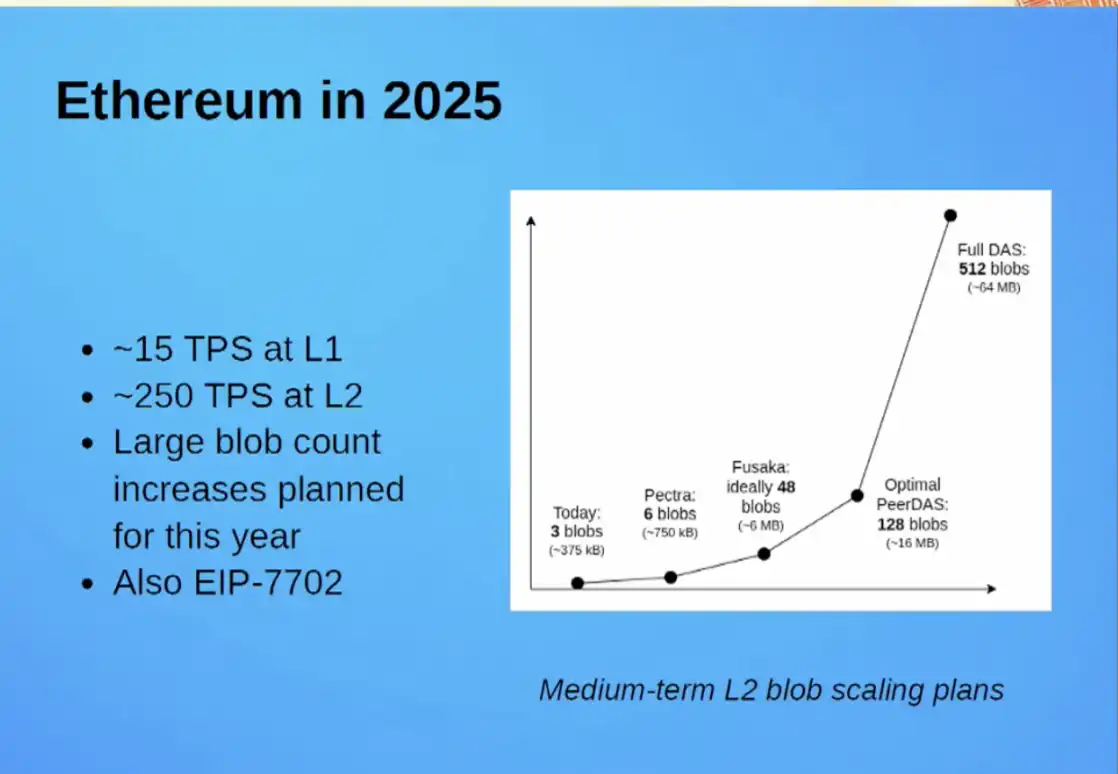
The upcoming Pectra upgrade will increase the Blob count from 3 to 6. Currently, 3 Blobs are approximately 375kb, generating 375kb of data every 12 seconds, roughly 20kb per second, corresponding to TPS of about 250; if the Blob count is increased to 6, TPS is expected to rise to 500. However, the expansion of Blob capacity largely depends on the Fusaka upgrade scheduled for the third or fourth quarter of this year. In an ideal scenario, the Fusaka upgrade could raise the Blob capacity to 48; if DAS is fully implemented, Blob capacity could reach 512, potentially allowing Ethereum L2's TPS to increase to tens of thousands.
Additionally, EIP-7702 has made significant progress, which is essentially the first step in abstracting accounts, giving accounts higher intelligence and security.
Of course, the extension of Ethereum L1 is equally crucial. Even if users widely adopt L2 in the future, L1 will still need to fulfill many key functions. Particularly when L2 experiences failures, L1 needs to provide corresponding remedies or support users in large-scale exit operations.
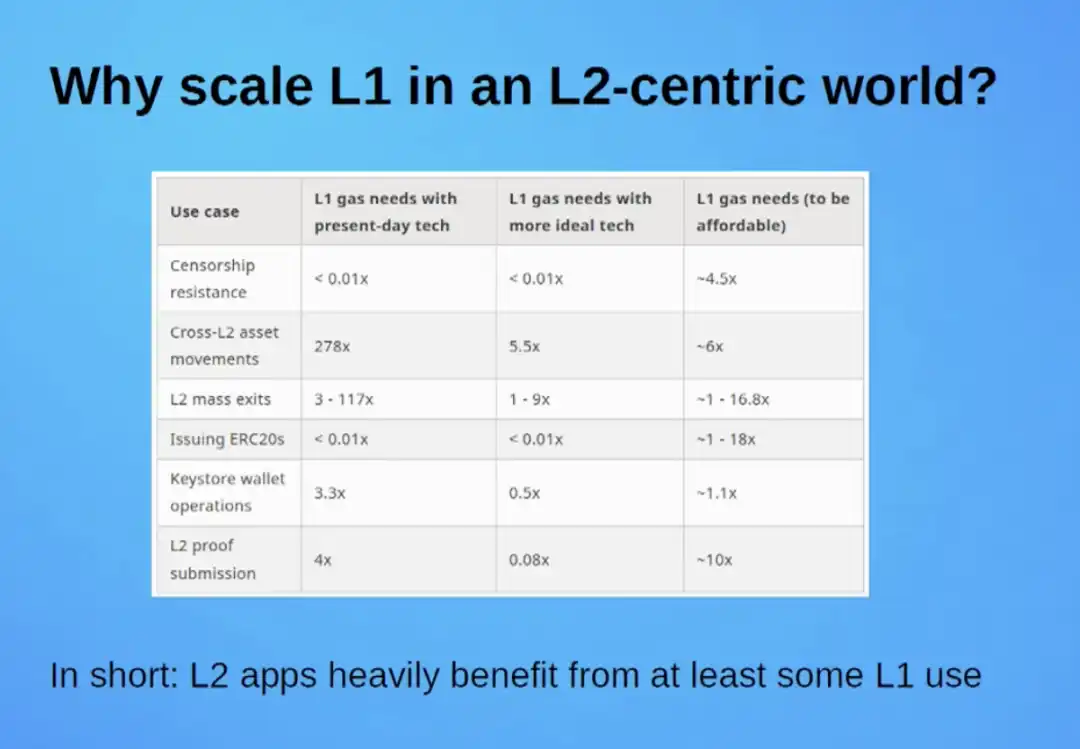
This means that despite the rapid development of L2, enhancing L1's scalability remains crucial to achieve censorship resistance and cross-L2 asset transfers. So, what changes will expanding L1 further bring?
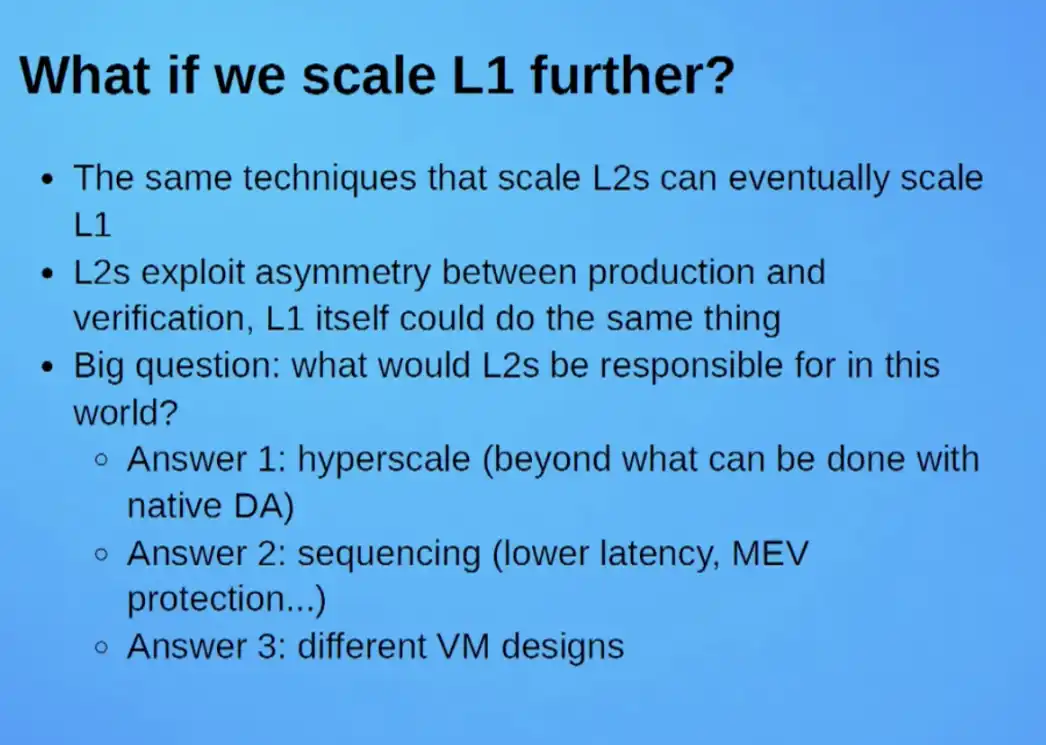
Extension technologies applied to L2 can also be used for L1 scalability in the future; L2 leverages the asymmetry between production and verification, a concept that L1 can also benefit from; in such a world, what responsibilities will L2 take on? 1. Hyperscale (beyond the level achievable by native DA); 2. Orderliness (lower latency, MEV protection, etc.); 3. Different virtual machine (VM) designs.
In other words, L1 can learn from L2's scaling solutions, while L2 continues to focus on processing transactions at hyperscale and experimenting with new technologies.
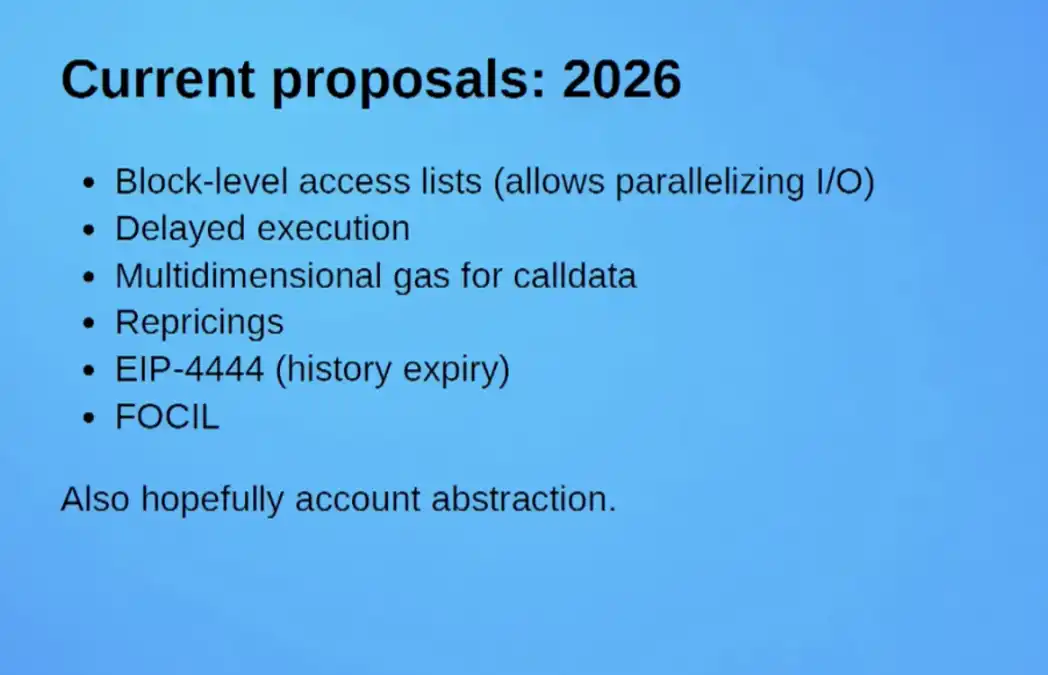
Vitalik expressed that in the short-term roadmap, a series of proposals are expected to be gradually implemented by 2026. Through these proposals, Ethereum is poised to significantly increase the Gas limit and achieve this goal securely while ensuring that node decentralization is not compromised.
Regarding the 2026 plan, some of the proposed initiatives include:
Block-level access lists (allowing I/O parallelization); delayed execution; multi-dimensional calldata Gas; repricing; EIP-4444 (historical data expiry): no longer requiring every Ethereum node to store Ethereum historical records, instead using a peer-to-peer network and distributing historical data in a more decentralized manner; FOCIL.
Vitalik also outlined numerous benefits that account abstraction can bring, including enhanced security and user experience; quantum attack resistance; Paymaster: allowing others to pay Gas fees for you or pay Gas fees with tokens other than ETH; support for smart contract wallets' native use; L1 lead, L1 follow.
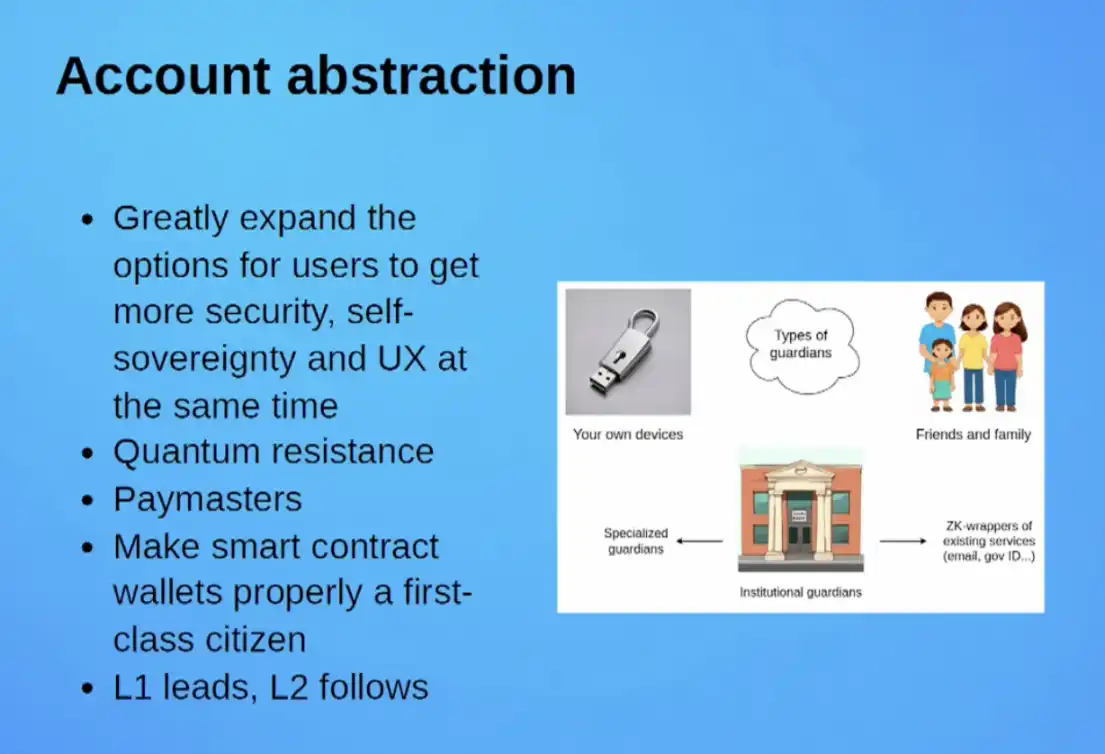
Furthermore, through technologies like Social Recovery and Guardians, Ethereum will provide more decentralized identity verification and asset control solutions.
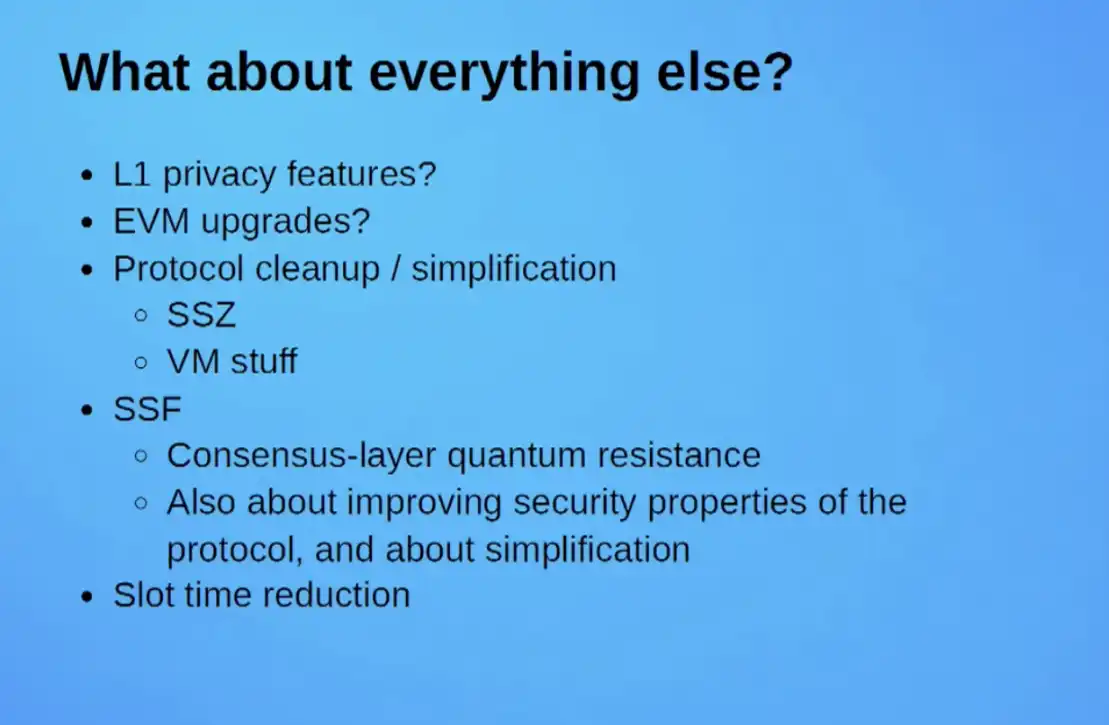
In other aspects, Ethereum is actively exploring L1 privacy enhancement, EVM upgrades, protocol cleanup/simplification, consensus layer quantum resistance improvement, protocol security properties and simplification optimizations, as well as Slot time reduction.
Overall, we need to improve L1, enhance L2, consider Ethereum's diversified development path, including AI-based approaches, improve the application layer, to truly drive the development of the Ethereum ecosystem. Ethereum is striving to be well-prepared for mainstream large-scale applications, with the ultimate goal of making Ethereum L1 the core of the "world computer," supporting a diverse range of applications with high security and efficiency.
You may also like

Tiger Research: What AI services do cryptocurrency companies offer?

The war not only drives up oil prices but also causes Circle's stock price to soar

When agents become consumers, who will rewrite the underlying logic of internet commerce?

AI Agents in Action Summit: March 31, Hong Kong Cyberport, focusing on the deep waters of AI implementation

29 Days In, What Are America’s Options on Iran?

Flash Crash Down 97%+ with Ongoing Unlocking, WLD Completes $65 Million Off-chain Funding: Who Is Still Buying?

Bitcoin for Real Estate? Fannie Mae Teams Up with Coinbase to Launch Crypto Mortgage
Tether Hires Big Four Auditor, USDT Enters First Attestation Phase

Google AI Paper Destroys $900B Storage Stock, Accused of Faking Experiment
Evaporate $2 Trillion, U.S. Stocks See Worst Start in 4 Years, Why is the Market Bearish?

The speed at which AI discovers vulnerabilities has surpassed the speed at which it patches vulnerabilities.

AI Crypto Trading Bot Explained: Aurora's Multi-Factor Strategy in WEEX Hackathon
Aurora demonstrates how structured, multi-agent AI Trading systems can deliver more adaptive and resilient performance in the WEEX AI Trading Hackathon.

Cyber Taoist Fortune Teller: Fake Taoist, AI Fortune Telling, and Northeastern Metaphysics History

Bloomberg: Stablecoin Payments Emerge as Crypto VC's Newest Favorite Thing
BeatSwap is evolving towards a full-stack Web3 infrastructure, covering the entire lifecycle of IP rights.
BeatSwap, a global Web3 Intellectual Property (IP) infrastructure project, is attempting to overcome the current fragmentation limitations of the Web3 ecosystem, building a full-stack system that covers the entire lifecycle of IP rights.
Currently, most Web3 projects are still in the stage of functional fragmentation, often focusing only on a single aspect, such as IP asset tokenization, transaction functionality, or a simple incentive model. This structural dispersion has become a key bottleneck hindering the industry's scale application.
BeatSwap's approach is more integrated, integrating multiple core modules into the same system, including:
· IP authentication and on-chain registration
· Authorization-based revenue sharing mechanism
· User-engagement-driven incentive system
· Transaction and liquidity infrastructure
Through the above integration, the platform builds an end-to-end closed-loop path, allowing IP rights to complete a full cycle of "creation, use, and monetization" within the same ecosystem.
BeatSwap is not limited to existing crypto users but is attempting to take the global music industry as a starting point, actively creating new market demand. Its core strategies include:
Exploring and incubating music creators (Artist discovery)
Building a fan community
Igniting IP-centric content consumption demand
The current global music industry is valued at around $260 billion, with over 2 billion digital music users. This means that the potential market corresponding to the tokenization and financialization of IP far exceeds the traditional crypto user base.
In this context, BeatSwap positions itself at the intersection of "real-world content demand" and "on-chain infrastructure," attempting to bridge the structural gap between content production and financial flow.
BeatSwap's upcoming core product "Space" is scheduled to launch in the second quarter of 2026. This product is defined as the SocialFi layer in the ecosystem, aiming to directly connect creators with users and achieve deep integration with other platform modules.
Key designs include:
A fan-centric interactive mechanism
Exposure and distribution logic based on $BTX staking
User paths connected to DeFi and liquidity structures
Thus, a complete user behavior loop is formed within the platform: Discovery → Participation → Consumption → Rewards → Trading
$BTX is designed to be a core utility asset within the ecosystem, rather than just a simple incentive token, with its value directly tied to platform activity and IP use cases.
Main features include:
· Yield distribution based on on-chain authorized actions
· Value reflection based on IP usage and user engagement dynamics
· Support for staking and DeFi participation mechanisms
· Value growth driven by ecosystem expansion
With the increased frequency of IP use, the utility and value support of $BTX will enhance simultaneously, helping alleviate the "disconnect between value and utility" issue present in traditional Web3 token models to some extent.
Currently, $BTX has been listed on several mainstream exchanges, including:
Binance Alpha
Gate
MEXC
OKX Boost
As the launch of "Space" approaches, BeatSwap is actively pursuing more exchange listings to further enhance liquidity and global accessibility, laying a foundation for future market expansion.
BeatSwap's goal is no longer limited to the traditional Web3 narrative but aims to target over 2 billion digital music users and a trillion KRW-scale content market.
By integrating content creators, users, capital, and liquidity into a blockchain framework centered around IP rights, BeatSwap is striving to build a next-generation infrastructure focused on "IP tokenization."
BeatSwap integrates IP authentication, authorization distribution, incentive mechanism, transaction system, and market construction to establish a unified structure that bridges the full lifecycle path of IP rights.
With the launch of the Q2 2026 "Space," the project is expected to become a key infrastructure connecting content and finance in the IP-RWA (Real World Assets) track.

Mag 7 Evaporates $2 Trillion | Rewire News Morning Edition

Losing $19K per Coin Mined, Bitcoin Mining Firms Collective AI Defection



 App
App