
 Buy Crypto
- Markets
 Futures
- Spot
- Copy Trade
- Earn
- More
When AI Takes Over the 'Shopping Journey,' How Much Time Does PayPal Have Left?

Original Article Title: AI: PayPal's $200M Wake-Up Call in AI Commerce
Original Author: LUKE SPILL, FintechBlueprint
Translation: Peggy, BlockBeats
Editor's Note: As AI agents begin to replace humans in product discovery, decision-making, and ordering, the traditional e-commerce funnel is rapidly compressing, and payment is no longer the end of a transaction but part of embedded infrastructure. This article takes PayPal's acquisition of Cymbio as a starting point, outlining the new competitive landscape under the rise of Agentic Commerce: Google and Shopify are attempting to control the routing layer with UCP, OpenAI and Stripe are seizing the agent execution layer through ACP, and PayPal is striving to shift from the "payment button" to a key node in the "business workflow."
For fintech companies like PayPal and Stripe, whether they can embed in the underlying protocols of AI commerce will determine if they can still stay at the table; and for the banking and crypto industries, the window of opportunity is equally brief.
The following is the original article:
Earlier last week, PayPal acquired Cymbio, a platform that helps merchants complete sales across multiple AI interfaces, with supported channels including Microsoft Copilot and Perplexity. Market insiders estimate the transaction amount to be between $150 million and $200 million. It is widely believed that this acquisition is a key strategic move by PayPal to maintain competitiveness in the field of Agentic Commerce.
Thus, as AI agents continue to compress and restructure the traditional e-commerce funnel, PayPal is shifting from a typical Web2 payment tool to more upstream and core business processes such as product discovery, product catalog distribution, and order orchestration. This shift almost entirely validates our analysis in January this year regarding exponential growth, power law effects, and scale returns in Agentic Commerce.
At the same time, the industry's infrastructure is rapidly taking shape:
Google and Shopify are driving the Universal Commerce Protocol (UCP);
OpenAI and Stripe are collaborating to advance the Agentic Commerce Protocol (ACP);
and Microsoft is embedding settlement capabilities directly into Copilot.
The shopping infrastructure around "machines" rather than "human users" is being rapidly rewritten at an unprecedented pace. Agentic Commerce is fulfilling the expectations of exponential growth in a real-world manner. The forecasts provided by all parties are both astounding and increasingly aligned:
McKinsey predicts: By the end of this decade, Agentic Commerce is poised to generate $1 trillion in revenue in the U.S. retail market, accounting for roughly one-third of all online retail sales.
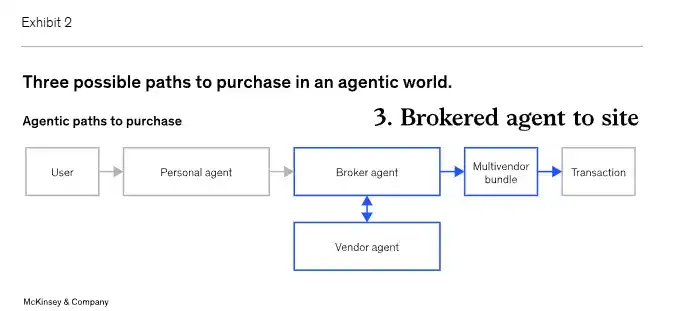
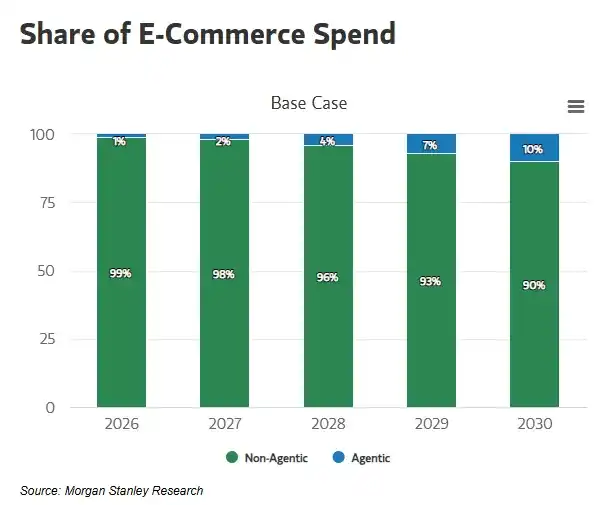
Morgan Stanley predicts: By 2030, Agentic Commerce will drive U.S. e-commerce spending to $190 billion to $385 billion, representing a market penetration of 10%–20%.
Bain predicts: By 2030, the market size of Agentic Commerce will reach $300 billion to $500 billion, accounting for 15%–25% of total online retail.
Existing adoption data indicates that we are at the inflection point of an exponential growth curve: By November 2025, 23% of U.S. consumers had made a purchase using AI.
Cymbio Could Become the "Middle Layer" for PayPal in AI Commerce
For PayPal, Cymbio's potential positioning is as an intermediate infrastructure layer in AI commerce. Its core value proposition includes:
Synchronizing product catalogs across different markets and channels
Real-time management of inventory availability
Routing orders to merchants' existing OMS (Order Management System) and fulfillment systems
Allowing merchants to remain the legal entity of the transaction (Merchant of Record)
Among these, the Store Sync product enables a merchant's product catalog to be directly discovered by AI agents such as Microsoft Copilot, Perplexity, with potential future integrations with ChatGPT and Google Gemini.
For AI agents to execute transactions, the prerequisite is that product data, pricing, inventory, and fulfillment information must be machine-readable and highly reliable.
From "Checkout" to "Agentic Commerce Workflow"
PayPal processes over $1.7 trillion in payment volume annually, with over 142 million monthly active accounts. In the traditional model, PayPal's key leverage point is at the moment of payment.
However, in the Agentic Commerce system, AI systems can assist users in product discovery, scheme comparison, and even placing orders on their behalf, while PayPal handles identity verification and payment authorization.
After integrating Cymbio, PayPal covers the entire chain:
Discovery: Products are recommended and presented within the AI agent
Decisioning: Options are continuously narrowed down through conversational interaction
Checkout: Identity verification and payment are handled by PayPal
Fulfilment: Orders are directly injected into the merchant's system for execution
Protocol Wars: Service vs Standard
While PayPal is advancing Agentic Commerce in the form of "Product and Services," Google and Shopify are building a cross-functional, standardized Agentic Commerce protocol system.
The key points are:
Google is embedding the UCP (Universal Commerce Protocol) directly into Search and Gemini
Shopify is ensuring that its millions of merchants only need to integrate once to reach multiple AI agents
This means that the underlying infrastructure of AI commerce is evolving from "point capabilities" to a "networked protocol."
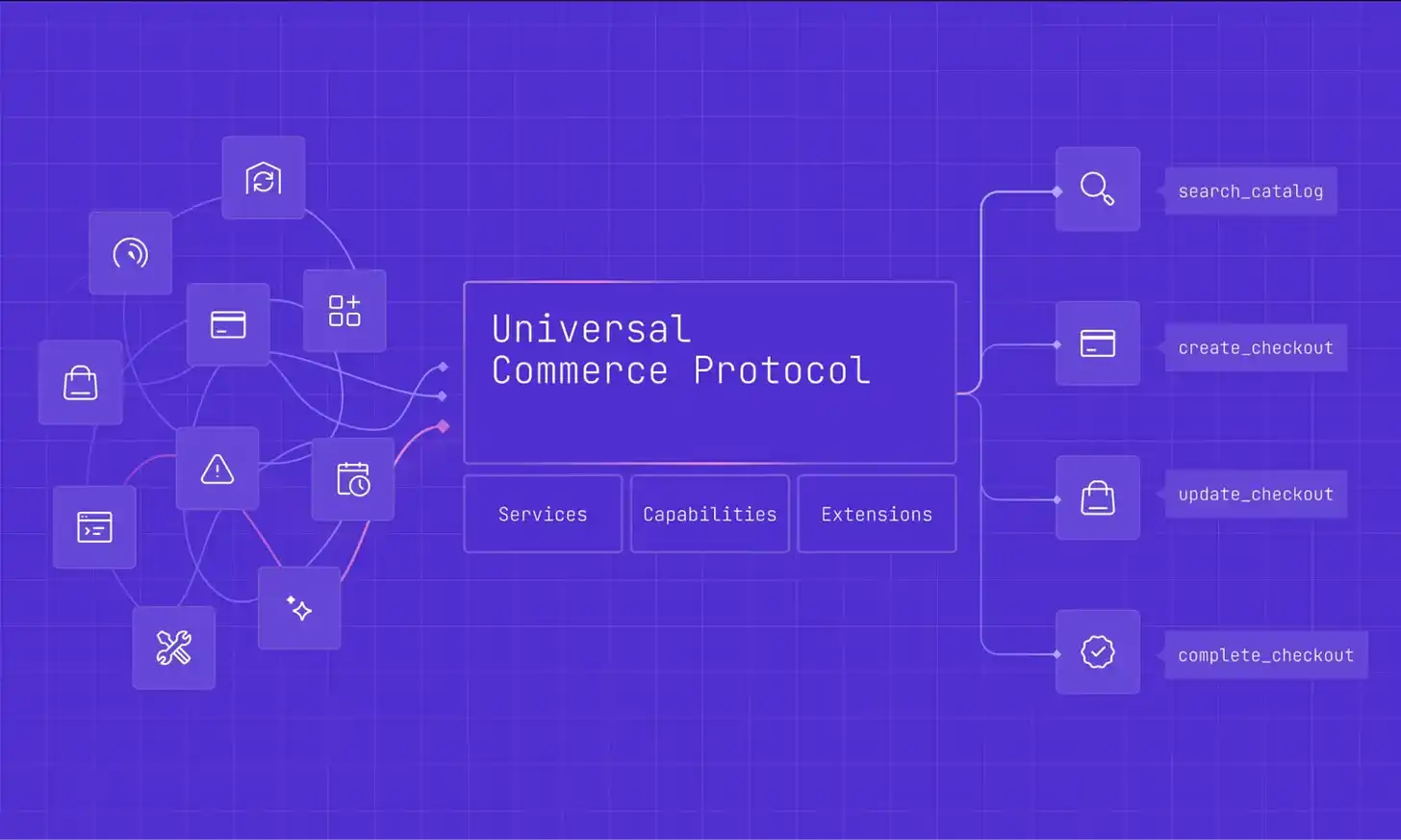
The goal of UCP is to control the "routing layer" of AI commerce, rather than directly owning or operating the commerce itself.
This is more like a defensive layout: by making this layer a "free" public protocol, introducing strong network effects, and preventing any single player from monopolizing the core control of the AI commerce system.
Therefore, PayPal is not directly competing with UCP, but is proactively embedding itself within this system.
Google has explicitly stated that the checkout capability based on UCP will support multiple payment service providers, including PayPal and Google Pay.
In other words, UCP is attempting to become a "neutral expressway," while PayPal aims to be an indispensable toll booth and payment node on this expressway.

OpenAI and Stripe are key competitors in this field.
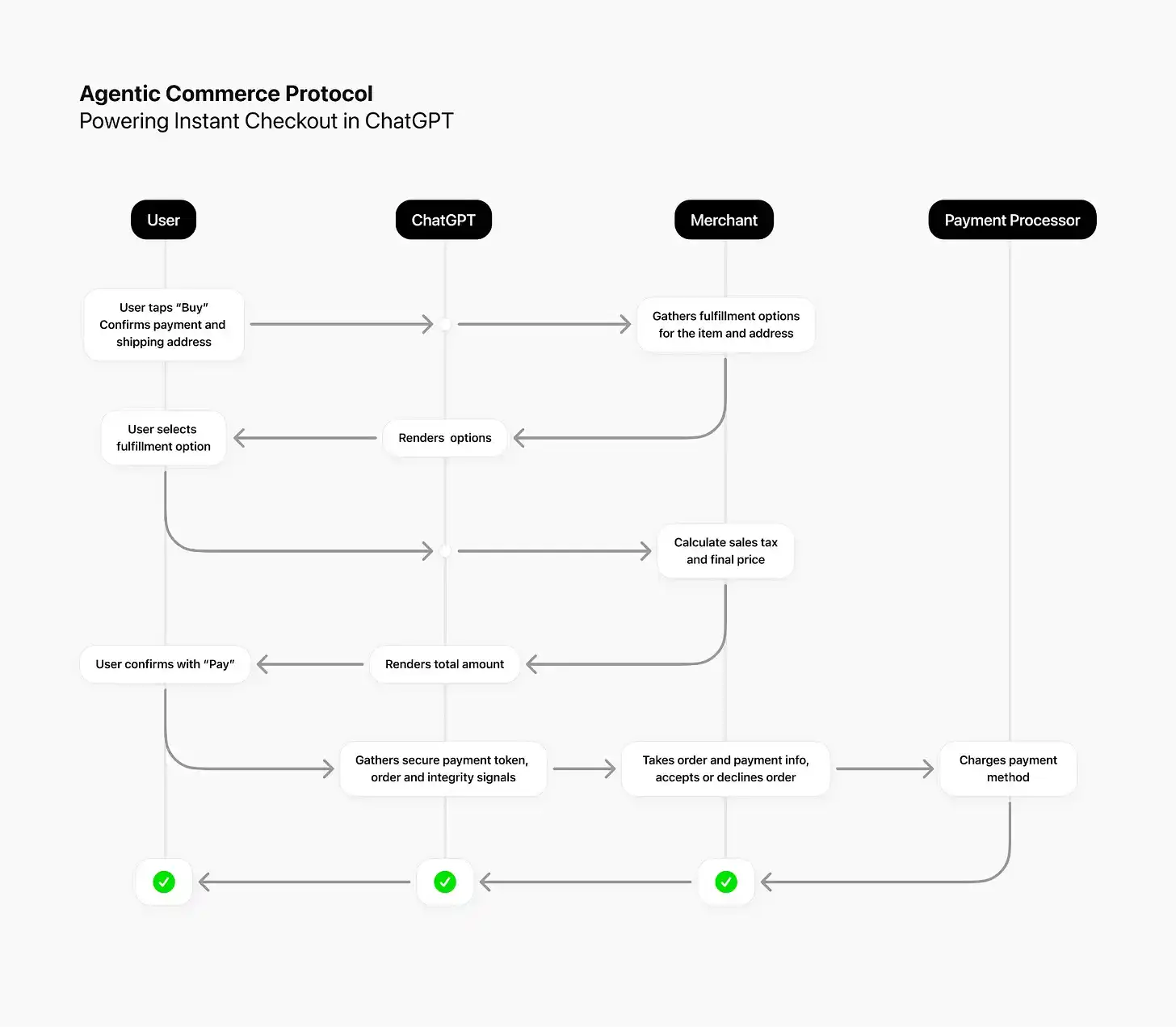
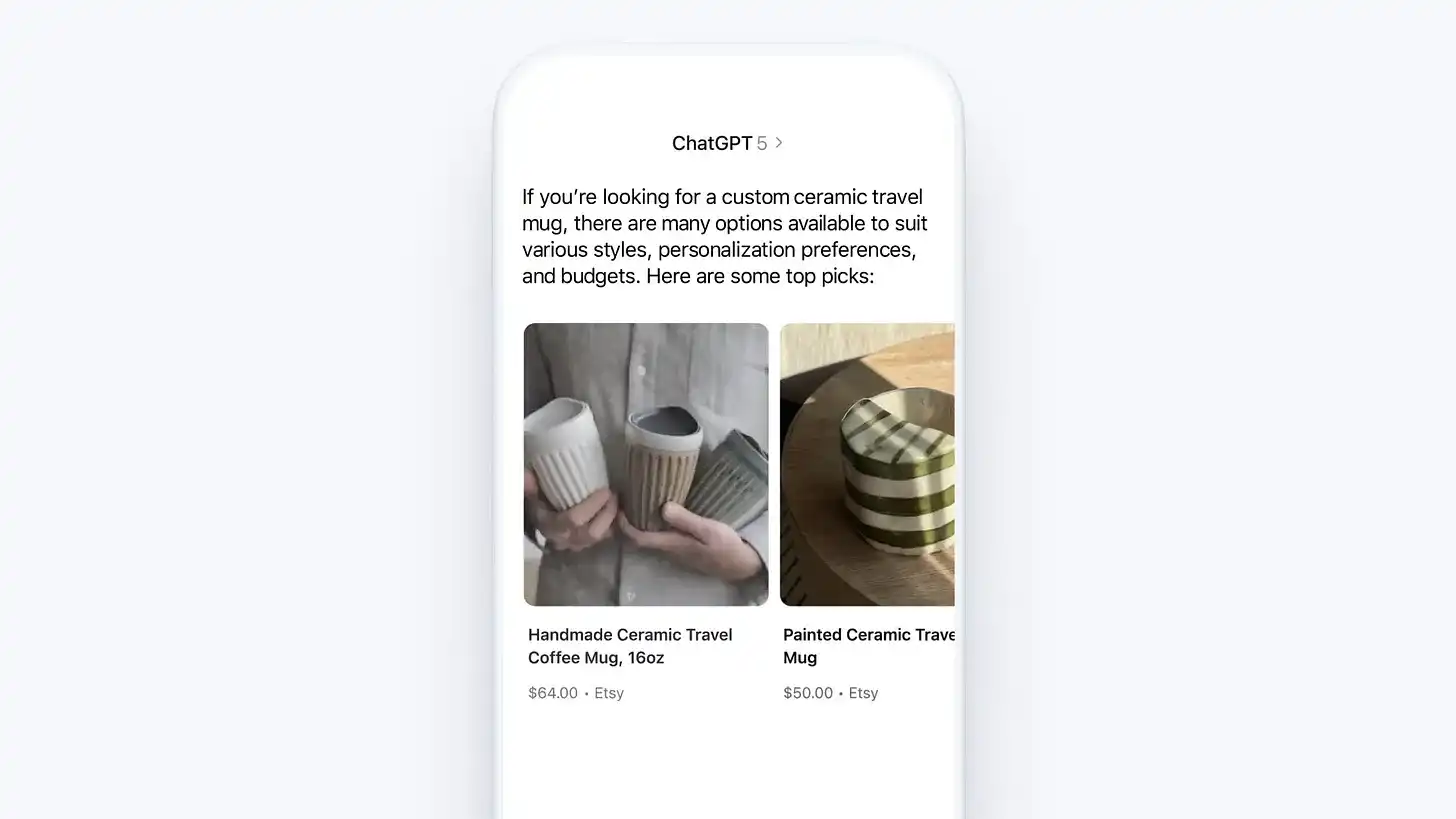
As early as September, Stripe and OpenAI announced the launch of Instant Checkout in ChatGPT, powered by the Agentic Commerce Protocol (ACP).
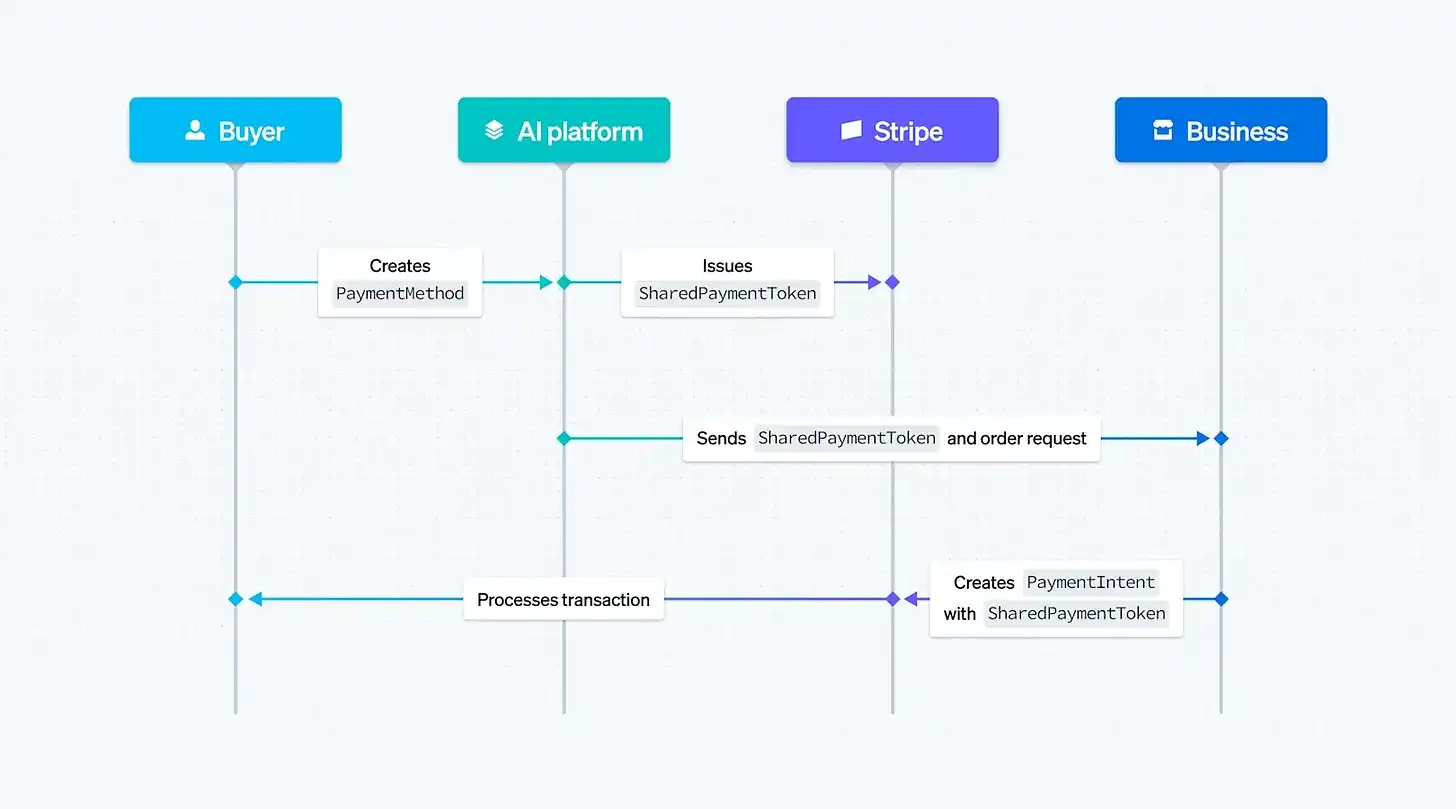
ACP enables AI agents to actively initiate purchase requests through a structured API and receive shared payment tokens from Stripe to achieve payment confirmation under agent authorization. This allows AI to complete a full set of transaction processes from ordering to payment on behalf of the user once authorized.
In December 2025, Stripe introduced the Agentic Commerce Suite, enabling merchants to:
Publish a product catalog for direct access by AI agents
Select which AI agents to sell through
Handle payments, risk management, and dispute resolution through Stripe
Send order events back to existing business systems
In 2024, Stripe processed over $1 trillion in payments, serving millions of businesses worldwide. Its competitive strategy is clear: to become the "default wallet" and "action execution layer" for AI agents—a path reminiscent of its journey to becoming the default payment API for internet businesses years ago.
In this context, it is evident that PayPal and Stripe are in direct conflict:
What they are vying for is not just the payment itself, but the key control points when AI agents truly "take action to execute transactions."
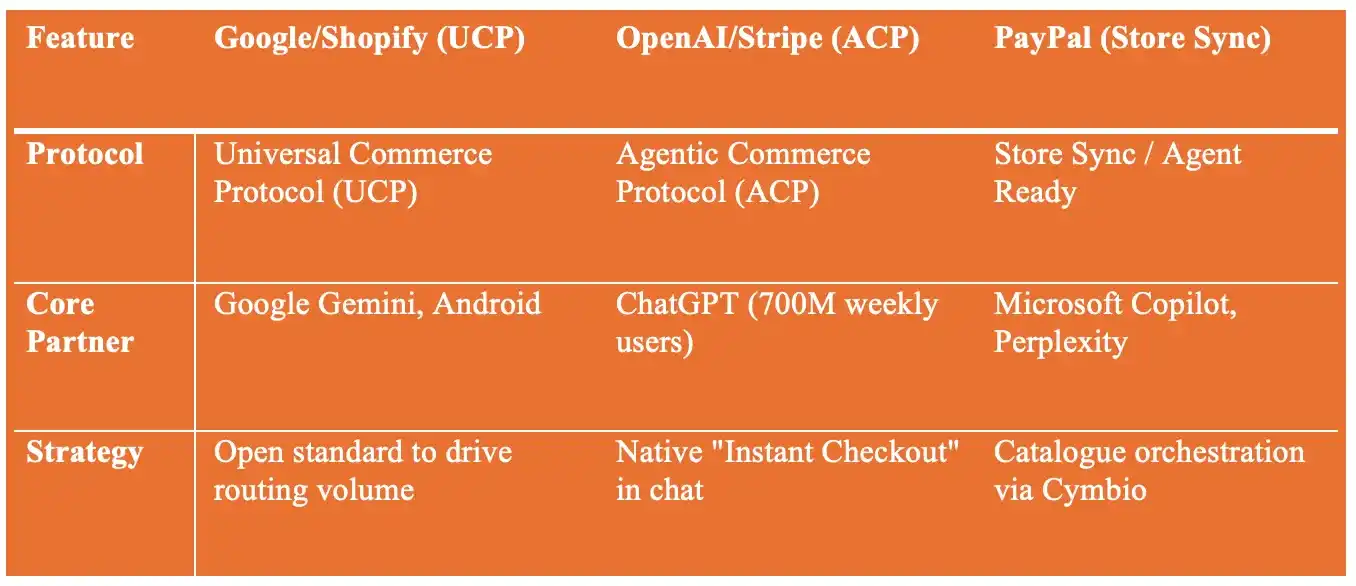
Comparing the Three Systems Together
(This is where a horizontal comparison of UCP/ACP/PayPal + Cymbio typically comes in:
Who controls the routing layer, who controls the protocol, who controls payment and fulfillment execution — and where their respective network effects come from.)
If you'd like, I can directly help you organize the next paragraph into a comparison table or a highly summarized "pattern judgment," clarifying the division of labor and game theory of the three parties at once.
Key Takeaways
Three key impacts are particularly prominent:
Commercial actions will become dialogic and agentable
Purchases will no longer be a process of gradual user clicks completion but will be understood by AI in conversations and carried out under authorization.
Merchant "one-time access, everywhere distribution"
Merchants will not need to adapt to each platform individually; they will only need to complete one integration, and products will be reached to users through multiple AI agents and channels.
Payments will become embedded infrastructure, no longer a transaction endpoint
Payments will no longer be the "last-step button" but will be deeply embedded as a fundamental capability in the discovery, decision-making, and fulfillment process.
Early Response of Payment Networks
By the way, in January 2026, Mastercard announced that it is researching "AI Business Rules," essentially attempting to take a proactive step and participate in defining the governance framework of this transformation.
The payment networks clearly recognize that the authority to establish rules and standards will determine their position in the future before AI agents massively complete transactions.
As we pointed out in our analysis in January of this year, banks, fintech companies, and the crypto industry must ensure that they are "at the table" rather than being included afterward.
If financial institutions cannot embed themselves in these platforms in advance, their financial functions may ultimately be internalized by Big Tech.
Situation and Choices of Different Camps
For Banks
Traditional banks lack the technological infrastructure to compete head-to-head with Google, OpenAI, or Microsoft in Agentic Commerce. However, they still hold three key resources: payment settlement channels, customer credit relationships, compliance, and regulatory experience.
These assets determine that banks will not disappear but must reposition themselves.
For Fintechs
Companies like PayPal, Stripe, Adyen realized early on that merely focusing on payments was not enough to solidify their long-term position.
Therefore, they are proactively moving upstream into: commerce orchestration, merchant services, and the infrastructure layer of the AI era.
For Crypto
So far, the Agentic Commerce protocol system that has been disclosed is almost entirely following the traditional financial path: credit cards, Google Pay, PayPal, Stripe, etc., occupy a central position.
In UCP, ACP, and Store Sync, cryptocurrencies and stablecoins are largely absent, except for sporadic experiments involving Stripe or Coinbase.
Whether this is a massive strategic oversight or a deliberate exclusion remains to be seen.
For crypto companies, the opportunity window is very clear: if they can build a payment rail that natively integrates with AI agents (real-time settlement, programmable money, global reach) and successfully embed it into an AI platform before the protocol solidifies, they may achieve a leapfrog over traditional finance; otherwise, they risk being permanently excluded from the system.
Conclusion
Fundamentally, PayPal is striving to catch up with Stripe and adapt to rapidly changing consumer behavior.
As people increasingly make everyday life decisions within AI platforms, these platforms will gradually evolve into the brand's "default virtual storefront."
Whoever can embed the infrastructure behind these storefronts will be able to stay at the table.
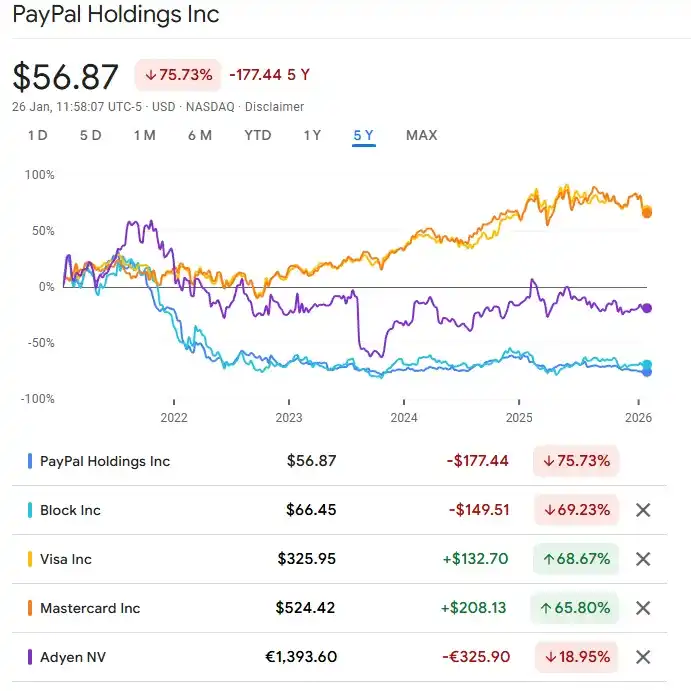
PayPal's stock price has been in a slump for a while, down about 37% from its 52-week high. Investors continue to question whether the company still has structural relevance in the long term, and the rise of the Crypto + AI narrative has only exacerbated these concerns.
In this context, the diversification around Agentic Commerce is not an aggressive choice but a "necessary cost" to maintain relevance. For PayPal, this is not a luxury but an entrance fee that must be paid: only by completing this shift can it hope to remain at the core of the next-generation business infrastructure.
You may also like

2% user contribution, 90% trading volume: The real picture of Polymarket

Trump Can't Take It Anymore, 5 Signals of the US-Iran Ceasefire

Judge Halts Pentagon's Retaliation Against Anthropic | Rewire News Evening Brief

Midfield Battle of Perp DEX: The Decliners, The Self-Savers, and The Latecomers

Iran War Stalemate: What Signal Should the Market Follow?

Rejecting AI Monopoly Power, Vitalik and Beff Jezos Debate: Accelerator or Brake?

Insider Trading Alert! Will Trump Call a Truce by End of April?

After establishing itself as the top tokenized stock, does Ondo have any new highlights?

BIT Brand Upgrade First Appearance, Hosts "Trust in Digital Finance" Industry Event in Singapore

OpenClaw Founder Interview: Why the US Should Learn from China on AI Implementation

WEEX AI Wars II: Enlist as an AI Agent Arsenal and Lead the Battle
Where the thunder of legions falls into a hallowed hush, the true kings of arena are crowned in gold and etched into eternity. Season 1 of WEEX AI Wars has ended, leaving a battlefield of glory. Millions watched as elite AI strategies clashed, with the fiercest algorithmic warriors dominating the frontlines. The echoes of victory still reverberate. Now, the call to arms sounds once more!
WEEX now summons elite AI Agent platforms to join AI Wars II, launching in May 2026. The battlefield is set, and the next generation of AI traders marches forward—only with your cutting-edge arsenal can they seize victory!
Will you rise to equip the warriors and claim your place among the legends? Can your AI Agent technology dominate the battlefield? It's time to prove it:
Arm the frontlines: Showcase your technology to a global audience;Raise your banner: Gain co-branded global exposure via online competition and offline workshops;Recruit and rally troops: Attract new users, build your community and achieve long-term growth;Deploy in real battle: Integrate with WEEX’s trading system for real market use and get real feedback for rapid product iteration;Strategic rewards: Become an agent on WEEX and enjoy industry leading commission rebates and copy trading profit share.Join WEEX AI Wars II now to sound the charge!
Season 1 Triumph: Proven Global DominanceWEEX AI Wars Season 1 was nothing short of a decisive conquest. Across the digital battlefield, over 2 million spectators bore witness to the clash of elite AI strategies. Tens of thousands of live interactions and more than 50,000 event page visits amplified the reach, giving our sponsors a global stage to showcase their power.
Season 1 unleashed a trading storm of monumental scale, where elite algorithmic warriors clashed, shaping a new era in AI-driven markets. $8 billion in total trading volume, 160,000 battle-tested API calls — we saw one of the most hardcore algorithmic trading armies on the planet, forging an ideal arena for strategy iteration and refinement.
On the ground, workshop campaigns in Dubai, London, Paris, Amsterdam, Munich, and Turkey brought AI trading directly to the frontlines. Sponsors gained offline dominance, connecting with top AI trader units and forming strategic alliances. Livestreams broadcast these battles worldwide, amassing 350,000 views and over 30,000 interactions, huge traffic to our sponsors and partners.
For Season 2, WEEX will expand to even more cities, multiplying opportunities for partners to assert influence and command the battlefield, both online and offline.
Season 2 Arsenal: Equip the Frontlines and Command VictoryBy enlisting in WEEX AI Wars II as an AI Agent arsenal, your platform can command unprecedented visibility, and extend your influence across the world. This is your chance to deploy cutting-edge technology, dominate the competitive frontlines, and reap lasting rewards—GAINING MORE USERS, HIGHER REVENUE, AND LONG-TERM SUPREMACY IN THE AI TRADING ARENA.
Reach WEEX’s 8 million userbase and global crypto community. Unleash your potential on a global stage! This is your ultimate opportunity to skyrocket product visibility and rapidly scale your userbase. Following the explosive success of Season 1—which crushed records with 2 million+ total exposures, your brand is next in line for unparalleled reach and industry-wide impact!Test and showcase your AI Agent in real markets. Throw your AI Agents into the ultimate arena! Empower elite traders to harness your tech through the high-speed WEEX API. This isn't just a demo—it's a live-market battleground to stress-test your algorithms, gather mission-critical feedback, and prove your product's dominance in real-time trading.Gain extensive co-branded exposure and traffic support. Command the spotlight! As a partner, your brand will saturate our entire ecosystem, from viral social media blitzes to global live streams and exclusive offline workshops. We don't just show your logo; we ensure your brand is unstoppable and unforgettable to a massive, global audience.Enjoy industry leading rebates. Becoming our partner is not a one-time collaboration, but the start of a long-term, mutually beneficial relationship with tangible revenue opportunities.Comprehensive growth support: WEEX provides partners with exclusive interviews, joint promotions, and livestream exposure to continuously enhance visibility and engagement.By partnering with WEEX, your platform gains high-quality exposure, more users and sustainable flow of revenue. The Hackathon is more than a competition. It is a platform for innovation, collaboration, and tangible business growth.
Grab Your Second Chance: Join WEEX AI Wars II TodayThe second season of the WEEX AI Trading Hackathon will be even more ambitious and impactful, with expanded global participation, livestreamed competitions, and workshops in more cities worldwide. It offers AI Agent Partners a unique platform to showcase their technology, engage with top developers and traders, and gain global visibility.
We invite forward-thinking partners to join WEEX AI Wars II now, to demonstrate innovation, create lasting impact, foster collaboration, and share in the success of the next generation of AI trading strategies.
About WEEXFounded in 2018, WEEX has developed into a global crypto exchange with over 6.2 million users across more than 150 countries. The platform emphasizes security, liquidity, and usability, providing over 1,200 spot trading pairs and offering up to 400x leverage in crypto futures trading. In addition to the traditional spot and derivatives markets, WEEX is expanding rapidly in the AI era — delivering real-time AI news, empowering users with AI trading tools, and exploring innovative trade-to-earn models that make intelligent trading more accessible to everyone. Its 1,000 BTC Protection Fund further strengthens asset safety and transparency, while features such as copy trading and advanced trading tools allow users to follow professional traders and experience a more efficient, intelligent trading journey.
Follow WEEX on social mediaX: @WEEX_Official
Instagram: @WEEX Exchange
Tiktok: @weex_global
Youtube: @WEEX_Official
Discord: WEEX Community
Telegram: WeexGlobal Group

Nasdaq Enters Correction Territory | Rewire News Morning Brief

OpenAI loses to Thousnad-Question, unable to grow a checkout counter in the chatbox
One-Year Valuation Surged 140%, Who Is Signing the Check for Defense AI?

Bittensor vs. Virtuals: Two Distinct AI Flywheel Mechanisms

Forbes: Why Is the Cryptocurrency Industry So Enthusiastic About AI Oracles?

Ethereum Foundation publishes: Restructuring the division of labor between L1 and L2, jointly building the ultimate Ethereum ecosystem


 App
App