
 Buy Crypto
- Markets
 Futures
- Spot
- Copy Trade
- Earn
- More
When Retail FUDs, Crypto VCs Quietly Accumulate These Projects

Original Article Title: In Market Crash, What Should You Buy? Crypto VCs Are Making These Bets
Original Article Author: Steven Ehrlich, Unchained
Original Article Translation: Yuliya, PANews
The global financial market has recently experienced severe turmoil, and the cryptocurrency sector has not been spared. However, as the investment world often says, market downturns often create rare buying opportunities for visionary investors. In this turbulent environment, understanding the positioning strategy of professional investors is particularly important.
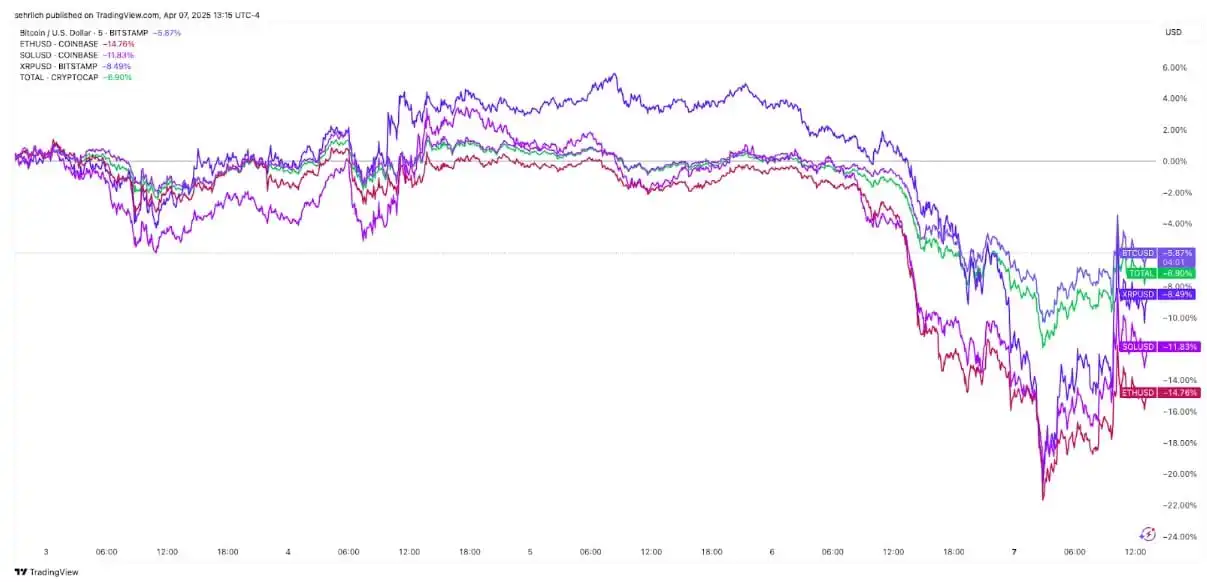
Due to President Trump's announcement last Wednesday of large-scale and indiscriminate global sanctions, cryptocurrencies continued to decline along with the overall market. At the time of writing, Bitcoin has fallen by 5.86% since then, even after a slight recovery following its first drop below $75,000 (the first time since the November 5 election). Other large-cap cryptocurrencies such as ETH, Solana, and XRP have also performed poorly during this period, lagging behind the market leader.
In such a market environment, market panic is clearly on the rise. The Cboe VIX index, which measures expected stock market volatility, has touched 60 for the first time since the outbreak of the COVID-19 pandemic, while Deribit's Bitcoin Volatility Index (DVOL), as the closest cryptocurrency market proxy to VIX, has risen by nearly 30% in the past week.
In this situation, investors seeking refuge—or in other words, buying US Treasuries—is a natural response. However, the investment world has a common saying: "Be fearful when others are greedy, and be greedy when others are fearful." This means that now is the time to buy blue-chip assets at a discount. To understand how professional funds are positioning themselves in the cryptocurrency market during this volatility, two main venture capital investors who requested anonymity shared insights into their respective companies' strategies and provided key information on which categories and industries may perform best in the coming weeks and months.
Store of Value: Bitcoin and Ethereum
While not surprising, both interviewees believe that Bitcoin is still the preferred choice. Gold has recently hit new highs and is widely considered a symbol of a safe-haven asset. At the same time, Bitcoin is increasingly showing its attributes as a "digital store of value." Despite recent price fluctuations, there is still significant room for growth between Bitcoin and gold based on market capitalization comparisons.
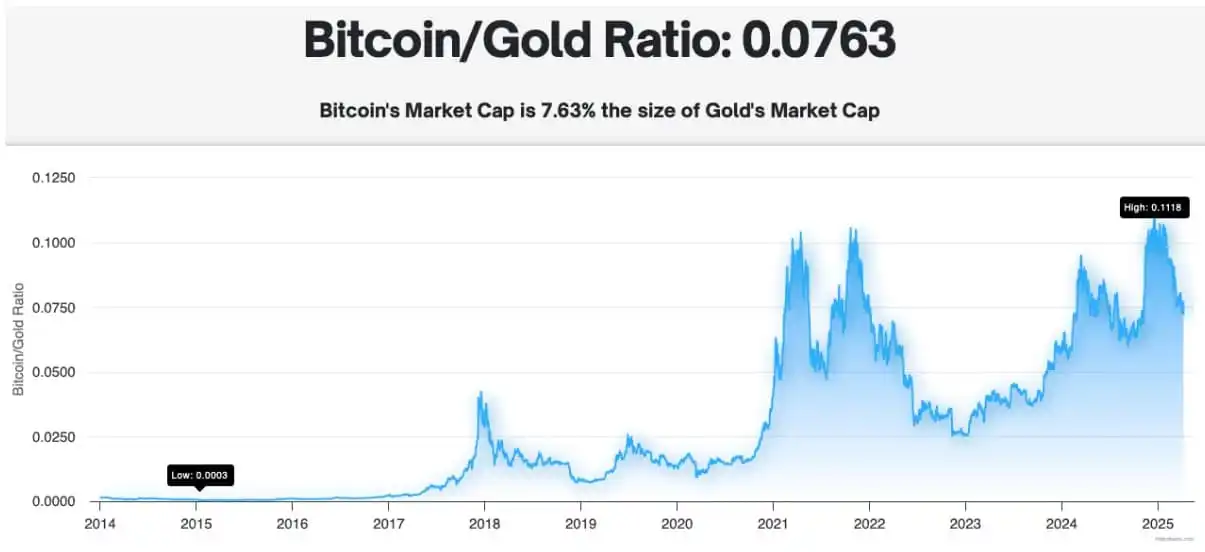
The current market value of gold is approximately $20.4 trillion, while Bitcoin's market value is only $1.64 trillion. An investor pointed out: "For Bitcoin to reach a 1:1 market value ratio with gold, it would need to increase by at least 12 to 15 times. In the current environment, this is the most straightforward and confident opportunity."
Ethereum is also considered an asset worth watching, although it has significantly lagged behind Bitcoin in price performance in recent years, and its ratio to Bitcoin is currently at its lowest point since the early days of the pandemic.
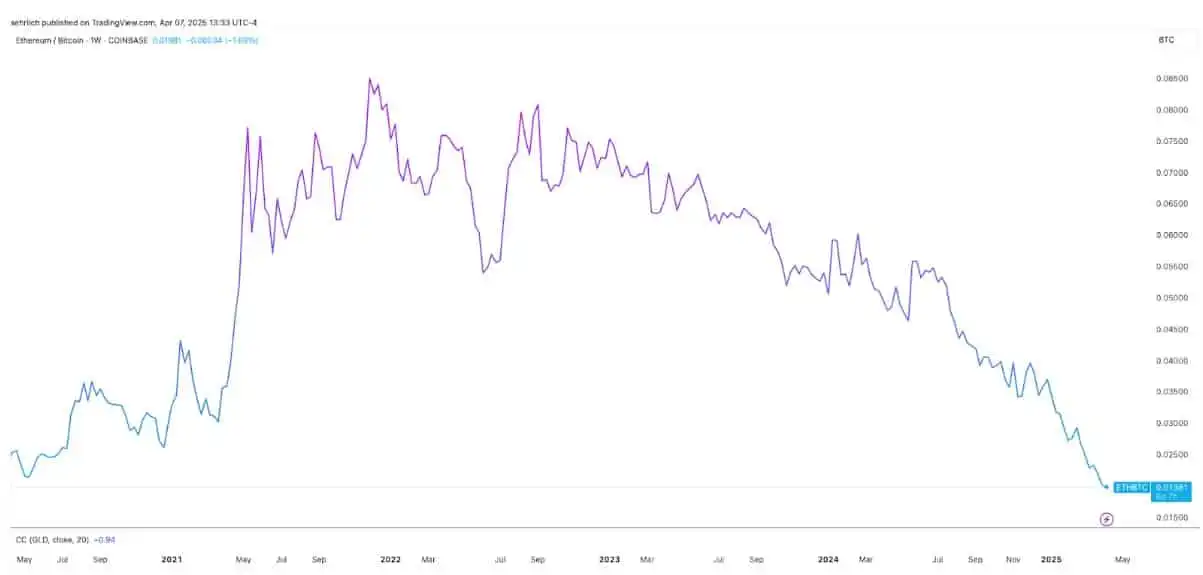
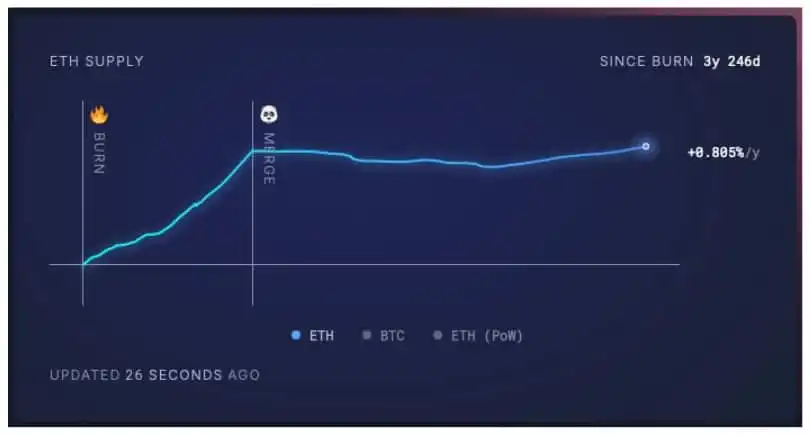
One interviewee mentioned that after Ethereum transitions from Proof of Work (PoW) to Proof of Stake (PoS) in 2022, its monetary policy tends toward deflation, allowing it to some extent to embrace Bitcoin's "store of value" narrative. Despite recent poor network usage and a slight uptick in inflation, from a valuation perspective, the current price is at a historical low.
Another investor stated: "Ethereum being this low right now is indeed a good buying opportunity."
Solana and DeFi Opportunity
Decentralized Finance (DeFi) tokens have generally suffered setbacks this year, with native tokens of trading platforms and lending protocols such as Uniswap, Aave, Curve, and Compound experiencing a nearly 50% decline from the beginning of the year. However, both investors believe that in the current macro environment of ongoing tightening, this sector is likely to stage a strong rebound.
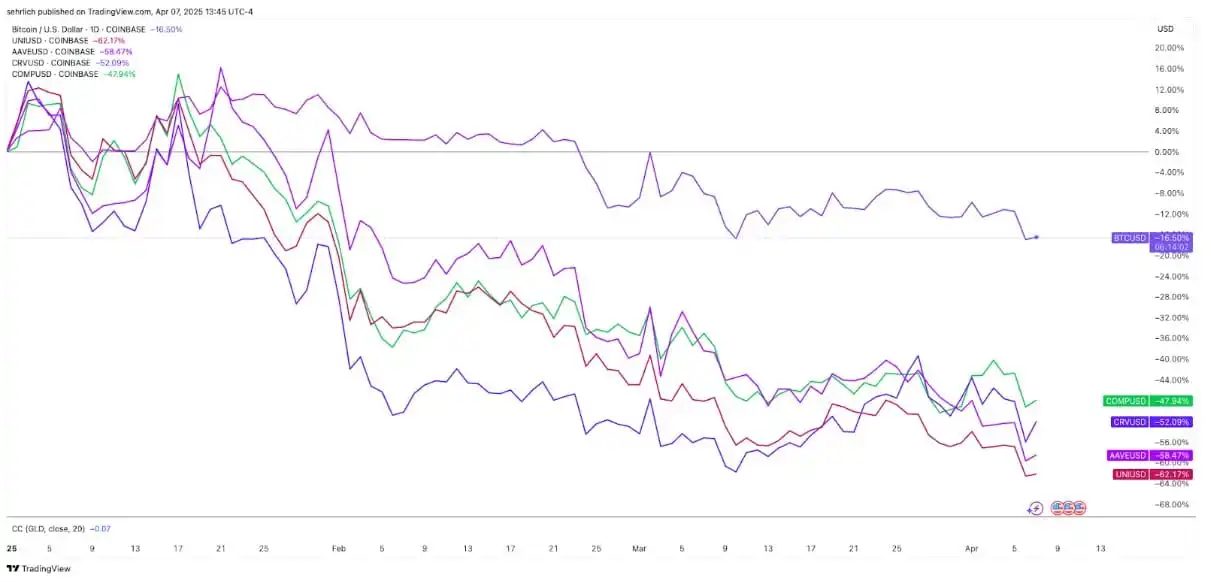
One of them pointed out that during a period of low stablecoin yields, DeFi may see a return of funds. This is because in on-chain lending portfolio loop operations, there are still ways to achieve relatively high returns. "This is similar to the situation in 2021," he added.
Two projects worth focusing on are Raydium and Hyperliquid. The former is a traditional automated market maker trading platform built on Solana, similar to Uniswap; the latter focuses on perpetual contracts and is a cash-settled derivative.
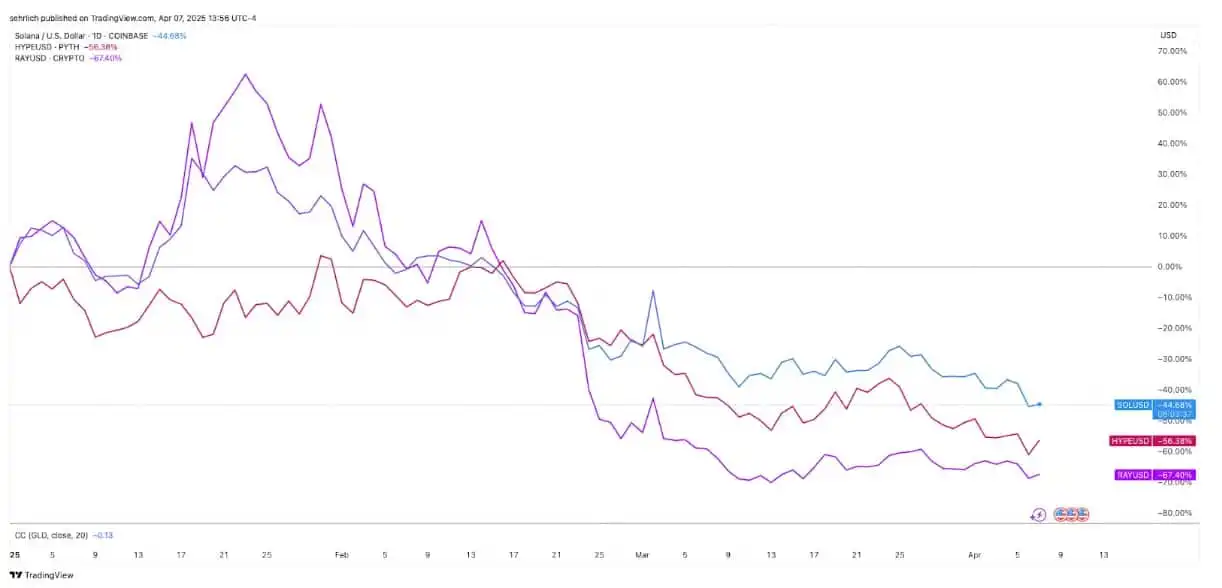
If one is unwilling to pick a single token, attention can also be paid to Solana itself. "Solana is somewhat like an index fund for DeFi. There are many very interesting DeFi projects developing on it."
EigenLayer and Near: The Next Infrastructure Opportunity
Both investors believe that last year's hot concept of "AI + Blockchain" was mostly overhyped. One of them bluntly stated, "Basically, it's all vaporware projects." However, he also pointed out that this situation is not uncommon in early-stage trends, just like the ICO craze of 2017. "The first wave is usually vaporware projects, but there is also a little bit of real substance in them, and those are what's worth paying attention to in the following years."
They believe that the next phase of the AI narrative is more likely to focus on "AI agents," such as automated booking travel bots. The question is, how to ensure that the funds deposited into these agent programs will not be stolen? One way to do this is to have their security guaranteed by the security of Ethereum itself.
However, Ethereum is not suitable for all projects, mainly due to high transaction costs and the need for some applications to operate cross-chain. EigenLayer was born in this context, providing applications with a "shared trust layer" that allows projects to leverage Ethereum's security without needing to fully deploy on its mainnet.
"Once your application runs on EigenLayer, its fund security is guaranteed by Ethereum," one investor stated. He also specifically mentioned that Near could also benefit from this trend.
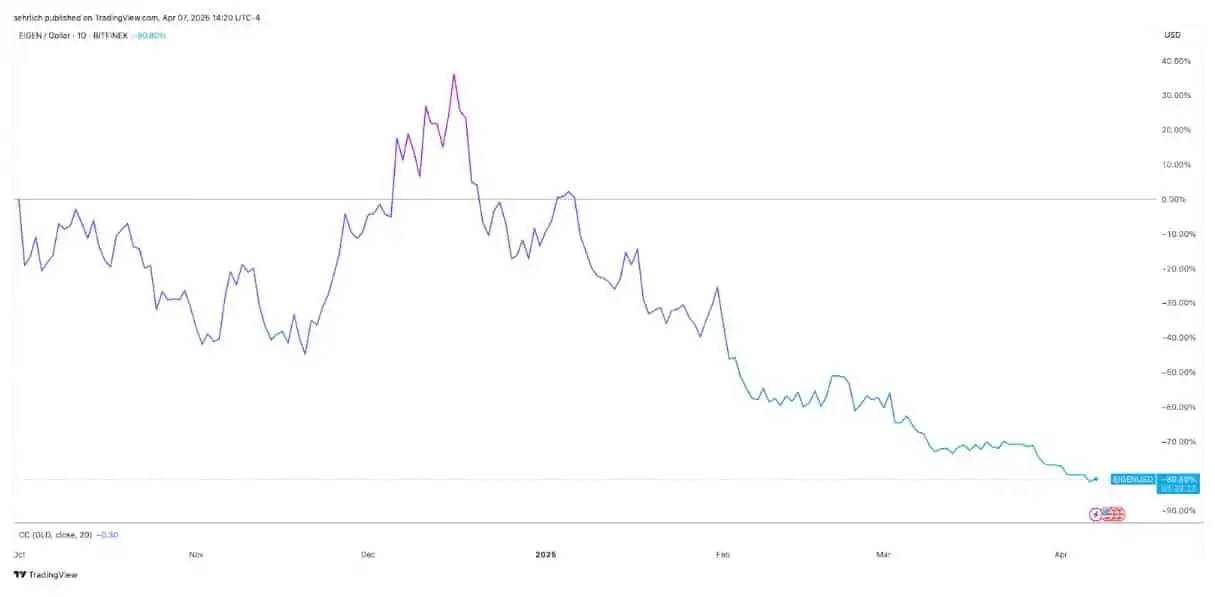
EigenLayer was once one of the most anticipated projects in the market, but its token launched in October last year, close to the peak of the bull market, and then the price plummeted by over 80%. However, if the current narrative holds, this actually means that investors can buy in at a significant discount. One investor added, "EigenLayer's market cap is still less than $1 billion now, this is the opportunity to buy and hold."
Overall, although the crypto market is still digesting uncertainty at the macro and policy levels in the short term, for institutional investors, now is a crucial time to reallocate assets and position for a new uptrend cycle. From store of value assets to infrastructure and DeFi platforms, to emerging AI interactive applications, the direction of fund bets has gradually emerged.
You may also like

Cyber Taoist Fortune Teller: Fake Taoist, AI Fortune Telling, and Northeastern Metaphysics History

Bloomberg: Stablecoin Payments Emerge as Crypto VC's Newest Favorite Thing
BeatSwap is evolving towards a full-stack Web3 infrastructure, covering the entire lifecycle of IP rights.
BeatSwap, a global Web3 Intellectual Property (IP) infrastructure project, is attempting to overcome the current fragmentation limitations of the Web3 ecosystem, building a full-stack system that covers the entire lifecycle of IP rights.
Currently, most Web3 projects are still in the stage of functional fragmentation, often focusing only on a single aspect, such as IP asset tokenization, transaction functionality, or a simple incentive model. This structural dispersion has become a key bottleneck hindering the industry's scale application.
BeatSwap's approach is more integrated, integrating multiple core modules into the same system, including:
· IP authentication and on-chain registration
· Authorization-based revenue sharing mechanism
· User-engagement-driven incentive system
· Transaction and liquidity infrastructure
Through the above integration, the platform builds an end-to-end closed-loop path, allowing IP rights to complete a full cycle of "creation, use, and monetization" within the same ecosystem.
BeatSwap is not limited to existing crypto users but is attempting to take the global music industry as a starting point, actively creating new market demand. Its core strategies include:
Exploring and incubating music creators (Artist discovery)
Building a fan community
Igniting IP-centric content consumption demand
The current global music industry is valued at around $260 billion, with over 2 billion digital music users. This means that the potential market corresponding to the tokenization and financialization of IP far exceeds the traditional crypto user base.
In this context, BeatSwap positions itself at the intersection of "real-world content demand" and "on-chain infrastructure," attempting to bridge the structural gap between content production and financial flow.
BeatSwap's upcoming core product "Space" is scheduled to launch in the second quarter of 2026. This product is defined as the SocialFi layer in the ecosystem, aiming to directly connect creators with users and achieve deep integration with other platform modules.
Key designs include:
A fan-centric interactive mechanism
Exposure and distribution logic based on $BTX staking
User paths connected to DeFi and liquidity structures
Thus, a complete user behavior loop is formed within the platform: Discovery → Participation → Consumption → Rewards → Trading
$BTX is designed to be a core utility asset within the ecosystem, rather than just a simple incentive token, with its value directly tied to platform activity and IP use cases.
Main features include:
· Yield distribution based on on-chain authorized actions
· Value reflection based on IP usage and user engagement dynamics
· Support for staking and DeFi participation mechanisms
· Value growth driven by ecosystem expansion
With the increased frequency of IP use, the utility and value support of $BTX will enhance simultaneously, helping alleviate the "disconnect between value and utility" issue present in traditional Web3 token models to some extent.
Currently, $BTX has been listed on several mainstream exchanges, including:
Binance Alpha
Gate
MEXC
OKX Boost
As the launch of "Space" approaches, BeatSwap is actively pursuing more exchange listings to further enhance liquidity and global accessibility, laying a foundation for future market expansion.
BeatSwap's goal is no longer limited to the traditional Web3 narrative but aims to target over 2 billion digital music users and a trillion KRW-scale content market.
By integrating content creators, users, capital, and liquidity into a blockchain framework centered around IP rights, BeatSwap is striving to build a next-generation infrastructure focused on "IP tokenization."
BeatSwap integrates IP authentication, authorization distribution, incentive mechanism, transaction system, and market construction to establish a unified structure that bridges the full lifecycle path of IP rights.
With the launch of the Q2 2026 "Space," the project is expected to become a key infrastructure connecting content and finance in the IP-RWA (Real World Assets) track.

Mag 7 Evaporates $2 Trillion | Rewire News Morning Edition

Losing $19K per Coin Mined, Bitcoin Mining Firms Collective AI Defection

Morning Report | Tom Lee predicts that the cryptocurrency winter will end in April; xStocks introduces a new on-chain private equity fund; Sui mainnet upgraded to V1.68.1

Polymarket rules have changed, how should airdrop participants respond?

Crypto ETF Weekly | Last week, the net outflow of Bitcoin spot ETFs in the U.S. was $296 million; the net outflow of Ethereum spot ETFs in the U.S. was $206 million

This Week's Key News Preview | The U.S. Releases March Non-Farm Payroll Data; Polymarket Expands Fee Structure

Slow Down, That's the Answer to the Age of the Agent

From Cash to Cryptocurrency: Moving Towards a Unified Regulatory Path for Illegal Payments
Who will own the most Bitcoin in 2026

A private feud lasting 10 years, if not for OpenAI's "hypocrisy," would not have led to the world's strongest AI company, Anthropic

"Crypto Tsar" steps down: 130 days of political performance come to an end, how much of Trump's crypto promise remains?

From Utopian Narratives to Financial Infrastructure: The "Disenchantment" and Shift of Crypto VC
A decade-long personal feud, if not for OpenAI's "hypocrisy," there would be no globally leading AI company Anthropic

a16z: The True Meaning of Strong Chain Quality, Block Space Should Not Be Monopolized
a16z: The True Meaning of Strong Chain Quality, Block Space Should Not Be Monopolized
Cyber Taoist Fortune Teller: Fake Taoist, AI Fortune Telling, and Northeastern Metaphysics History
Bloomberg: Stablecoin Payments Emerge as Crypto VC's Newest Favorite Thing
BeatSwap is evolving towards a full-stack Web3 infrastructure, covering the entire lifecycle of IP rights.
BeatSwap, a global Web3 Intellectual Property (IP) infrastructure project, is attempting to overcome the current fragmentation limitations of the Web3 ecosystem, building a full-stack system that covers the entire lifecycle of IP rights.
Currently, most Web3 projects are still in the stage of functional fragmentation, often focusing only on a single aspect, such as IP asset tokenization, transaction functionality, or a simple incentive model. This structural dispersion has become a key bottleneck hindering the industry's scale application.
BeatSwap's approach is more integrated, integrating multiple core modules into the same system, including:
· IP authentication and on-chain registration
· Authorization-based revenue sharing mechanism
· User-engagement-driven incentive system
· Transaction and liquidity infrastructure
Through the above integration, the platform builds an end-to-end closed-loop path, allowing IP rights to complete a full cycle of "creation, use, and monetization" within the same ecosystem.
BeatSwap is not limited to existing crypto users but is attempting to take the global music industry as a starting point, actively creating new market demand. Its core strategies include:
Exploring and incubating music creators (Artist discovery)
Building a fan community
Igniting IP-centric content consumption demand
The current global music industry is valued at around $260 billion, with over 2 billion digital music users. This means that the potential market corresponding to the tokenization and financialization of IP far exceeds the traditional crypto user base.
In this context, BeatSwap positions itself at the intersection of "real-world content demand" and "on-chain infrastructure," attempting to bridge the structural gap between content production and financial flow.
BeatSwap's upcoming core product "Space" is scheduled to launch in the second quarter of 2026. This product is defined as the SocialFi layer in the ecosystem, aiming to directly connect creators with users and achieve deep integration with other platform modules.
Key designs include:
A fan-centric interactive mechanism
Exposure and distribution logic based on $BTX staking
User paths connected to DeFi and liquidity structures
Thus, a complete user behavior loop is formed within the platform: Discovery → Participation → Consumption → Rewards → Trading
$BTX is designed to be a core utility asset within the ecosystem, rather than just a simple incentive token, with its value directly tied to platform activity and IP use cases.
Main features include:
· Yield distribution based on on-chain authorized actions
· Value reflection based on IP usage and user engagement dynamics
· Support for staking and DeFi participation mechanisms
· Value growth driven by ecosystem expansion
With the increased frequency of IP use, the utility and value support of $BTX will enhance simultaneously, helping alleviate the "disconnect between value and utility" issue present in traditional Web3 token models to some extent.
Currently, $BTX has been listed on several mainstream exchanges, including:
Binance Alpha
Gate
MEXC
OKX Boost
As the launch of "Space" approaches, BeatSwap is actively pursuing more exchange listings to further enhance liquidity and global accessibility, laying a foundation for future market expansion.
BeatSwap's goal is no longer limited to the traditional Web3 narrative but aims to target over 2 billion digital music users and a trillion KRW-scale content market.
By integrating content creators, users, capital, and liquidity into a blockchain framework centered around IP rights, BeatSwap is striving to build a next-generation infrastructure focused on "IP tokenization."
BeatSwap integrates IP authentication, authorization distribution, incentive mechanism, transaction system, and market construction to establish a unified structure that bridges the full lifecycle path of IP rights.
With the launch of the Q2 2026 "Space," the project is expected to become a key infrastructure connecting content and finance in the IP-RWA (Real World Assets) track.


 App
App