
 Buy Crypto
- Markets
 Futures
- Spot
- Copy Trade
- Earn
- More
Why Ethereum Can’t Compete on Speed Alone

Key Takeaways
- Vitalik Buterin emphasizes the importance of bandwidth scaling over latency reduction for Ethereum’s future.
- Ethereum’s design as “the world heartbeat” focuses on decentralization rather than high-speed transactions.
- Emerging technologies such as ZKEVMs and PeerDAS address blockchain scalability issues.
- Ethereum’s role is compared to Linux, highlighting its decentralized infrastructure supporting global adoption.
- AI advancements will require city-scale infrastructure, enhancing demand for specialized Layer 2 solutions.
WEEX Crypto News, 2026-01-08 12:52:51
In recent discussions, Ethereum co-founder Vitalik Buterin has provided valuable insights into the inherent limitations and strategic directions for Ethereum, a leading blockchain platform known for its robust and decentralized architecture. Despite the growing pressure to accelerate Ethereum’s transaction speeds, Buterin argues that focusing on improving bandwidth while keeping latency reductions secondary is crucial for maintaining the network’s integrity and what he terms as Ethereum being “the world heartbeat.”
Bandwidth vs. Latency: A Strategic Choice
Buterin’s perspective on Ethereum’s development is clear: prioritize bandwidth scaling over reducing latency. He stresses that decentralized blockchain networks inherently have constraints due to physical principles, such as the speed of light, and the fundamental requirements of decentralization. These constraints make it challenging for the network to function efficiently as a high-frequency transaction processor on its mainnet. Instead, Layer 2 networks are positioned to handle applications where speed is critical, allowing Ethereum to maintain its core role.
Ethereum’s preference for bandwidth scaling is significantly safer as compared to reducing block times. Buterin points out that while scaling bandwidth can potentially result in exponential growth, physical limitations and economic factors put a cap on how fast latency can be minimized. These considerations are crucial, especially when maintaining blockchain’s foundational principles like censorship resistance and the anonymity of validators. Also, bandwidth scaling ensures the economic viability of staking operations spread across diverse geographical locations.
Recent Technological Advances
Ethereum’s recent advancements reflect its strategic choices. Since the implementation of the Fusaka upgrade, there has been an impressive 110% growth in new addresses, indicating a favorable reception and increased adoption of the platform. The introduction of technologies such as zero-knowledge Ethereum Virtual Machines (ZKEVMs) and PeerDAS has been pivotal in addressing the blockchain trilemma—balancing decentralization, security, and scalability. This development stage showcases Ethereum’s clear intention to lay a strong foundation for future growth by leveraging technical innovations.
Zero-Knowledge EVMs and PeerDAS
Zero-knowledge EVMs enable efficient proof mechanisms that do not disclose transaction details, making these solutions appealing for applications requiring high confidentiality levels. PeerDAS technology, on the other hand, allows for data availability sampling, which ensures the effective transmigration of data across nodes without compromising the network’s security. Such technologies are pointing towards an Ethereum capable of handling thousands of transactions seamlessly, offering a glimpse into the future where the network could potentially scale significantly from its current state.
The Role of Artificial Intelligence
Buterin also explored the intersection of blockchain technology and artificial intelligence, two watershed technologies expected to redefine digital landscapes. According to him, the need for infrastructure that can support AI communications—capable of speeds far beyond human capacity—would require city-scale infrastructure. This requirement opens the door for distinct Layer 2 chains optimized for specific locales or even individual structures. While Ethereum will continue to serve global coordination functions through its base layer, these specialized solutions will handle localized demands efficiently and expand global capability.
Buterin stresses that Ethereum should not morph into a “world video game server” but rather remain the backbone providing trustless consensus for advanced applications facilitated by higher-layer solutions. Through these efforts, Ethereum mainnet fortifies its position as fundamental infrastructure, guiding a diverse ecosystem of developments.
Ethereum’s Limits and Metaphors
Recognizing Ethereum’s technical limits, Buterin refers back to his 2021 analysis that sets realistic expectations for node requirements. Limitations with computation power, bandwidth, and storage represent significant areas where even advanced technology cannot completely bypass existing constraints. For instance, the physical limits of CPU capacity for block verification stand as a barrier due to energy consumption, Denial-of-Service (DoS) attack margins, synchronization tasks, and other routine processes. Similarly, storage limitations highlight the exponential cost implications when database sizes increase, serving as a stern reminder to align scalability efforts with these realities.
To better convey Ethereum’s strategic direction, Buterin compares it to Linux and BitTorrent, drawing parallels in terms of decentralization and widespread utilization. Linux, a free and open-source software, thrives on its foundational principles, serving billions globally without compromising its essence. In the same vein, Ethereum’s decentralized infrastructure aspires to accommodate diverse users, from purists demanding maximum autonomy to enterprises racing for robust, resilient solutions that align with corporate needs and risk management strategies. This alignment is further evidenced by increasing trends of institutional confidence, signified by significant networks and firms such as JPMorgan and Deutsche Bank exploring Ethereum-based tokenization products.
Brand Alignment and Institutional Adoption
The surge in new address creation—reaching 292,000 daily post the Fusaka upgrade—alongside major financial institutions’ growing interest, symbolizes Ethereum’s untapped potential within traditional financial spaces. This growing acceptance showcases Ethereum’s capacity to bolster trust in digital assets and inspire financial mechanisms that seamlessly integrate blockchain technology.
The intersection of Ethereum’s strategic emphasis on bandwidth scaling and institutional interests indicates the potential of Ethereum not only as a technological platform but as a brand offering reliability, innovation, and security. Likewise, it aligns brand needs with Ethereum’s decentralized principles, supporting institutions and enthusiasts alike in harnessing blockchain’s potential.
Conclusion
Vitalik Buterin’s thoughtful examination of Ethereum’s trajectory presents a compelling blend of technology and pragmatism, essential for navigating contemporary blockchain challenges. By putting bandwidth at the forefront, Ethereum acknowledges the limits posed by natural laws and decentralization necessities, ensuring it remains true to its vision. As narratives around technology and usage continue to evolve, Ethereum’s role as the “world heartbeat” underscores its global impact, balancing core principles with advancing capabilities to meet the growing needs of tomorrow’s digital environments.
Frequently Asked Questions
What are the main limitations of reducing latency on Ethereum?
Reducing latency on Ethereum faces significant challenges due to the speed of light constraints and the critical need to support globally distributed nodes. Further, it must maintain decentralization, which adds technical complexity to reducing latency effectively.
How do PeerDAS and ZKEVMs help in scaling Ethereum?
PeerDAS aids in efficient data distribution without jeopardizing network security, while ZKEVMs provide privacy-preserving computations. Together, they help address the limitations of current scaling methods by promising secure and scalable solutions.
Why is Ethereum compared to Linux and BitTorrent?
Ethereum is likened to Linux and BitTorrent due to its decentralized framework that serves both individual enthusiasts and large enterprises. It’s a stable, secure platform resembling these technologies, supporting mass adoption while staying true to decentralization ideals.
How does Ethereum plan to accommodate AI technology?
Ethereum anticipates that AI technology will require fast, localized infrastructure (city-scale solutions), handled mostly through Layer 2 integrations. These layers will provide the necessary speed and capacity while leveraging Ethereum’s base layer for larger, strategic operations.
What role do institutional adoptions play in Ethereum’s future?
Institutions adopting Ethereum signals trust in its ecosystem and potential for scalable use in traditional finance sectors. This adoption drives innovation in tokenization and augments Ethereum’s reputation as a conduit for bridging traditional finance with blockchain technology.
You may also like

After two years, Hong Kong's first batch of stablecoin licenses finally issued: HSBC, Standard Chartered make the cut

The person who helped TAO rise by 90% has now single-handedly crashed the price again today

3-Minute Guide to Participating in the SpaceX IPO on Bitget

Top 5 Cryptos to Buy in 2026 Q1: A ChatGPT Deep Dive Analysis
Explore the top 5 cryptos to buy in Q1 2026 including BTC, ETH, SOL, TAO, and ONDO. See price outlooks, key narratives, and institutional catalysts shaping the next market move.

How to Earn $15,000 with Idle USDT Before Altcoin Season 2026
Wondering if altcoin season is coming in 2026? Get the latest market update, and learn how to turn your idle stablecoins waiting for entry into extra rewards up to 15,000 USDT.
Can You Win Joker Returns Without Large Trading Volume? 5 Mistakes New Players Make In WEEX Joker Returns Season 2
Can small traders win WEEX Joker Returns 2026 without huge volume? Yes—if you avoid these 5 costly mistakes. Learn how to maximize card draws, use Jokers wisely, and turn small deposits into 15,000 USDT rewards.

Altcoin Season 2026: 4 Stages to Profit (Before the Crowd FOMO In)
Altcoin Season 2026 is starting — discover the 4 key stages of capital rotation (from ETH to PEPE) and how to position before the peak. Learn which tokens will lead each phase and avoid missing the rally.

Will Alt season come in 2026? 5 Tips to Spot the Next 100x Crypto Opportunities
Will altcoin season arrive in 2026? Discover 5 rotation stages, early signals smart traders watch, and the key crypto sectors where the next 100x altcoin opportunities may emerge.

The bear market has arrived, and cryptocurrency ETF issuers are also getting involved

The richest man had a quarrel with his former boss

BTC Firm Above 70K! Saylor’s "Institutional Logic" vs. Moon’s "Retail Faith": Who is Really Harvesting the Market?
Bitcoin is holding firm above the $70,000 support level following a massive short squeeze that liquidated $427 million. As the "Four-Year Cycle" narrative shifts, the market is split: Michael Saylor’s cold, institutional "indiscriminate stacking" vs. Carl Moon’s high-energy retail "hopium." This article decodes these two polar-opposite strategies for the 2026 bull run and reveals how WEEX’s institutional-grade liquidity and AI trading tools empower every type of investor to convert market volatility into profit.

The Girl Who Created the SBTI Test: A Story of a Doomed Cyber Love, an E-Widow Ratfolk

B.AI Officially Launched: Building AI Agent Financial Bedrock Platform, Driving AGI Era Business Underlying Logic

B.AI Officially Launched: Breaking Down A2A Collaboration Barriers to Unlock the Smart Body Economy's Full Potential
We helped Xu Mingxing write a book called "<OK Life>".

Rare APY of 400%, is TradeXYZ handing out money to oil bulls?
a16z: Perpetual Contracts are Rewriting Global Trading Rules
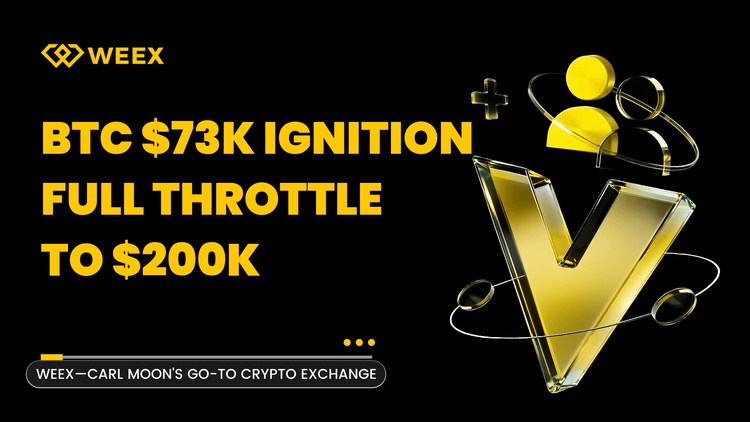
Bitcoin Hits $73,000 Triggering $427M Short Liquidation | Carl Moon: $200,000 is the Target
April 9, 2026 (UTC+0), 22:17. Bitcoin (BTC) executed a high-velocity surge within minutes, heavy-hitting the $73,000 psychological barrier and touching a local high near $74,000. While the price has since retraced to consolidate above $72,000, this "instant ambush" successfully completed a $427M liquidation of short positions.
After two years, Hong Kong's first batch of stablecoin licenses finally issued: HSBC, Standard Chartered make the cut
The person who helped TAO rise by 90% has now single-handedly crashed the price again today
3-Minute Guide to Participating in the SpaceX IPO on Bitget
Top 5 Cryptos to Buy in 2026 Q1: A ChatGPT Deep Dive Analysis
Explore the top 5 cryptos to buy in Q1 2026 including BTC, ETH, SOL, TAO, and ONDO. See price outlooks, key narratives, and institutional catalysts shaping the next market move.
How to Earn $15,000 with Idle USDT Before Altcoin Season 2026
Wondering if altcoin season is coming in 2026? Get the latest market update, and learn how to turn your idle stablecoins waiting for entry into extra rewards up to 15,000 USDT.
Can You Win Joker Returns Without Large Trading Volume? 5 Mistakes New Players Make In WEEX Joker Returns Season 2
Can small traders win WEEX Joker Returns 2026 without huge volume? Yes—if you avoid these 5 costly mistakes. Learn how to maximize card draws, use Jokers wisely, and turn small deposits into 15,000 USDT rewards.


 App
App