
 Buy Crypto
- Markets
 Futures
- Spot
- Copy Trade
- Earn
- More
Why Is the Cryptographic Smart Card Doomed to Extinction?

Original Title: Crypto cards don't have any future
Original Author: @paramonoww
Translation: Peggy, BlockBeats
Editor's Note: Crypto cards were once seen as a bridge between the traditional payment system and the crypto world. However, as the industry has developed, the limitations of this model have become increasingly apparent: centralization, reliance on compliance, lack of privacy, overlay fees, and even a betrayal of the core spirit of cryptocurrency.
This article delves into the essence of crypto cards, pointing out that they are merely a transitional solution, not a true decentralized payment innovation. At the same time, the article proposes EtherFi as one of the few models that align with crypto values, demonstrating the possibility of DeFi and TradFi integration.
The following is the original text:
My overall view is that cryptocurrency cards are just a temporary solution to address two well-known issues: first, to bring cryptocurrency to the masses; second, to ensure that cryptocurrency is accepted globally as a form of payment.
Crypto cards are ultimately still cards. If someone truly embraces the core value of cryptocurrency but believes that the future will be dominated by cards, then you may need to rethink your vision.
All crypto card companies will eventually disappear
In the long run, crypto cards are likely to disappear, but traditional cards will not. Crypto cards only add an additional layer of abstraction and are not a purely cryptocurrency use case. The card issuers are still banks. Yes, they may have different logos, designs, and user experiences, but as I mentioned earlier, this is only abstraction. Abstraction makes things more convenient for users, but the underlying processes remain unchanged.
Various public chains and Rollups have been obsessed with comparing their TPS and infrastructure to Visa, Mastercard. This goal has been around for years: either to "replace" or more aggressively "disrupt" Visa, Mastercard, AmEx, and other payment processors.
However, this goal cannot be achieved through crypto cards—they are not substitutes but instead bring more value to Visa and Mastercard.
These institutions are still key "gatekeepers" with the authority to set rules, define compliance standards, and even, if necessary, block your card, company, or even bank.
In an industry that has always pursued "permissionless" and "decentralization," why hand everything over to payment processors now?
Your card is Visa, not Ethereum. Your card is with a traditional bank, not MetaMask. You are spending fiat currency, not cryptocurrency.
Those crypto card companies you love so much have done almost nothing besides slapping their own logo on the card. They merely rely on a narrative, which will fade away in a few years, and those digital cards issued until 2030 won't even be operational by then.
I will explain later how easy it is to create a crypto card now — in the future, you might even make one yourself!
Same Issues + More Fees
The best analogy I can think of is "Application-Specific Sidechains." Yes, applications can process transactions independently and profit from them, which is a cool idea, but it's only temporary: infrastructure costs are decreasing, communication is maturing, and economic issues exist at a higher level rather than a lower one. (If you're interested, you can check out @mvyletel_jr's amazing talk about ASS.)
Crypto cards are the same way: yes, you can top up with cryptocurrency, and the card will convert it to fiat for spending, but the issues of centralization and permissioned access still exist.
It does help in the short term: merchants don't need to adopt new payment methods, and crypto consumption is almost "invisible."
But this is just a transitional step towards what most crypto believers truly desire:
Demand: Pay directly with stablecoins, Solana, Ethereum, Zcash
Not needed: USDT → Crypto Card → Bank → Fiat's indirect path
Adding a layer of abstraction adds a layer of fees: spread fees, withdrawal fees, transfer fees, and sometimes even custody fees. These fees may seem negligible, but they compound: saving a penny is earning a penny.
Using a Crypto Card Doesn't Mean You Are "Unbanked" or Achieving "Banklessness"
Another misconception I've noticed is that people think using a crypto card means they don't have a bank account or have achieved banklessness. Of course, that's not true. Under the guise of a crypto card, there is still a bank, and the bank must report some of your information to the local government. Not all data, but at least some critical data.
If you are a citizen or resident of the European Union, the government will know about your bank account interest, significant suspicious transactions, certain investment income, account balance, etc. If the underlying bank is in the U.S., they know even more.
From a cryptographic standpoint, this has both pros and cons. The benefit is transparency and verifiability, but the same rules also apply to using a standard debit or credit card issued by your local bank. The downside is that it is not anonymous or pseudonymous: the bank still sees your name, not an EVM or SVM address, and you still need to go through KYC.
Limitations Still Exist
You might say, crypto cards are great because they are really easy to set up: download the app, complete KYC, wait for 1–2 minutes for verification, top up with cryptocurrency, and then you can start using it. Yes, this is indeed a killer feature, extremely convenient, but not everyone can use it.
Russia, Ukraine, Syria, Iraq, Iran, Myanmar, Lebanon, Afghanistan, and half of Africa—citizens of these countries cannot use cryptocurrency for day-to-day transactions if they do not have residency rights in another country.
But hey, that's only 10–20 countries that are excluded, what about the other 150+ countries? The issue is not whether the majority can use it, but the core value of crypto: a decentralized network, equal nodes, financial inclusivity, everyone having equal rights. This does not exist in crypto cards because they are not "crypto" at all.
Max Karpis perfectly explains here why the "new banks" were doomed to fail from the start.
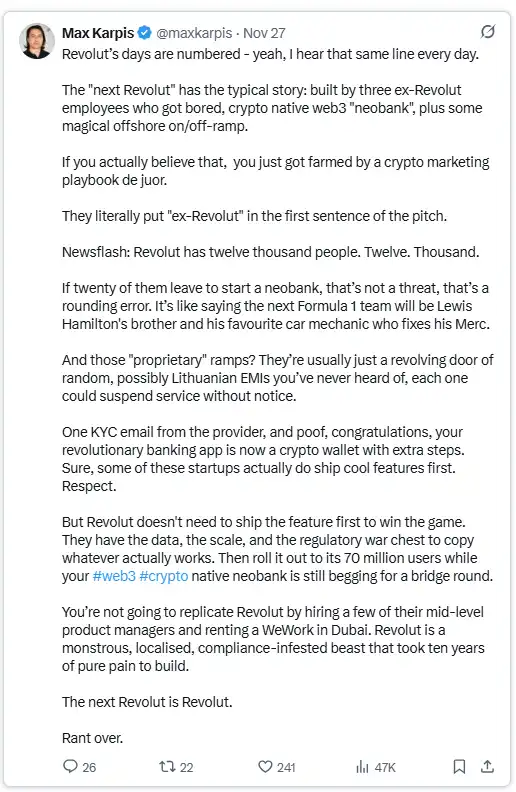
Max Karpis believes that "new banks" were doomed to fail from the start because they face multiple structural obstacles: high regulatory and compliance costs, lack of scale and user trust, a business model dependent on third parties and fragile, financial pressures, and profitability challenges. In contrast, giants like Revolut have a huge user base, data advantage, and regulatory moat, allowing them to rapidly replicate innovation and succeed through scale, making it difficult for startups in the new banking sector to survive or disrupt in competition.
The only scenario where I actually used cryptocurrency for payment was when booking a flight on Trip.com. They recently added an option to pay with a stablecoin, allowing you to pay directly from your wallet, and of course, anyone in the world can use it.
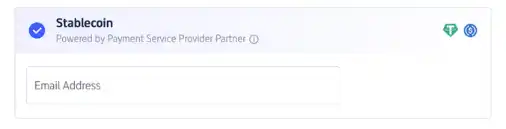
Don't use Booking, use Trip for true crypto payments. This is my sincere recommendation.
This is the true application scenario of cryptocurrency and a real cryptographic payment. I believe the ultimate form will look like this: wallets will be specially optimized for the user experience of payments and spending, or (less likely) wallets will evolve into crypto cards if crypto payments are widely adopted in some way.
The Functionality of a Crypto Card is Similar to a Liquidity Bridge (Rain)
I have an interesting observation: the operation of a self-custodial crypto card is very similar to a cross-chain bridge.
This only applies to self-custodial cards: cards issued by centralized exchanges (CEX) are not self-custodial, so exchanges like Coinbase are not obligated to let users think that the funds are under their control.
A reasonable use case for CEX cards is that they can serve as proof of funds, for government purposes, visa applications, or similar scenarios. When you use a crypto card tied to a CEX balance, you are still essentially within the same ecosystem.
Self-custodial crypto cards, on the other hand, are different: their operation is similar to a liquidity bridge, where you lock funds (cryptocurrency) on Chain A (crypto balance) and then unlock funds (fiat) on Chain B (real world).
This "bridge" in the crypto card field acts like a pickaxe during the California Gold Rush: it is a crucial secure channel that connects crypto-native users and enterprises looking to issue their own cards.
@stablewatchHQ has a very accurate analysis of this bridge, seeing it fundamentally as a Card-as-a-Service (CaaS) model. This is the most easily overlooked aspect by everyone discussing crypto cards. These CaaS platforms provide infrastructure for companies to launch their own branded cards.
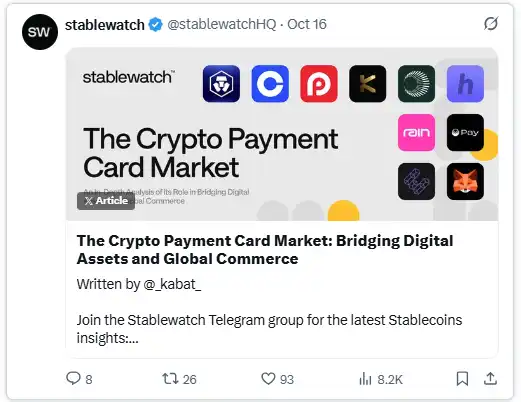
Related Reading: "The Crypto Payment Card Market: Bridging Digital Assets and Global Commerce"
Rain: How the Crypto Card was Born
In your favorite crypto card, half of it may be supported by @raincards, and you may have never heard of it. Rain is one of the most foundational protocols in the new banking system because it essentially underpins all the core components behind the crypto card. All the remaining companies have to do is slap their logo on it (sounds harsh, but it's close to the truth).
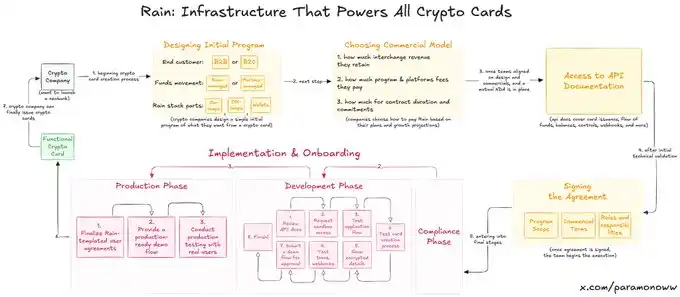
I have created a diagram to help you understand how Rain works and how easy it is to set up a crypto card. Tip: Better quality when zoomed in.
Rain enables companies to quickly launch their own crypto card. In all honesty, Rain's execution ability can even thrive beyond the crypto space. So, no more dreaming that a team needs to raise tens of millions of dollars to issue a crypto card; they don't need that funding — they just need Rain.
The reason I emphasize Rain so much is because people generally overestimate the effort required to issue a crypto card. Perhaps I will write a separate article about Rain in the future because it is truly a highly underestimated technology.
Crypto Cards Lack Privacy and Anonymity
The lack of privacy or anonymity in crypto cards is not an issue with the cards themselves, but rather the issues deliberately ignored by those driving crypto cards, hiding behind the so-called "crypto value."
Privacy is not a widely used feature in the crypto space, and pseudo-privacy (pseudo-anonymity) does exist because what we see are addresses, not names. However, if you are ZachXBT, Wintermute's Igor Igamberdiev, Storm from Paradigm, or others with strong on-chain analysis capabilities, you can significantly narrow down the real-world identity associated with an address.
Of course, the situation with crypto cards doesn't even have the pseudo-privacy of traditional cryptocurrencies because when you activate a crypto card, you must complete KYC (in reality, you are not activating a crypto card, but a bank account).
If you are in the EU, the companies providing crypto cards will still send some of your data to the government for tax or other purposes the government needs to know. Now, you have given regulators a new opportunity to track you: linking your crypto address to your real identity.
Personal Data: The Currency of the Future
Cash still exists (the only anonymous form, except the seller can see you), and it will exist for a long time. But ultimately, everything will be digitized. The current digital systems have not provided consumers with any privacy benefits: the more you spend, the higher the cost you pay, and in exchange, the more they know about you. What a "good deal"!
Privacy is a luxury, and in the crypto card space, it will continue to be so. An interesting idea is that if we achieve truly good privacy, making companies and institutions willing to pay for it (not like Facebook, but with our consent), it may become the currency of the future, even the only currency in a jobless, AI-driven world.
If Everything Is Doomed to Fail, Why Build Tempo, Arc Plasma, Stable?
The answer is simple—locking users into the ecosystem.
Most non-custodial card choices L2 (such as MetaMask using @LineaBuild) or standalone L1 (such as Plasma Card using @Plasma). Due to high costs and finality issues, Ethereum or Bitcoin is usually not suitable for such operations. Some cards use Solana, but this is still a minority.
Of course, companies choose different blockchains not only because of the infrastructure but also because of economic interests.
MetaMask using Linea is not because Linea is the fastest or the most secure, but because Linea and MetaMask both belong to the ConsenSys ecosystem.
I intentionally used MetaMask as an example because it uses Linea. As everyone knows, almost no one uses Linea, and it is far behind Base or Arbitrum in the L2 competition.
But ConsenSys made a clever decision by placing Linea at the core of their card because it can lock users into the ecosystem this way. Users are accustomed to a good user experience rather than what they use every day. Linea naturally attracts liquidity, trading volume, and other metrics, rather than relying on liquidity mining activities or begging users to cross chains.
This strategy is similar to Apple's approach when launching the iPhone in 2007, keeping users on iOS, making it difficult for them to switch to other ecosystems. Never underestimate the power of habit.
EtherFi is the Only Viable Crypto Card
After all this consideration, my conclusion is that @ether_fi might be the only crypto card that truly embodies the crypto spirit (this research is not sponsored by EtherFi, and even if it were, I would not mind).
In most crypto cards, the cryptocurrency you deposit is sold off, and your balance is then replenished with cash (similar to the liquidity bridge I described earlier).
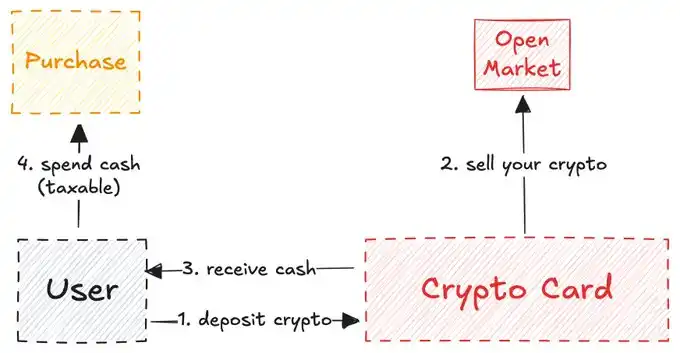
Most Common Crypto Cards
But EtherFi is different: the system never sells off your cryptocurrency but gives you a cash loan and uses your crypto assets to earn a return.
The EtherFi model is similar to Aave. Most DeFi users dream of being able to seamlessly collateralize their crypto assets for cash loans, and this capability has already emerged. You may ask, "Isn't this the same? I can top up my crypto and spend with a crypto card like a regular debit card, so why this extra step?"
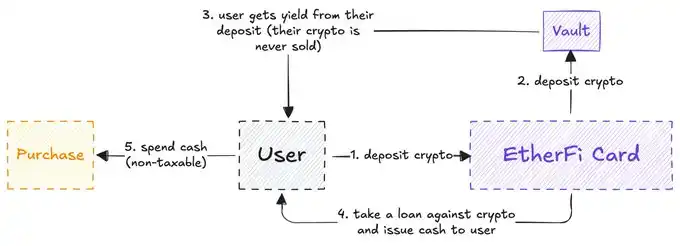
EtherFi's Mechanism (Simplified)
The problem is that selling your crypto is a taxable event, sometimes even more easily taxed than everyday spending. In most cards, each of your transactions can be a taxable event, leading you to pay more taxes (again, emphasizing that using a crypto card does not mean going bankless).
EtherFi somewhat addresses this issue because you are not actually selling the crypto; you are just using it as collateral for a loan.
On this basis alone (along with USD with no foreign exchange fees, cashback, and other benefits), EtherFi becomes the prime example of DeFi meeting TradFi.
Most cards try to pretend to be crypto products, but in reality, they are just liquidity bridges, while EtherFi truly caters to crypto users, not merely to mainstream crypto: it enables crypto users to spend locally until mainstream users realize how cool this model is. Among all crypto cards, EtherFi could be the only project that survives in the long run.
I see the crypto card as an experimental ground, but unfortunately, most teams you see are merely using the narrative without giving due credit to the underlying systems and developers.
Let's see where progress and innovation will take us. Currently, what we see is the globalization of crypto cards (horizontal growth) but a lack of vertical growth, which is precisely what this payment technology needed in its early days.
You may also like

Soaring 50 times, with an FDV exceeding 10 billion USD, why RaveDAO?

1 billion DOTs were minted out of thin air, but the hacker only made 230,000 dollars

After the blockade of the Strait of Hormuz, when will the war end?

Before using Musk's "Western WeChat" X Chat, you need to understand these three questions
The X Chat will be available for download on the App Store this Friday. The media has already covered the feature list, including self-destructing messages, screenshot prevention, 481-person group chats, Grok integration, and registration without a phone number, positioning it as the "Western WeChat." However, there are three questions that have hardly been addressed in any reports.
There is a sentence on X's official help page that is still hanging there: "If malicious insiders or X itself cause encrypted conversations to be exposed through legal processes, both the sender and receiver will be completely unaware."
No. The difference lies in where the keys are stored.
In Signal's end-to-end encryption, the keys never leave your device. X, the court, or any external party does not hold your keys. Signal's servers have nothing to decrypt your messages; even if they were subpoenaed, they could only provide registration timestamps and last connection times, as evidenced by past subpoena records.
X Chat uses the Juicebox protocol. This solution divides the key into three parts, each stored on three servers operated by X. When recovering the key with a PIN code, the system retrieves these three shards from X's servers and recombines them. No matter how complex the PIN code is, X is the actual custodian of the key, not the user.
This is the technical background of the "help page sentence": because the key is on X's servers, X has the ability to respond to legal processes without the user's knowledge. Signal does not have this capability, not because of policy, but because it simply does not have the key.
The following illustration compares the security mechanisms of Signal, WhatsApp, Telegram, and X Chat along six dimensions. X Chat is the only one of the four where the platform holds the key and the only one without Forward Secrecy.
The significance of Forward Secrecy is that even if a key is compromised at a certain point in time, historical messages cannot be decrypted because each message has a unique key. Signal's Double Ratchet protocol automatically updates the key after each message, a mechanism lacking in X Chat.
After analyzing the X Chat architecture in June 2025, Johns Hopkins University cryptology professor Matthew Green commented, "If we judge XChat as an end-to-end encryption scheme, this seems like a pretty game-over type of vulnerability." He later added, "I would not trust this any more than I trust current unencrypted DMs."
From a September 2025 TechCrunch report to being live in April 2026, this architecture saw no changes.
In a February 9, 2026 tweet, Musk pledged to undergo rigorous security tests of X Chat before its launch on X Chat and to open source all the code.
As of the April 17 launch date, no independent third-party audit has been completed, there is no official code repository on GitHub, the App Store's privacy label reveals X Chat collects five or more categories of data including location, contact info, and search history, directly contradicting the marketing claim of "No Ads, No Trackers."
Not continuous monitoring, but a clear access point.
For every message on X Chat, users can long-press and select "Ask Grok." When this button is clicked, the message is delivered to Grok in plaintext, transitioning from encrypted to unencrypted at this stage.
This design is not a vulnerability but a feature. However, X Chat's privacy policy does not state whether this plaintext data will be used for Grok's model training or if Grok will store this conversation content. By actively clicking "Ask Grok," users are voluntarily removing the encryption protection of that message.
There is also a structural issue: How quickly will this button shift from an "optional feature" to a "default habit"? The higher the quality of Grok's replies, the more frequently users will rely on it, leading to an increase in the proportion of messages flowing out of encryption protection. The actual encryption strength of X Chat, in the long run, depends not only on the design of the Juicebox protocol but also on the frequency of user clicks on "Ask Grok."
X Chat's initial release only supports iOS, with the Android version simply stating "coming soon" without a timeline.
In the global smartphone market, Android holds about 73%, while iOS holds about 27% (IDC/Statista, 2025). Of WhatsApp's 3.14 billion monthly active users, 73% are on Android (according to Demand Sage). In India, WhatsApp covers 854 million users, with over 95% Android penetration. In Brazil, there are 148 million users, with 81% on Android, and in Indonesia, there are 112 million users, with 87% on Android.
WhatsApp's dominance in the global communication market is built on Android. Signal, with a monthly active user base of around 85 million, also relies mainly on privacy-conscious users in Android-dominant countries.
X Chat circumvented this battlefield, with two possible interpretations. One is technical debt; X Chat is built with Rust, and achieving cross-platform support is not easy, so prioritizing iOS may be an engineering constraint. The other is a strategic choice; with iOS holding a market share of nearly 55% in the U.S., X's core user base being in the U.S., prioritizing iOS means focusing on their core user base rather than engaging in direct competition with Android-dominated emerging markets and WhatsApp.
These two interpretations are not mutually exclusive, leading to the same result: X Chat's debut saw it willingly forfeit 73% of the global smartphone user base.
This matter has been described by some: X Chat, along with X Money and Grok, forms a trifecta creating a closed-loop data system parallel to the existing infrastructure, similar in concept to the WeChat ecosystem. This assessment is not new, but with X Chat's launch, it's worth revisiting the schematic.
X Chat generates communication metadata, including information on who is talking to whom, for how long, and how frequently. This data flows into X's identity system. Part of the message content goes through the Ask Grok feature and enters Grok's processing chain. Financial transactions are handled by X Money: external public testing was completed in March, opening to the public in April, enabling fiat peer-to-peer transfers via Visa Direct. A senior Fireblocks executive confirmed plans for cryptocurrency payments to go live by the end of the year, holding money transmitter licenses in over 40 U.S. states currently.
Every WeChat feature operates within China's regulatory framework. Musk's system operates within Western regulatory frameworks, but he also serves as the head of the Department of Government Efficiency (DOGE). This is not a WeChat replica; it is a reenactment of the same logic under different political conditions.
The difference is that WeChat has never explicitly claimed to be "end-to-end encrypted" on its main interface, whereas X Chat does. "End-to-end encryption" in user perception means that no one, not even the platform, can see your messages. X Chat's architectural design does not meet this user expectation, but it uses this term.
X Chat consolidates the three data lines of "who this person is, who they are talking to, and where their money comes from and goes to" in one company's hands.
The help page sentence has never been just technical instructions.

Parse Noise's newly launched Beta version, how to "on-chain" this heat?

Is Lobster a Thing of the Past? Unpacking the Hermes Agent Tools that Supercharge Your Throughput to 100x

Declare War on AI? The Doomsday Narrative Behind Ultraman's Residence in Flames
Crypto VCs Are Dead? The Market Extinction Cycle Has Begun

Claude's Journey to Foolishness in Diagrams: The Cost of Thriftiness, or How API Bill Increased 100-Fold

Edge Land Regress: A Rehash Around Maritime Power, Energy, and the Dollar
Arthur Hayes Latest Interview: How Should Retail Investors Navigate the Iran Conflict?
Just now, Sam Altman was attacked again, this time by gunfire

Straits Blockade, Stablecoin Recap | Rewire News Morning Edition

From High Expectations to Controversial Turnaround, Genius Airdrop Triggers Community Backlash
The Xiaomi electric vehicle factory in Beijing's Daxing district has become the new Jerusalem for the American elite

Lean Harness, Fat Skill: The Real Source of 100x AI Productivity

Ultraman is not afraid of his mansion being attacked; he has a fortress.
US-Iran Negotiations Collapse, Bitcoin Faces Battle to Defend $70,000 Level
Soaring 50 times, with an FDV exceeding 10 billion USD, why RaveDAO?
1 billion DOTs were minted out of thin air, but the hacker only made 230,000 dollars
After the blockade of the Strait of Hormuz, when will the war end?
Before using Musk's "Western WeChat" X Chat, you need to understand these three questions
The X Chat will be available for download on the App Store this Friday. The media has already covered the feature list, including self-destructing messages, screenshot prevention, 481-person group chats, Grok integration, and registration without a phone number, positioning it as the "Western WeChat." However, there are three questions that have hardly been addressed in any reports.
There is a sentence on X's official help page that is still hanging there: "If malicious insiders or X itself cause encrypted conversations to be exposed through legal processes, both the sender and receiver will be completely unaware."
No. The difference lies in where the keys are stored.
In Signal's end-to-end encryption, the keys never leave your device. X, the court, or any external party does not hold your keys. Signal's servers have nothing to decrypt your messages; even if they were subpoenaed, they could only provide registration timestamps and last connection times, as evidenced by past subpoena records.
X Chat uses the Juicebox protocol. This solution divides the key into three parts, each stored on three servers operated by X. When recovering the key with a PIN code, the system retrieves these three shards from X's servers and recombines them. No matter how complex the PIN code is, X is the actual custodian of the key, not the user.
This is the technical background of the "help page sentence": because the key is on X's servers, X has the ability to respond to legal processes without the user's knowledge. Signal does not have this capability, not because of policy, but because it simply does not have the key.
The following illustration compares the security mechanisms of Signal, WhatsApp, Telegram, and X Chat along six dimensions. X Chat is the only one of the four where the platform holds the key and the only one without Forward Secrecy.
The significance of Forward Secrecy is that even if a key is compromised at a certain point in time, historical messages cannot be decrypted because each message has a unique key. Signal's Double Ratchet protocol automatically updates the key after each message, a mechanism lacking in X Chat.
After analyzing the X Chat architecture in June 2025, Johns Hopkins University cryptology professor Matthew Green commented, "If we judge XChat as an end-to-end encryption scheme, this seems like a pretty game-over type of vulnerability." He later added, "I would not trust this any more than I trust current unencrypted DMs."
From a September 2025 TechCrunch report to being live in April 2026, this architecture saw no changes.
In a February 9, 2026 tweet, Musk pledged to undergo rigorous security tests of X Chat before its launch on X Chat and to open source all the code.
As of the April 17 launch date, no independent third-party audit has been completed, there is no official code repository on GitHub, the App Store's privacy label reveals X Chat collects five or more categories of data including location, contact info, and search history, directly contradicting the marketing claim of "No Ads, No Trackers."
Not continuous monitoring, but a clear access point.
For every message on X Chat, users can long-press and select "Ask Grok." When this button is clicked, the message is delivered to Grok in plaintext, transitioning from encrypted to unencrypted at this stage.
This design is not a vulnerability but a feature. However, X Chat's privacy policy does not state whether this plaintext data will be used for Grok's model training or if Grok will store this conversation content. By actively clicking "Ask Grok," users are voluntarily removing the encryption protection of that message.
There is also a structural issue: How quickly will this button shift from an "optional feature" to a "default habit"? The higher the quality of Grok's replies, the more frequently users will rely on it, leading to an increase in the proportion of messages flowing out of encryption protection. The actual encryption strength of X Chat, in the long run, depends not only on the design of the Juicebox protocol but also on the frequency of user clicks on "Ask Grok."
X Chat's initial release only supports iOS, with the Android version simply stating "coming soon" without a timeline.
In the global smartphone market, Android holds about 73%, while iOS holds about 27% (IDC/Statista, 2025). Of WhatsApp's 3.14 billion monthly active users, 73% are on Android (according to Demand Sage). In India, WhatsApp covers 854 million users, with over 95% Android penetration. In Brazil, there are 148 million users, with 81% on Android, and in Indonesia, there are 112 million users, with 87% on Android.
WhatsApp's dominance in the global communication market is built on Android. Signal, with a monthly active user base of around 85 million, also relies mainly on privacy-conscious users in Android-dominant countries.
X Chat circumvented this battlefield, with two possible interpretations. One is technical debt; X Chat is built with Rust, and achieving cross-platform support is not easy, so prioritizing iOS may be an engineering constraint. The other is a strategic choice; with iOS holding a market share of nearly 55% in the U.S., X's core user base being in the U.S., prioritizing iOS means focusing on their core user base rather than engaging in direct competition with Android-dominated emerging markets and WhatsApp.
These two interpretations are not mutually exclusive, leading to the same result: X Chat's debut saw it willingly forfeit 73% of the global smartphone user base.
This matter has been described by some: X Chat, along with X Money and Grok, forms a trifecta creating a closed-loop data system parallel to the existing infrastructure, similar in concept to the WeChat ecosystem. This assessment is not new, but with X Chat's launch, it's worth revisiting the schematic.
X Chat generates communication metadata, including information on who is talking to whom, for how long, and how frequently. This data flows into X's identity system. Part of the message content goes through the Ask Grok feature and enters Grok's processing chain. Financial transactions are handled by X Money: external public testing was completed in March, opening to the public in April, enabling fiat peer-to-peer transfers via Visa Direct. A senior Fireblocks executive confirmed plans for cryptocurrency payments to go live by the end of the year, holding money transmitter licenses in over 40 U.S. states currently.
Every WeChat feature operates within China's regulatory framework. Musk's system operates within Western regulatory frameworks, but he also serves as the head of the Department of Government Efficiency (DOGE). This is not a WeChat replica; it is a reenactment of the same logic under different political conditions.
The difference is that WeChat has never explicitly claimed to be "end-to-end encrypted" on its main interface, whereas X Chat does. "End-to-end encryption" in user perception means that no one, not even the platform, can see your messages. X Chat's architectural design does not meet this user expectation, but it uses this term.
X Chat consolidates the three data lines of "who this person is, who they are talking to, and where their money comes from and goes to" in one company's hands.
The help page sentence has never been just technical instructions.


 App
App