
 Buy Crypto
- Markets
 Futures
- Spot
- Copy Trade
- Earn
- More
With a single-day increase of over 40%, what is special about CoW Swap?

Original title: "COW doubled in one day to lead the DeFi track, what is the ability of V God's favorite swap?"
Original author: Luke
With Trump's victory, crypto assets rose across the board, but the most eye-catching project was COW, which had just been launched on Binance, with the highest increase of 204%.
Some people say that COW chose to be launched on Binance on a good day to reap such a high increase, and others say that COW is V God's favorite swap, and every time the market smashes the meme, it uses cowswap, so the cow itself is also a meme, but is this really the case?
In contrast, the maximum increase of CETUS, a DeFi project of the SUI ecosystem that was newly launched on Binance on the same day, was only 100%, which also benefited from the recent surge in SUI. So, why can COW, which was not discussed much before, lead DeFi so strongly? What advantages does the project itself have? Marsbit takes you to a quick look at CoW Swap in this article.
What is CoW Swap?
CoW Protocol is a DEX aggregation protocol deployed on Ethereum and Gnosis, integrating exchange protocols, batch transactions (Batch Auctions), intentions (Trade Intents) and MEV protection. CoW Swap is the front end of CoW Protocol. To avoid confusion, both are referred to as CoW Swap in this article.
The predecessor of CoW Swap, Gnosis Protocol V1, was launched in 2020. It is the first DEX to provide ring transactions through batch auctions. These are order settlements that share liquidity between all orders. It was followed by V2 launched in April 2021. The innovation of V2 has led to the renaming of Gnosis Protocol to CoW Swap.
The pain point of current DEX: MEV
To understand the advantages of CoW Swap, we must first understand the pain points of current DEX. The current transaction sequence is:
1. The user creates a transaction.
2. The transaction is sent to the memory pool through the RPC endpoint.
3. The validator gets the transaction and executes it.
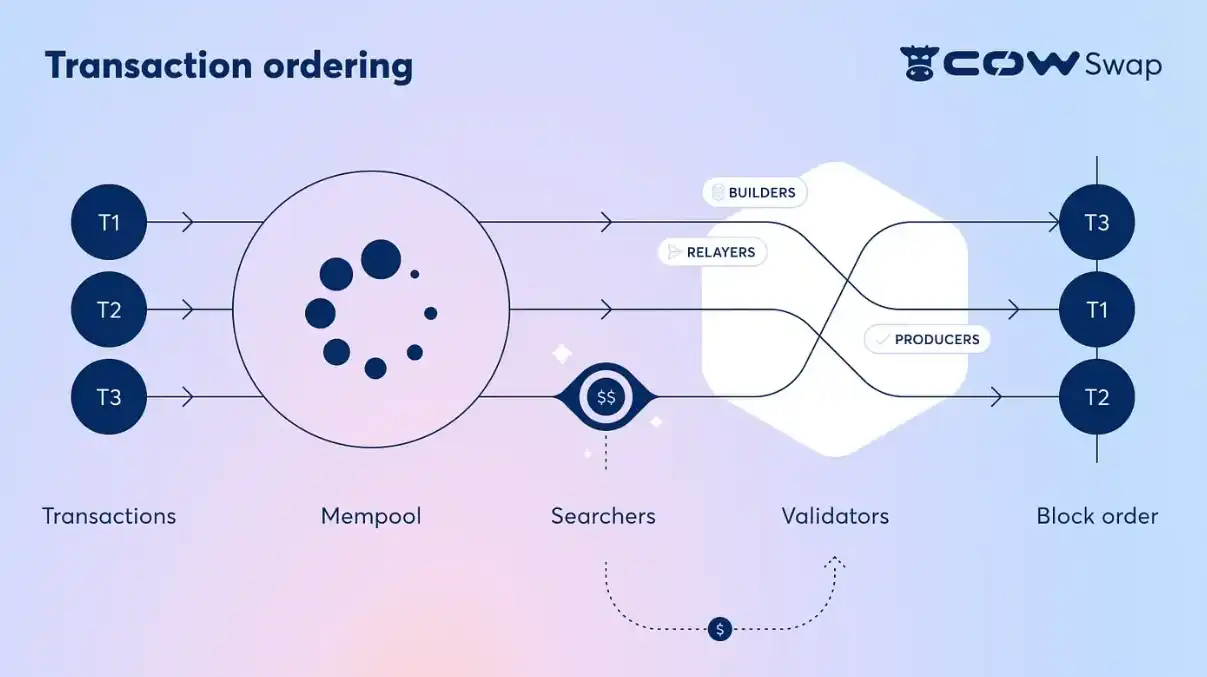
However, there is a significant problem with this process: it makes the end user vulnerable to MEV (maximum extractable value). This not only leads to a serious degradation of the user experience, such as front-running, sandwich attacks, etc., but also may cause poor order execution.
Specifically, MEV robots constantly scan the Ethereum network for users who are ready to buy tokens. Once the target is found, these robots will quickly jump the queue and place large orders before the user, artificially raising the price. After the victim's transaction is completed, the price rises further, and the robot then sells the token at a higher price to make a profit.
The harm of this behavior cannot be underestimated. According to a report released by investment company Galaxy Digital in June last year, it is estimated that MEV robots have extracted up to $300 million to $900 million from Ethereum traders using these strategies.
Faced with this severe challenge, the CoW protocol stands out. One of its main advantages is that it provides comprehensive MEV protection for each order, and this attack is difficult to avoid in most major DEXs. Through its unique trading model, the CoW protocol has built a solid defense system for users mainly from the following three aspects:
· Unified clearing price batches:Innovatively introduces the "unified clearing price" mechanism. When the same token pair (such as ETH-USDC) is traded multiple times in the same batch, the assets of each transaction will be cleared at the same market price. This mechanism cleverly makes the order of transactions irrelevant, effectively preventing MEV robots from profiting by reordering transactions. More importantly, it provides the Ethereum DeFi ecosystem with a way to establish consistent prices for the same token pair within the same block, solving the price inconsistency problem caused by the constant function market maker (CFMM) design such as the traditional Uniswap liquidity pool.
· Delegated Transaction Execution:The CoW protocol introduces secured third parties called Solvers who execute transactions on behalf of users. This means that users are no longer directly exposed to MEV risk on the chain (although Solvers may be exposed). The winning Solvers must ensure that users are provided with execution results that are no less than the price they signed, which actually transfers the price risk of all potential MEV attacks to Solvers. As professionals, Solvers will accurately calculate the optimal slippage for each transaction and match liquidity off-chain through CoW or private market makers as much as possible, thereby significantly reducing MEV risk.
· Coincidence of Demand:The CoW protocol cleverly exploits the principle of "coincidence of demand". Traditional MEV attacks mainly rely on the price dynamics of automated market makers (AMMs). However, when orders are matched peer-to-peer through CoW, they completely bypass on-chain liquidity, fundamentally eliminating the possibility of MEV attacks. This innovative trading method not only improves efficiency, but also provides users with a safe and fair trading environment.
Core Detailed Explanation: CoW Coincidence of Demand
The Cow in the name of CoW Swap is not a groundless imitation of Uniswap or 1inch to make an animal head as the logo of the protocol. In fact, Cow is the abbreviation of Coincidence of Wants, which means coincidence of demand. Coincidence of demand is an economic phenomenon in which two parties exchange assets peer-to-peer. On CoW Swap, coincidence of demand occurs when two (or more) traders exchange cryptocurrencies with each other without having to use on-chain liquidity.
To better understand this concept, let's take Alice and Bob as an example:
Alice wants to exchange 0.5 ETH for $1,000 DAI. At the same time, Bob wants to exchange 0.75 ETH for $1,500 DAI. On a traditional exchange like Uniswap, both Alice and Bob would trade using the ETH/DAI liquidity pool.
However, on CoW Swap, there is another possibility. CoW Swap orders start as signed "intention to trade" messages, which are batched together before being sent to on-chain liquidity sources such as Uniswap. In this way, CoW Swap can match orders peer-to-peer.
This also means that Alice and Bob both have something the other wants. Alice can give her ETH directly to Bob, and Bob can send his DAI directly to Alice. This transaction does not need to go through the liquidity pool, but is a spontaneous peer-to-peer transaction. This saves liquidity providers fees and gas costs, avoids slippage, and prevents MEV attacks.
At its core, what CoW demand coincidence does is order matching.
In addition, Bob needs 0.75 ETH, but Alice only has 0.5 ETH, which cannot meet Bob's needs. In this case, if no one else can make a second CoW transaction with him during the current trading session, then Bob's transaction will have to be routed to the on-chain liquidity pool through services such as Uniswap or Balancer to fill his remaining transactions.
The second design of CoW is to bundle these orders that have to go to the liquidity pool for trading together and send them to the chain, so that everyone can share the gas fee. A similar design is very similar to Layer2 in the public chain. Yes, this model can be said to be rollup in DEX, which is very clever.
The third design of CoW is off-chain batch trading, which can not only find "demand coincidences", but also create ring trades. Ring trades share liquidity among all orders, rather than a single token pair. This enables the protocol to break down transactions into multiple parts, thereby reducing user costs.
Now let's take the example of 4 traders trying to exchange different token pairs. Alice tries to sell DAI to OWL, Daniel tries to sell OWL to USDC, and Bob & Carry tries to sell USDC to DAI. Instead of routing all transactions through AMM, the Cowswap protocol forms a ring that directly matches three different currency pairs with each other.
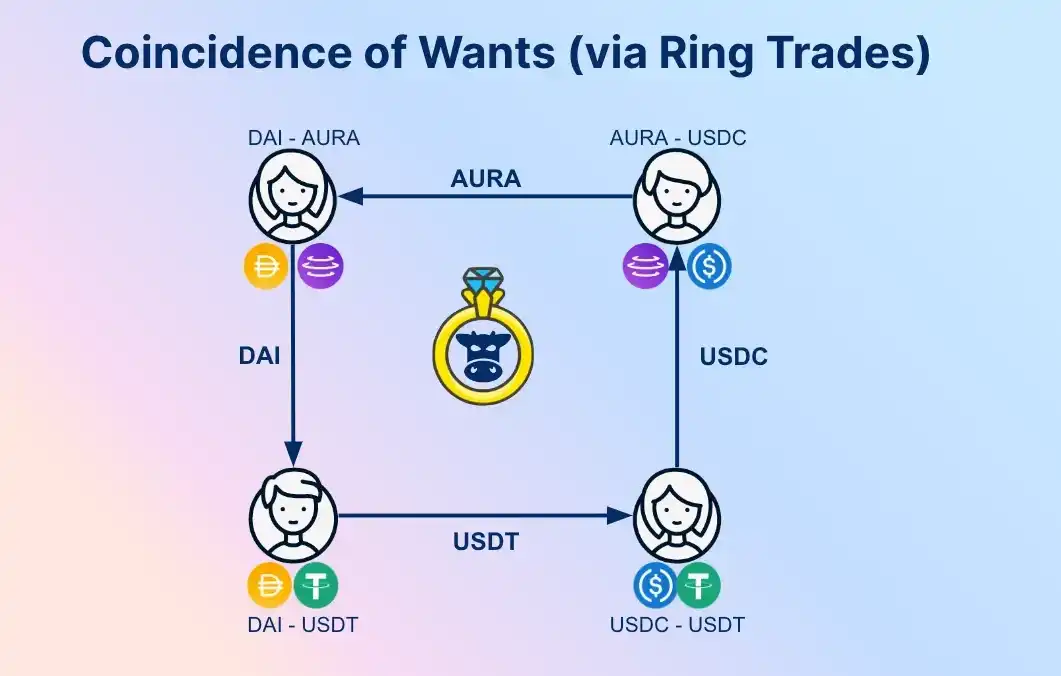
The corresponding is that traditional AMM needs to jump between different pools and routes. The more steps of jumping, the more expensive the handling fee is, and the ring transaction solves this problem well.
Innovative trading mechanism: intention trading
CoW Protocol introduces a revolutionary trading method-intention trading. Instead of sending transactions directly, users submit a signed order, which is the so-called trading intention. This order precisely defines the assets that users want to trade within a specific time frame. It is worth noting that users do not need to care about the specific execution details of the transaction, such as slippage or the choice of liquidity pool. These signed orders are then passed off-chain to professional participants called Solvers. These solvers will compete fiercely during the order period, striving to find the best execution path, and the winning solver will win the right to execute the transaction.
This innovative mechanism brings significant improvements to the user experience: the Gas fee required for the transaction is borne by the Solver, which means that even if the transaction fails to be successfully executed (for example, a path that meets the promised price cannot be found before the deadline), the user does not need to pay any Gas fee, which effectively reduces the user's transaction risk.
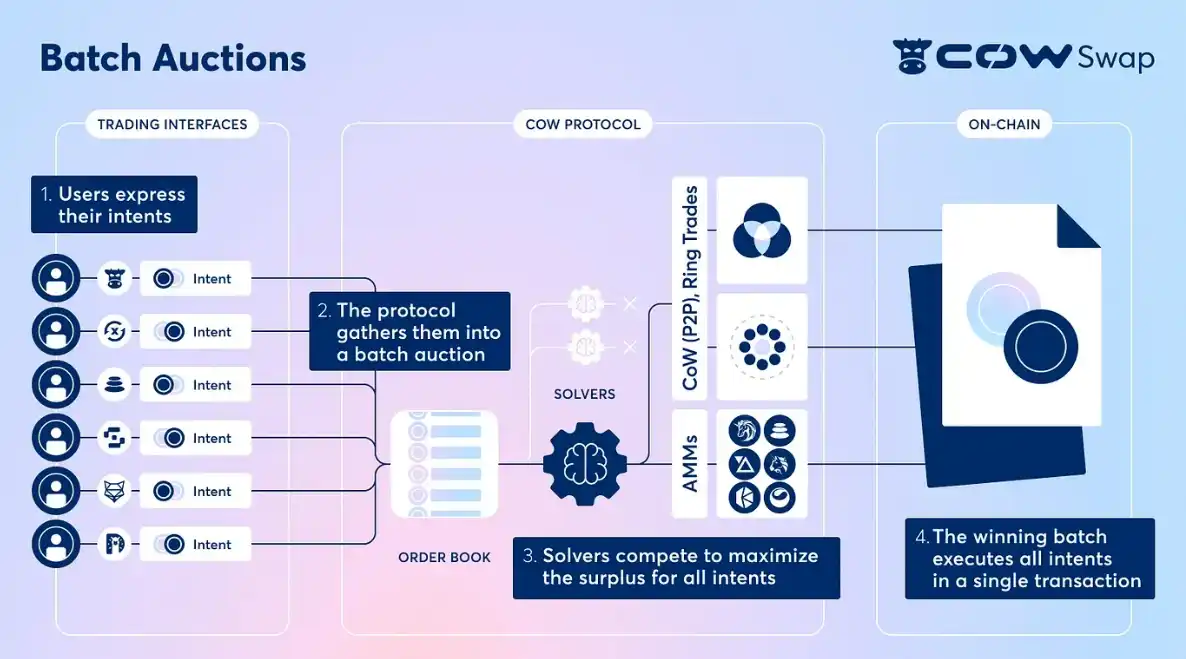
In the CoW Swap trading interface, users can clearly see the minimum guaranteed price they will get when executing a transaction. What's more exciting is that thanks to its unique batch trading and CoW (Coincidence of Wants) mechanism, traders can often get returns beyond their expectations. This pleasant phenomenon is officially called "Price Improvement", which further demonstrates CoW Swap's outstanding performance in improving user trading experience.
Economic model and market value
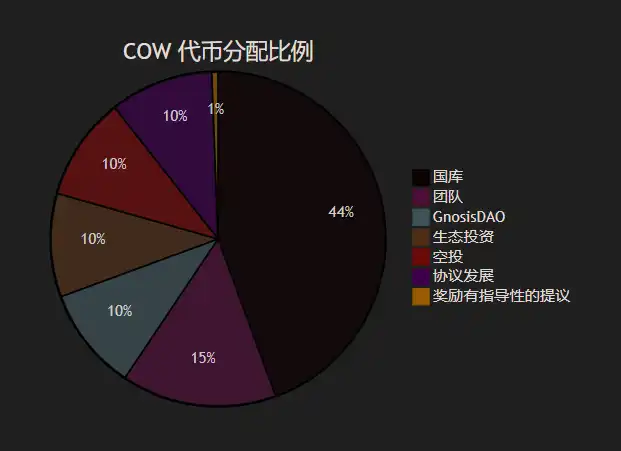
COW is the governance token of Cow Protocol, with a total of 1 billion tokens, 90.25 million tokens in circulation, accounting for 9.02% of the total tokens, and a market value of 142 million US dollars; the token distribution is as follows
· 44.4% belongs to the treasury
· 15% belongs to the team
· 10% belongs to GnosisDAO
· 10% for ecological investment
· 0.6% for rewarding guiding proposals
· 10% for airdrops
· 10% for protocol development
Governance:COW token holders can participate in CoW DAO
Incentive Mechanism: COW tokens are used to reward Solvers who provide the best transaction paths in the protocol, encouraging them to continuously optimize transaction execution and improve user experience.
Fee Allocation: CoW Protocol plans to introduce a protocol fee mechanism, and part of the revenue will be used to repurchase and destroy COW tokens, reduce market supply, and potentially increase token value.
Market Analysis and Price Prediction
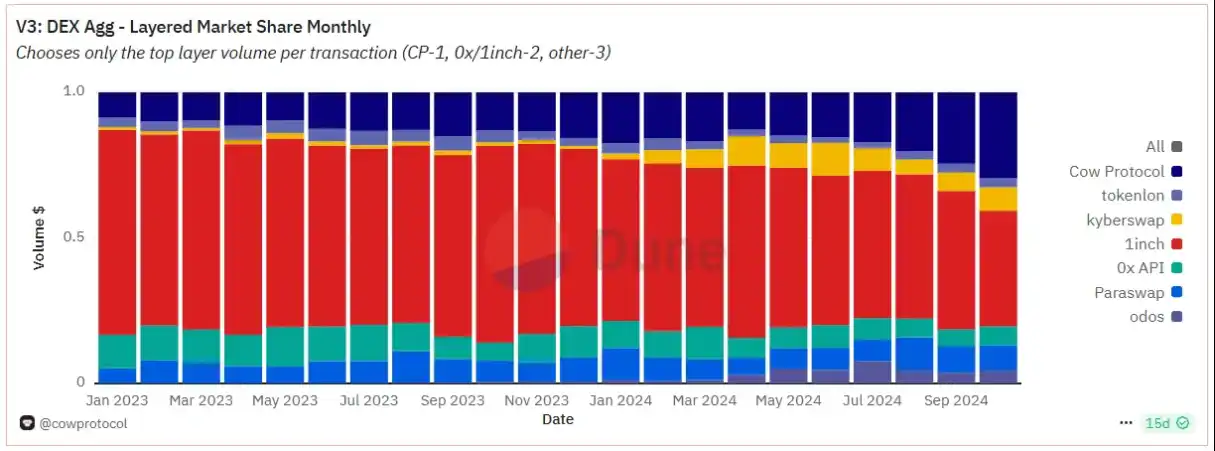
Cow Swap stands out for its outstanding innovative performance, providing practical solutions for on-chain trading users in key areas such as MEV resistance, gas-free transactions, and advanced orders. With its superb design concept and excellent user experience, Cow Swap has performed well in the highly competitive DEX aggregator market. The latest data shows that the protocol's transaction volume exceeded the $3 billion mark last month, achieving a considerable revenue of $870,000, fully demonstrating its strong market appeal and growth potential.
What is even more striking is that Cow Swap's market share in the field of aggregated trading has shown a steady upward trend. It has jumped from 17% at the beginning of the year to 30%, and the gap with the industry leader 1inch has narrowed to only 9 percentage points. However, despite Cow Swap's strong growth momentum, its current market value of US$140 million is still less than half of 1inch. This significant valuation difference has triggered market discussions about the underestimation of Cow Swap's potential value. Analysts generally believe that as Cow Swap continues to expand its market influence and further improve its ecosystem, its valuation is expected to increase significantly.
You may also like

Dragonfly Partners: Most agents will not engage in autonomous trading, how can crypto payments prevail?

US AI Startup Goes All In on Chinese Mega-Model | Rewire News Morning Brief

Trump Lies Again: A "Five-Day Pause" Psyop, How Wall Street, Bitcoin, and Polymarket Insiders Synced Uposciogen

When a Token Becomes Labor, People Become the Interface

Ceasefire News Leaked Ahead of Time? Large Polymarket Bets on Outcome Before Trump's Tweet

BlackRock CEO's Annual Shareholder Letter: How is Wall Street Using AI to Keep Profiting from National Pension Funds?

Sun Valley Releases 2025 Financial Report: Bitcoin Mining Revenue Reaches $670 Million, Accelerating Transformation to AI Infrastructure Platform
On March 16, 2026, in Dallas, Texas, USA, CanGu Company (New York Stock Exchange code: CANG, hereinafter referred to as "CanGu" or the "Company") today announced its unaudited financial performance for the fourth quarter and full year ended December 31, 2025. As a btc-42">bitcoin mining enterprise relying on a globally operated layout and dedicated to building an integrated energy and AI computing power platform, CanGu is actively advancing its business transformation and infrastructure development.
• Financial Performance:
Total revenue for the full year 2025 was $688.1 million, with $179.5 million in the fourth quarter.
Bitcoin mining business revenue for the full year was $675.5 million, with $172.4 million in the fourth quarter.
Full-year adjusted EBITDA was $24.5 million, while the fourth quarter was -$156.3 million.
• Mining Operations and Costs:
A total of 6,594.6 bitcoins were mined throughout the year, averaging 18.07 bitcoins per day; of which 1,718.3 bitcoins were mined in the fourth quarter, averaging 18.68 bitcoins per day.
The average mining cost for the full year (excluding miner depreciation) was $79,707 per bitcoin, and for the fourth quarter, it was $84,552;
The all-in sustaining costs were $97,272 and $106,251 per bitcoin, respectively.
As of the end of December 2025, the company has cumulatively produced 7,528.4 bitcoins since entering the bitcoin mining business.
• Strategic Progress:
The company has completed the termination of the American Depositary Receipt (ADR) program and transitioned to a direct listing on the NYSE to enhance information transparency and align with its strategic direction, with a long-term goal of expanding its investor base.
CEO Paul Yu stated: "2025 marked the company's first full year as a bitcoin mining enterprise, characterized by rapid execution and structural reshaping. We completed a comprehensive adjustment of our asset system and established a globally distributed mining network. Additionally, the company introduced a new management team, further strengthening our capabilities and competitive advantage in the digital asset and energy infrastructure space. The completion of the NYSE direct listing and USD pricing also signifies our transformation into a global AI infrastructure company."
"As we enter 2026, the company will continue to optimize its balance sheet structure and enhance operational efficiency and cost resilience through adjustments to the miner portfolio. At the same time, we are advancing our strategic transformation into an AI infrastructure provider. Leveraging EcoHash, we will utilize our capabilities in scalable computing power and energy networks to provide cost-effective AI inference solutions. The relevant site transformations and product development are progressing simultaneously, and the company is well-positioned to sustain its execution in the new phase."
The company's Chief Financial Officer, Michael Zhang, stated: "By 2025, the company is expected to achieve significant revenue growth through its scaled mining operations. Despite recording a net loss of $452.8 million from ongoing operations, mainly due to one-time transformation costs and market-driven fair value adjustments, the company, from a financial perspective, will reduce its leverage, optimize its Bitcoin reserve strategy and liquidity management, introduce new capital to strengthen its financial position, and seize investment opportunities in high-potential areas such as AI infrastructure while navigating market volatility."
The total revenue for the fourth quarter was $1.795 billion. Of this, the Bitcoin mining business contributed $1.724 billion in revenue, generating 1,718.3 Bitcoins during the quarter. Revenue from the international automobile trading business was $4.8 million.
The total operating costs and expenses for the fourth quarter amounted to $4.56 billion, primarily attributed to expenses related to the Bitcoin mining business, as well as impairment of mining machines and fair value losses on Bitcoin collateral receivables.
This includes:
· Cost of Revenue (excluding depreciation): $1.553 billion
· Cost of Revenue (depreciation): $38.1 million
· Operating Expenses: $9.9 million (including related-party expenses of $1.1 million)
· Mining Machine Impairment Loss: $81.4 million
· Fair Value Loss on Bitcoin Collateral Receivables: $171.4 million
The operating loss for the fourth quarter was $276.6 million, a significant increase from a loss of $0.7 million in the same period of 2024, primarily due to the downward trend in Bitcoin prices.
The net loss from ongoing operations was $285 million, compared to a net profit of $2.4 million in the same period last year.
The adjusted EBITDA was -$156.3 million, compared to $2.4 million in the same period last year.
The total revenue for the full year was $6.881 billion. Of this, the revenue from the Bitcoin mining business was $6.755 billion, with a total output of 6,594.6 Bitcoins for the year. Revenue from the international automobile trading business was $9.8 million.
The total annual operating costs and expenses amount to $1.1 billion.
Specifically, they include:
· Revenue Cost (excluding depreciation): $543.3 million
· Revenue Cost (depreciation): $116.6 million
· Operating Expenses: $28.9 million (including related-party expenses of $1.1 million)
· Miner Impairment Loss: $338.3 million
· Bitcoin Collateral Receivable Fair Value Change Loss: $96.5 million
The full-year operating loss is $437.1 million. The continuing operations net loss is $452.8 million, while in 2024, there was a net profit of $4.8 million.
The 2025 non-GAAP adjusted net profit is $24.5 million (compared to $5.7 million in 2024). This measure does not include share-based compensation expenses; refer to "Use of Non-GAAP Financial Measures" for details.
As of December 31, 2025, the company's key assets and liabilities are as follows:
· Cash and Cash Equivalents: $41.2 million
· Bitcoin Collateral Receivable (Non-current, related party): $663.0 million
· Miner Net Value: $248.7 million
· Long-Term Debt (related party): $557.6 million
In February 2026, the company sold 4,451 bitcoins and repaid a portion of related-party long-term debt to reduce financial leverage and optimize the asset-liability structure.
As per the stock repurchase plan disclosed on March 13, 2025, as of December 31, 2025, the company had repurchased a total of 890,155 shares of Class A common stock for approximately $1.2 million.

The US AI Startup Is Loving China's Open Source Model

Three Weeks of the US-Iran War: Who's Making Money, Who's Paying the Bill?

Interpreting Polymarket's Major Update Last Night: Fee Expansion, Self-Regulation, and New Incentives

From Human Application to Intelligent Collaboration: How GOAT Network Builds the Next Generation Digital Economy

CZ Washington Dialogue: Crypto Entrepreneurs are Accelerating Their Return to the United States

Morning Report | Strategy increased its holdings by 1,031 bitcoins last week; Katana Blockchain acquires IDEX; NYSE completes rule change to eliminate trading limits on crypto ETF options

WEEX P2P now supports JOD, USD & EUR—Merchant Recruitment Now Open
To make crypto deposits easier, WEEX has officially launched its P2P trading platform and continues to expand fiat support. We're excited to announce that the Jordanian Dinar (JOD), United States Dollar (USD ) and Euro (EUR) are now available on WEEX P2P!

Electric Capital: Tracking 501 types of yield-generating RWA assets, we discovered these patterns
Those who are cut off by AI will not disappear; they will become the creators of the next round of the economy

Stablecoins reshaping cross-border payments in Asia? Strategic panorama and investment opportunity analysis



 App
App