
 Buy Crypto
- Markets
 Futures
- Spot
- Copy Trade
- Earn
- More
WSJ Original Article: Department of Justice Investigates Justin Sun for Alleged Financial Crimes, CZ's Plea Deal May Provide Evidence

Original Article Title: Binance Seeks to Curb U.S. Oversight While in Deal Talks With Trump's Crypto Company
Original Article Authors: Angus Berwick, Patricia Kowsmann, Rebecca Ballhaus, Authors of The Wall Street Journal
Original Article Translation: Lawlink Deep
Editor's Note: Binance executives recently met with the U.S. Treasury Department to seek relaxation of government oversight, including the removal of the Anti-Money Laundering compliance officer supervision. At the same time, they are in talks with the Trump family's crypto company, "World Liberty Financial," planning to list its USD stablecoin. This move could bring huge profits to the Trump family, and Binance hopes to leverage Trump's presidential power to escape legal troubles and re-enter the U.S. market.
The following is the original content (slightly edited for readability):
April 11, 2025, 9:00 PM (Eastern Time)
According to sources familiar with the matter, executives from the cryptocurrency exchange Binance met with U.S. Treasury Department officials in Washington last month to discuss easing government oversight of the company, while the company is also exploring a business transaction with the Trump family's crypto enterprise.
Sources said Binance executives asked Treasury officials to waive U.S. oversight of the exchange's compliance with anti-money laundering laws. This would be the first step for the company to re-enter the U.S. market, as the company pleaded guilty to AML violations in 2023.
According to other sources, Binance is also in talks to list a new type of U.S. dollar-pegged cryptocurrency supported by the Trump family's World Liberty Financial. Listing this token, known as a stablecoin, could help it quickly penetrate the vast market and potentially bring billions of dollars in profit to the Trump family.
These transactions mark an increasingly close alliance between the Trump family and the world's largest cryptocurrency exchange, Binance. Binance has paid a record $4.3 billion fine for allowing terrorists, drug traffickers, and sanctioned entities to transfer billions of dollars through its exchange. Prior to the Treasury Department talks, Binance had already begun discussions with representatives of the Trump family.
For World Liberty Financial, Binance's market influence could help it become a key player in the crypto industry. Binance has more than 250 million users and processes around $650 billion in transactions daily.
The more US Dollar stablecoins (USD1) in circulation, the more the Trump family profits from the assets supporting the token's value. The largest stablecoin issuer, Tether, reported a $13 billion profit last year.
For Binance, Trump's presidential power may help the company get out of legal troubles. An agreement reached with US authorities in 2023 imposed strict restrictions on this once freely operating exchange, requiring it to exit all US customers, report all past suspicious transactions, and cooperate with two independent regulators appointed by the Treasury and Justice Departments, overseeing for five and three years, respectively.
According to The Wall Street Journal's previous report, Binance is also seeking a pardon for its convicted founder CZ. CZ pleaded guilty to related charges last year and served a four-month sentence, and a pardon would make it easier for the company to re-enter the US.
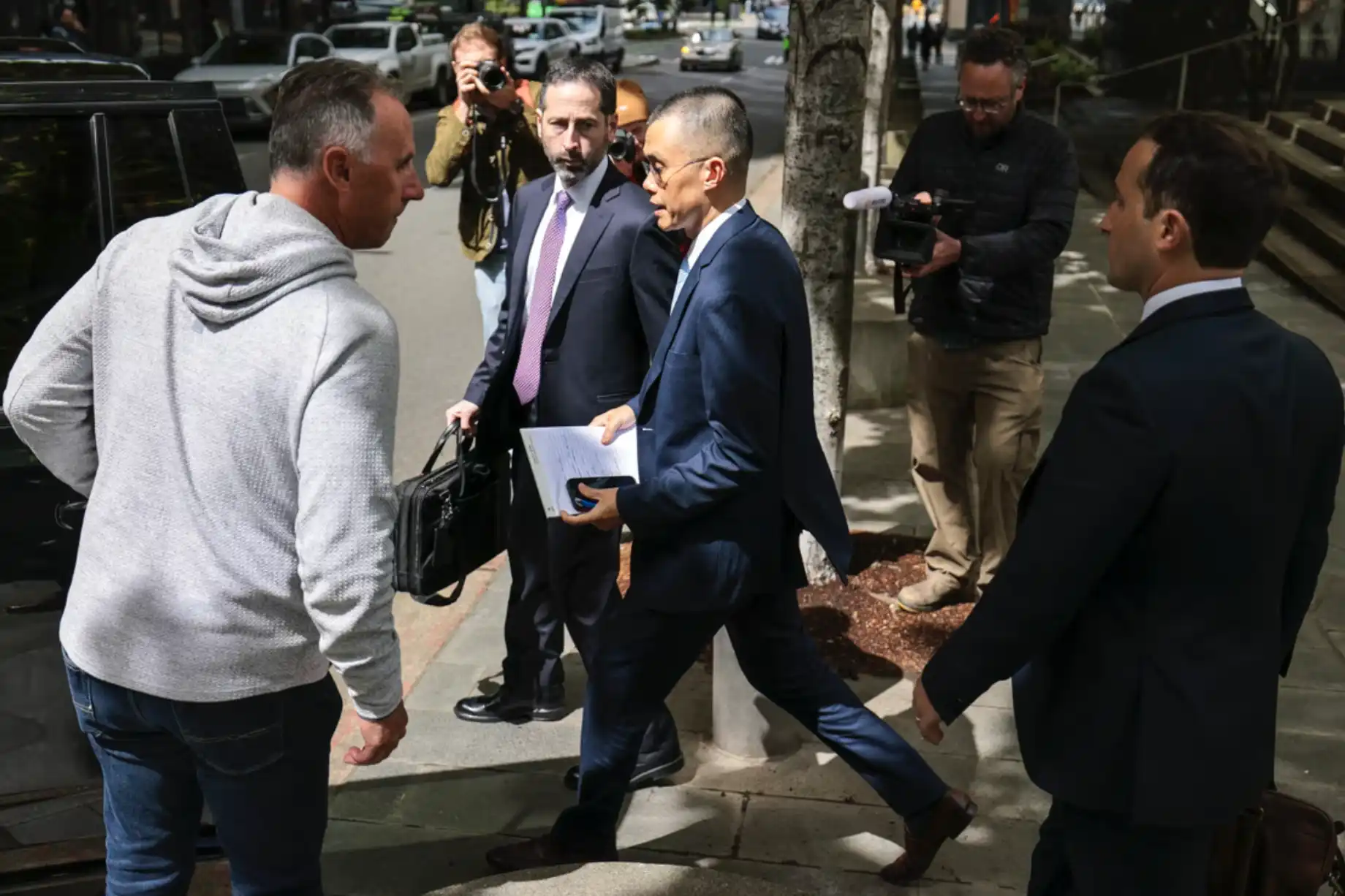
Former Binance CEO CZ leaving the courtroom after sentencing last year
Image Source: JASON REDMOND/AFP/GETTY IMAGES
The Wall Street Journal reported last month that Trump family representatives also discussed acquiring a stake in Binance US, the troubled US branch of Binance that operates independently.
A Treasury Department official stated the meeting with Binance was one of dozens the agency had with the crypto industry. A spokesperson for World Free Finance said the company aims to have the US Dollar stablecoin (USD1) "used by millions worldwide."
CZ declined to comment through a Binance spokesperson. Last month, CZ stated on the X platform that he had no business dealings with World Free Finance and had not discussed any transactions involving Binance US with anyone. He added, "No criminal minds being mindful of an amnesty."
A Binance spokesperson said, "The astonishing momentum of the US crypto movement under the new government and congressional leadership is inspiring. We are excited to support any efforts seeking to strike a balance between innovation and user protection in digital asset regulation."
A White House spokesperson said they would not disclose who is or is not being considered for pardon.
"Ending with Enforcement Rather than Regulation"
The alliance between the Trump family and Binance began at a crypto conference in Abu Dhabi in December last year, just weeks before the inauguration. In an exclusive "Whale" (VIP) backstage area accessible with a $10,000 VIP pass, attendees interacted with CZ, Trump's son Eric, and Trump ally and incoming Middle East envoy Steve Witkoff. Witkoff told attendees he would promote cryptocurrency development in the new government.
During the event, Eric promoted the upcoming era of digital currency under his father's leadership, Gold Rush, and advocated for World Free Finance, co-founded a few months ago by the Trump family with Vitkov and his son. The conference also offered a 21% discount on tickets using the discount code "TRUMPPUMP21." Both Eric and a spokesperson for the Trump organization did not respond to requests for comment.
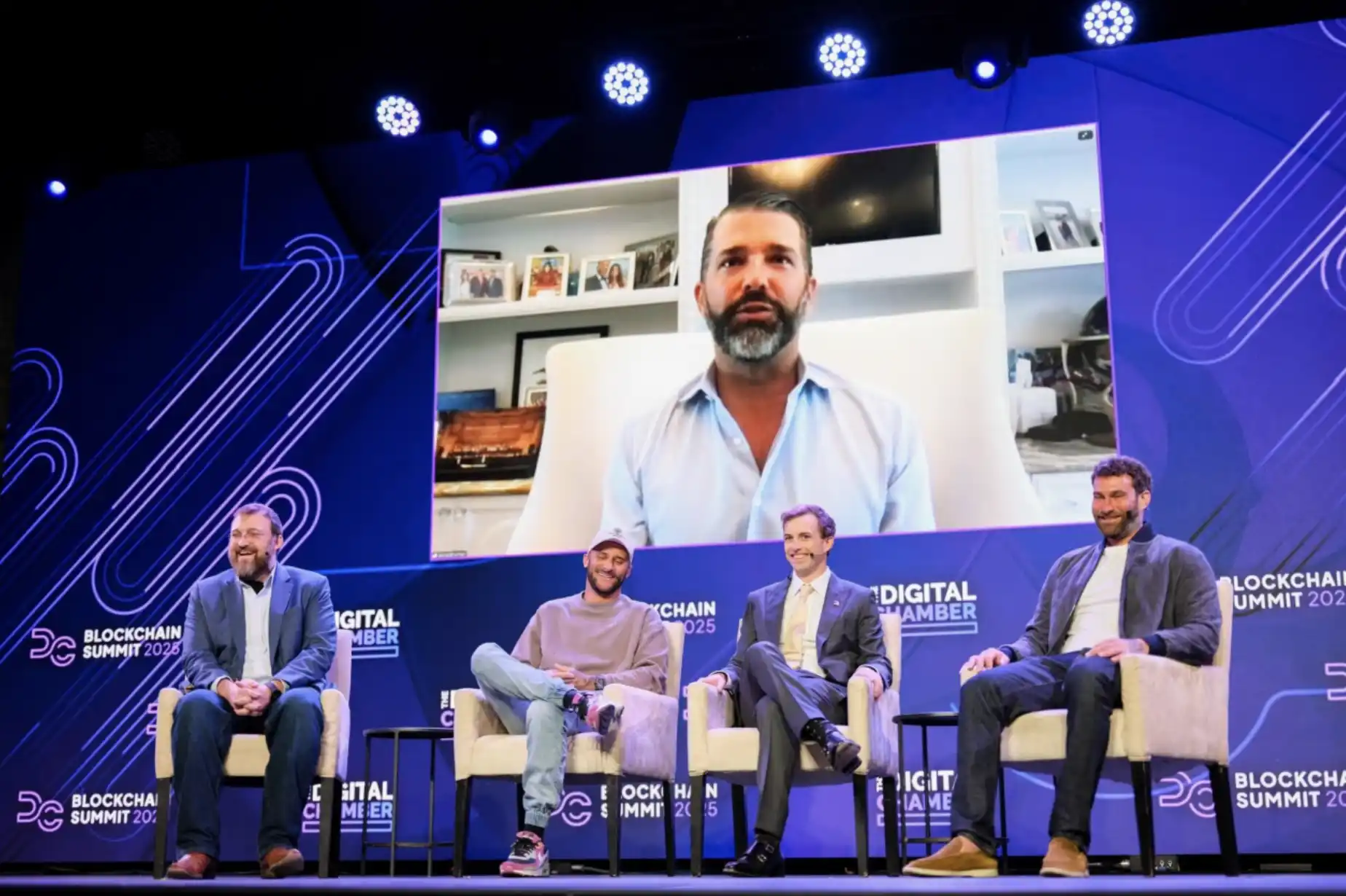
Co-founders of World Free Finance on stage, from left to right: Chase Herro, Zach Witko#, and Zak Folkman. On the screen is Donald Trump Jr.
Image Source: KENT NISHIMURA/BLOOMBERG NEWS
CZ was seeking a pardon at the time and complained about the US's excessive regulation of the crypto industry during a public speech. He said, "You have to stop using law enforcement instead of regulation."
Insiders say that after the conference, business negotiations about Binance's US equity and a USD stablecoin accelerated over the following months.
The Trump administration swiftly made progress in easing cryptocurrency regulation. In recent weeks, the Department of Justice paused its corporate oversight plans and disbanded its cryptocurrency unit, which had been instrumental in advancing the 2023 case against Binance. In a memo titled "Ending Law Enforcement Overreach," the Department of Justice announced this move.
According to insiders, Binance still has to deal with a regulatory officer appointed by the Treasury Department, which is seen as more burdensome.
Insiders say that conflicts have arisen between Binance executives and the Treasury Department's regulatory officer, with disagreements being less severe than those with the Department of Justice's regulators mainly revolving around the officer's access to the company, including the ability to interview employees and review documents.
Insiders revealed that in a meeting last month with the Treasury Department, Binance CEO Changpeng Zhao and Chief Legal Officer Eleanor Hughes asked the department to lift or shorten the regulatory oversight or reduce its scope.
Binance executives are optimistic that the Trump administration will approve their request. Insiders say that exchange employees have been discussing adjusting their anti-money laundering measures, with some employees viewing this as a move to relax checks on high-risk customers.
A Binance spokesperson stated that the regulatory officer has resulted in "an inefficient and costly burden." They added that Binance is "fine-tuning rules but not relaxing controls."
A String of Crypto Criminals
According to sources familiar with the matter, Binance began reaching out to allies of Trump around the time of the 2024 election. A special team was formed within the company to explore re-entry into the U.S. under the Trump administration and seek a pardon for CZ (CZ).
Even before the December meeting, CZ had been in contact with the World Free Finance team. Vitkov's son Zach had previously referred to CZ as a "sage" on X. In October of last year, World Free Finance hired CZ's close friend Richie Theo to assist in the launch of their stablecoin, with Theo having previously requested leniency from the judge presiding over CZ's case.
A spokesperson for World Free Finance stated, "Nearly every leading company in the digital asset industry has engaged with Binance." She added, "We are very grateful for CZ's many contributions to the cryptocurrency industry, perhaps even more so for his philanthropy."
The Trump family's embrace of Binance reflects dynamics within the White House. Helped by previous administrations, the U.S. government once pursued crypto tycoons who facilitated fund transfers for adversaries—Russian sanctions evaders, Islamic terrorist groups, Mexican drug cartels, global scam syndicates—and they are now doing business with the President and his inner circle.
Trump has already pardoned a string of crypto criminals, including BitMEX exchange co-founder Arthur Hayes, who pleaded guilty to violating the same U.S. anti-money laundering laws as CZ.
Tron blockchain network founder Justin Sun is a major external investor in World Free Finance and provides counsel to the company. According to blockchain analytics firm TRM Labs, over half of last year's illicit crypto activity—around $260 billion—occurred on the Tron network.
In February of this year, after Sun invested $75 million in World Free Finance's token, the U.S. Securities and Exchange Commission requested a court to pause its fraud lawsuit against him.
Sources revealed that during the Biden administration, the Department of Justice has been investigating Sun for financial crimes. It is currently unclear if the investigation is ongoing.
As part of CZ's plea agreement, sources say he has agreed to provide evidence about Sun to prosecutors. This arrangement had not been previously reported. The Department of Justice declined to comment.
A representative for Sun declined to comment on "baseless accusations regarding legal matters" and stated that claims of Tron fostering criminal activity are inaccurate.
In December of last year, Sun also interacted with VIPs in the backstage of an Abu Dhabi conference, distributing miniatures of a $6 million banana art piece he had recently purchased.
You may also like

PUMP Valuation Breakdown: On-chain Data Disproves the "Fake Volume" Theory, Where Does the Real Discount Come From?

Tiger Research: What AI services do cryptocurrency companies offer?

The war not only drives up oil prices but also causes Circle's stock price to soar

When agents become consumers, who will rewrite the underlying logic of internet commerce?

AI Agents in Action Summit: March 31, Hong Kong Cyberport, focusing on the deep waters of AI implementation

29 Days In, What Are America’s Options on Iran?

Flash Crash Down 97%+ with Ongoing Unlocking, WLD Completes $65 Million Off-chain Funding: Who Is Still Buying?

Bitcoin for Real Estate? Fannie Mae Teams Up with Coinbase to Launch Crypto Mortgage
Tether Hires Big Four Auditor, USDT Enters First Attestation Phase

Google AI Paper Destroys $900B Storage Stock, Accused of Faking Experiment
Evaporate $2 Trillion, U.S. Stocks See Worst Start in 4 Years, Why is the Market Bearish?

The speed at which AI discovers vulnerabilities has surpassed the speed at which it patches vulnerabilities.
AI Crypto Trading Bot Explained: Aurora's Multi-Factor Strategy in WEEX Hackathon
Aurora demonstrates how structured, multi-agent AI Trading systems can deliver more adaptive and resilient performance in the WEEX AI Trading Hackathon.

Cyber Taoist Fortune Teller: Fake Taoist, AI Fortune Telling, and Northeastern Metaphysics History

Bloomberg: Stablecoin Payments Emerge as Crypto VC's Newest Favorite Thing
BeatSwap is evolving towards a full-stack Web3 infrastructure, covering the entire lifecycle of IP rights.
BeatSwap, a global Web3 Intellectual Property (IP) infrastructure project, is attempting to overcome the current fragmentation limitations of the Web3 ecosystem, building a full-stack system that covers the entire lifecycle of IP rights.
Currently, most Web3 projects are still in the stage of functional fragmentation, often focusing only on a single aspect, such as IP asset tokenization, transaction functionality, or a simple incentive model. This structural dispersion has become a key bottleneck hindering the industry's scale application.
BeatSwap's approach is more integrated, integrating multiple core modules into the same system, including:
· IP authentication and on-chain registration
· Authorization-based revenue sharing mechanism
· User-engagement-driven incentive system
· Transaction and liquidity infrastructure
Through the above integration, the platform builds an end-to-end closed-loop path, allowing IP rights to complete a full cycle of "creation, use, and monetization" within the same ecosystem.
BeatSwap is not limited to existing crypto users but is attempting to take the global music industry as a starting point, actively creating new market demand. Its core strategies include:
Exploring and incubating music creators (Artist discovery)
Building a fan community
Igniting IP-centric content consumption demand
The current global music industry is valued at around $260 billion, with over 2 billion digital music users. This means that the potential market corresponding to the tokenization and financialization of IP far exceeds the traditional crypto user base.
In this context, BeatSwap positions itself at the intersection of "real-world content demand" and "on-chain infrastructure," attempting to bridge the structural gap between content production and financial flow.
BeatSwap's upcoming core product "Space" is scheduled to launch in the second quarter of 2026. This product is defined as the SocialFi layer in the ecosystem, aiming to directly connect creators with users and achieve deep integration with other platform modules.
Key designs include:
A fan-centric interactive mechanism
Exposure and distribution logic based on $BTX staking
User paths connected to DeFi and liquidity structures
Thus, a complete user behavior loop is formed within the platform: Discovery → Participation → Consumption → Rewards → Trading
$BTX is designed to be a core utility asset within the ecosystem, rather than just a simple incentive token, with its value directly tied to platform activity and IP use cases.
Main features include:
· Yield distribution based on on-chain authorized actions
· Value reflection based on IP usage and user engagement dynamics
· Support for staking and DeFi participation mechanisms
· Value growth driven by ecosystem expansion
With the increased frequency of IP use, the utility and value support of $BTX will enhance simultaneously, helping alleviate the "disconnect between value and utility" issue present in traditional Web3 token models to some extent.
Currently, $BTX has been listed on several mainstream exchanges, including:
Binance Alpha
Gate
MEXC
OKX Boost
As the launch of "Space" approaches, BeatSwap is actively pursuing more exchange listings to further enhance liquidity and global accessibility, laying a foundation for future market expansion.
BeatSwap's goal is no longer limited to the traditional Web3 narrative but aims to target over 2 billion digital music users and a trillion KRW-scale content market.
By integrating content creators, users, capital, and liquidity into a blockchain framework centered around IP rights, BeatSwap is striving to build a next-generation infrastructure focused on "IP tokenization."
BeatSwap integrates IP authentication, authorization distribution, incentive mechanism, transaction system, and market construction to establish a unified structure that bridges the full lifecycle path of IP rights.
With the launch of the Q2 2026 "Space," the project is expected to become a key infrastructure connecting content and finance in the IP-RWA (Real World Assets) track.

Mag 7 Evaporates $2 Trillion | Rewire News Morning Edition



 App
App