
Is GMAR Crypto Safe? Full Risk Analysis Before You Invest




The Solana meme coin market is no stranger to controversy, but GMAR has sparked more debate than most. If you‘ve been searching “gmar crypto red flag” or “is gmar safe,” you’ve probably noticed the crypto community is deeply divided. Some traders see it as a high-stakes gamble with military-grade hype, while others warn it carries the hallmarks of a classic rug pull.
The truth lies somewhere in between—but much closer to the danger zone.
Before you even think about adding this token to your watchlist, here is what you need to know. This GMAR risk analysis cuts through the noise, breaks down the red flags, and helps you decide if this speculative asset deserves your attention or your total avoidance.
Key Takeaways:
- GMAR is built on narrative, not fundamentals, and shows multiple red flags, including anonymous developers and unclear tokenomics.
- The military “reserve” theme is marketing, not a real connection to defense contracts or government budgets.
- Most investors should steer clear, though experienced traders might take micro-positions purely for speculative short-term plays.
What is GMAR?
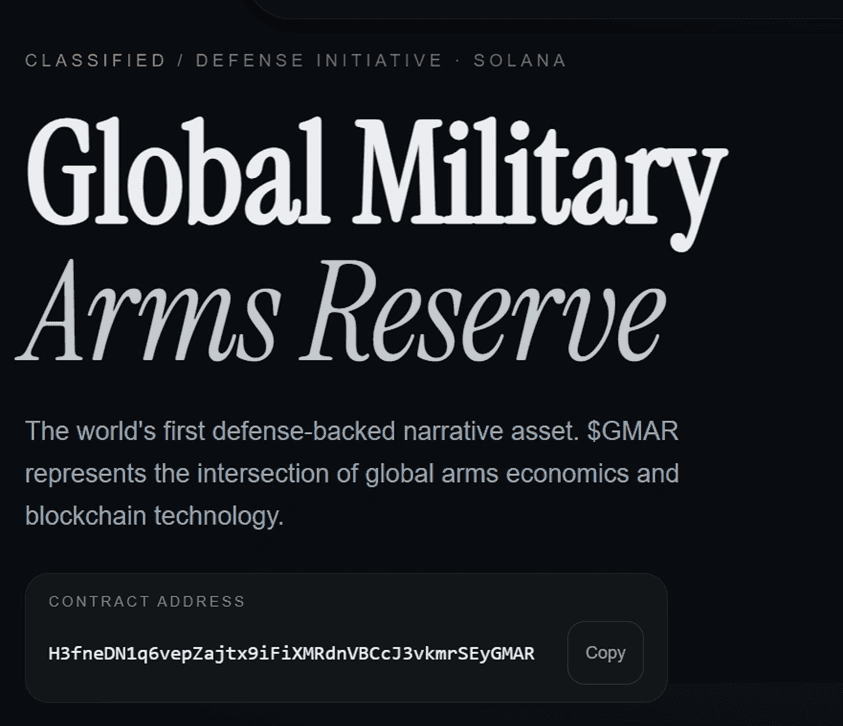
GMAR—short for Global Military Arms Reserve—is a token on the Solana blockchain. The project markets itself as a “defense-backed narrative asset,” using phrases like “the military fund for the new world” to sound institutional and serious .
But here is where things get tricky. The branding suggests ties to global military economics, defense spending, or even government reserves. In reality, there is zero evidence that GMAR has any actual relationship with governments, defense contractors, or real-world reserve assets . The word “reserve” is marketing language, not a legal or financial reality.
Think of it this way: I can name my cat “Treasury Secretary,” but that doesn‘t mean she manages the national debt. GMAR is a similar situation—impressive name, very different reality.
The token is better classified as a narrative coin or even a meme coin rather than a legitimate blockchain project . It has no working platform, no decentralized application, no staking system, and no institutional partnerships .
What it does have is a compelling story at a time when geopolitical tensions dominate headlines. And right now, that story is attracting attention.
GMAR Crypto Red Flag Analysis
Let's be direct with you. As someone who analyzes crypto projects daily, I see patterns. And GMAR checks almost every box on the “high-risk speculative token” checklist.
No Public Team, No Accountability
This is the biggest gmar crypto red flag.
The project reportedly has:
- No verified founders
- No identifiable development team
- No legal registration
- No transparent governance structure
- No clear operational roadmap
In legitimate crypto projects, transparency builds trust. You can usually find team credentials on LinkedIn, see their GitHub activity, or watch them speak at conferences. With GMAR? Crickets.
Now, anonymous teams aren‘t automatically scams—Satoshi Nakamoto was anonymous, after all. But when anonymity combines with aggressive marketing, zero transparency, and hype-driven branding, the risk level skyrockets.
Missing Whitepaper and Weak Documentation
A proper whitepaper explains token utility, revenue models, technical architecture, governance, and long-term sustainability. GMAR reportedly lacks meaningful documentation that clearly explains how the project works or generates value .
Without these fundamentals, investors are essentially speculating on momentum alone. This creates a dangerous environment where price action becomes completely detached from real utility—because there is no utility to speak of.
No Real Utility Behind the Hype
This is the core issue in any GMAR crypto scam discussion. Currently, there is no evidence of:
- A working platform or dApp
- Revenue generation
- Staking systems
- Institutional partnerships
- Defense-related integrations
GMAR thrives entirely on social hype and geopolitical storytelling. Narrative coins can surge quickly during trending news cycles—especially on Solana. But once attention fades, these tokens often struggle to maintain value because there is no underlying demand driver.
In other words: you‘re betting on attention, not adoption.
Thin Liquidity and Whale Manipulation Risk
GMAR primarily trades on Solana decentralized exchanges rather than established centralized platforms. This creates several dangers:
- High slippage when trading
- Low liquidity depth
- Difficulty exiting positions quickly
- Greater vulnerability to manipulation
Low-cap tokens with concentrated ownership are particularly vulnerable to whale-driven price swings. A small number of wallets can significantly influence market direction, causing sudden crashes after rapid pumps. This pattern is extremely common among speculative Solana meme coins, and GMAR shows all the signs.
Is GMAR Safe for Investors?
Let me give it to you straight: From a risk-management perspective, GMAR cannot currently be considered a safe investment.
Here is what you are up against:
Risk Factor | GMAR Status |
Team transparency | Anonymous |
Verified utility | None |
Clear tokenomics | Inconsistent |
Liquidity depth | Thin |
Hype reliance | Extreme |
Rug-pull characteristics | Present |
Narrative-driven coins also often become breeding grounds for fake contract addresses, scam impersonations, wallet drainers, and phishing attacks . If you choose to interact with GMAR, you must verify contract addresses independently through trusted on-chain analytics platforms like Dexscreener or Birdeye.
But even technical verification doesn‘t eliminate project risk—it just confirms you’re buying the right token.
Should I Buy GMAR?
For most investors, the answer is no.
GMAR fits nearly every characteristic of high-risk speculative tokens:
- Narrative-first branding without substance
- Weak or missing transparency
- Unclear and inconsistent tokenomics
- Anonymous developers
- Low liquidity
- No proven utility
Experienced micro-cap traders may still speculate with very small amounts of disposable capital. But treat this as high-risk gambling, not investing.
Final Thoughts
When evaluating GMAR crypto legitimacy, the evidence points toward extreme caution. The project shows classic warning signs: hype-driven branding, lack of accountability, no audited fundamentals, weak transparency, and manipulation risks. The military narrative sounds timely, but branding alone does not create value.
Short-term traders may find GMAR attractive, but for long-term investors, the risks outweigh the rewards. Always prioritize due diligence over hype. Protecting your capital matters more than chasing the next viral trend.
Ready to trade? WEEX offers zero fees, instant execution, and the security you need. Sign up on WEEX Now and Start Trading!
FAQ
Is GMAR crypto a scam?
There is no official confirmation that GMAR is a scam, but it displays many high-risk characteristics commonly associated with speculative meme coins and potential rug-pull projects. The anonymous team, missing whitepaper, and unclear tokenomics are significant red flags .
Is GMAR safe to invest in?
No. GMAR is considered extremely risky due to low transparency, anonymous developers, thin liquidity, and lack of proven utility. Most investors should avoid it unless they are experienced speculators using disposable capital .
Does GMAR have real military backing?
No. There is no evidence that GMAR is connected to governments, military organizations, defense contractors, or defense reserves. The branding is purely narrative-driven marketing language .
Latest Updates on WEEX
If you want to buy WXT now, you can sign up for a WEEX account.
Welcome Bonus from WEEX — Claim Up to 30,000 USDT! Join Now!
You may also like

What Is SAOS? Strategic American Oil Supply Token Explained
SAOS is a meme token on Solana with a 75,000 USD market cap and 22,000 USD locked liquidity, positioned around oil supply themes but lacking real asset backing
It thrives on pure narrative speculation, with no utility, website, or doxxed team, making it highly volatile and attention-dependent
Traders should distinguish SAOS from legitimate real-world asset projects, as its branding is speculative rather than substantive
Positive aspects include locked liquidity reducing rug pull risks, but low trading activity signals high uncertainty
How to Buy Public Asset Control (PAC) Token in 2026: Latest Solana Buying Guide
How to buy Public Asset Control (PAC) token in 2026, PAC contract address, Solana wallet setup, Jupiter swap guide, latest price, liquidity, and risks.

What Is Public Asset Control (PAC) Token and How Does It Work? Latest Solana PAC Token Guide
Public Asset Control (PAC) token explained. Learn what PAC is, how it works on Solana, current price snapshot, risks, and buying basics.

Can PAC Coin Reach $1 Soon? Analyzing Public Asset Control
PAC is a Solana-based meme token with a government-themed narrative, but it is highly speculative.
At its current price (~$0.0009) and 1B supply, reaching $1 would require a $1B market cap, which is very unlikely.
Short-term moves to $0.001 or $0.01 are more realistic, but the token is highly volatile due to low liquidity and hype-driven trading.
Overall, $1 is not a realistic target, and PAC is better suited for short-term speculation than long-term investment.

United Nations Oil Reserve (UNOS) Crypto: Solana Token, UN Links, and Risks
United Nations Oil Reserve (UNOS) Crypto explained: Solana token basics, UN links, oil-backing claims, market risks, contract checks, and buying cautions.

What Is Public Asset Control (PAC) Coin? Explained for Beginners
Public Asset Control (PAC) is a Solana-based token that uses a “government asset control” narrative involving oil and gold themes, but it has no verified ties to any real institutions or governments. It is mainly an entertainment-focused, speculative meme coin.
The project’s claims about links to entities like BlackRock or Palantir are unverified, and its own disclaimer states it is not a real financial or institutional asset. Like many new Solana tokens, PAC is highly volatile, with low liquidity and limited transparency, including no fully verified audit.
Overall, PAC is a high-risk speculative token driven by hype and storytelling rather than real utility. Beginners are advised to be cautious, verify contract details, and prioritize risk control before considering any trading.
What Is Official Saudi Oil Reserve (OSOR) Coin?
Learn what OSOR coin is, why its Saudi oil narrative matters, how to verify the contract, and what risks to check before trading.

Global Digital Oil Reserve (GDOR): What It Is, Risks, and How to Check It
Global Digital Oil Reserve (GDOR) is an oil-themed Solana token with unclear backing. Learn its risks, market data, and verification checklist.

Is OBC Crypto a Good Investment?
Is OBC crypto a good investment? We analyze the latest market data, holder concentration, liquidity risks, and short-term momentum. Read this before you invest in OBC token.

Can OSOR Reach $1? Full Price Analysis 2026
OSOR crypto price prediction 2026: Can Saudi Oil Reserve token reach 1? Read before buying.

What is International Oil Supply (IOS) Coin?
Wondering what is IOS crypto? Here’s a straight look at International Oil Supply (IOS) coin—the Solana token tied to oil reserve data. Contract address, risks, and what’s still unverified.

What Is the Unified International Token (UNIT)? Is UNIT Crypto Legit or Scam?
what is UNIT crypto? Here’s a breakdown of the Unified International Token ($UNIT), how it ties to BRICS+ data, where to buy it, and why it’s a conceptual project—not an official currency.
What Is Stablecoin Business OS (SBOS) Coin?
What is SBOS crypto? We break down Stablecoin Business OS, its USDC invoicing tools, AI finance assistant, token contract address, and real utility for online businesses.

World Collective Oil Reserve ($WCOR) Price Prediction: May 2026 Rally Analysis and Future Outlook
Is $WCOR a good investment? Read our comprehensive World Collective Oil Reserve price prediction and market analysis for 2026-2030. Learn about the energy narrative on Solana and start your trading journey with WEEX rewards.

Is $PAC Token a Good Investment in 2026? Price, Risks, and Market Analysis
A data-driven analysis of Public Asset Control (PAC) token: current price, market cap, liquidity, $1 target feasibility, and risk factors. Is it a legitimate investment or a high-risk meme coin?

Is OSOR Token Next 10X Like WCOR or Just Market Hype?
Is OSOR the next 10X crypto like WCOR or just market hype? Compare OSOR vs WCOR on-chain data, price discrepancies, and holder risks in this deep dive into Saudi oil-backed tokens.
NEAR Airdrop: Join WEEX to Share 50,000 USDT in Crypto Rewards
Join the NEAR airdrop on WEEX from May 7 to May 14 to share a 50,000 USDT prize pool. New users can earn rewards through deposits and spot trades with zero-fee trading advantages.
What Is $PAC Token? Legitimate Crypto or Just A High-Risk Meme Coin?
Is Public Asset Control ($PAC) a real asset-backed token or just another meme coin narrative? We analyze its official website, market data, and risks.
What Is SAOS? Strategic American Oil Supply Token Explained
SAOS is a meme token on Solana with a 75,000 USD market cap and 22,000 USD locked liquidity, positioned around oil supply themes but lacking real asset backing
It thrives on pure narrative speculation, with no utility, website, or doxxed team, making it highly volatile and attention-dependent
Traders should distinguish SAOS from legitimate real-world asset projects, as its branding is speculative rather than substantive
Positive aspects include locked liquidity reducing rug pull risks, but low trading activity signals high uncertainty
How to Buy Public Asset Control (PAC) Token in 2026: Latest Solana Buying Guide
How to buy Public Asset Control (PAC) token in 2026, PAC contract address, Solana wallet setup, Jupiter swap guide, latest price, liquidity, and risks.
What Is Public Asset Control (PAC) Token and How Does It Work? Latest Solana PAC Token Guide
Public Asset Control (PAC) token explained. Learn what PAC is, how it works on Solana, current price snapshot, risks, and buying basics.
Can PAC Coin Reach $1 Soon? Analyzing Public Asset Control
PAC is a Solana-based meme token with a government-themed narrative, but it is highly speculative.
At its current price (~$0.0009) and 1B supply, reaching $1 would require a $1B market cap, which is very unlikely.
Short-term moves to $0.001 or $0.01 are more realistic, but the token is highly volatile due to low liquidity and hype-driven trading.
Overall, $1 is not a realistic target, and PAC is better suited for short-term speculation than long-term investment.
United Nations Oil Reserve (UNOS) Crypto: Solana Token, UN Links, and Risks
United Nations Oil Reserve (UNOS) Crypto explained: Solana token basics, UN links, oil-backing claims, market risks, contract checks, and buying cautions.
What Is Public Asset Control (PAC) Coin? Explained for Beginners
Public Asset Control (PAC) is a Solana-based token that uses a “government asset control” narrative involving oil and gold themes, but it has no verified ties to any real institutions or governments. It is mainly an entertainment-focused, speculative meme coin.
The project’s claims about links to entities like BlackRock or Palantir are unverified, and its own disclaimer states it is not a real financial or institutional asset. Like many new Solana tokens, PAC is highly volatile, with low liquidity and limited transparency, including no fully verified audit.
Overall, PAC is a high-risk speculative token driven by hype and storytelling rather than real utility. Beginners are advised to be cautious, verify contract details, and prioritize risk control before considering any trading.


